Cops & Robbers

What do the deaths of 12-year-old African-American Gilmore Johnson and 15-year-old Lithuanian-American Joseph Donner, both of Springfield, tell us about crime and punishment during The Great Depression? I was surprised to learn that even petty property crime by youths back then was often met with fatal gunfire, both by police and by family business owners.

This no doubt speaks to the high frequency—and the high stakes–of property crime as families struggled to survive the greatest economic calamity in American history, at the same time that local coal mines were conducting mass layoffs and the Progressive Miners of America (PMA) were on strike. The nature of crime and punishment during those trying years of wholesale unemployment and bread lines definitely seemed to pit struggling families against each other–just as the Mine Wars pitted the United Mine Workers against the Progressives.

I say that because the taverns and groceries being targeted for break-ins–and occasionally, armed robbery–were owned and defended by working families living on the premises. And, the policemen shooting to halt, maim or kill were often laid-off miners distinguished from the perpetrators they were shooting at mainly by the luck of having secured their jobs on the force.

The fact that men on both sides of the Mine Wars, as well as child burglars and the family business owners they targeted, pretty universally seemed to own or to be able to steal firearms underscores the fact that our seemingly crime-ridden times may not be unique.

Shot by Police

Joseph Donner, Jr. of N. 19th St. was born on May 8, 1917 in Piston, Pennsylvania to coal-mining father Joseph Donner, Sr. and mother Anna Zacarosky Donner, both born in Lithuania. Only a few months after I learned of this young man’s death, I stumbled upon his graduation photo from Ridgely School at the age of 15 in 1932.

From left: Joseph Donner with friend John Shaudis at their Ridgely Grade School graduation, 1932.

From left: Joseph Donner with friend John Shaudis at their Ridgely Grade School graduation, 1932.

According to the Illinois State Journal, Joe apparently began participating in a string of petty burglaries and larcenies starting two months after his grade school graduation, on July 4, 1932, when he entered the Woodland Ave. home of Walter Hanson with an older boy, Joseph Orback, 17. Orback was the son of the late Frank Orback and Anna (Baksyte) Orback, my father’s paternal aunt.

On Dec. 1, 1932, according to the newspaper, Orback, Donner, Charles Jedrosky, 17, and George Sotak, 17, all–except Donner, of N. 17th St.–and likely all Lithuanian-Americans, broke into the Voyzel lunchroom on R.R. 8, taking a small quantity of tobacco and candy to sell. Then Orback, Jedrosky and Donner, minus Sotak, broke into the Frank Mason Grocery at Walnut & Calhoun Ave., where they were ambushed by police. Young Donner was shot in the back and the side when he ran away instead of obeying the order to halt. While initial reports indicated he was improving, poor Joe died of his wounds at St. John’s Hospital on Dec. 3, and was buried at Calvary on Dec. 6.

A State Journal article dated Dec. 1, 1932, states that Patrolmen John Rooney and William Cellini, and Detectives Edward Hagan and Samuel Phoenix, were the police who had fired the shots. The coroner’s inquest did not determine which officer fired the shots that hit and killed young Donner. According to Bill Cellini, Jr., grandson of Patrolman William Cellini, “Sam Phoenix (1903-73) was one of the few African-Americans on the force at that time. He must have joined at the same time as my grandfather, because on the 1930 census, Sam is listed as a coal miner at 520 North 12th. Then by 1931, he’s on the force. It’s remarkable that he got to be a detective in the short span from 1931-32.” Edward Hagan, despite his Irish-sounding name, was another African-American detective. Patrolman John Rooney was from England, and the 1930 census shows he immigrated to the U.S. in 1910.

Probable ringleader Joe Orback went on to violate the probation he was granted for the 1932 break-ins and was sent to Menard for two years in 1933. This seems to have launched him into a life of crime, since the 1940 Census finds him in prison at Marion. I sometimes wonder if young Donner might not have ended as he did if it hadn’t been the Depression, and he hadn’t taken up with the wrong older boys.

Shot by Tavern Owner

Gilmore Johnson, 12, of N. 14th St. was breaking through the window of a side door at Lapinski’s Tavern at 11th and Washington at 5:50 a.m. Dec. 20, 1937, while his 13-year-old accomplice Griffin Clark kept watch–when Lithuanian immigrant owner Simon (Sam, Sr.) Lapinski, who slept upstairs, was awakened by the noise and grabbed his gun. After Lapinski shouted at the boy, he took off south down 11th Street. Lapinski ran into the street and fired three shots in warning, while ordering Johnson (never having seen Clark) to halt, and then fired a fourth shot that he said he DID intend to hit the fleeing burglar—whom in the darkness, he didn’t know was just a boy. Young Gilmore was fatally wounded.

An unloaded .38 caliber pistol and a watch were found on him, taken from the Starlight Tavern at 1230 E. Washington, which the boys had previously broken into. The newspaper reported the two boys also had broken into the Edward McCann tavern at 917 E. Washington and the Leon Stuart filling station at 14th and Jefferson, and had been apprehended three times before and released, due to their youth. This time the surviving boy was turned over to juvenile authorities.

An “all-colored” coroner’s jury unanimously recommended that Sam Lapinski be turned over to a grand jury, and he was held for investigation by a grand jury, but I could find no further articles about what happened next. Sam, Sr. was active at St. Vincent de Paul Lithuanian Catholic Church and its chapter of the Knights of Lithuania. His son Sam, Jr., a former miner, had recently joined the Springfield police force and later took over Lapinski’s tavern.

My thanks to Bill Cellini, Jr. and Tom Mann, a retired Springfield police officer and genealogy researcher, for their assistance with this post.

Outlaws & Outliers

With the help of loving and intact families and their church, many Lithuanian-Americans here were able to rise above generations of harsh oppression in the old country and harsh conditions in the new to achieve a kind of impoverished respectability. Not, all, however. I would wager that almost every Lithuanian-American from Springfield has at least one outlaw or outlier in the closet, not too many generations back.

Some of these “outlaws” were probably genetically disposed to go a-wilding. The majority, I would guess, had never known a family or community life un-marred by unnatural death and spontaneous acts of violence: crimes of passion, temporary insanity or inebriation that served to relieve unbearable pressures from the daily struggles of living–unfortunately, by doing harm to a fellow human being who was similarly struggling.

Of course, there was little treatment for the disease of alcoholism, let alone the full spectrum of mental illness or criminal tendencies at the turn of the Twentieth Century—no welfare or social safety net. Insecurity–physical, economic and social–was the rule for most immigrants, and early death smote the upstanding as unexpectedly and frequently as the morally or criminally deranged. Property crime to support the family after the injury or death of a father in the coal mines launched more than one disadvantaged youth into the Illinois penal system.

Bootlegging

According to Wally Surgis, Jr., bootlegging during Prohibition provided the perfect pathway to illegal activity for Lithuanians and other immigrants for whom alcohol consumption and production was a way of life. In fact, pervasive alcoholism and crimes under-the-influence in burgeoning immigrant communities drove much popular support for the Christian Temperance movement that resulted in Prohibition.

Wally, Jr. reports that his Surgis (Sudrius) grandparents in Auburn were illiterate but owned a still. During Prohibition, Wally’s father, Walter, Sr., and his sister were employed by their parents to haul illegal, home-made alcohol to customers. Grandfather Frank Surgis, Sr. actually became quite rich from his bootleg trade, and later went to live with his daughter on E. Mason in Springfield, where medical treatment for black lung disease eventually ate up all his earnings, so that he died in the same poverty he thought he had escaped.

Young Wally, Sr. continued on the wrong side of the law, eventually running with the famous Southern Illinois bootlegging gang headed by immigrant Charlie Birger, and serving sentences at Menard (Chester) for bank robbery and bootlegging. Wally, Jr. adds: “During Prohibition or the Depression, my father and a friend from Auburn got hold of some phony deputy sheriffs badges and went into the bars in Springfield under the guise of being officers of the law. They confiscated the slot machines, took them somewhere and broke them open for the money inside. It didn’t take long for the big boys in Chicago to come downstate to put a permanent stop to this.

“My dad’s friend got wind of this and left town, but my dad was caught and taken out to Lake Springfield to be done away with. He somehow managed to escape when they stopped the car, dove into the Lake and swam away. He didn’t say, but I assume he was probably under fire as he swam to safety. He then got out and walked the railroad tracks back to Auburn to stay off the road. He said he packed some clothes, went hitch-hiking and didn’t care which direction, as long as it was far away. He ended up in Oklahoma, worked the coal mines there for a while and then rode the rails to Colorado. Dad stayed gone for three years and figured it was safe after that to come home. I doubt if he ever stole a slot machine again.”

Wally, Sr.’s criminal career did not later prevent him from working for Pillsbury Mills and the City of Springfield. He was also famous for fishing and gardening and sharing produce with the poor of E. Reynolds St. through friend and barkeep Tony Romanowski (Ramanauskas).

Untimely / Violent Death

To see just how pervasive crime and unnatural death were in the Lithuanian immigrant community here, one only need look at the Sangamon County Coroner’s inquest book from a 12-day period in February 1926. According to these records, on Feb. 9, Alice Tamoszaitis, 37, born in Lithuania, was shot and killed at 6:30 a.m. in her home at 1604 E. Carpenter by Charles Kaziusis, while the defendant was apparently “laboring under some delusion with murderous intent.” Kaziusis subsequently shot himself through his left lung and died on Feb. 22, according to newspaper reports.

The grave of Alice Tamoszaitis (Tamosaitiene), Calvary Cemetery

The grave of Alice Tamoszaitis (Tamosaitiene), Calvary Cemetery

John Blazis, 45, of 2565 S. College, was cut in half by a train on the Wabash tracks between the Wits and Iles junctions at 6:15 a.m. Feb. 18. No speculation was offered as to whether the death was intentional, but it appeared Mr. Blazis had fallen or was lying across the tracks. Then on Feb. 21, my father’s uncle by marriage, Frank Orback, Sr., died after consuming a quantity of 55-proof alcohol with traces of poison wood alcohol that had been sold to him (despite Prohibition) by Antanas and Ursula Lawrence (Launikonis), as alleged by Frank’s widow Anna Orback in a civil suit for $10,000 in damages, which she later dropped.

I almost always stumble over arrests/crimes involving local Lithuanian immigrants when searching newspaper archives for other information. For example, in 1910, Lithuanian immigrant William Gurski was charged with stabbing his countryman and N. 15th St. neighbor Tony Krodok in the right lung as he stepped off a streetcar following a dispute between the two men earlier that night in a downtown bar. Krodok was described as a boarder. Both men were probably miners. Lithuanian Mike Karinanski also was later held for complicity in the stabbing.

All in the Family Violence

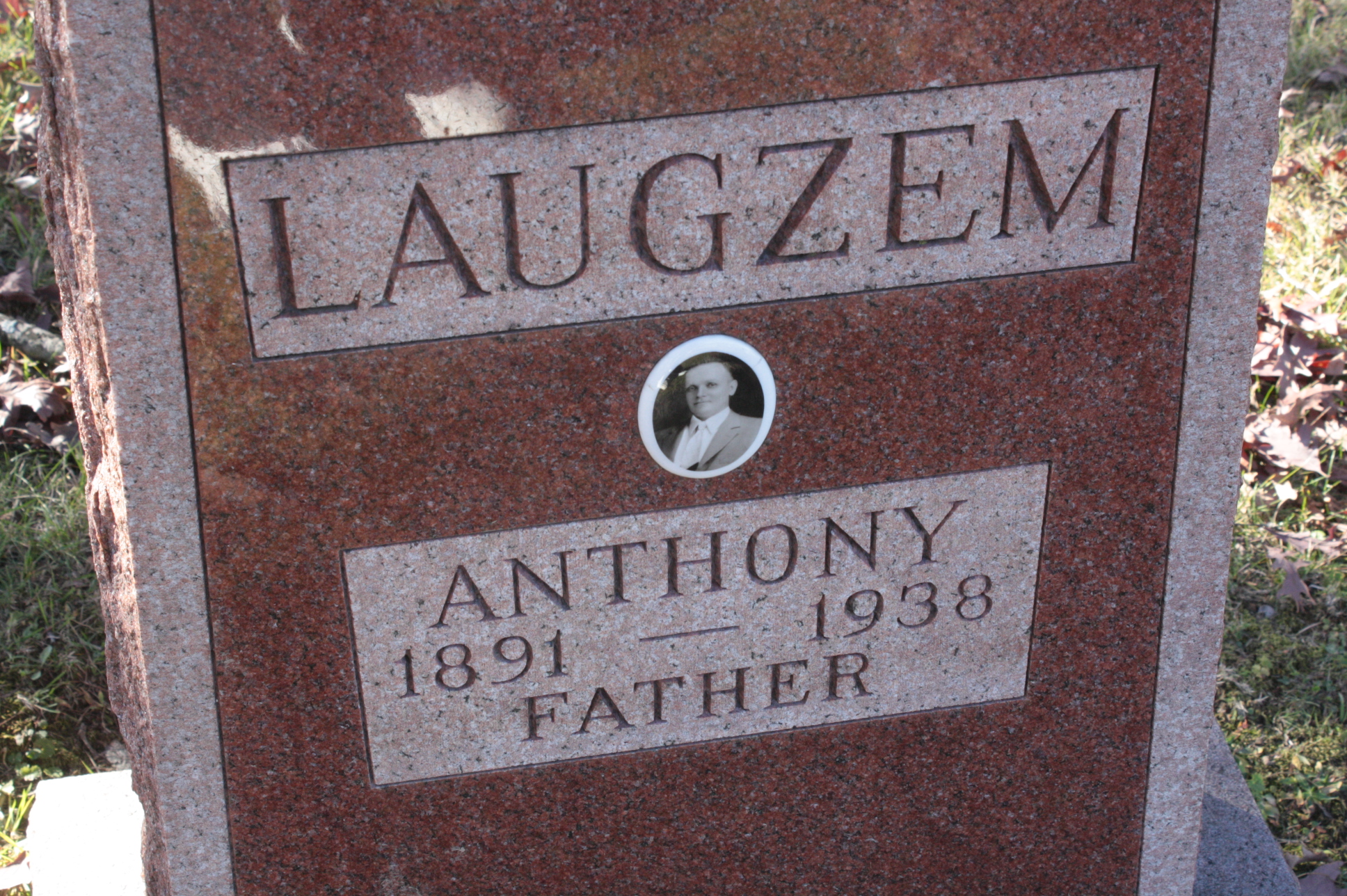
The case of Anthony (Antanas) Laugzem (1891-1938) is an example of the alcohol-fueled violence that could erupt at immigrant social gatherings. Despite his pleas of innocence, Laugzem was found guilty of murdering a fellow Lithuanian-American, Tony Pachules, by a Sangamon circuit court jury on Oct. 18, 1922, according to the Illinois State Journal. Party guests had placed bets on an informal dancing contest at the Laugzem home on E. Black St., in the Ridgely neighborhood. Laugzem testified that a dispute erupted between the victim and another man over their bets, and he asked both men to leave. Pachules, the victim, was shot in the back while walking away from the house. His deathbed statement claimed he turned and saw Laugzem firing from the porch, but Laugzem never wavered in his testimony that he remained inside the house and that the other man who was asked to leave must have shot Pachules.

Photo by William Cellini, Jr.

Photo by William Cellini, Jr.

Laugzem’s lawyer, Edmund Burke, a prominent former state’s attorney, appealed the conviction, unsuccessfully, all the way to the Illinois Supreme Court after being denied a new trial based on insufficient evidence. Burke’s insufficient evidence claim might have been based on the “X” signature by the illiterate victim on the written statement naming Laugzem. His 14-year trial sentence was upheld, even though he continued to deny guilt. (Laugzem’s daughter Stella Laugzem (Lang) later became the first of three wives who all predeceased John (Nevardoskus or Nevidauski) Nevada, who earned a purple heart in World War II.)

It seems clear that the same language and economic barriers that ghettoized immigrants also made violent crime largely an “all in the family” affair. Many individuals could survive and succeed only by cutting themselves loose from the lifelong burden of relatives who consistently drank away all their earnings, then begged for money, or descended into a life of crime. Clearly Lithuanian-on-Lithuanian violence, including domestic and sexual abuse, added significantly to the minefield of risks Lithuanian immigrants and their offspring had to sidestep while walking the “straight and narrow” in their adopted land.

Two Presidents Visit Springfield

Antanas Smetona, President of Lithuania 1919-1920 and 1926-1940.

Antanas Smetona, President of Lithuania 1919-1920 and 1926-1940, Wikipedia. Photo owned by the National Museum of Lithuania. http://creativecommons.or/licenses/by-sa-4.0/

Due to its large Lithuanian population, Springfield has played host to two Lithuanian presidents over the years: to be exact, one president-in-exile and one president-to-be. The first man was the most important leader of Lithuania’s inter-war period of independence.  The second was a World War II exile who returned to lead Lithuania through the trials and triumphs of its early post-Soviet years.

On May 3, 1941, Lithuanian President Antanas Smetona became the first foreign president ever to visit Springfield, according to the Illinois State Journal. A life-long patriot who had worked for and signed the 1918 Act of Independence of the new Lithuanian republic following World War I, Smetona became Lithuania’s first president in 1919 and subsequently, its longest-serving leader. He visited Springfield as a president-in-exile following the Soviet invasion and illegal  annexation of Lithuania in the summer of 1940.

According to the newspaper, an official delegation including Springfield’s mayor met Smetona’s train from Chicago at the depot, and police led his motorcade to the Illinois Capitol. (So the public could line the streets, the route of the motorcade was printed in advance in the newspaper: west on Jefferson, south on Fifth St. and then west on Capitol Ave.) The official welcoming delegation included Fr. Stanley Yunker (Junkeris), of St. Vincent de Paul Lithuanian Catholic Church, and William Yates (Yacubasky), chair of the Sangamon County Republican Central Committee. Several local women also helped arrange the visit and welcome the president: Mrs. Verona Welch (Wilcauskas), Mrs. Bertha (Yacubasky) Adams (Adomaitis), and Mrs. Julia (Gedman) Lukitis.

One newspaper report said Smetona proceeded to have an informal meeting at the Executive Mansion with Gov. Dwight Green. Other reports said he was met at the depot and introduced at a luncheon at the Leland Hotel (sponsored by Springfield’s Mid-Day Club) by (acting governor) Lt. Gov. Hugh Cross, who likened the Lithuanian president to Abraham Lincoln and noted his achievement in establishing compulsory education and widely extending literacy.

St. Vincent de Paul Church choir in performance dress, undated State Journal Register photo, circa 1940. Ann (Tisckos) Wisnoski center, with necklace.

St. Vincent de Paul Church choir in performance dress, undated State Journal-Register photo, circa 1940. Ann (Tisckos) Wisnoski center, with necklace.

Prior to his speech in English and Lithuanian, Smetona was honored by the singing of the Lithuanian national hymn by St. Vincent de Paul’s choir (in costume) and the playing of the anthem and folk songs by George W. Killius on violin. Members of the choir that day included: Bernice Bernotas, Agnes Bakunas, Genevieve Bugaveski, Frances Petrovich, Bernice Kurila, C. Turasky, Petronella Shimla, Ann Zintelis, Virginia Shadis, Bernice Rautis, Mary A. Shimkus, and Antocie (sp?) Zipnis.

Following lunch, the Lithuanian president toured the Lincoln tomb, where he was greeted by other Lithuanian-Americans, and Lake Springfield, where he stopped at the home of Saddle Club owner Joseph Welch (Wilcauskas). Before returning to Chicago by train, Smetona was also feted at public reception at the Leland Hotel.

mystery photo: Mary (Dodd) Dunham Homer as a child with her mother Helen (Banzin) to left & looking down. Early 1940s.

mystery photo: Mary (Dodd) Dunham Homer as a child with her mother Helen (Banzin) Dodd to left & looking down. Early 1940s. Courtesy of Rick Dunham.

When I heard that local Lithuanians lined the streets to see President Smetona’s motorcade, and saw the dirndl dresses worn by the choir at Smetona’s luncheon, I wondered if this photo, owned by Rick Dunham, could have come from that day…? (Note the boy in Cossack hat.)

The State Journal reported that President Smetona’s luncheon address detailed the brutality being suffered by the people of Lithuania at the hands of the Soviet Union, pleading for the return of justice and freedom to his homeland. For more information about the remarkable life and career of Antanas Smetona, please see: http://en.wikipedia.org/wiki/Antanas_Smetona

A Second President visits

Fifty-six years and a long Soviet occupation later, Springfield was visited by Valdas V. Adamkus, a Lithuanian-born émigré who had risen to power inside the U.S. Environmental Protection Agency (EPA) in Chicago. Adamkus visited here on March 27, 1997 to give a talk at the University of Illinois at Springfield sponsored by the EPA’s International Division. He was in the process of retiring from the EPA and moving back to Lithuania, after re-establishing his citizenship there in 1992. Adamkus also likely was already in the process of raising $1.25 million, with the help of Chicago friends, for his successful run for the Lithuanian presidency in 1998.

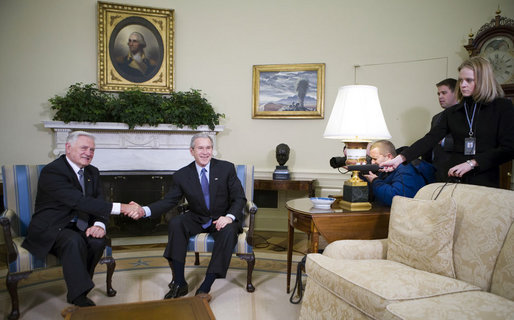
President George W. Bush exchanges handshakes with President Valdas Adamkus of Lithuania, Feb. 12, 2007. White House photo by Eric Draper.

President George W. Bush exchanges handshakes with President Valdas Adamkus of Lithuania, Feb. 12, 2007. White House photo by Eric Draper.

Members of the local Lithuanian-American Club, some of whom knew Adamkus personally (Ben & Vita Zemaitis), attended his March 27 talk and I believe, met him for dinner or a reception. Perhaps there was even a local fundraising event. Those photographed with Adamkus that day included: Romualda (Sidlauskas) Capranica, Rita Kupris, Vita Zemaitis, and Barbara Endzelis.

President Adamkus went on to lead Lithuania from 1998 to 2003, and then from 2004 to 2009, critical years for the country’s admission to the European Union and NATO, and its modernization and re-integration into the democratic world order. For more information about Valdas Adamkus, Lithuania’s émigré president, who was also the longest-serving senior executive of the U.S. EPA and largely responsible for the clean-up of the U.S. Great Lakes, please see: http://en.wikipedia.org/wiki/Valdas_Adamkus

Footnotes: In 1998, while I was working in Miami at a PR agency, I noticed a mistake on the front page of the Wall Street Journal. I promptly contacted the writer of the article to inform him that the Valdas Adamkus who had been cited for mysteriously or perhaps frivolously deciding to renounce his American citizenship had done so to become president of another nation: Lithuania.

In 2005, while visiting relatives, I was shown the Lithuanian Presidential Palace in Vilnius. It was interesting for me, while so far away from home, to think of the fellow Lithuanian-American residing there.

Our Sports Hall of Fame

Dr. Al Urbanckas (left) named to the Illinois State Journal-Register's Sports Hall of fame, 1992.

Dr. Al Urbanckas (left) named to the Illinois State Journal-Register’s Sports Hall of fame, 1992.

Lithuanian-Americans have contributed their share of Springfield sports heroes and athletic “greats.” Names like Rudis, Blazis, Banaitis, Wisnosky, Gurski, Darran, Gvazdinskas, Bestudik and Alane have graced the columns of our local sports pages over the years. However, even in this company, the Urbanckas name stands out.

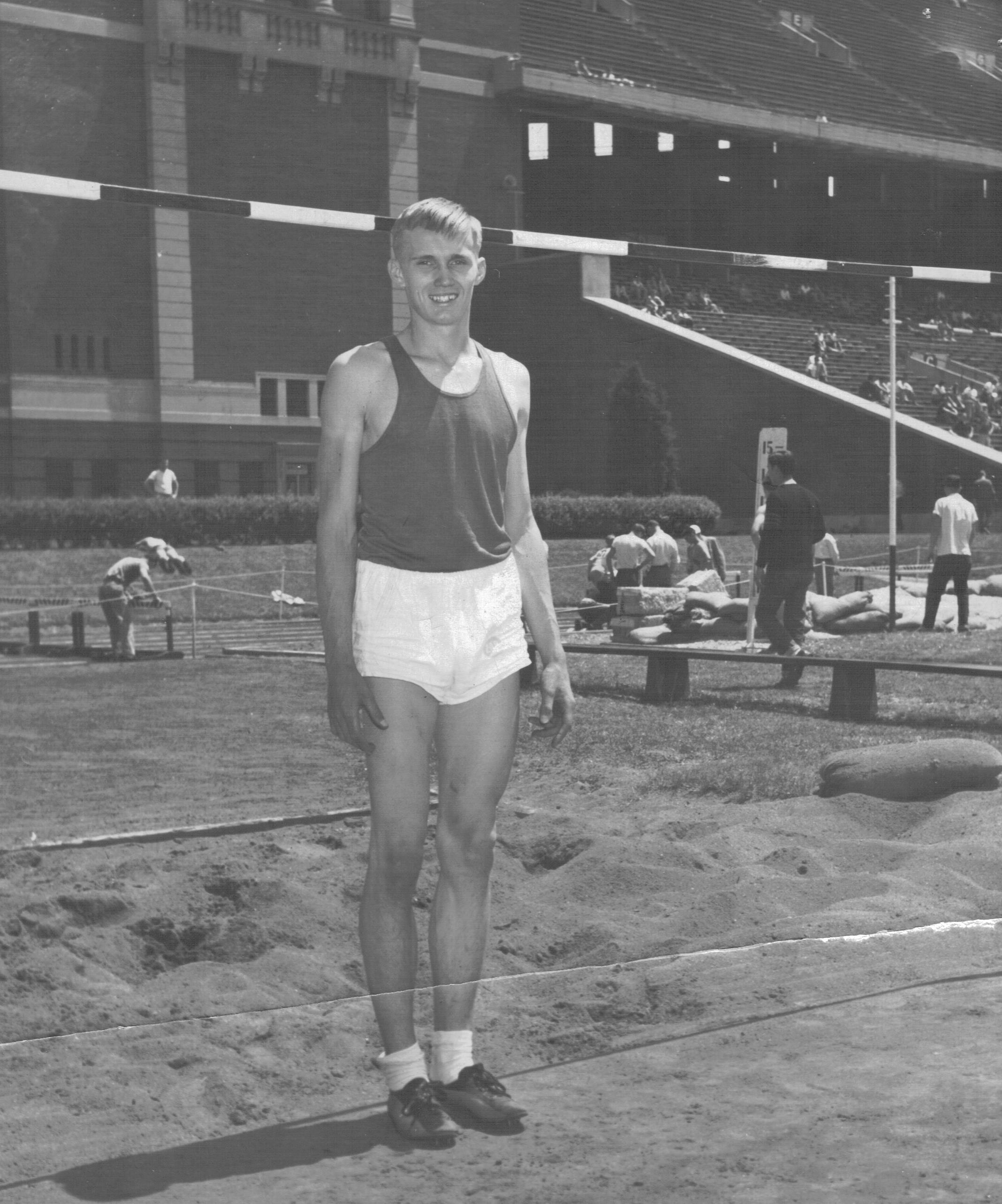
Al (Alfred) Urbanckas, Jr., who later became a Springfield dentist, played basketball for Cathedral Boys High School, becoming the first Cathedral athlete to lead the City Tournament in scoring the same year (1954) that he won the state high jump title. Dr. Al was all-city in basketball in both 1953 and 1954. Later, he set the Big Ten high-jump record on behalf of the University of Illinois (6-8 & 3/4 inches) that stood 1954-64, and in 1957 won the high jump in the Big Ten outdoor and indoor track & field conferences.

Al Urbanckas in high jump competition, 1950s.

Al Urbanckas in high jump competition, 1950s.

After he also tied for first place in the NCAA high jump competition that same year, Dr. Al was named Midwest track athlete of the year (1957) by Coach and Athlete magazine. His jumps routinely boosted U of I’s rankings at Big Ten track and field events throughout his college career.

Dr. Al’s uncle Peter Urbanckas, Springfield High School Class of 1934, played SHS basketball and football (as offensive and defensive left tackle). Known as the “Bone Crusher” on the gridiron, Peter later helped bring Golden Gloves (boxing) to the Illinois State Armory in Springfield, and still later was known as “Pistol Pete” for recruiting thousands of new members for Springfield’s YMCA 1968-94. He was inducted into Springfield’s Sports Hall of Fame (as a “Friend of Sport”) at age 85 in 2000, nine years after the induction of his nephew, Dr. Al.

Not to be outdone, Debbie Urbanckas (Jemison), daughter of Dr. Al and Peter’s great niece, was inducted into Springfield’s Sports Hall of Fame in 2014 for her outstanding career in Sacred Heart Academy and University of Missouri (Columbia) volleyball.

Debbie Urbanckas, high school.

Debbie Urbanckas, high school.

Debbie graduated from SHA in 1981 after being named to “All City Volleyball” in 1979 and 1980. At UM, Debbie was a starting outside hitter for four years and captain of the team during her junior and senior years. She set the university’s record for service aces in a four-game match, and held the record for kills –23 in one match—for five years. Debbie even made the final cut for the U.S. Junior Olympic Team.

One more Urbanckas, Dr. Al’s father and Peter’s brother Al, Sr., completed four decades of “chain gang” service at high school football games in Memorial Stadium at age 86 in 1997, along with his Lithuanian-American friend Peter Kurila. Al, Sr. had played football for SHS and was a member of the class of 1928.

Photo of Chaperone Mary (Rudis) Bestudik of the AAGPBL.  (From the official site of the AAGPBL.)

Photo of Chaperone Mary (Rudis) Bestudik of the AAGPBL. (From the official site of the AAGPBL.)

In addition to the four Urbanckases just mentioned, the Springfield Sports Hall of Fame also includes Lithuanian-Americans Ed Gvazdinskas (2004) and “Friends of Sport” Rich Lamsargis (1999) and Bill Maslauski (1997).

Inducted in 1993, Mary (Rudis) Bestudik was a multi-talented athlete (basketball, baseball, diving, bowling) who played women’s basketball at the regional and national level, and captained the 1934 AAU All-American basketball team. Nine years later, she teamed with Marge Tapocik to win the scratch and handicap doubles titles in the women’s city bowling tournament. An early champion of women’s sports, in 1948 Mary also chaperoned away games for the “Springfield Sallies” AAGPBL team (Remember the film, “A League of Their Own?).

Mary was the wife of Sports Hall of Fame member Joe Bestudik (2003),  a U.S. Navy veteran of World War II who was drafted by the Brooklyn Dodgers baseball team prior to the war. He played for several teams in the American League after the war, as well.

Read more: http://databases.sj-r.com/sports/hall-of-fame/inductee/331/#ixzz3MOuwjFvI

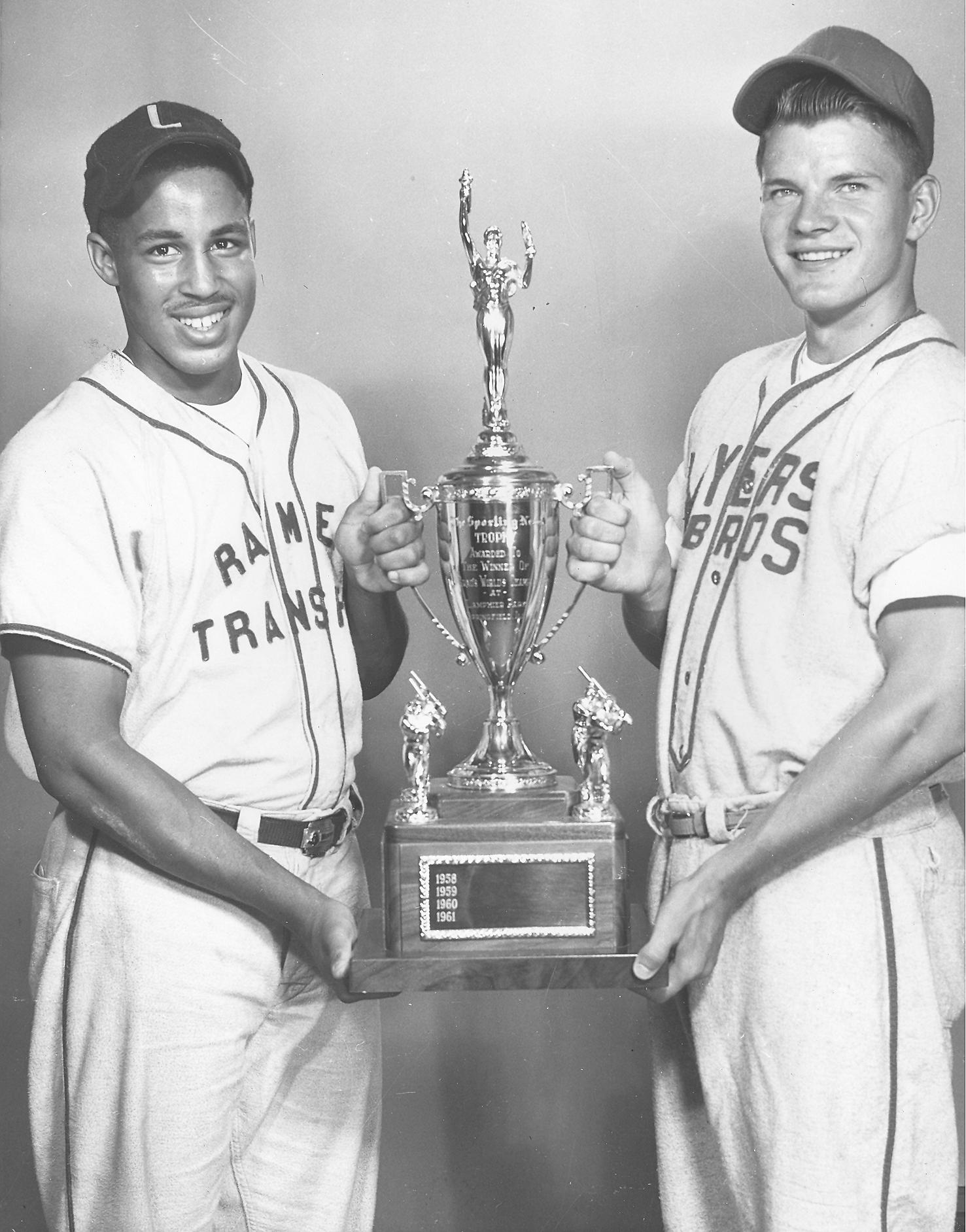
l to r: Gordon White and Dick Alane holding the trophy for the Colt League World Series, 1958.

l to r: Gordon White and Dick Alane holding the trophy for the Colt League World Series, 1958.

Here are some other notable Lithuanian-American sports men and women:

Matt Banaitis was a baseball catcher and winning quarterback (2014) for the Chatham Glenwood Titans.

Enoch Blazis and John Wisnosky played football for Griffin High School. After four years on the Griffin team, Enoch also played for the U.S. Naval Academy in Annapolis, M.D. (He’s now a development executive for St. Olaf’s College in Northfield, Minn.)

Dianne (Darran) Warren was the first Southeast High School swimmer to go to state in 1978. Swimming for Southeast in a city meet, her younger sister Kristen broke the record for the 500-meter freestyle that’s still on the board at Eisenhower Pool. She also went to state in the 200 and 500 freestyle, placing fourth in the 500.

Dick Alane, #35, knocks the ball down for Griffin High School's basketball team, 1958

Dick Alane, #35, knocks the ball down for Griffin High School’s basketball team, 1958

Dianne and Kristen’s dad Bud Darran, as president of Anchor Boat Club, spearheaded a Sports Night each year that featured a whole series of pro athlete speakers, including Coach Mike Ditka of the Chicago Bears. Bud also served as a high school swim “starter” for 37 years.

Dick Alane was a triple threat on the Griffin High School baseball, basketball and football teams.

John Gurski won the Springfield Public Links Golf Tournament in 1948.

From age 68 to 88, George Rackauskas was a committed volunteer organizer for The State Farm (LPGA) Classic at The Rail Golf Course (1980-2000).

Peter Urbanckas,

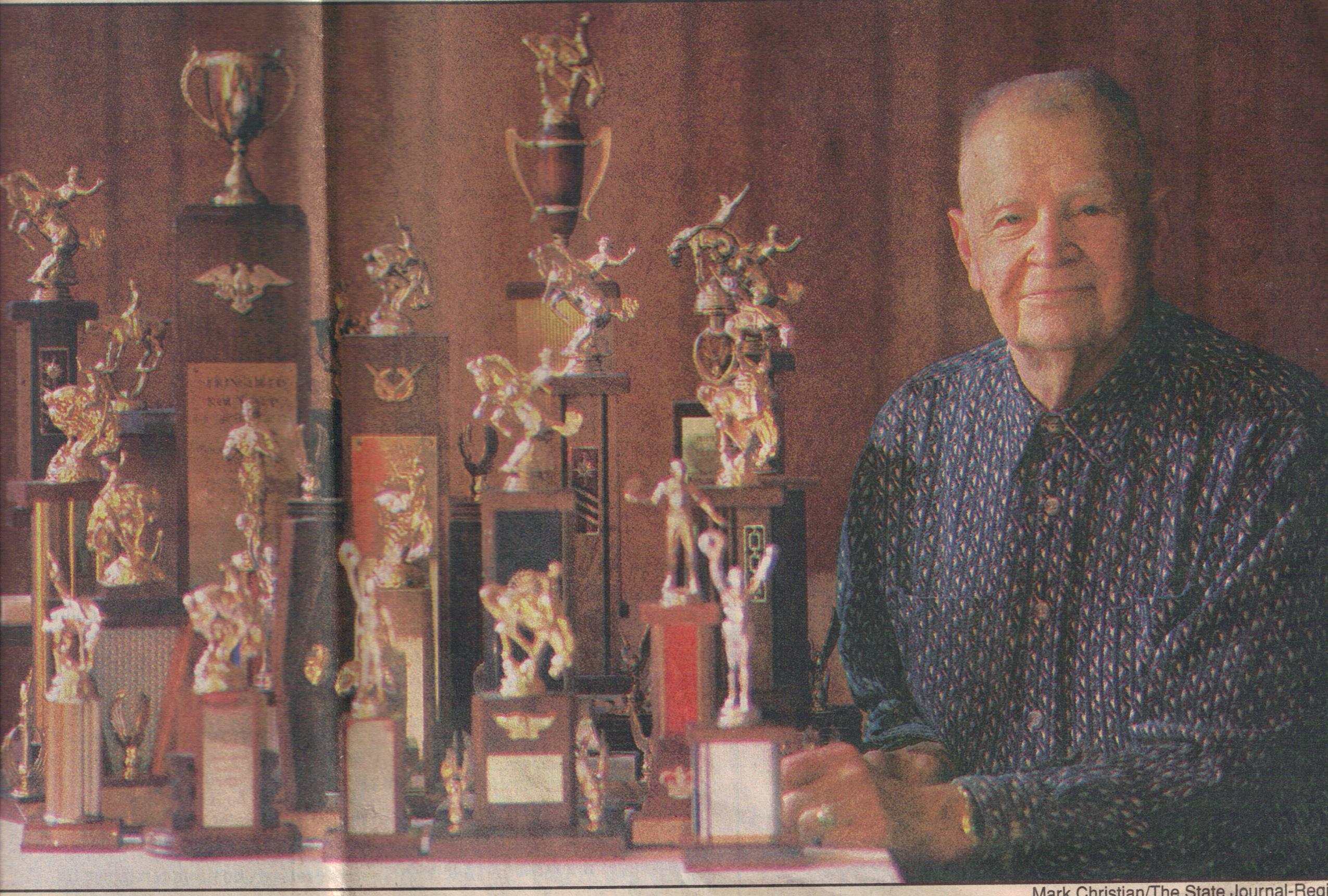
Peter Urbanckas, “Friend of Sport” Hall of Famer, with his trophies, State Journal-Register, Dec. 25, 1997.

An Immigrant Childhood: Ann Tisckos Wisnosky

Ann (Tisckos) Wisnosky, homemaker, writer, contest winner

Ann (Tisckos) Wisnosky, homemaker, writer, contest winner

“Lithuanians in Springfield” by Ann Wisnosky

“…During the oppressive regime of Russian Czar Nicholas II, my father, Jonas Petras (John Peter) Tisckus and his parents lived in Kedainiai and Kaunas. With Father approaching draft age and facing enslavement in the Russian army, Grandfather made arrangements, as did many other parents, to spirit his son out of Lithuania. This was done with the aid of sympathetic Prussian “agents” who lived (in the Konigsberg/Karolauciaus region) near the Lithuanian border.

Father escaped by ship to live with a cousin in Glasgow, Scotland. There, he met other countrymen who had taken refuge and were working in the coal mines. Father joined their ranks. Although the work was hard, dirty, and dangerous, it posed no language barrier and required no skill. After a year as a miner, Father could afford to continue on to “Americka.”

In 1906, he arrived in Salem, Mass. Friends helped him obtain work in a hide (tanning) factory, but he could not tolerate the sickening stench that permeated the entire town. In January 1907, he came by train to Springfield to live with a family he had known in Lithuania, in a home east of the city near what is now the (I-55) bypass.

Springfield’s Streets of Mud

The immigrant of those days found a varied scene in Springfield: muddy roads, board sidewalks, gas street lights, outdoor plumbing, and horse-drawn fire engines, trolley cars, carriages and paddy wagons, as well as corner saloons, player pianos, nickelodeons, medicine men, and balloon ascensions. There were also chickens, cows and gardens on city lots, nickel bread and penny ice cream cones. The fashion of the day found ladies in long dresses with “rats” in their hair and plumes in their hats; boys in knickers, girls with braids and ribbons, and men in celluloid collars, striped shirts, and straw or felt hats.

To work and play in this new environment, the immigrant had always to cope with the language barrier. Father, like most men, immediately applied for work in one of the dozen or more coal mines in the area, although Springfield also had over three hundred manufacturing concerns employing several thousand workers. Immigrant women found work as hotel maids or domestics. To supplement its income, nearly every foreign family already established here took in a “greeneris” (greenhorn) or a “boardingerie” (boarder) or two or three, no matter how crowded the home already was.

Mother Arrives

My mother, Alexandra (Olse) Urbas, left Aztenu, Lithuania at the age of 17. An older brother living here paid her fare. Sailing to New York as a third-class passenger, she recalled how she had almost died aboard ship from breathing the gas from an extinguished lamp. Crowded conditions and seasickness plagued the passengers; with the latter condition, victims sniffed camphor in an effort to obtain relief.

In April 1908, Mother arrived by train in Springfield to live with a married cousin who had many boarders. Mother earned her keep by cooking and doing housework and laundry, the latter all by hand. She remarked that she had not found America any easier than Lithuania.

Four months after her arrival, mother married my father in “Old St. Mary’s” Catholic Church at 7th and Monroe Streets. A year later, a son was born–then a daughter, followed by three boys in rapid succession. Babies were usually born at home with the help of a midwife who stayed on for several days to assist in the household. After the children arrived, a three-room house on 15th St. near Madison St. was rented. The range and a heating stove supplied warmth, and kerosene lamps supplied light. Hot water was obtained from a nearby railroad roundhouse.

Mutual Aid in America

Immigrant families felt that owning a home was their greatest security. So, in 1916, my parents made a down payment on a modest home of four rooms on E. Reynolds St. in an almost all-Lithuanian community. Most families were buying homes and raising children, chickens, cows, and gardens. With parents and grandparents left behind in Lithuania, neighbors had to rely on each other for help in everyday projects, as well as emergencies. They exchanged tools, seeds, cuttings, recipes, and ideas about life in America. Women helped each other cut out clothes from homemade patterns, and many owned foot-operated Singer sewing machines.

From Flour Sack to Embroidered Petticoat

Because most families baked bread, flour was purchased in 50-lb cotton bags. Bags that were not used for dish towels or bedding were bleached in boiling lye solution, then used for nightgowns and petticoats. Sometimes, the commercial markings were not quite bleached out of the sacks, but even such petticoats boasted hand-crocheted hems of lace made by loving mothers. These were “Sunday best” for many little girls.

Sundays saw most church-going Lithuanians attending the Roman Catholic Church. By 1909, they had built their own church, St. Vincent de Paul’s, at N. 8th St. and Enos Ave. It became the center of their religious, cultural and social life, and was a great force in the preservation of their language, songs and customs.

“Those Foreign Kids”

Home recreation found children playing with hoops, marbles, home-made stilts, and kites. Some families listened to Victrolas or sang along with player pianos. Occasionally, a nickelodeon movie starring Pearl White or Mary Pickford could be enjoyed. As children, our happy hours of neighborhood play were in contrast to our ambivalent feelings about attending school. When we started Palmer School, we were looked upon as “those foreign kids” and sometimes called names. (Ann doesn’t mention it, but she might have started school without speaking any English, like many children of immigrants back then.)

Other ethnic groups had the same problem. It gave us a deep sense of not belonging in the outside world. Our real world was the family, neighborhood, and church. To add to our educational hurdles, few parents could help with school lessons, for most knew only their native language, manners and customs. Father had learned to read and write by now, but Mother had not. She did learn to write her name and do some reading later through classes held in the homes of immigrants.

The free public school system was an overwhelming joy to Father, compared to the suppression of education he had endured in Czarist Lithuania. As we began school, Father told us, “Tas kas skaita ir rasa, duonas ne prasa.” (“The one who reads and writes does not ask for bread.”) Study was encouraged, and teachers were respected. There were some fine, dedicated and very helpful teachers at Palmer School who understood the problems the frustrated foreign children faced. They encouraged the use of the Lincoln Library, where pupils were introduced to stereoscopes and free books that could be taken home to enjoy. Most immigrants had few, if any books at home.

Feathers in My Stockings

On wet days, teachers let children huddle near radiators to dry stockings, while shoes were drying nearby. Many pupils had wool stockings, mittens, hats, scarves, and sweaters–but few owned boots. One freezing winter day, Mother sent me to school with feathers stuffed in my stockings for warmth. Each time a feather stuck out, I bent to pull it free. Finally, the teacher, in a rare moment of exasperation, rapped my knuckles with her ruler. Mother was tearfully told that afternoon that “no other second-grader wore feathers to school.”

Home life had its share of other major and minor problems and inconveniences: numerous contagious diseases and indoor pollution from smoke and ashes; the dodging of lines of laundry drying throughout the house during winter; and Saturday night baths in a tub in the kitchen. Economies were achieved by fathers repairing children’s shoes with soles cut from large slabs of tough leather. In addition to chores like bringing in coal and wood from outdoor sheds and carrying out ashes, many boys sold papers or had routes. Girls helped with housework, cleaned and filled lamps, and helped with smaller children.

In the homes of miners, incomes were far from steady; work was seasonal and strikes frequent. Grocers developed a system of extending summer-long credit while mine work was slack. Families lived with uncertainty, and hard work was accepted as a way of life. Uncertainty and disruption had also been the lot of the immigrants in their native Lithuania, but American held the promise of a better living, new opportunities, and certainly, new freedoms. There were milestones along the way–the earning of U.S. citizenship (Father and Mother gained theirs on a happy day in 1918) and subsequent political participation.
Eventually, economic gains were realized, and many first-generation Lithuanian-Americans secured advanced education and entered professional and business fields. Certainly, a new diversity had been added to America’s talent and character.”

Possibly penned around the time of the U.S. Bicentennial in 1976 and adapted for “Historico,” a publication of the Sangamon County Historical Society. The piece printed here is taken from Ann’s original typed essay as preserved by Ann Pazemetsky Traeger, with minor edits for my blog.

Post-script: Long before I started writing about Lithuanians in Springfield, a very special lady, Ann (Tisckos) Wisnosky (Visnauskas), wife of self-made Illinois National Bank executive August (Augie), Sr., and mother of John, a University of Hawaii art professor, and Augie, Jr., a leading Springfield architect, wrote the story of her immigrant family under the same title.

In addition to being a first-class homemaker who won the Chicago Daily Tribune “Cook of the Month” award for her fruitbread recipe, and a 1948 Tribune recipe contest for her Lithuanian potato kugelis, as well as a Quaker Oats contest, Ann was a talented writer with some touching childhood memories, as you see here. Please share it with family and friends.

Lithuanian Taverns II: Holding Up the Neighborhood

Sam and Mary Lapinski, proprietors, behind the bar

Sam and Mary Lapinski, proprietors, behind the bar

Last week’s post struck a rich vein of local Lithuanian lore, which I continue to mine this week, after hearing from Wally Surgis (Lith. Sudrius) about another interesting tavern-keeper, immigrant Tony Romanowski (Antanas Ramanauskas), who owned a grocery store/tavern on East Reynolds from what appears to be the 1920s to the mid-1950s. Tony, whom Wally Surgis describes as only about 5-foot-3 and very round, with “Peter Lorre” eyes, lived in the attached house at #1729 E. Reynolds and cooked food and gave out drinks to poor Lithuanian immigrants in the area. According to Wally, “Tony would feed and house the poor of the neighborhood, and even bought enough life insurance to bury the ones who had no family.”

Tony’s moving service to his fellow man was probably part of a larger fabric of Lithuanian immigrant communalism in a neighborhood between 16th and 19th Streets on E. Reynolds that rivaled the north 15th St. and 11th St. and Peoria Road areas for its concentration of Lithuanian residents. We already know that during the infamous 1932-36 “Mine Wars,” when thousands of Progressive Miners of America went on strike, corner groceries and taverns acted as food collection and distribution points or “commissaries” for hungry mining families. According to Wally, mutual aid in the neighborhood long after the 1930s included sharing personal fishing catches and canned garden produce.

1956 East Reynolds

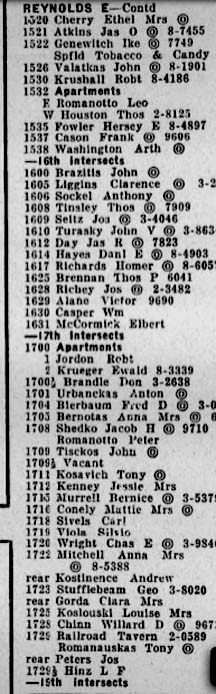
To get a sense of the persistence of the E. Reynolds Lithuanian community from the year 1900 or so up through the 1950s, take a look at these snapshots taken by Genealogics from the Springfield City Directories of 1951 and 1956, including familiar Lithuanian names like: Genewitch, Valatkas, Brazitis, Sockel, Turasky, Alane, Casper, Urbanckas, Bernotas, Tisckos, Kosavich, Sivels, Kostinence(?,) Gorda (?), Koslouski, Ro(a)manauskas, Kerchowski—and Orback(!!)

1951 East Reynolds

Finding my Lost Orback Family

Here is where my passion for the stories of other families—and of a community—gets unexpectedly personal. The Anna Orback living at 1729 and ½ E. Reynolds in 1956, right next to the Railroad Tavern at #1729, which had since been sold by Tony Ramanauskas to a Mrs. Frances Casper, is my long-lost great aunt! (Tony is listed as living at the rear of the tavern.)

How serendipitous that a few days after I hear about a man with strong ethnic loyalty and a big heart who is helping all the old and poor Lithuanians of his neighborhood, I also learn that one of the closest and poorest of those immigrants, who happens to be living right next to Tony, is my own, lost aunt Anna. Could there be any doubt that she was one of those whom Tony housed, fed, and possibly even buried?

My great aunt or “Teta” Mary Yamont (Marija Baksyte Jomantiene), who was like our grandmother, spoke only Lithuanian. She, herself, was of modest circumstances and lived in a three-room house at 2102 N. Peoria Rd. But I remember hearing nothing, ever, of Mary’s own sister Anna, either from Teta or my father. Sometime in the years after Teta died in 1978, I remember hearing maybe once of a second great aunt in Springfield who was unmentionable: someone of very close blood, considering we had so few relatives on our Springfield Lithuanian side, yet someone I had never met.

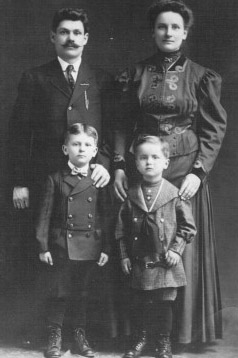
Mary Yamont (Marija Baksyte Jomantiene) with husband and sons Benny (left) and Joseph, circa 1909.

Mary Yamont (Marija Baksyte Jomantiene) with husband and sons Benny (left) and Joseph, circa 1909.

How strange and miraculous to find her—Anna Orback–suddenly on May 31, 2014 in a snapshot from our city directory, and to learn the family shame that was hidden along with any mention of her. According to several newspaper reports, Anna’s husband Frank, also a Lithuanian immigrant, reportedly had died of methyl alcohol poisoning at age 39 in 1926, and Anna had sued three people, Joseph Ponder and corner grocery owners Anthony and Ursula Lawrence (Launikonis), for selling him that alleged wood alcohol. (I don’t know yet how the suit turned out).

Even more clippings relate to the criminal history of Anna’s then-fatherless son Joe Orback, starting in the trough of the Great Depression in 1932 with an arrest for burglary and larceny at age 17, in connection with an attempted break-in met by a police ambush that left one of the youths Joe was with shot dead. Joe requested and was given probation for his first string of property crimes, but is reported to have violated it within a year and to have been sent to Menard for a term of 1-5 at age 18.

Anna and Frank also had a daughter, Elizabeth, and a son Frank, Jr., who got an upstanding job as a driver, married a Frasco, and built onto a home, but may have fallen on hard times or perished before his mother Anna reached old age on E. Reynolds. And so, I find myself grateful that tavern-keeper Tony Ramanauskas was there for Anna, whom I’m now told was alcoholic, in her declining years. (The story of Tony and the old, poor and alcoholic immigrants left behind on E. Reynolds by the 1950s is the flip-side of the immigrant success story whereby the young, educated and successful American-born of the 1930s and 1940s left the immigrant neighborhoods.)

The 1924 Springfield City Directory lists Tony as a grocer at 1729 Reynolds with wife Mary (later, also living with his brother John), according to Genealogics. (Readers will remember that in 1927, the Kasawich family of “Three-Day Lithuanian Wedding” fame owned the grocery/tavern at the corner of 16th and Reynolds.)

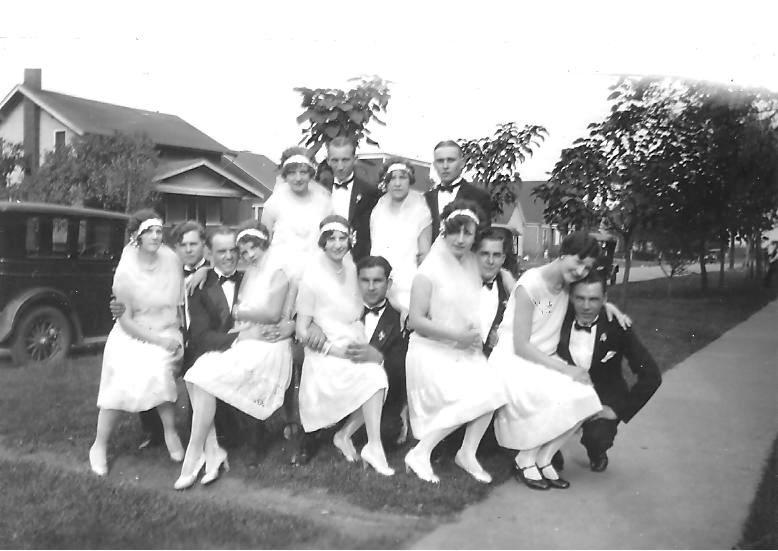
The Wedding Party: Eva Kasawich and Victor Alane wedding, 1600 block of E. Reynolds, 1927.

The Wedding Party: Eva Kasawich and Victor Alane wedding, 1600 block of E. Reynolds, 1927.

Scrolling back in time, the 1906 Springfield City Directory listed quite a few more Lithuanian-owned taverns that apparently did not make it till the 1930s, roughly the beginning of the tavern and supper club coverage in my first blog. In 1906, William Anskis owned a tavern at 1931 Peoria Rd; John Brazis, a tavern at 805 E. Washington; Michael Dunkus, one at 729 E. Washington; Charles Gedmin (Gedman?), 800 E. Washington; George Kamiczaites (Kamizaitis), at 1800 S. 11th; Mssrs. Kaslavsky (Kazlauskas) & Burezik, at 1428 E. Reynolds; and Mssrs. Yuris & Kalosky, at 112 S. 7th St.

Why did more of these very early taverns not survive? It is awe-inspiring to consider the possibilities: 1. Those that were in the famous “Levee” area might have been burned or sacked in the 1908 Springfield (White) Race Riot, or 2. They could have been put out of business by 1920s Prohibition and never recovered, as some did after stints as groceries or confectionaries. Imagine coming to the U.S. with no education, money or language, fighting your way up through the mines to save enough to open a “beer parlor,” even a hole in the wall, only to be hit by the disaster of Prohibition—followed by The Great Depression.

Enabling Alcoholism vs. Social Safety Net

Suddenly, through this study of Lithuanian tavern life, I understand the manifold reasons why many Lithuanian-Americans in Springfield were poor, living in crowded or substandard housing and with little money after two generations on American soil. The times were very, very hard. There was a lot of alcoholism. And seeing how little headway many of the first-wave immigrants and their descendants had made here, without having seen the causes, must have been frightening—even incomprehensible–for the mostly professional and educated Lithuanians who arrived as refugees or displaced persons (“DPs”) after World War II.

These new immigrants, like my father, could easily have seen “tavern life,” i.e., alcoholism, as a cause, and not mainly a result of the poverty and lack of opportunity faced by first-wave immigrants–first in their homeland, where they were not even taught to read and write–and then here in the U.S., where they were cruelly exploited then abandoned by the coal mines. Although drinking was never part of my family life, I have come to believe that the human psyche is far too sensitive for the extreme hardships of life, leading many individually–and when such brutalities are widely shared, even communally—to a culture that numbs the senses when such hardships cannot be escaped.

Alcoholism was certainly an ugly reality of immigrant family life all over Springfield. At the same time, corner groceries and taverns seem to have been the only/first visible nodes of immigrants’ economic progress–not only for the families that owned them, but also, as the story of Tony Ramanauskas demonstrates—for the surrounding neighborhood when tavern proprietors communally shared some of their modest success through a sense of ethnic loyalty/responsibility. And, finally, corner taverns are were what remained, along with the poor and outcast of once-vibrant ethnic neighborhoods, after younger generations progressed and joined the American mainstream, leaving their families and communities behind.

Helping World War II Displaced Persons

Along the way, tavern owners like Sam and Mary Lapinski helped displaced persons (DPs) who immigrated after World War II. Violeta (Abramikas) Abad remembers that her immigrant family, including her parents and baby sister Regina, lived in a third-floor apartment above Lapinski’s Tavern for several years after their arrival in the U.S. under the U.S. Displaced Persons Act of 1948. Violeta says, “In fact, my father sponsored his brother and family to come to America in 1951 from the DP camps in Germany, and they also lived with us above Lapinski’s until my Uncle Vincas was able to save enough money to move to their own apartment.”

Immigrants Stephanie and Walter Abramikas, circa 1985.

Immigrants Stephanie and Walter Abramikas, circa 1985.

After reading last week’s taverns post, Violeta says she shared memories with her first cousin Laima (Abramikas) Milaitis of moving their mattress out on the porch/balcony on summer nights because it was too hot to sleep inside the third-floor apartment. After its first years above the Lapinskis, the Abramikas family made its way to middle class success in America with a speed that the First Wave of coal-mining immigrants had found elusive. Mr. (Walter) Abramikas, who had been a forestry professional in Lithuania, worked a union job at Fiat-Allis, which hired many immigrants after World War II. This allowed him and his wife Stephanie to save enough money to get into rental real estate–and send their two daughters to college. In my own immigrant family, also thanks to a good union job, parents who had never gone to high school sent five daughters to college and straight to the middle class.

As for the first generations of coal-mining Lithuanian immigrants and their children who faced many harsh decades of minimal opportunity in Springfield, I am now convinced that institutions like the church and neighborhood taverns and groceries fulfilled the critical function of building and preserving the communal bonds that could often be an individual or family’s last means of survival and support. May we always view with respect the people who had to face such incredibly tough times, study these times for perspective, and pray that they never return.

Sincere thanks to Genealogics for my serendipitous discovery of my lost great aunt while researching the Ramanauskas tavern on E. Reynolds.

Lithuanian Tavern Life

Sam and Mary (Mankus) Lapinski (Lapinskas) behind the bar, 1935

Sam and Mary (Mankus) Lapinski (Lapinskas) behind the bar, 1935

Family-owned corner taverns where coal miners ate, drank and socialized proliferated throughout Springfield during the first half of the 20th Century. Keeping the tavern going was a family affair, with wives often doing the cooking and cleaning, and husbands, sons and sons-in-law tending bar. This leads me to believe that a goodly number were founded by formerly single miners after they married as a step up the economic ladder–and like the corner grocery store, a safer line of work. The tavern family usually lived behind, above, or next-door to their establishment.

The following local taverns, most now defunct, were owned by Lithuanian immigrants and/or their offspring: Lapinski’s (11th & Washington), Bernie Yanor’s and Jim Casper’s taverns (opposite corners of 11th at Peoria Rd.), (Kostie) Welch’s Tavern (11th and Laurel–later at 1827 Peoria Rd.), The (Rekesius) Welcome Inn (11th and Washington), Tony Romanowski (Antanas Ramanauskas)’s “The Railroad Tavern” at 1729 E. Reynolds, “Alby’s” (and Vera Stasukinas’) Tavern (14th & Carpenter), Bozis’s tavern on E. Mason, Enoch and William Blazis’s White City Tavern on E. Cook St., Carl Pokora’s tavern at 22nd St. and S. Grand Ave. East, The Lazy Lou at 1737 E. Moffatt, not far from Pillsbury Mill, which was owned by Frank W. and Mary (Gerula) Grinn–plus taverns owned by Walter Kerchowski (“Wally’s”), Nancy (Kensman Zakar Nevada) Treinis around 16th and Carpenter and Anna (Leschinsky) Kasawich on E. Reynolds St. I’m sure there were even more.

Back row, l to r: Antonia and Bernie Yanor, owners of Bernie's tavern, with daughter Josephine (Stankavich).  Front row, l to r: Yanor children  Joe, Anna (Carver), and Bernie, Jr. 1920s.

Back row, l to r: Antonia and Bernie Yanor, owners of Bernie’s tavern, with daughter Josephine (Stankavich). Front row, l to r: Yanor children Joe, Anna (Carver), and Bernie, Jr. 1920s.

Some taverns started out serving beer to miners in the early 1900s, then became grocery stores or soda fountains, exclusively, during 1920s Prohibition–then reverted to taverns again in the 1930s. The ancillary restaurant/grocery functions of taverns were perhaps not as important as their provision of alcohol, but many are still also remembered for their food. Fish dinners on Friday were extremely popular, due to a heavily Catholic customer base. An ad from 1956 for Alby’s Tavern mentions “Homemade Chili, Hamburgers, Hot Tamales and Cheese.” In 1940, Welch’s Tavern had chicken and potato salad dinners for 10 cents and boneless fish dinners for 5 cents.

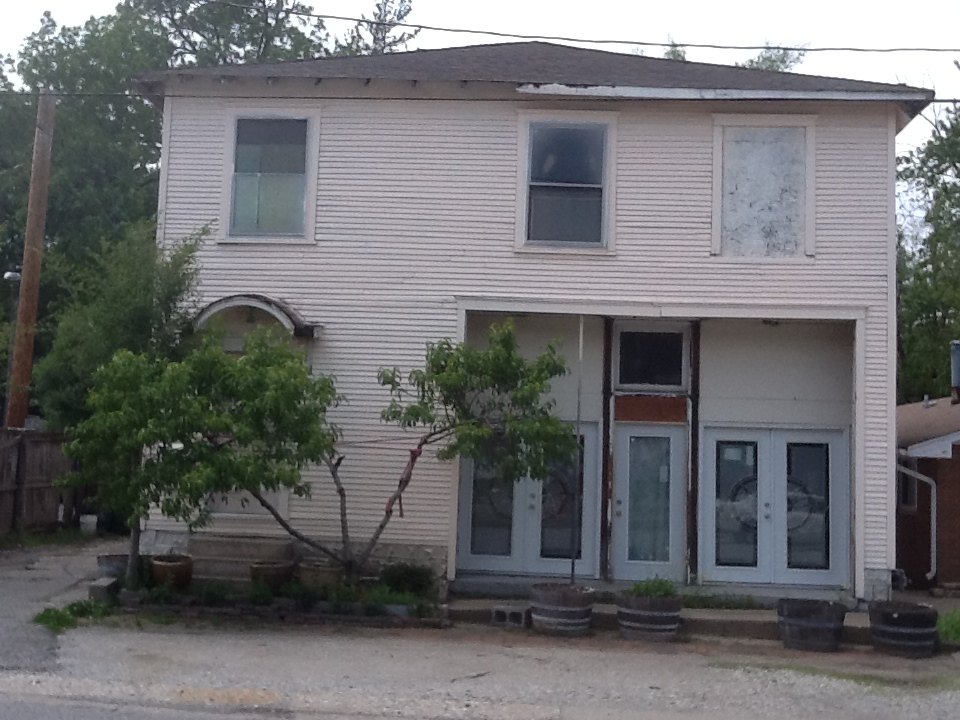
The Fairview as it is today, under different ownership

The Fairview as it is today, under different ownership

Over the decades, the basic tavern “hole in the wall” with food and drink evolved into the larger and more ambitious “supper club” that featured entertainment such as live music with dancing and a more extensive–and expensive–menu for sit-down dining, drawing customers from a wider area. One of the first of these was The Blue Danube, built on Keys Ave. by the Yates/Yacubasky family in 1933. Some of the best-known Lithuanian-owned supper clubs were The Cara-Sel Lounge (Tony Yuscius) on N. Grand Ave., the Skyrocket Inn (Kostie Welch) on Sangamon Ave. near the fairgrounds, The Fairview (Alex & Alice Palusinski) and Butch’s (Frank Gudauski’s) Steak House on Sangamon Ave. east of the fairgrounds, Boggens Grove (Harmony House?) on West Washington, (Stephen) Benya’s Supper Club in Nokomis, and the upscale Saddle Club (Joe Welch) at 307 S. 6th St., which was also a local newspaper watering hole.
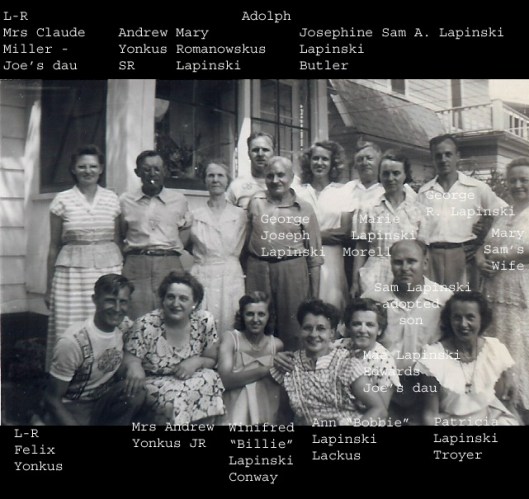
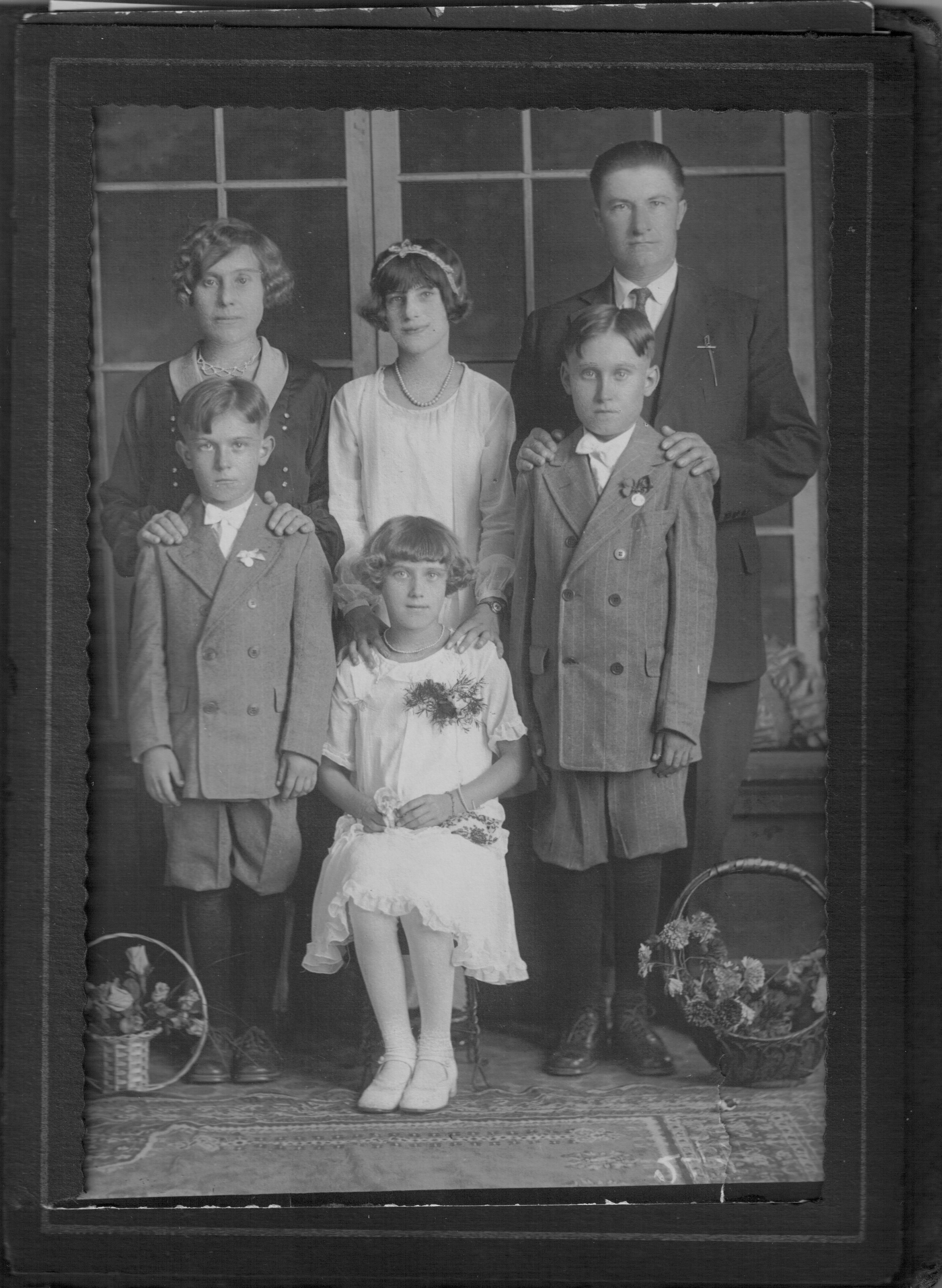
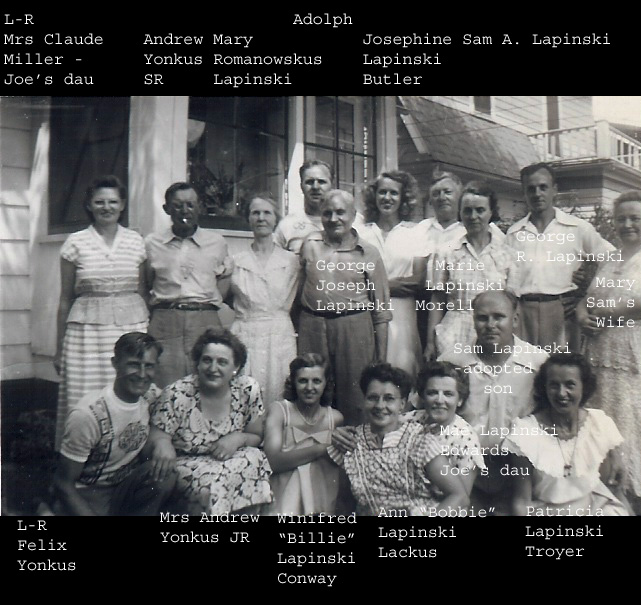
Lapinski family, 1940s?

Lapinski family, 1940s?

Taverns served an important, little-known function during the infamous “Mine Wars” 1932-35, when they were neighborhood “commissaries” for striking members of the Progressive Miners of America (PMA), storing and distributing food to hungry families. A Dec. 4, 1937 article in the Illinois State Journal describes character testimony given by Lithuanian-born tavern owner Sam (Simon) Lapinski in defense of Sam’s Lithuanian-American son-in-law Anthony Chunes, who was on trial in federal district court in Springfield for strike-related railroad sabotage. The article states that Anthony had been a bartender at Lapinski’s, and that the basement of the tavern functioned as a PMA commissary. Chunes was convicted and imprisoned in the 1937 mass trial of 36 PMA strikers, despite the testimony of his Lapinski wife Monica (they later divorced), father-in-law and mother-in-law. (Lithuanian-Americans Charles Mostaka and his son-in-law Joe Biernoski testified in defense of PMA miners Sam and Tony Profeta in the same mass trial.)

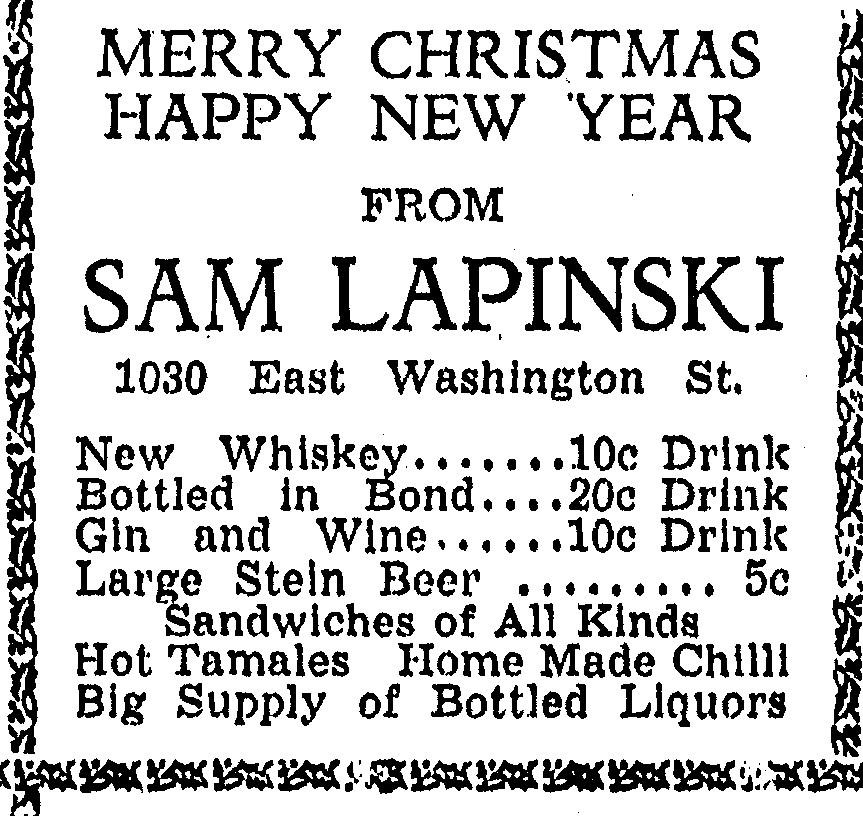
Lapinski ad

Distributed, as they were, throughout Springfield’s neighborhoods and built on an intimate scale, corner taverns were the neighborhood restaurants and entertainment centers of their time: an era when social life took place on the scale of the family and the neighborhood, and “people knew each other.” They were the familiar and common places for adult socializing, listening to juke box music, and playing pinball, shuffleboard, punch boards and slot machines. On the bad side, taverns presented a temptation to alcohol and gambling (both during and after gambling was legal) on every corner for those who could least afford it. To my knowledge, the potentially rougher side of tavern life made them generally off-limits for children at night.

Punch boards were a form of gambling in which a key was purchased and used to push in a circle on a board to see if there was a prize behind. During the height of the Depression, before gambling became illegal within Springfield’s city limits in 1939, even candy stores had punch boards with candy prizes for children. The price of the key was commensurate with the value of the potential prize.
One family of Lithuanian-American tavern-keepers was prominent in the business of distributing punch boards to taverns and social clubs throughout the county for decades, according to primary source and newspaper reports. In sensitivity to the illegal nature of the business in the city after 1939 and the county after 1948 (more of less), a descendant of that Lithuanian-American family has emphatically requested that I not write about the family’s great success in this aspect of the tavern business.
Therefore, I can only refer any interested readers to several articles in the Illinois State Journal. One, dated Oct. 21, 1948 gives the names of Sangamon County’s three main punch board suppliers according to a special grand jury report. Another, dated Sept. 6, 1963, describes gambling arrests related to a raid by authorities on a (non-Lithuanian-owned) tavern called The Press Box.  A March 12, 1964 Journal article describes an anonymous tip and police raid on a garage behind a Lithuanian-American tavern on Peoria Road that netted 5-10,000 punch boards and tip boards–and resulted in a family member’s arrest.
Growing up in a Tavern Family
N. 11th St. near Peoria Rd. building where Klim's Shoe Repair was located and Klim and Yanor-Carver families lived

N. 11th St. near Peoria Rd. building where Klim’s Shoe Repair was located and Klim and Yanor-Carver families lived

And now, for the perspective of a Lithuanian-American girl whose family was in the tavern business, we have the memories of Georgeann (Carver) Madison, granddaughter of Bernie and Antonia Yanor, owners of Bernie’s Tavern. In early childhood, Georgeann lived with her parents George and Ann (Yanor) Carver above Lithuanian immigrants Peter and Helen Klim’s Shoe Repair shop, next door to Klim’s son Jim Casper’s Tavern, and across the street from Bernie (Yanor)’s Tavern.
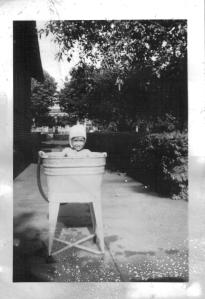
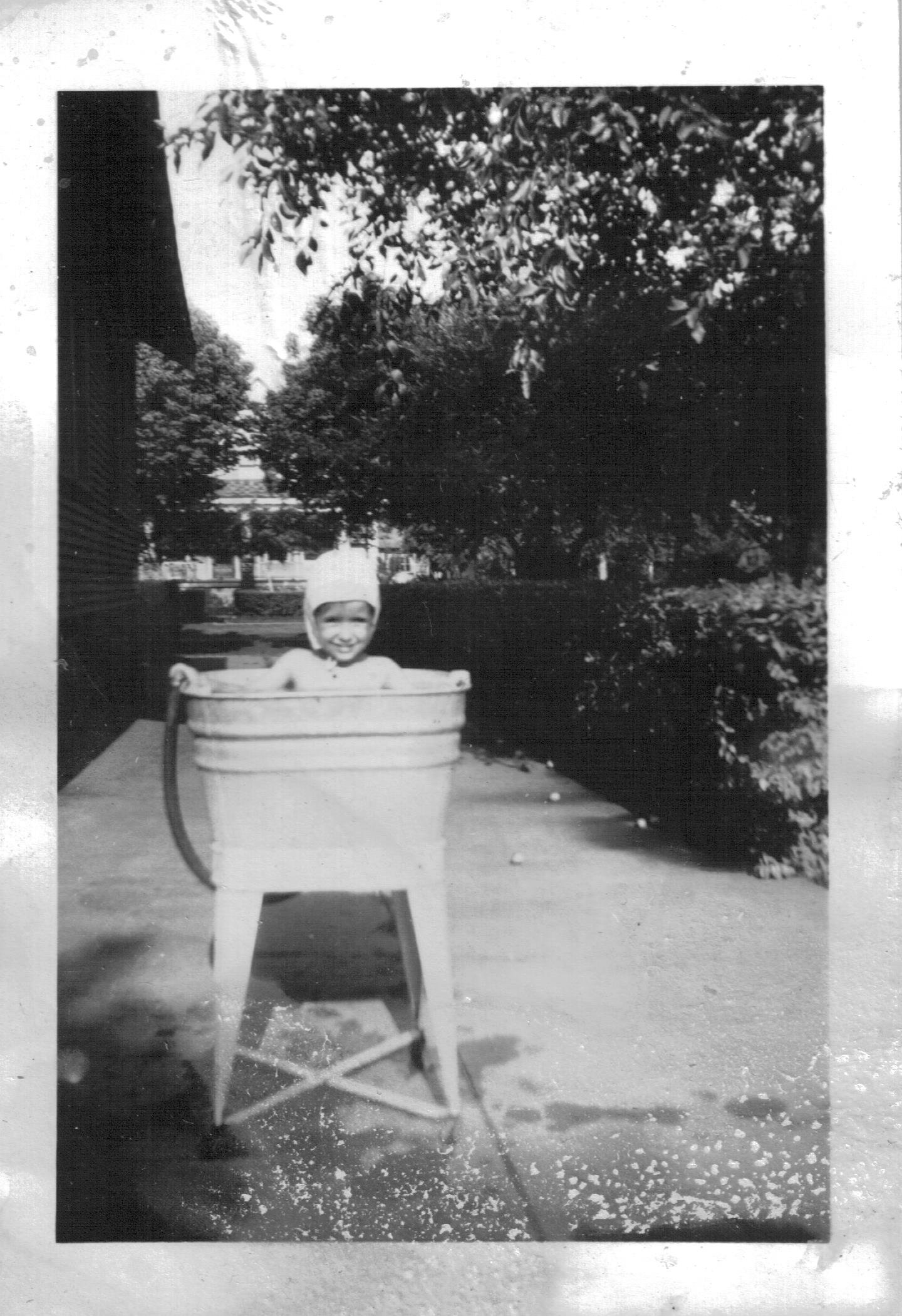
little Georgeann Carver (of the Yanor clan) in a home-made

little Georgeann Carver (of the Yanor clan) in a home-made “swimming pool,” 1940s.

Georgeann recalls: “My Uncle Bernie tended bar there and after school, I was allowed to sit at the end of the bar and watch “Pinkie Lee” on TV instead of practicing my piano lessons like my mother sent me across the street to do.” (Before TV ownership was common, television was another major draw of the corner tavern. In 1956, an Alby’s ad enticed customers to come in and “Enjoy Television Tonight”).

Georgeann continues: “My Uncle Bernie cooked the best cheeseburgers, tamales, chili and barbecues. He would make a cheeseburger for me even though my mom wanted me to eat dinner at home. Almost every time I was there, my grandfather would hand me a silver dollar out of his pocket. I would be at the tavern in the early evening before the coal miners came in from work at the mine on 11th Street.”

George and Anna (Yanor) Carver, baby Georgeann Carver (Madison), circa 1945

George and Anna (Yanor) Carver, baby Georgeann Carver (Madison), circa 1945

She also remembers that on Christmas Eve, Father Stanley Yunker, pastor of St. Vincent de Paul’s Lithuanian Catholic Church, would come to the Yanor living quarters at the tavern and distribute Holy Communion. “He would have a drink of whiskey or wine or two and some holiday food with the Yanor-Stankavich-Carver families.” (Georgeann’s beloved maternal aunt Josephine Yanor and husband Bill Stankavich lived across Peoria Rd., one block south on 11th St.)

Here are some additional memories from Georgeann, Sharon Darran, Chuck Tisckos, Ann Traeger, Scott Welsh, Joe Turasky, Frank Mazrim and Bill Cellini, Jr.:

Lapinski’s: Adolph Kelert and Sam Lapinski, Jr., also a Springfield policeman, ran the tavern after parents Sam (Simon) and Mary Lapinski retired. The St. Vincent de Paul Church choir used to go there for beers and fish dinners on Friday nights after choir practice. Constance Kelert, Adolph’s wife, was a talented soloist in the choir when she died suddenly at age 44 while attending a funeral in LaSalle. During the 1940s, customers would drive up, buy carp sandwiches and eat them in their cars.

Sam, Jr. and his wife had a house on Lake Springfield, and St. Vincent de Paul’s held its annual “didelis iškylą,” a.k.a. big picnic, there in the 1950s-60s, according to Chuck Tisckos. Simon (Sam, Sr.’)s brother Jurgis Josef Lapinskas was in Central Illinois for awhile, but his branch of the family moved to Michigan to find better jobs in the early 1920s.

Sam and Mary also rented apartments in the neighborhood, including above their tavern, to World War II Lithuanian displaced persons or “DPs,” including the Abramikas family.

The Fairview: Some of the St. Vincent de Paul choir members would go there for the fried chicken (half a chicken) special on Thursday nights. Alice Palusinski was the daughter of Lithuanian immigrants Kaston and Caroline Compardo Stockus. Ownership changed when the Palusinskis retired in the 1980s, and the establishment recently re-opened after a fire two years ago.

Bouser Viele also owned The Fairview in 1956, according to an ad in the St. Vincent de Paul Jubilee book.

The Saddle Club: Owned by Joe Welch (Wilcauskas) who also, at various times, owned the Capitol Food Market, Raydine Corp., Empire Hotel and Independent Novelty, Co., according to articles in the Illinois State Journal.

Also owned by Al Miles (Milkouskas?).

The Welcome Inn: Great 5-cent fish sandwich. Part of a three-lot property owned by immigrant John Frank Rekesius, Sr.

Boggens (Bogden’s) Grove (Harmony House): A huge establishment with music and dancing. Picnics were also held on the grounds.

Bernie’s: Antonia Yanor cleaned the tavern at night, but never entered the premises during operations. The Lithuanian-born daughter of Michael and Margaret (Shalunas) Razuskinas, Grandma Antonia was introverted and spoke only Lithuanian. Her son Bernie was affected by polio and never married. Son Joe was a welder and married Monica (Monty) Yanor, a long-time officer of the Springfield Lithuanian-American Club.
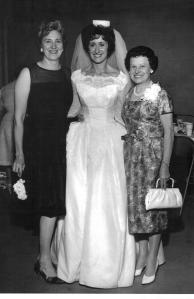
l to r: Monty (Monica) Yanor, Georgeann (Carver) Madison, Josephine (Yanor) Stankavich, 1962.

l to r: Monty (Monica) Yanor, Georgeann (Carver) Madison, Josephine (Yanor) Stankavich, 1962.

The Skyrocket: Opened in 1945 by Kostie Welch (Wilcauskas), the Skyrocket started with dancing on Sunday nights to the music of The Rocket Trio, and later featured dancing every night except Monday and “really good” steak dinners, according to one ad. (Starting in 1953, Bill Cellini, Sr. had gigs playing piano at the Skyrocket with his uncle’s band.) After Kostie Welch, the Skyrocket was owned by Ules Rose, whose daughter Barb married Charlie Foster, Jr., the son of Charles, Sr. and Ann Mosteika Foster, the long-time music director and organist at St. Vincent dePaul’s Church.

Peter Welsh bought the SkyRocket in 1963 from Ules Rose. All seven Welsh children and their mother Barbara worked in the bar at one time or another, and its position next to the Illinois State Fairgrounds attracted a cast of characters few places in town would see. According to son Scott Welsh, “It was an interesting education for all of us. The stories of the SkyRocket are legend, including visits from the Hell’s Angels, dignitaries hanging out late night, and many ‘disagreements’ between patrons handled with flying fists. My dad Pete ran a tight ship and was respected by most for not putting up with a lot of problems.”

The SkyRocket served food until the late 1960s, then only during Fair week, when Barbara Welsh ran the kitchen. Thornton Oil purchased the land in the early 1990′s.

The Blue Danube: Founded in 1933 by the Yacubasky/Yates family next to their grocery on Keys Ave. The tavern was managed by Joseph Yates, as his brother William presumably spent the majority of his time in Republican politics. The Blue Danube had a kitchen, a dance floor that was “well sanded and waxed,” and an ample area for tables and booths–but its claim to fame was its “magic bar.” One State Journal-Register writer described it as “electrically charged in such a way that when specially-treated glasses are placed on it, they are illuminated in many colors. This gives the appearance of nothing short of magic, and has proven a very popular source of entertainment.”

The Blue Danube’s motto was, “where courtesy prevails,” and it featured festive New Year’s parties and Sunday dinners of either roast young duck, fried, milk-fed spring chicken, T-bone steak, frog legs, breaded veal cutlet, or roast loin of pork with many different sides, including “Chinese” celery salad and lime and grapefruit salad, plus a full spread of desserts—all for just 65 cents. Also on the menu were “fancy mixed drinks, the finest of wines, liquors and beer, good music and dancing.”

The Yates’ were involved in protracted dispute with the City’s liquor board for allegedly operating without a liquor license, hosting dancing without a permit and serving alcohol after hours. They sold their supper club in 1938. (Please see my blog post on the political rise of the Adams and Yates families).

Bozis’s Tavern: Owned by Tony and Mae Bozis, who lived next to the tavern on E. Mason in a small brick bungalow. Several Lithuanians lived around there, and across the street on the corner, Tony’s mother owned a grocery store. Sharon Darran recalls going to a celebration at the tavern after a funeral, and being served the hot Lithuanian spiced honey and whiskey drink viditos, and lots of Lithuanian food. Tony was also a plumber with his brother John, who lived in Riverton. At Bozis’s, beer was served in glass jelly jars. They had a couch in the bar and Tony would lay on it and take a nap while his wife Mae did the bartending.

Casper’s: Still standing– now “Dude’s Saloon.” Helen Klim, mother of owner Jim Casper, used to make the best chili. Klim’s shoe repair was just north on 11th Street from the tavern, which was at the corner of Peoria Rd. and 11th St.

Alby’s: Alby Stasukinas, a former coal miner, was born in Springfield, the son of Joseph Adam and Rose Anna Poskevicius Stasukinas. The tavern served a chicken lunch.
Mother’s Day Pilgrimage

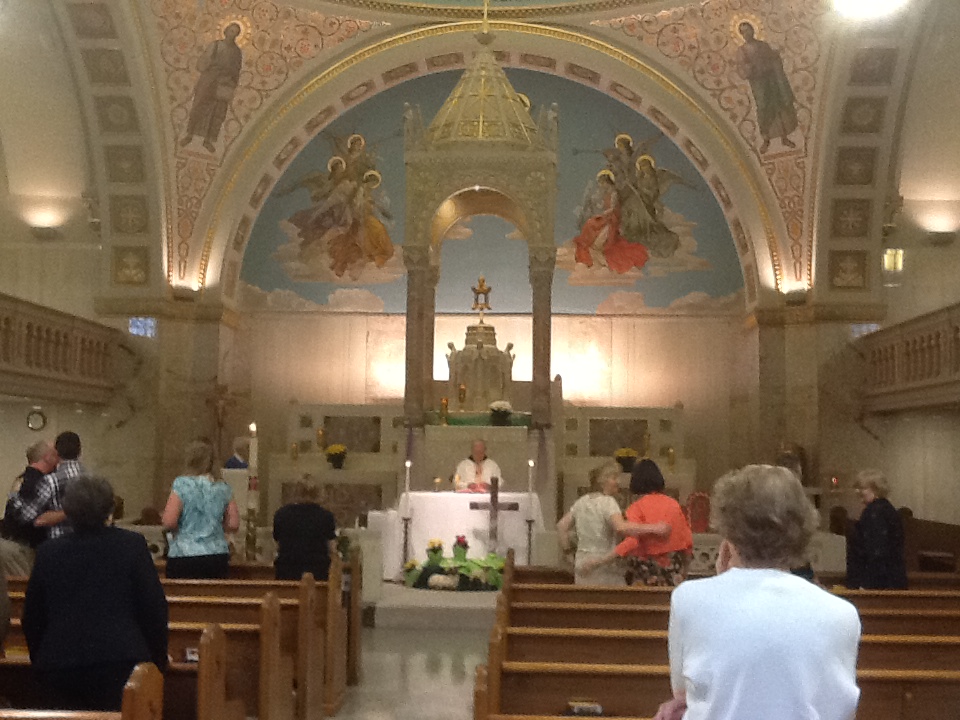
C. V. White memorial mass at Franciscan convent Adoration Chapel, Riverton

C. V. White memorial mass at Franciscan convent Adoration Chapel, Riverton

A Minnesota Lithuanian-American family with deep roots in Springfield returned this weekend to honor their mother and bury her ashes in Calvary Cemetery. John (Steve), Jim, Dave and Terri White, and their sisters Mary (White) Doberstein and Kathy (White) DeGrote, all traveled to Springfield to attend a memorial mass for their mom, Christina Virginia (Cooper) White Friday, May 9 at the St. Clare of Assisi Adoration Chapel at the St. Francis Convent near Riverton.

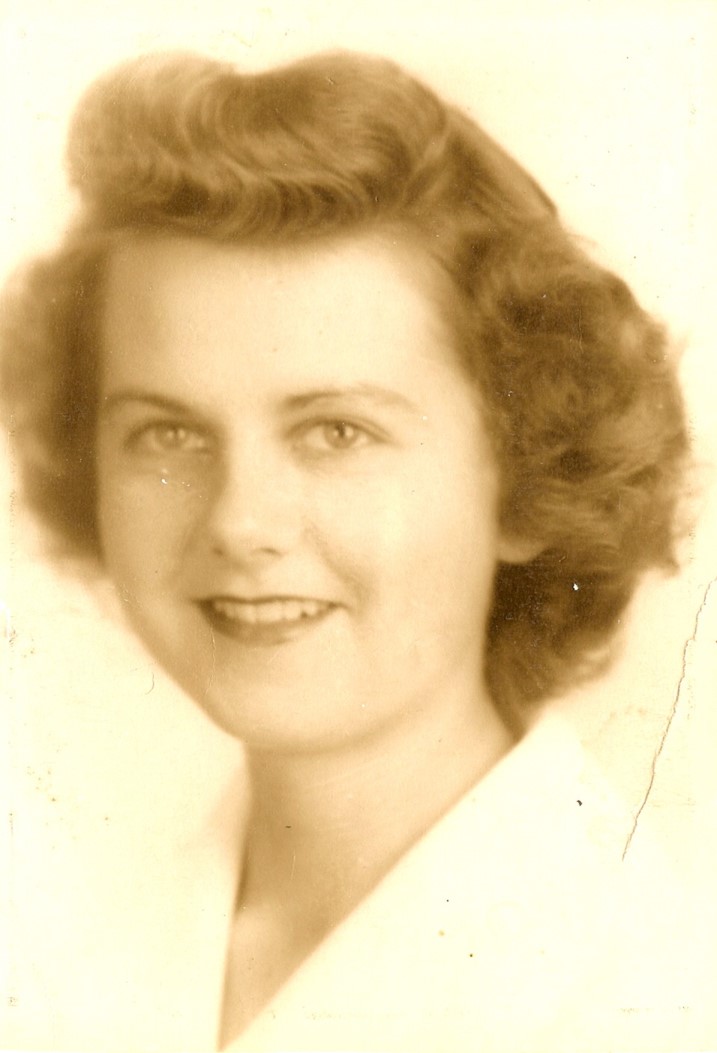
baby Catherine as an infant with her mother Anna Marie Stuches Gilletties, circa 1900.

baby Christina Virginia (“Ginny”)  with her mother Catherine (Gillette) Cooper, circa 1920.

Ginny (Cooper) White died in 2012 at age 92 in Anoka, Minnesota, where she had lived with her dentist husband for many years. Known to her Minnesota friends as “Chris,” she was born in 1919 in Springfield to Anthony and Catherine (Gillette) Cooper. Ginny’s mother Catherine had been born in Cantrall in 1898 to Lithuanian immigrants Joseph Gilletties and Anna Marie (Smylus) Stuches. As the story goes, Anna (Ona) Stuches was disinherited by her wealthy family near Kaunas when she fell in love with her future husband, Joseph Gilletties, the family’s carriage driver. Thus, she became one of the few Lithuanian women forced into immigration and the harsh coal-mining life not by the poverty of her birth, but by love.

Christina Virginia Cooper as flower girl at Kasawich-Alane wedding, 1927.

“Ginny” Cooper as flower girl at Kasawich-Alane wedding, 1927.

Anna and Joseph were married in Liverpool, England in 1892, and their first child was born that same year. They immigrated to the U.S. in 1893, first to Kansas City, then the Springfield area. The couple’s union produced an amazing eight daughters and four sons who lived to adulthood, in addition to three boys who died in infancy.

Catherine Gillette Cooper

Catherine Gillette Cooper

According to Anna’s great-granddaughters Terri, Kathy and Mary, their great-grandmother preserved a little of her high birth and refinement even as a struggling immigrant by making sure her 12 children had impeccable table manners and all played a musical instrument. In fact, the Stuches-Gillette children, including Catherine Cooper, comprised something of a family band who brought music and dancing to the family’s home on special occasions.

Christina Virginia Cooper (White)

“Ginny” Cooper (White)

Catherine Gillette married Anthony Cooper ( Lith. Antanas Pikcilingis), born in Sapiskis, Lithuania in 1886, who had immigrated to the U.S. in 1905. Anthony worked as a liquor distributor, and Catherine as a skilled floral designer (an echo of her mother’s patrician past?) for Winch and Heimbracher Floral Designs of Springfield, often traveling to Chicago for special projects. Among her local honors were decoration for former President Herbert Hoover’s train when it stopped in Springfield and pinning an orchid on the visiting First Lady Eleanor Roosevelt. According to an undated newspaper clipping, while with the S.Y. Bloom Flower Shop in Chicago, Mrs. Cooper developed the bridal wrist bouquet and decorated the Ambassador East Hotel room of President Dwight D. Eisenhower. Very active in leadership roles with St. Vincent de Paul Lithuanian Catholic Church and the Knights of Lithuania, including singing in famed KOL choir and operettas, the Coopers had one daughter, Christina Virginia (“Ginny”), who grew up on East Phillips Street and reportedly always was dressed to the nines due to her status as a cherished only child—and the extra income from her mother’s employment. (The Cooper-White children remember visiting their grandmother Catherine’s house on East Phillips.)
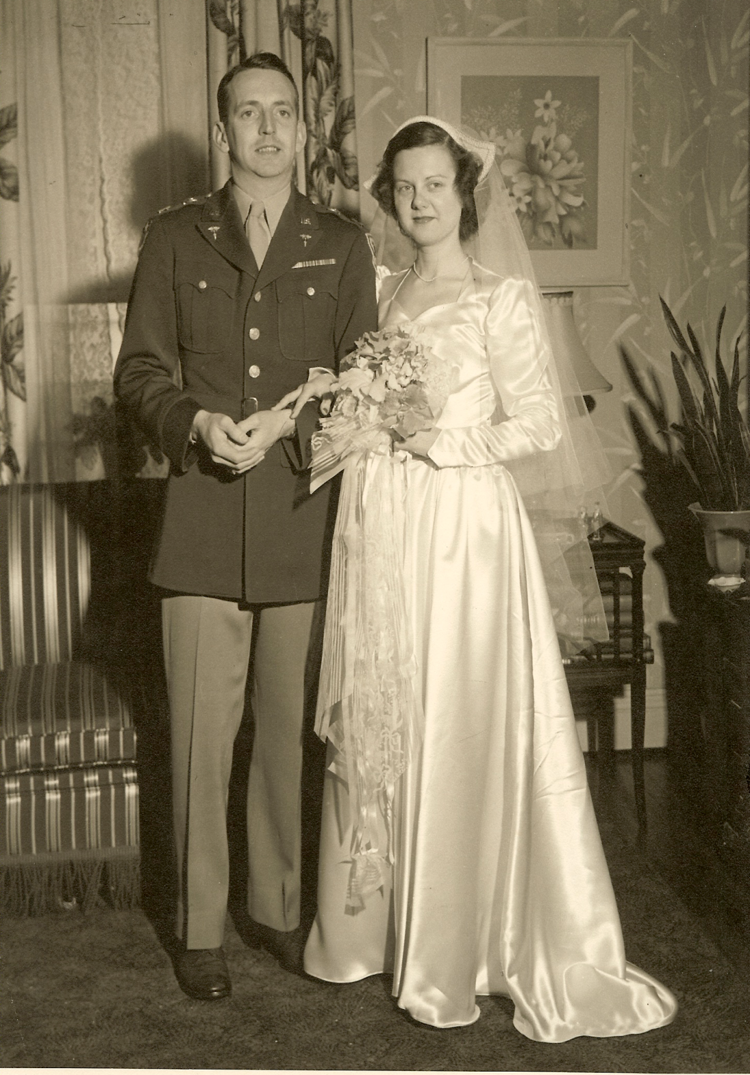
Christina Virginia Cooper and John White wedding, 1946

Ginny Cooper and John White wedding, 1946

Ginny attended St. Peter & Paul School, class of ’33, and was the first to receive a diploma in the first graduating class at Lanphier High School, class of ’37. She received a “full ride” college scholarship to St. Mary’s College (sister school to Notre Dame), but was unable to attend. Her mother was working in Chicago at the time, and asked Ginny to stay in Springfield to be near and take care of her father Anthony.

Later (1945), Ginny graduated from St. John’s College of Nursing in Springfield. She married John F. White D.D.S. in 1946 and raised seven children in Pipestone, St. Peter and Anoka, Minnesota. Since a four-year college degree was very important to her, after raising her children and ensuring their education, in 1981 Ginny finally realized her dream and earned a B.S. from the College of St. Francis.

She was past president of the Minnesota Southern District Women’s Dental Auxiliary, and her husband and son William preceded her in death.

Cooper-White family descendants and spouses Jim, Mary, Krista, John-Steve, Roberta, Kathy, Terri, Michael, and David at Calvary Cemetery with burial urn, May 9, 2014

Cooper-White family descendants and spouses Jim, Mary, Krista, John-Steve, Roberta, Kathy, Terri, Michael, and David at Calvary Cemetery with burial urn, May 9, 2014

I was touched by the Cooper-White children’s loving pilgrimage back to Springfield to bury their mother’s ashes, including the memories they shared with me during a luncheon at the Chesapeake Seafood House. What a special way to celebrate Mother’s Day, honoring their mother and their shared memories of her together as a family. How pleased she would have been to see her children all together in her old hometown.

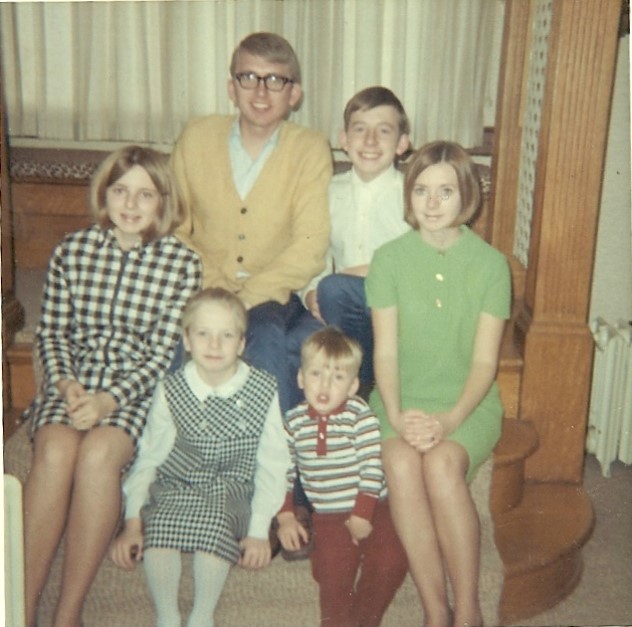
The Cooper-White children, circa 1968.

The Cooper-White children, circa 1968.

As a special note, the Anthony and Catherine Cooper grave, where their daughter Ginnie’s ashes were buried, is within 25 yards of stones bearing many other local Lithuanian family names: Bernotas, Kazokaitis, Yakst, Pazemetsky, Grigas, Gedman, Butkus, Bumpus, Usas, Jurkonis, Stankavich, and Klutnick.

Comedy Dance Man Joey Mack

Jo and Joey Mack,  1940s

I write a lot about coal miners on this blog, but perhaps the most famous Lithuanian-American in Springfield in the 1940s was in show business: Joey Yanaitis (Janaitis or Jonaitis) Mack. Famous in Boston, Rockford, Cleveland, Augusta, Ga., and dozens of places in between, from the late 1930s through the 1940s, Joey was the male half of the traveling married vaudeville dance team of Betty Jo (Yanda Connors) and Joey Mack (billed as Jo and Joey Mack).

Joey and his wife Betty Jo made a significant contribution to entertainment in Springfield back when civic groups routinely put on amateur dance programs with sketches and costumes based on vaudeville and the silver screen.

In 1945, as their USO and vaudeville careers were winding down, Betty Jo gave birth to the couple’s son, Jerry. The family settled in Betty Jo’s hometown, Springfield, and Jo and Joey opened the Mack Professional School of Dance, first in the old Kerasotes Building downtown–where the school of Betty Jo’s instructor, Mildred Caskey, was located—then at Spring St. and South Grand Ave.

Mary Judith Johnson (Kraus) and her professional dance partner and brother Tom, late 1950s.

Mary Judith Johnson (Kraus) and her professional dance partner and brother Tom, late 1950s.

I visited the Mack dance studio on South Grand Ave. with my mother in 1966, just two years before it closed in 1968. Mary Judith Kraus, my own wonderful dance instructor who taught me on scholarship for 7 years, was one of several Springfield-area dance teachers who first studied or taught at the Mack school, including Jan Regan Burghart of Jan’s Dance Studio in Chatham.

Adopted into the Mack Brothers

Joey’s obit from 1995 reports that he was born in 1909 in Amsterdam, NY of Lithuanian immigrant Anthony Yanaitis and Sally (Snow) Yanaitis. His early days are shrouded in mystery, though Joey reported in a 1981 news story that he was 13 in upstate New York when Bobby Mack and his son Harold “took him in and gave him their name.” It’s unclear exactly when, but Joey joined a comedy and acrobatic vaudeville act called The Mack Brothers, and proceeded to perform not just at New York City’s biggest live-entertainment theatres, the Paramount, Palace, Hippodrome and Capitol, but also in London, France, Italy and Germany.

Joey Mack in 1981 Peoria Journal-Star photo

Joey Mack in 1981 Peoria Journal-Star photo

His 1981 newspaper interview reports that in his heyday, Joey shared stage billings with Judy Garland, Jack Benny, Chico Marx, Bette Davis, Buster Keaton, and Johnny Weismuller, among other leading lights known mainly on the vaudeville stage, not from movies. Joey even reportedly appeared in a dance routine in a movie called “Three Sailors on a Holiday.”

http://news.google.com/newspapers?nid=2209&dat=19810520&id=PqkrAAAAIBAJ&sjid=IP0FAAAAIBAJ&pg=7054,4417268

Other clippings I found in my research hinted at a gig with Alvin Feig as part of a Cleveland, Ohio “song and dance team” that included a jazz band—and before that, a stint with Wesley Barry’s “movie and stage act.” The fact that Joey played the violin, sometimes on the floor of the Illinois Senate in his last stint as the Senate’s sergeant-at-arms, and that his obit states he was a long-time member of the American Federation of Musicians, seems to support the Cleveland connection.

A Boxing Connection

One of my most interesting finds was a clipping referring to an International Amateur Boxing Tournament at the Chicago Stadium in Rockford in 1929, where a Joey Mack of NY defeated Ray Trumblie in a four-round middleweight bout by judges’ decision. All of this points to a fluid career for a “hoofer” with both musical and athletic gifts, and maybe not much education, from the Roaring ‘20s through the Great Depression, when survival, itself, for the son of an impoverished immigrant, was an entrepreneurial–if not an acrobatic–exercise.

In the days when running away to the circus was a real phenomenon, it’s possible that Joey Yanaitis was already tumbling/playing music/boxing/acting by the age of 13, when he met the Macks.

Even a brief background in boxing would have given Joey something in common with his future wife, Betty Jo Yanda Connors, a professional dancer (“chorus girl”) he met when they were both traveling separately on the vaudeville circuit in 1939. Betty Jo was the step-granddaughter of famous Springfield featherweight fighter, boxing promoter and Empire Hotel and Theatre owner Johnny Connors of North Fifth Street. (The architecturally interesting Connors house in Enos Park is currently being rehabbed after a fire in 2013).

Betty Jo came from a line of dancers. Her maternal grandfather, Aidan Moses McCann, won several prizes in local dance contests. Betty Jo’s mother Jerry McCann (Yanda) Connors, born in 1899, was a bathing beauty who appeared in “Yankee Doodle in Berlin,” a 1919 comedy/World War I propaganda silent film produced by Mack Sennett. Jerry toured for three years promoting that film and others–one starring Gloria Swanson. So, it’s no surprise daughter Betty Jo had the stage bug.

Joey Mack and Betty Jo Connors also had something else in common. Joey’s mother, whose re-married last name was Punibajas (sp?), ended up living in Springfield, Betty Jo’s hometown (though I’m unsure if that was before or after Joey and Betty Jo married).

“Knockabout Funsters”

Billed as “novelty entertainers,” a “madcap dance team,” “comedy knockabout dancers,” and “knockabout funsters,” Jo and Joey combined Betty Jo’s refined dance skills–some of them acquired at the famous Martha Graham school in New York–with Joey’s vaudevillian comedy acrobatics and pantomime. In the typical live-theater vaudeville style, their touring act often followed a “warm-up” burlesque show–exotic ladies of all descriptions. After the burlesque was over, band and singing acts and other comedy and dance routines like Jo and Joey Mack’s closed out the evening.

One description of their act is that Betty Jo would dance and Joey would “fall down a lot.” Another clipping refers to Joey’s hilarious pantomime of a woman getting dressed in the morning. Joey considered his comic impressions and mannerisms a core component of his tradecraft. Unfortunately, none of us will ever see any of Jo and Joey’s storied routines. It’s more regrettable, still, that not a single glossy publicity photo of Joey or his wife survive in the Sangamon Valley Collection to grace this blog.

Jo & Joey Mack dance school program, Springfield High School, 1958.

Jo & Joey Mack dance school program, Springfield High School, 1958.

Mack Enterprises

At the peak of their Springfield careers in 1956, “Mack Enterprises” included Springfield, Taylorville, and Southern View dance studios, a dance accessory store and a costume manufacturing business, as well as a professional troupe of actors and dancers. While running their dance school, Betty Jo also worked as a women’s physical education instructor at Springfield College, Joey made and repaired violins and wrote comedy scripts for old show business friends, and the couple occasionally performed a traveling act that included their young son, Jerry. I can’t imagine juggling that much, but Jo and Joey were from a different time, and they were nothing if not “fleet of feet.”

Thanks to Chuck Tisckos of St. Charles, MO, for inspiring and helping with this post. To read more about Jo and Joey Mack in Springfield, some of their famous local students, and how dance-entertainment culture evolved here through the early TV age, please look for my next post.

Finding & Preserving Our Lithuanian Heritage

Bill Cellini, Jr. presents with PPT slides at the Club's annual meeting

Bill Cellini, Jr. presents with PPT slides at the Club’s annual meeting

About 40 people attended our Lithuanian-American Club annual meeting and potluck Saturday, April 26, followed by a genealogy presentation by Springfield native, documentary film-maker, historian and genealogist Bill Cellini, Jr. of Chicago. Bill spoke about ways to physically catalog and preserve family documents, and how to conduct public and church records research into European ancestors starting with little or no information.

Genealogy speaker Bill Cellini, Jr., who also scanned historic photos and documents of Lithuanian-American Club members

Genealogy speaker Bill Cellini, Jr. also scanned historic photos and documents of Lithuanian-American Club members

The Club demonstrated its appreciation to Bill by giving him a coffee-table book with photos of Lithuania, plus a DVD “tour” of Lithuania, as well as a DVD of the 1992 Olympic basketball documentary, “The Other Dream Team.” The Lithuanian and U.S. anthems were sung, and members enjoyed the best home-made buffet in town, including kugelis, suris, and a jello layered in the three colors of the Lithuanian flag.

l to r:  Helen Rackauskas and Rita (Lukitis) Marley

l to r: Helen Rackauskas and Rita (Lukitis) Marley