When the Mom and Pop was the Place to Shop

An Overview of Springfield’s Lithuanian-Owned Grocery Stores:
Part I

By William Cellini, Jr.
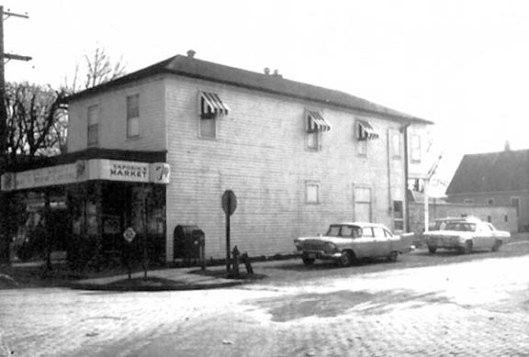
 1700 Sangamon 1967 recorder of deeds

1700 Sangamon Ave. market formerly owned by the Mankevich, Yucus, and Meiron families before it became Tapocik’s Market. Sangamon County Recorder of Deeds, 1967.

The enormous influx of immigrants into the United States in the years prior to WWI is often described as the Great Wave. While immigrants were lured to the U.S. by jobs in the labor trades, there was a cross-section who worked in food retailing, either opening their own stores or working for others.

In the Midwest, Southern and Eastern European immigrants dominated the grocery industry despite, in many cases, speaking little English and not even being eligible to vote. That’s because much of the grocery business back then was conducted at the neighborhood level, and grocers with family-owned stores spoke the language or languages of the immigrant neighborhoods where they were located.

Lithuanian-owned groceries, in particular, sprouted up along Sangamon Avenue and Peoria Road, south and east of the Illinois State Fairgrounds, in what was a “Little Lithuania” prior to WWII. However, neighborhoods throughout Springfield, Ill., before WWII, had segments of residents who spoke limited English and therefore, grocery stores owned and operated by immigrants often had an advantage in these areas over a native-born grocer.

By 1918, Springfield was estimated to have a population of 62,800. The city directory for that year revealed over 250 grocery stores operating all over town. A sizeable number of the owners had Southern and Eastern European surnames. At least 10 of the owners were of Lithuanian descent–Stasukinas, Yucabusky, Mankevich, Brioda and Casper among them.

In 1926, one Illinois State Journal ad listing dozens of grocery stores in Springfield mentions 26 likely owned and operated by Lithuanian-Americans. (Editor’s note: Since 1926 fell squarely within Prohibition, it’s likely that the number of Lithuanian groceries was boosted by what formerly had been taverns. Part two of this series will focus on several of these family-owned stores.)

Shopping in a Corner Grocery

Herman's Market 1331 E. Reynolds Undated. Sangamon Valley Collection

Herman’s Market, 1331 E. Reynolds, undated. Sangamon Valley Collecttion.

Before supermarkets and so-called “mega-stores” existed, shopping at your neighborhood grocery meant that the owner or clerks guided you around the merchandise (consisting of dry goods and other non-perishable items) while you told them what you needed to buy. Store workers pulled merchandise from shelves and bagged it behind the counter, so the only effort you exerted was paying at the register. Items were also staged behind the counter so at times, there was no need to walk around the store.

With the spread of home telephone service, grocery stores provided delivery to your residence for a small fee. Yet, all this personal assistance had downsides. Getting the attention of store clerks or the owner on a busy day meant your shopping time was needlessly lengthened. In addition, the family-run store, while easy to navigate, suffered from a lack of new and rotating selection.
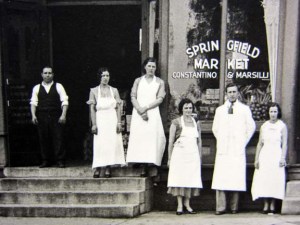
Springfield Market Constantino and Marsilli 711 E.Wash c. 1930 Sangamon Valley Collection

Springfield market (Constantino and Marsilli), 711 E. Washington St., circa 1930. Sangamon Valley Collection.

Until the mid-twentieth century in the United States, grocery shopping and store layout remained similar to the model utilized throughout the 1800s. Changes to neighborhood stores languished for several reasons. The proprietor’s family often lived above or behind the store, and to expand retail space was beyond what the family could afford. Equally significant, the lack of transport and refrigeration meant stores did not receive or have equipment to stock perishables. Furthermore, produce was seldom offered in a grocery store because pushcart vendors frequented neighborhoods, delivering fresh fruit and vegetables directly to homes.

(Editor’s note: And, as you can read elsewhere on this blog site, many impoverished immigrants leveraged their backgrounds as former agricultural workers to run small farms in their own backyards for fresh and canned produce and even meat.)

Store size restricted what could be purchased. Even larger chain stores of the early-1920s offered as few as 300 items. And, even when a family-run grocery was large enough to stock multiple deli products, customers paid for each item at its respective counter versus paying for everything at one checkout station.

Grocery Chains and ‘Self-Help’ Shopping

The 1920s ushered in a bull market on the stock exchange as the U.S. and Europe recovered from the Great War. In Springfield, post-WWI prosperity saw a real estate boom that resulted in the development of new neighborhoods that created opportunity for new grocery businesses. Across the U.S., people changed the way they went shopping, and that change was steered in large part by a business plan that transformed grocery store logistics, at least for many chains.

The plan was coined “self-help” It eliminated in-store credit**, brought merchandise standardization and allowed customers to examine and choose the items they wanted without pressure from store clerks. Tennessee-based Piggly Wiggly is credited with launching the self-help model in the U.S.
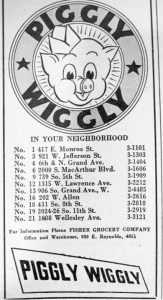
Piggly Wiggly Advert Springfield, IL Illinois Bell Telephone Book,1950

Piggly Wiggly ad for Springfield, 1950. Illinois Bell Telephone Book.

At its height in 1932, the Piggly Wiggly chain had 2,660 stores across the United States, including 23 in Springfield under the franchise of partners Leon Fisher, a local grocer, and Albert Eisner, Jr., a grocer from Champaign, Illinois. After Fisher’s death, Eisner took over the partnership and opened his own stores. (Editor’s note: In the 1930s, there was a Piggly Wiggly on Peoria Road at 11th Street in “Little Lithuania,” amid multiple family-owned  groceries.)

The self-help shopping model was appealing to some women in the post-war era. According to one Piggly Wiggly operator in 1929, “A woman does not like to run a gauntlet of clerks looking over her when she enters a store. This is sometimes the case in stores where the clerks are not busy and loll over the customer…”

Another self-help grocery to aggressively expand in the 1920s was the Kroger Grocery and Baking Company. That chain’s roots go back to 1876, when Bernard Kroger took a job selling coffee and tea door-to-door for The Great Northern and Pacific Tea Company in his hometown of Cincinnati. Following the financial Panic of 1893, Kroger purchased numerous grocery stores that had fallen onto hard times.

By the end of the crisis in 1897, he owned 17 locations in Ohio. Kroger bought in bulk and sold staples, like in-store baked bread, at better prices than competitors–while offering enhancements like in-store butcher service. By the 1930s, the company was consolidating the industry, buying-out smaller groceries, including over 100 Piggly Wiggly stores in Illinois.
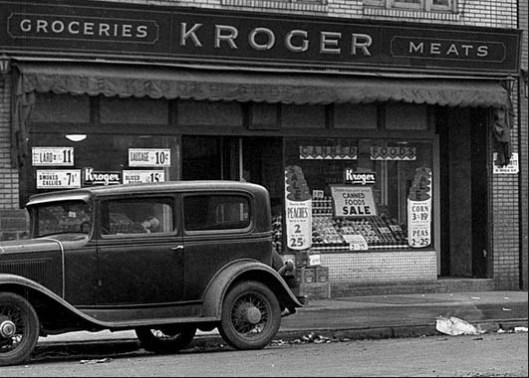
Kroger Market on Brookline Boulevard in 1933. by www.brooklineconnection.com Pittsburgh

Kroger store in Pittsburgh, Penn., 1933. http://www.brooklineconnection.com.

Springfield was home to Kroger chain stores from the mid-1920s until the 1980s, when its locations were bought-out by the National Supermarket chain. Today, the Kroger name lives on as the largest supermarket entity in the United States with over 2,500 locations in 34 states.

Economies of Scale

The aim of Piggly Wiggly was to cut labor costs when it first allowed customers to select their own groceries and take them to a cashier. However, the main competitive challenge that chains began to present to independent, family-owned groceries came from the economies of scale these chains benefited from on both the buy and sell sides of their business.

Grocery store chains bought enormous lots of goods and sold them in equal volume as quickly as possible through as many stores as possible. As major customers for processors and suppliers, they were able to demand supply-side discounts that translated into tremendous per-unit retail discounting. Due to their much higher volumes, chains reaped superior profits while offering steeper discounts over independent grocers. Profits could be ploughed back into growth, resulting in even greater market power.

With their size and resources, chains eventually became vertically integrated on the supply side, as A&P did when it took its processing in-house to bypass the middleman. The impact was made clear in a 1929 Chicago grocery analysis that found that self-service grocery chains had significantly lower prices on nationally branded items–underselling independent stores by an average of 8.82 percent to 11.54 percent.

Private-Label Brands, Advertising and the A&P

Prior to WWII, the foremost leader of chain grocery stores in the United States was A&P (Great Atlantic & Pacific Tea Company). A&P is credited with being the first grocery to build chain stores across the United States. Founded by George Gillman of New York, it was expanded in 1870 by George Hartford of New Jersey using a business model that called for no price cuts and no sales—but instead, narrow markups on certain items week after week.

Like the Kroger stores, A&P offered private-label foods such as their freshly ground Eight O’Clock Coffee and Our Own Tea to attract shoppers. By the early 1930s, A&P controlled one-sixth of the U.S. coffee market, and the chain’s business model paid off in 1930 when it became the first retailer to sell $1 billion in merchandise in a single year. By 1950, Time magazine boasted, “Of every dollar the U.S. spends on food, about 10¢ is passed over A&P counters… A&P sells more goods than any other company in the world.”

A&P 1929 Ladies Home Journal ad

A&P ad, Ladies Home Journal magazine, 1929. Flickr.com.

From the 1920s until the 1980s, Springfield had several A&P stores in various locations around town. The grocery chain self-help model coincided with targeted advertising campaigns for women promising low prices and customer independence. A&P’s advertising in the late 1920s (above) emphasized the woman’s role in the family and equated frequenting A&P with homemaker empowerment.

From Neighborhood Store to Supermarket

WWII brought a widespread slowdown in real estate development across the U.S., as manufacturers converted peace-time work to war production. This decelerated new grocery store development.

However, in the decade immediately following World War II, the chain grocery industry experienced rapid growth in the types of stores developed, as well the types of non-food items (mainly health and beauty products) offered in them. The Kroger Co. (its official name after 1946) was at the forefront of this trend with most of its stores featuring a full health and beauty product line by the end of the 1940s.

The average size of a chain grocery increased from 5,000 to 8,000 square feet at war’s end to 20,000 to 30,000 square feet in the early 1960s. This reflected a new business model whereby store count fell as stand-alone groceries were replaced with supermarkets. With the rise of the automobile and suburban development, larger stores with multiple product lines had increased market power from increased volume and were stronger magnets for the new consumers able to drive across town for sales and bargains.

Store consolidation by the national chains came to an end in the mid-1960s, when conversion to the supermarket model was essentially complete and newly formed corporate grocery entities began acquiring mid-sized regional chains. Throughout the nation, as well as in Springfield, the family-run neighborhood grocery lost profitability and appeal as its customer base sought the wider range of merchandise and discounts offered by supermarkets and commercial strips well outside the old neighborhood.

** Store credit, called being “on the book,” arose from the seasonal unemployment of coal miners and was a feature of the corner grocery business across Springfield through the 1932-36 Mine Wars strike and beyond.

Works Consulted

A.C. Jones, “An Analysis of Piggly Wiggly Progress” qtd. in Belasco, W. J., & Scranton, P. (2001). Food nations: Selling taste in consumer societies. New York: Routledge.

Abstract of financial statistics of cities having a population of over 30,000, 1918. (1919). Washington: Government printing office.

Andrews, D. (2015). Shopping: Material culture perspectives. Lanham, MD: University of Delaware Press.

Belasco, W. J., & Scranton, P. (2001). Food nations: Selling taste in consumer societies. New York: Routledge.

Gordon, R.J. (2016). The Rise and Fall of American Growth: the US Standard of Living Since the Civil War. Princeton Univ.

Kleniewski, N. (1997). Cities, change, and conflict: A political economy of urban life. Belmont, CA: Wadsworth Pub. Co., P. 251.

Laycock, G. (1983). The Kroger story: A century of innovation. Cincinnati, Ohio: Kroger Co.

Levinson, M. (2011). The great A & P and the struggle for small business in America. New York: Hill and Wang.

Mao, V. (2010, August). Clarence Saunders Had Self-Service In Store With His Piggly Wiggly Supermarkets, Investor’s Business Daily.

Meyers, H. M., & Gerstman, R. (2005). The visionary package: Using packaging to build effective brands. Houndmills, Basingstoke, Hampshire: Palgrave Macmillan.

Myers, D. (2007). Immigrants and boomers: Forging a new social contract for the future of America. New York: Russell Sage Foundation.

Piggly Wiggly Opens Here In Springfield Today at 10:00 A.M. (1918, November 22). Illinois State Journal. P. 2.

Pleasant Valley Shopping (2008, December 4.) The Postwar Kroger [Web log post]. Retrieved January 15, 2016, from: http://pleasantfamilyshopping.blogspot.com/2008/12/postwar-kroger.html

Pleasant Valley Shopping (2008, November 11.) Barney Kroger-The Cincinnati Kid [Web log post]. Retrieved January 10, 2016, from: http://pleasantfamilyshopping.blogspot.com/2008/11/barney-kroger-cincinnati-kid.html

R.L. Polk & Co. (1917). Springfield city directory. Springfield, IL: Ralph Lane Polk & Co.

Retail Trade: Red Circle and Gold Leaf. (1950). Time, Vol. 56, (20), pp. 89.

Rushton, B.: Grocery stores galore: supermarkets flood Springfield (2013, November). Illinois Times. Retrieved January 19, 2016 from: illinoistimes.com/article-permalink-13145.html

Schumpeter: The Piggly Wiggly Way. (2015, May). The Economist. Retrieved January 10, 2016 from: http://www.economist.com/news/business/21650554-businesses-should-think-carefully-about-continuing-heap-work-their-customers-piggly

Shimogawa, D.: Nation’s largest supermarket chain Kroger registers another Hawaii prescription facility. (2015, March). Pacific Business News. Retrieved January 10, 2016 from: http://www.bizjournals.com/pacific/blog/2015/03/nations-largest-supermarket-chain-registers.html


Illinois County Fair Queen?

Megan Urbas, Sangamon County Fair Queen

Megan Urbas, Miss Sangamon County Fair Queen 2015, competed Sunday, January 17, to become Miss Illinois County Fair Queen 2016.

http://www.sj-r.com/article/20160116/NEWS/160119621/0/SEARCH

A 2015 graduate of Sacred-Heart Griffin High School in Springfield, Megan competed against 68 other young women around the state, according to a Jan. 16 article in the State Journal-Register.

Queen

Megan Urbas, center, reacts after being named Miss Sangamon County Fair Queen 2015 during the 57th Annual Sangamon County Fair Queen Pageant at the Sangamon County Fairgrounds, Wednesday, June 17, 2015, in New Berlin, Ill. Justin L. Fowler/The State Journal-Register

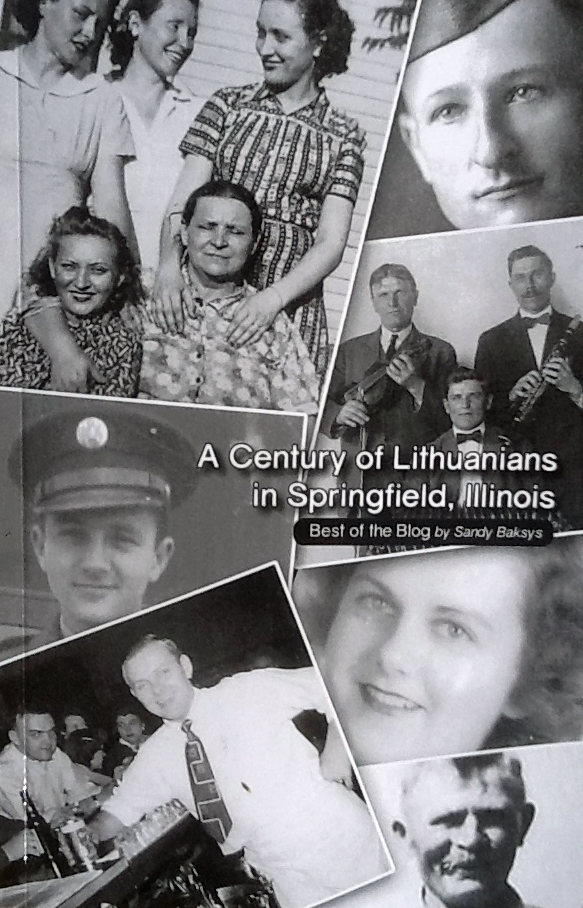
I’ve never met Megan or any of the Urbas family, but I’m thinking she could be a descendant, perhaps great-grandniece, of Lithuanian immigrant Alice (Urbas) Tisckos. Alice and John Tisckos had lawyer son Charlie, who owned Tisckos Furniture Store with his brother Martin, as noted in my book, “A Century of Lithuanians in Springfield, Illinois.”

If anyone knows how Megan’s Urbas family is related to the Alice Urbas family, please comment. (Since I wrote this, Chuck Tisckos contacted Megan and found out she is the great-granddaughter of Adolph Urbas, who was the son of Lithuanian immigrant Peter Urbas.  Peter was the brother of Alice (Urbas) Tisckos, mother of Tisckos Furniture-owning sons Martin and Charlie.)

On this cold winter night, let’s salute the beauty and personality of this  young Lithuanian-American of Springfield.

Update: We can still salute Megan, despite my belated find that another contestant won the 2016 County Fair Queen title. title. http://www.sj-r.com/apps/pbcs.dll/gallery?Site=LS&Date=20160118&Category=NEWS&ArtNo=118009999&Ref=PH&taxoid=


Queen

Megan Urbas takes her first walk as Miss Sangamon County Fair Queen 2015 during the 57thAnnual Sangamon County Fair Queen Pageant at the Sangamon County Fairgrounds, Wednesday, June 17, 2015, in New Berlin, Ill. Justin L. Fowler/The State Journal-Register


More Tavern Life: Alby’s Tavern Family

Alby's wedding

Wedding day, 1933, St. Vincent de Paul Church. Couple on the left: Alby Stasukinas and Vera Wisnoski (Vysnauskas); couple on the right: John Staken and Anna Stasukinas. Back row, from left: Albina Dombroski, George Stasukinas, unknown, Wally Kerchowski, Eva Casper, John Dombroski, Barbara Gent Beck (age 20), and Chick Michaels (who lost a leg in a mine accident in West Frankfort, Ill.)  Courtesy of Jerry Stasukinas.

Alby (Albinas) Stasukinas, son of Lithuanian immigrants Joseph and Rose (Poskevicius) Stasukinas, opened his storied tavern at 14th and Carpenter streets in 1944. After quitting coal mining in 1940 and working several years at the Illiopolis munitions plant, by 1944 Alby was a traveling boilermaker. So it was actually his wife Veronika (Vysnauskas or Wisnoski), who managed the new tavern for the first couple of years.

Alby and Vera’s middle son Jerry, the informant for this story, began working at his family’s tavern in 1946 when he was 10. Jerry says drinks were pretty simple at such neighborhood watering holes. “It was pretty much just draft beer and whiskey shots, and sometimes a simple drink like a coke or 7-Up with a shot of whiskey. I remember my father would say if you wanted a fancy mixed drink like a Manhattan, you’d better go drink uptown.”

Jerry also reports that tips were not required, or even accepted at Alby’s. “If anybody left change, my father would scotch tape it to the bar so it would be there when the customer came back. Dad always said the people he served didn’t have money for tips.”

Tavern hours were 8 a.m. till 1 a.m. daily, except Sundays, when bars could not open before 1 p.m. After writing about so many serious turn-of-the-century battles over Sunday drinking, I was pleasantly surprised to learn of this compromise. Early morning drinking was another matter.

Back when Springfield was a blue-collar mining and factory town, a bar couldn’t make it unless it met the demand for a shot or two before a hard or dangerous day’s work. “Dad always said if a customer came by early once and we weren’t open, he may come a second time, but not a third,” Jerry recalls.

Jerry also remembers his Dad’s strict observance of federal liquor labeling laws, and the prohibition against serving minors. Jerry says he had to go to other taverns to drink before he was 21. “Dad would never serve me when I was under-age. But I do remember he served some boys who were working at Pillsbury Mills while attending Lanphier (High School). His reasoning was, if they were doing a man’s work shoveling wheat, they deserved to be treated like men, and they got served.”

An Entrepreneurial Tradition

Alby’s father Joseph left the area of Vilnius, Lithuania, at age 21 to avoid conscription into the czar’s army, where Jerry says his grandfather reported that Lithuanians “were starved and treated as slave labor to Russian soldiers.” After arriving in the U.S. around 1900, Joseph mined coal. From 1932 onward, he was a member of the Progressive Miners of America along with many other Lithuanians, and worked the Progressive “Mine A” on West Washington Street until the mine closed in 1947 or ’48. He eventually died of black lung disease.

Stasukinas.immigrants

Joseph Adam and Rose Anna (Poskevicius) Stasukinas, 1934. Courtesy of Jerry Stasukinas.

But from their early years in Springfield, Joseph and his wife Rose set a thrifty and entrepreneurial example for their family. Up until 1919, they operated a grocery store, first at 19th and Moffatt. Later, they built a new house and a replacement store in the 1500 block of Moffatt.

Joseph was a thoughtful man who had been taught to read and write by a traveling peddler back in Lithuania. He read the Draugas Lithuanian daily newspaper from Chicago, as well as the local newspaper in English. He served as scribe to Lithuanians who couldn’t read and write. Good at math, and no doubt chronically underemployed in the mines, in addition to operating a store, Joseph also taught his sons and grandsons how to make a buck by building and fixing things on the side.

“My grandfather could fix anything,” Jerry recalls. While holding down their mining jobs, Joseph and his son Alby sold homes they built from re-purposed materials. “They would tear down an old house, salvage the lumber and use it to build a new house. They were very conservative.”

Eventually, Jerry says that his father and mother (Alby and Vera) in partnership built 14 new homes that they rented. “Mom and Dad were very good business people. They were hard workers all their lives; my grandparents were the same.”

Prior to its opening in 1944, immigrant Joseph helped son Alby renovate the basement and roof of the first Alby’s tavern, including two apartments upstairs that served as the family’s living quarters. In the 1960s, Joseph even helped his son build a new all-brick Alby’s tavern right across the street from the first. (See photo above of the new building, circa 1965, from the Sangamon County Recorder of Deeds.)

The new Alby’s featured 1950s-style indirect lighting, red and black floors, a wall of rough walnut lumber and the same red leather bar that had graced the original. (The original building was sold to Concordia Seminary, while the newer building became a motorcycle club after Alby’s son Albert closed the tavern in 1986.)

“Even when he was 65 years old, my grandfather built his aunt a new home. He worked almost right up until he passed away.”

Image

Vera and Alby, Anna and John celebrating their wedding anniversary. Courtesy of Jerry Stasukinas.

Bank of Grandma

Jerry remembers that his immigrant paternal grandma Rose held the purse strings of the family, managing its mining wages and business income. “My grandfather would always turn his mining paycheck over to her. And after my dad went down into the mines at 16, he also turned his paycheck over to his mother until he was 21.” As a youth, Jerry followed the same tradition, giving his grandma his earnings from finding, fixing, and selling old or broken-down bicycles and other items.

“The grandmother was the banker of the family back then,” he says. “For a long time, when they needed money, none of the Lithuanians went to the bank because it was seen as going outside the family.”

Losing Two Brothers in One Night

According to a State-Journal Register article dated March 29, 1919, Grandma Rose suffered a terrible loss when her two single, immigrant coal-mining brothers who boarded with her and husband Joseph were shot and killed while they were patronizing a “soft drink establishment.” The shooter was a Sicilian employee of Joe Yucas, owner of the drinking parlor at Eighth and Washington streets.

The fact that Yucas was dubbed “King of the Lithuanians” in one State Journal-Register article makes me suspect that more lay behind the double-murder of George and Joseph Poskevicius than a simple wrestling match that turned into a scuffle with Yucas, according to eyewitness testimony. The crime bears all the markings of an execution, perhaps resulting from a personal feud or business disagreement or competition over illegal alcohol or gambling.

The fact that Yucas was initially arrested, held, then bonded out for the crime only adds to my suspicions that perhaps police believed the murders were premeditated, and that employee Simanella, who ran the tavern because Yucas was legally prevented from doing so, was acting at the behest of his boss. Alternatively, it’s possible that Yucas set  his countrymen up for execution by Simanella.

Rose was quoted in one SJ-R story saying that her brothers drank a little but were good men who had never been in any trouble, and had never mentioned Simanella to her once in their whole lives. Unfortunately, they appear to have received no justice.

Newspaper accounts located by my faithful researcher Tom Mann report that Simanella successfully fled law enforcement for two years, not turning himself in until summer or fall 1921. After a story saying Simanella was released on bond in early 1922,  Tom also located an SJ-R story saying Simanella was tried and acquitted of the double-murder in 1923, despite testimony immediately after the killings by six eyewitnesses naming him as the shooter and never mentioning that he had been attacked or had any fear for his life. (One of the Poskevicius brothers was shot in the side of the head from close range, and the other in the back as he fled.)

Years later, Jerry reports that Tony Simanella, son of the trigger man, made a visit to his dying father, Alby, perhaps to explain or apologize for the murders. Whether or not the mystery of the murders was solved in that deathbed conversation remains a secret.

The loss of the two young Poskevicius brothers (George was 30 and Joseph was 31) coincided with the closing of Joseph and Rose’s  grocery store shortly afterwards in 1919. Perhaps the brothers had been needed to help work the store when they were not in the mines–or the store had provided them extra income that was no longer needed after their deaths. Maybe the brothers were shot over some kind of mafia threat involving the store, and contraband alcohol that was often sold by corner groceries back then. Or maybe Rose and Joseph were just too upset to go on alone in the business.

Alby's Tavern, 1963

The new Alby’s Tavern, 1960s. Sangamon Recorder of Deeds.

Selling to and Helping Alcoholics

Because of its location at 14th and Carpenter, Alby’s was the neighborhood tavern mainly to the nearby public housing development known as the John Hay Homes. “That was our neighborhood, where our business came from,” Jerry says. Unfortunately, he also remembers, “Our whole neighborhood was afflicted with alcoholism.” That meant a neighborhood tavern-keeper’s job did not end with selling alcohol. Jerry says his father also made it his job to “take in all the poor souls who were afflicted by liquor.

“My father had a charitable heart, and so he had a lot of alcoholics who were boarders of the tavern, whom he tried to ween off liquor as best he could. There was always somebody who was sleeping on a cot in our basement.

“Dad’s bedroom was on the first floor of the tavern, and that’s where our family also had our dining room. Many times, the guy Dad was trying to help ended up in our dining room, eating supper with us. My father even had them sleeping in his own bed recuperating, hallucinating. He also always had projects to give them work and let them make a dollar, so they could become men again. It was his whole life.”

Jerry continues: “None of them ever totally recovered, that I can remember. One guy ended up boarding at Romanowski’s (the Railroad Tavern on East Reynolds Street). He cut his own throat because of alcoholism.

“Another time Dad finally put a friend of his in the hospital. Back then, they would treat them with formaldehyde, make them so sick they would not want to drink, but many of them still would drink alcohol.”

Alby’s tavern family extended other forms of charity to the neighborhood. In addition to helping two families in the Hay Homes with hand-me-down clothes from their sons, Alby and Vera (who had married in 1932 at St. Vincent de Paul’s) also took in an orphaned boy of about Jerry’s age, who lived with the family from when he was 14 to 17. “My dad tutored him in the carpentry business, and later, he learned the plumbing trade from me. Dad treated him just like son.”

Image

From left: Jerry, Jr., Andy, Frannie, Jerry, and Sherrie Stasukinas, 1970s.

All in the Neighborhood

Jerry’s mother Vera was from the Wisnoski (Vysnauskas/Visnesky) clan, which had its own tragedy. Vera’s Lithuanian-born uncle John Wisnoski was crushed to death in a roof fall in 1928 in a mine located on Phillips Street. According to public records, Clements Wisnoski, Vera’s immigrant father (Jerry’s maternal grandfather), suffered a shattered leg in the same accident.

Like so many Springfieldians of his time, Jerry grew up on the neighborhood scale with extended family from both the Stasukinas and Wisnoski clans who lived close by and who cooperated on various projects. In the classic “tavern family” youth, he also grew up knowing Alby’s  cast of local characters and customers.

Also, when he studied at St. Peter & Paul Grade School, Jerry got to know some of the children of the second wave of Lithuanian immigrants  who arrived in Springfield after 1948. Born in Lithuania, these child “DPs” or displaced persons did not yet speak English. Jerry says, “Barbara Staken, me, and Augie Wisnosky–we were in the same class at St. Peter & Paul, and they would put the immigrant kids in our class because we could still speak some of the old language (Lithuanian).”

Parents Alby and Vera always encouraged education for their three sons, Albert, Jerry, and John.  However, though sharp of mind, Jerry suffered from dyslexia and found himself more attracted to business and the trades. After studying in the machine shop at St. James Trade School, he became a licensed plumbing journeyman, later joining the union.

Respect for Women

Jerry married his late wife Frances (Frannie) in 1957, and the two operated plumbing/heating company Springfield Mechanical for many years.Two of the company’s biggest contracts were the $2 million renovation of the piping system in the Hay Homes (which involved installing five miles of piping in occupied buildings) and the first phase of the HVAC and plumbing work for the campus of Lincoln Land Community College.

Along the way, Jerry also became a commercial real estate investor and developer, a line of business he continues today. The Lithuanian in him still lives through phrases of the language both he and his father were taught by immigrants Joseph and Rose.

Jerry has visited Lithuania and plans to do so again next summer with his own granddaughters, which leads me to my favorite strand of this story: how several generations of Stasukinas women were respected partners to their men in business as well as marriage and family life.

Image

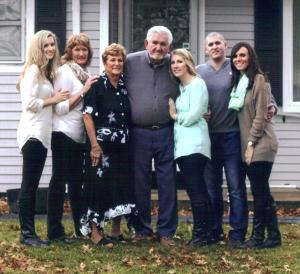
From left: Brittany, Sherrie, Frannie and Jerry, Katie, Justin and wife Crystal, circa 2015.

I like to think that three generations of husband-and-wife partnerships, including the “bank of grandma,” made this Lithuanian-American family, though it suffered its own share of tragedies and problems, more resilient and successful than many others. Today Jerry’s daughter Sherrie and his granddaughters Katie and Brittany continue in the long tradition of successful Stasukinas women. Jerry also has a grandson, Justin.

Flappers & Jail Breaks: The Ballad of ‘Hunkie John’

There used to be an “H” word for immigrants from Eastern Europe, a slang expression that could be funny and familiar–or offensive, depending on who was using it.

Back in the 1920s, local newspapers used the “H” word, “hunkie,” to describe young John Buskiewich (Lith. Buskievicius), who at age 23 went on trial for his life in the most sensational murder in years. The hot lights of page-one celebrity, including a following of rebellious teenage “flappers” with their short dresses and bobbed hair, may actually have made John feel important for the first time in his life. For them, he might have been an early James Dean anti-hero.

From “Hunkie John’s” wretched childhood in a dysfunctional immigrant family, one thing is clear: it was through public delinquency and crime that John first chose to make his mark on the world. Although I was initially repulsed by John’s violence, thanks to dozens of additional articles collected by genealogy researcher Tom Mann, I soon developed a more complex view of this young man, his life and times.

The Back Story

According to U.S. Census records, John seems to have been born in 1903 (or 1901) in Bureau County, Illinois, to John Joseph and Anna (Lawson) Buskiewich. Anna and John Joseph were born in Lithuania in the mid-1870s and early 1880s, respectively. They met and married in Shenandoah, Penn., coal country in 1897.

The couple seems to have lived and worked in Bureau, then Macoupin County before moving on to Springfield in the 1910s—by then with children Emily, Edith, and John in tow. We know about the family’s presence in Macoupin County from a record referring to Anna’s work as a midwife in the vicinity of Benld. Around 1910, she was accused of practicing midwifery without a license and brought to court, but none of her immigrant clients would testify against her, so the charges were dismissed.

Witness to Domestic Violence

The first record indicating that “Hunkie John” grew up in a violent home was his father’s arrest on Dec. 30, 1914 on a charge of assaulting and trying to kill his wife, John’s mother. A Jan. 3, 1915 article in the Illinois State Journal says that after the arrest, Anna quickly filed for divorce, accusing her husband of making threats on her life, knocking her against a cedar chest and choking her.

One can assume that it took more than a one-time outburst of violence to motivate an impoverished woman to seek divorce in that day and age. Anna’s bill of divorce also sought an injunction on her husband withdrawing several hundred dollars in savings from the couple’s bank account.

Not long afterwards, newspaper accounts also reveal young John’s first brush with the law. In September 1915, 14-year-old John Buskiewich of 802 N. Ninth St. was arrested with three other boys in the Capitol Theatre, 613 East Washington St., for “shooting pins shoved through a piece of cardboard at the ceiling, to see if they would stick.”

According to the Journal, the behavior was considered disruptive because “many of the pins did not stick and instead fell, endangering the heads of the audience.” The boys were taken to Springfield’s jail annex, but released after “being lectured” by the chief of police.

Mother Achieves, Loses Independence

In 1920, Anna completed the Burnham School to become a hairdresser. In 1921, the newspaper carried a professional notice also listing her as a registered midwife. Even more propitiously, the 1920 U.S. Census listed Anna as head of her own household at a separate, new address on North Ninth Street. (By this time, both of her daughters had married U.S.-born men and moved to Chicago.)

Yet despite Anna’s hard work and initiative, permanent financial and emotional independence were apparently beyond her reach. By 1924, she is back living with her husband and son John at 1505 North Eighth St. Meanwhile, John, Jr., seems to be taking his next step as a delinquent. On August 2, 1924, the newspaper reports that he has been picked up by police with two other men for attempting to rob a soft drink establishment on East Jefferson.

Mother Dies

Then on May 29, 1925, when Anna is 45 and her son John is 22, it is reported that she has committed suicide in the family home on North Eighth by drinking carbolic acid. Some of us have doubts about how Anna happened to drink poison almost in front her husband, who goes on to report his suspicious lack of concern to the newspaper. Due to his record of domestic violence, we wonder if John Joseph did not actually force the poison down his wife’s throat by some means. We also wonder why it was a neighboring Lithuanian grocer, Peter Burczik—not Anna’s husband–who belatedly summoned a physician.

All Hell Breaks Lose

A mere two months after his mother’s death, “Hunkie John” makes the headlines by being the first man arrested for the “highway robbery” of C.R. Owens by three men who forced Owens’ car off Peoria Road near the city limits. While one man waited in the getaway car, the other two, allegedly including Buskiewich, threatened the victim with hammers and wrenches to seize his gold watch and $12.96 in cash. Buskiewich is later released on bail.

A rash of armed robberies of local “road houses” in which young Buskiewich is implicated follow. And then, just four months after Anna Buskiewich’s death, in early November 1925, headlines scream of a roadhouse robbery that has resulted in a shooting death. “Hunkie John” is the first of several arrested for murdering Chicago furniture manufacturer Edmund J. Hansen during a hold-up at the Riley (or Reilly) chicken farm on the “St. Louis hardtop” (Chatham Road).

According to initial Journal reports, accomplices “Short- Arm Louie” Schomber and two out-of-town characters known as “Frenchy” (Frank Logan) and “Shorty” (Charlie Miller) are also under arrest warrant. Harold “Piney” Cline is later arrested as the getaway driver. (As the investigation and interrogations proceed, Lee Antie, John Jones, and John Parks, Jr., are also arrested for the hold-up at Reilly’s and/or other road houses in the area.)

A Crime of the Roaring Twenties?

Several details make newspaper coverage of the Reilly robbery/Hansen murder interesting. First, cars are fairly new, often referred to as “machines.” And the new mobility that cars provide creates a new vulnerability for isolated highway establishments, making them targets that can be struck suddenly or even spontaneously—with a quick getaway nearly assured. Leveraging the auto for highway hold-ups is at once a no-brainer and a genuine “Roaring Twenties” innovation in crime.

Of course, the new mobility provided by the auto also causes more and more remote highway establishments to spring up. But what, exactly, was a roadhouse? Often nothing more than a private farmhouse serving hungry travelers food and illegal Prohibition-era alcohol in the family dining room, as was the case with the Reilly establishment where Hansen was murdered.

In another “Roaring Twenties” twist, newspaper accounts of the Buskiewich trial refer to a courthouse packed largely with the “fairer sex.” And there’s something special about these girls, called “flappers:” perhaps the first liberated generation of young American women, post-suffrage, who have ditched stays and corsets, bobbed their hair and created their own codes of conduct, which include public smoking. According to the newspaper:

“The thrill seekers were there (at the trial) in greater numbers than they have been in months and months. Among them were many of the fairer sex—chiefly girls in their teens.

“The flappers were by far the most interested of all the spectators. They never lost a question or an answer. Nor were they at all slow in passing with each other their opinions of the importance of the testimony.”

Image

Could so much female attention have come from the fact that the only two men actually charged with the Hansen road house murder were so young (Parks, 19; Buskiewich, 23) and handsome? As he enters the courtroom, Buskiewich reportedly smiles and greets his supporters like a celebrity.

The charisma of youth and good looks is probably only enhanced by a failed attempt by the young men to escape from the city/county jail on Dec. 7, 1925, while awaiting trial. Their plot is foiled when one man in the roadhouse robbery gang, Lee Antie, is caught sawing an escape hatch in the jail’s roof. Although Antie claims to be acting alone, Buskiewich and Parks are considered part of the plot.

The First Trial

The prosecution of Parks and Buskiewich for the Hansen murder in March 1926 hinges on several key factors. First, gang members “Frenchy” and “Shorty” have yet to be caught. Second, getaway driver Cline turns state’s evidence and testifies against them, supposedly with no promise of immunity or reduced sentence (though several years later, he is notably on probation and not in jail). Several men who provided the guns for the hold-up also testify for the prosecution.

According to the state’s case, in the early hours of Oct. 30, 1925, Buskiewich and Parks entered the Reilly home by the front door and Parks fired a sawed-off shotgun blast into the floor to get control of the Reillys and their patrons. Two other masked men (presumably “Frenchy” and “Shorty”) entered through the kitchen at the rear. After Hansen was relieved of the $700 or $800 he had won at the Marion racetrack that day, Reilly suddenly attacked young Parks and knocked the shotgun out of his hands. Mrs. Reilly picked up the shotgun and tried to shoot Parks, unsuccessfully.

Meanwhile, roadhouse customer Hansen sprang into action to protect Reilly, picking up a chair and lunging at the man covering Parks from the entryway to the dining room. That man, the prosecution argues, was Buskiewich, who fell back from Hansen’s assault through swinging doors while firing one shot that went straight into Hansen’s heart, killing him in front of his wife.

During the police investigation, the newspaper reports, “a dozen (shiftless) youths are rounded up in visits to rooming houses, pool rooms and soft drink parlors.” (Soft drink parlors often served banned booze.) According to the Nov. 1, 1925 Journal, “Hunkie John” has long been regarded “as one of the most hard-boiled members of a gang of youthful police characters.” However, in other articles, “the midget Shorty” is described as the leader of the gang linked to a whole series of armed road house robberies starting several months before the fatal Chatham Road hold-up.

It doesn’t help Buskiewich that getaway driver Harold Cline also implicates him in previous hold-ups of local establishments owned by Tony Colcari and Alex Bucari and the August 1925 robbery of “Boots” Schaefer’s roadhouse 2.5 miles west of Springfield on “the Beardstown hard road.” In that robbery, masked men entered, “cowed 12 patrons with a fusillade of shots, and then escaped with approximately $3,000 is cash and jewelry.” All of the victims are too frightened to identify any of the bandits.

Yet despite being one of the “usual suspects,” was Buskiewich really guilty of the Hansen murder? Was he even at the scene?

The Second Trial

After the first Hansen murder trial ends with a hung jury in March 1926, a second trial is mounted only weeks later, in early April. The same testimony is presented, just to different jurors with more motivation to reach a verdict and to go home in time for Easter with their families.

As in the first trial, the crux of the defense is that neither Parks nor Buskiewich was with the gang that robbed the Reilly roadhouse the night of the murder. Family members, friends, and neighbors provide alibis placing Buskiewich first at the movies, then at home in bed. John’s immigrant father John Joseph testifies to his son’s return home after going to the movies, and two young women report to have seen him out and about at the movies.

Are Buskiewich and Parks convenient perps for police trying to clear the record on a whole string of unsolved road house robberies? It’s hard to know. Certainly Buskiewich had left a trail of prior criminal activity. But since the bandits were masked, neither the Reillies nor the Hansen widow can identify them. And, I can’t help wondering if “Shorty” and “Frenchy” hadn’t skipped town before they could be arrested, could they have been the two robbers identified and tried as the two masked men in the fatal dining room scuffle instead of Parks and Buskiewich?

As early as November 15, 1925, the Journal reports, “With the exception of the Wayside Inn robbery, practically all (local) hold-ups have been cleared, it is believed with the arrest of James Herbert (the gun supplier), Harold Cline, John Buskiewich and John Parks.” (They must have forgotten about “Frenchy” and “Shorty,” still on the loose, the reported planners of additional hold-ups in Pekin and Rockford that were to have occurred after the one at Reilly’s.)

Unfortunately for Parks and Buskiewich, the second trial concludes quickly with two convictions for murder. Parks gets 20 years, and Buskiewich, 30. Prosecutors’ retreat from the death penalty presumably expedites the all-male jury in reaching its verdict.

Jail Break

As Buskiewich is being transported from the courtroom to jail, the April 5, 1926 Journal reports, he declares that he would rather be hanged than spend 30 years in prison. “If it’s up to me, I’ll never serve a day in the penitentiary,” he quips.

Three days later, Buskiewich and Lee Antie (who previously was caught sawing through the jail’s roof), make a break for it during lunch while the doors to the east cell block are unlocked for meals to be brought in. They attack a burly guard with fists and a club made from a broom handle.

The guard overcomes Antie, but Buskiewich escapes. Before he does, he hits the button unlocking the cells on the entire east block before running out the back door right past the sheriff’s wife (the jail’s cook).

If trying to release everybody in his wing weren’t enough, Buskiewich seems only to add to his legend when he is spotted by police and caught only a few blocks from the jail because he has decided to go visit his girl on the way out of town.

Post-Script: It’s likely that whatever purpose or importance Buskiewich had found in crime ended abruptly at the grim Menard (Chester) Penitentiary. It was there that his co-defendant, young John Parks, is stabbed to death in 1932, despite his parents’ 1931 appeal to the governor for clemency.

Buskiewich appears to have been released by 1937, when he is recorded as living with his father again in Springfield. In 1940, the elder John Joseph dies, and the recently freed Buskiewich marries Martha Nickel. His 1969 obituary lists a widow, two daughters and six grandchildren, as well as service in World War II.

Unfortunately, there are also several newspaper reports from the 1940s and ’50s of drunk driving accidents involving John–and grand larceny auto by his daughter Nellie–that point to a certain trans-generational problem with alcohol and crime.  Edward L. Reilly, proprietor of the chicken dinner establishment on the Chatham blacktop was charged with bootlegging / violating national Prohibition in 1926, only about a year after the killing in his “road house.” 

From Lithuania to the Land of Lincoln

cover

This week I found out what it was like to be an author on a “mini book tour.” On Thursday, A Century of Lithuanians in Springfield, Illinois, was reviewed in the Illinois Times.  Click here to read the review: http://illinoistimes.com/article-16383-from-lithuania-to-the-land-of-lincoln.html

Then on Thursday night, thanks to a gracious invitation from my reviewer, writer and professor emeritus Jaqueline Jackson, I also participated with two other authors in a book presentation and signing event at First Presbyterian Church.

Two days earlier, on Tuesday, Nov. 10,  I gave a 40-minute luncheon presentation about the book to almost 60 people at the Sangamo Club, including Augie and Ann Wisnosky, Diane Urbanckas and Debbie (Urbanckas) Jemison, and Mike Lelys and his mother Helgi. Laimutis Nargelenas was also in attendance, along with Barb Dirksen, Trish Quintenz and Rip Yaskinski, Jerry Stasukinas, and Rick Dunham from our Lithuanian-American Club.

The Sangamo Club Literary Circle coordinator told me that ours was the biggest crowd in at least several years!

Illinois Times publisher Fletcher Farrar and Tara McAndrew, history writer for the Illinois State Journal-Register, also graciously attended my Sangamo Club event, along with writer Jaqui Jackson and local history activist Nancy Chapin.

125px-Flag_of_Lithuania.svg We  were also joined at the Sangamo Club by proud Lithuanian-Americans Judy Jozaitis, Lynn Freitag, Susan Eby, and Connie Klutnick.

All I can do is thank all who participated and everyone who is supporting my telling of the lost story of our Lithuanian-American families in Springfield and central Illinois. Please spread our history by spreading the word about my book, which can be purchased at Noonan’s Hardware on North Grand Ave. East, as well as on Amazon and in the CreateSpace E-store  https://www.createspace.com/5493567

One of the best parts of my “big book tour week” was not having to leave town. I am finding so much interest and support right here in Springfield, where the stories I have told matter the most, and probably always will. (However, I am also working to place a copy of the book in the collections of Vytautas Magnus University in Kaunas, and I have heard that other copies have been mailed to Lithuania, as well.)

Svekas, ir aciu labai!

Unbreakable Ties: Raised by Teresa and Tony Witkins

Teresa (Mullen) and Tony Witkins, circa 1940.

Teresa (Mullen) and Tony Witkins, circa 1940.

A year after her mother died, when she was just seven years old, Kathy Mason (Begando) went to live with her maternal aunt and uncle Teresa and Anthony Witkins (Lith. Waitkunas). Childless themselves, the couple took their little niece in with open arms, providing what Kathy calls her “stable home life” until she was 18 and old enough to strike out on her own.

Years later, Kathy returned the favor by taking care of her widowed Uncle Anthony Witkins until he died in 2002 in his early 90s. This is the kind of story that gets to the core of family: a love and loyalty that go beyond mere blood or accident of birth. Because of those unbreakable ties, Kathy recently approached me to tell the story of the aunt and uncle who loved and raised her like their own child.

Anthony (Tony) Witkins was born in 1910, one of four children of Vilnius, Lithuania immigrants Karal and Helen (Delunas) Waitkunas, who arrived first in Des Moines, Iowa, before moving to Springfield around 1908. As the story goes, Karal mined coal in Pawnee. Because he habitually stopped and drank at taverns and saloons all the way home (from work) to Springfield, wife Helen had to board single miners in the family’s small home to secure an income on which she and her children could depend.

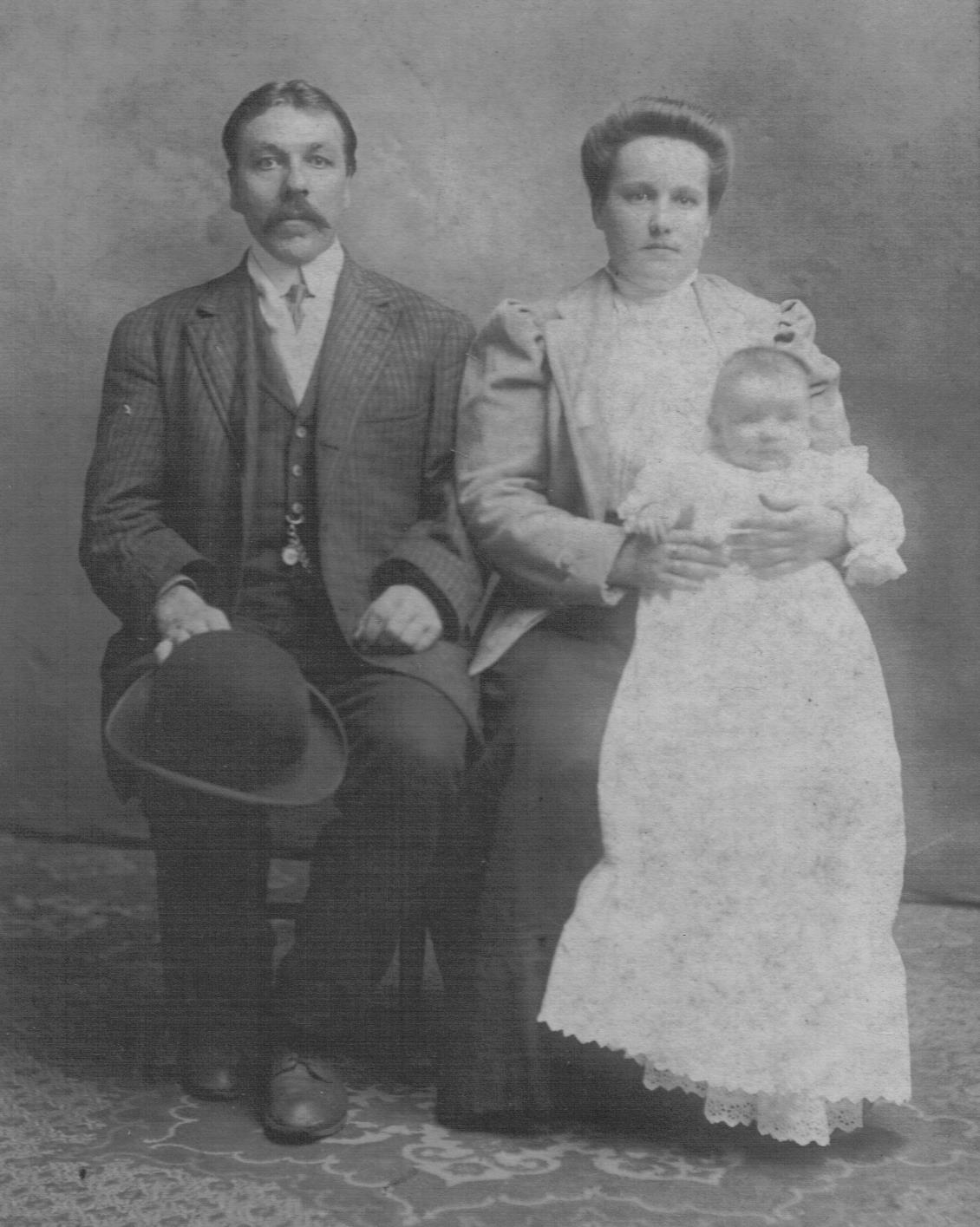
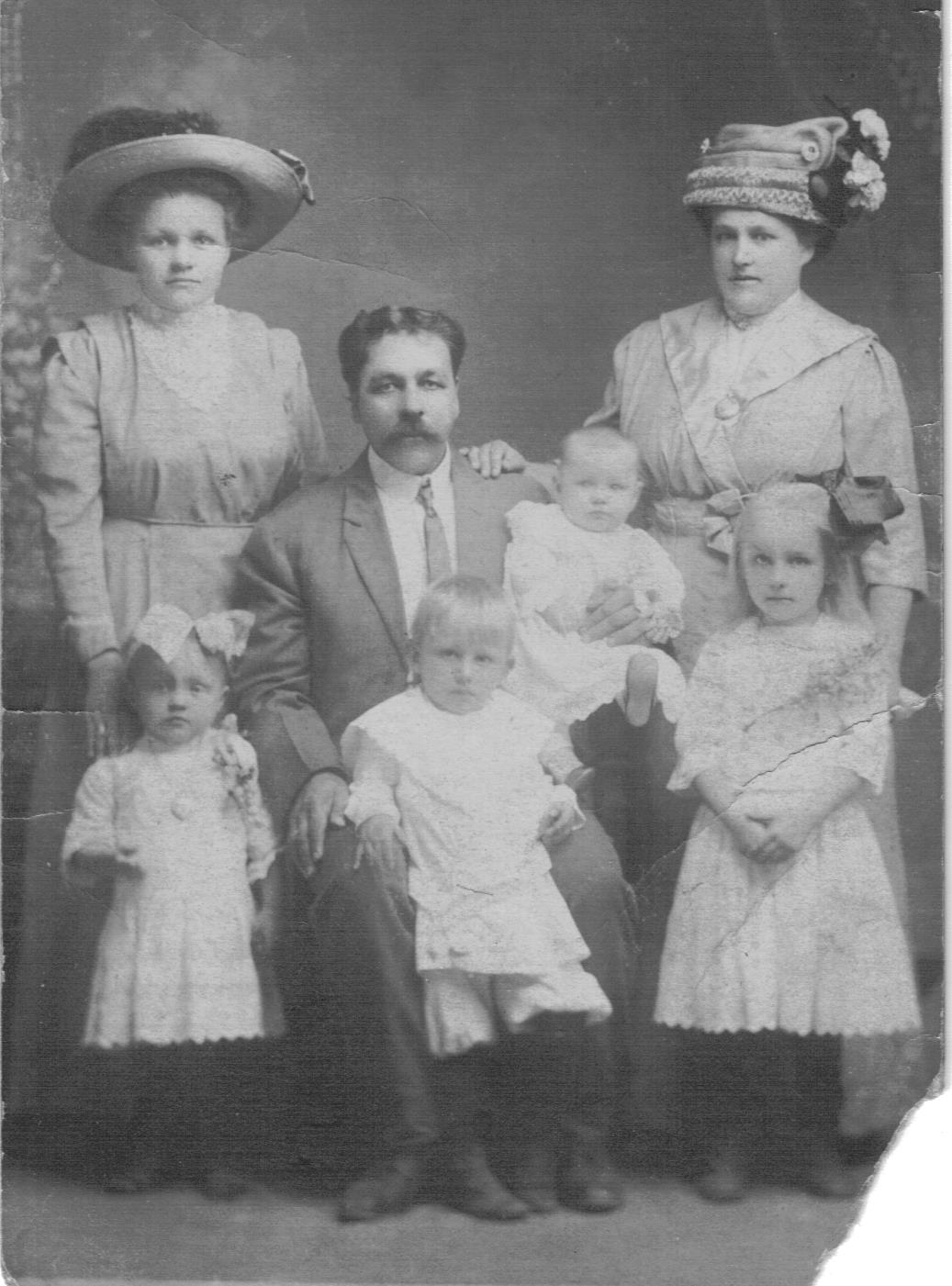
Karal and Helen (Delunas) Waitkunas with daughter Bernice, 1909.

Karal and Helen (Delunas) Waitkunas with daughter Bernice, 1909.

Losing Two Daughters to TB

Tony’s siblings were Bernice, born in 1909, Frances, born in 1914, and Veronica, born in 1919. I came across Veronica a few years ago in a photo of the officers of the women’s sodality at St. Vincent de Paul (Lithuanian) Catholic Church. Extremely thin and tall in that photo, Veronica looked close to the end of her road as a victim of tuberculosis. She died of TB at age 23 in 1942, compounding the tragedy of the death of her older sister Bernice from the same disease at age 21 in 1931. What terrible losses for their mother Helen, with whom son Tony remained close all his life.

Nor could Tony escape the emotional impact of watching two young sisters who should have been vigorous and healthy slowly succumb to disease. According to his niece Kathy, Tony seems to have responded by dedicating his entire life to physical and spiritual health. On the spiritual side, Kathy reports that Tony rose to pray in his chair every morning at 4:30 before going to work, and was a dedicated parishioner at St. Vincent’s.

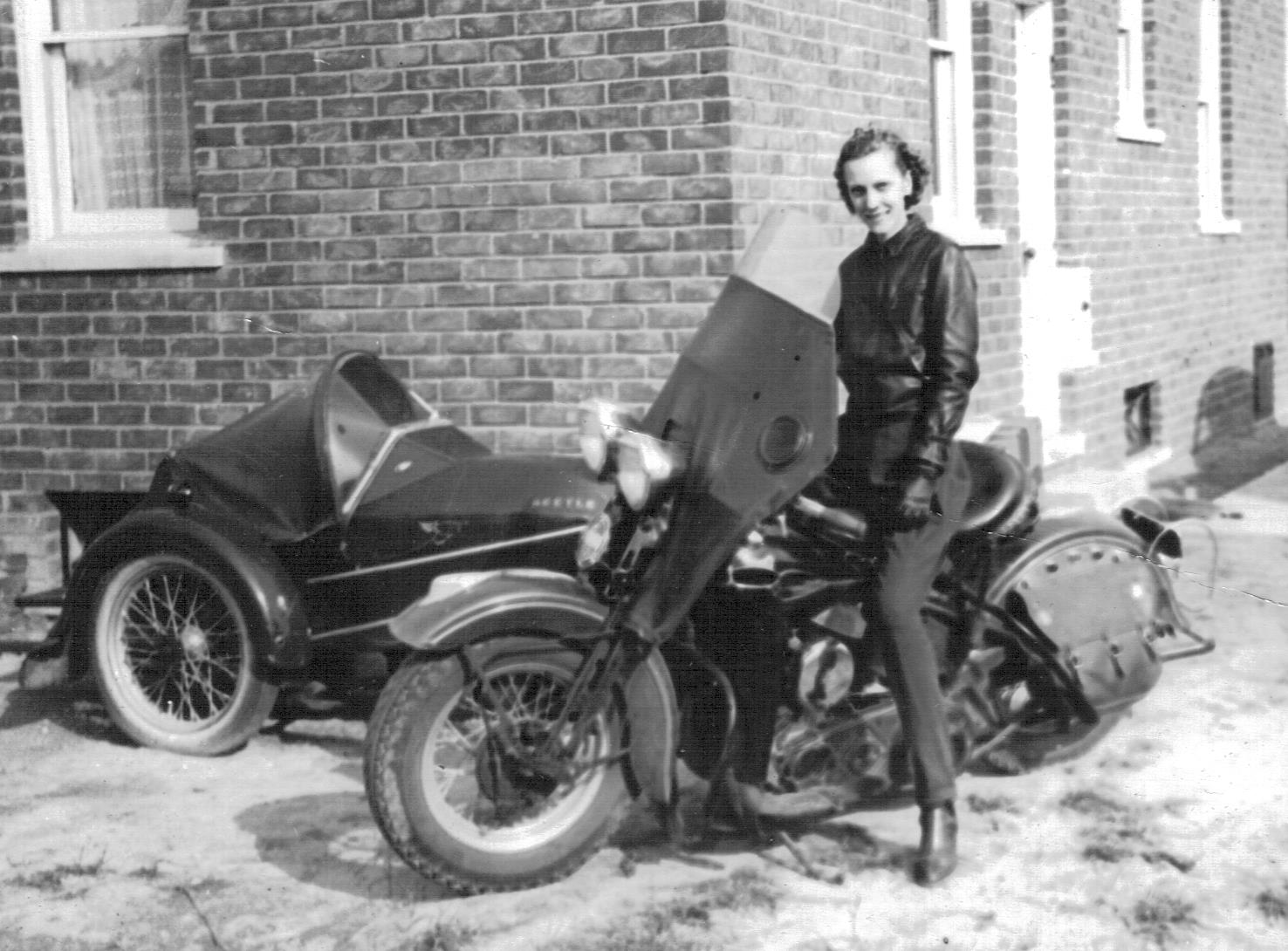
Veronica Witkins poses, perhaps with Tony's motorcycle. She died of TB at age 23 in 1942.

Veronica Witkins poses, perhaps with Tony’s motorcycle. She died of TB at age 23 in 1942.

Diver, Swimmer, Model-Maker

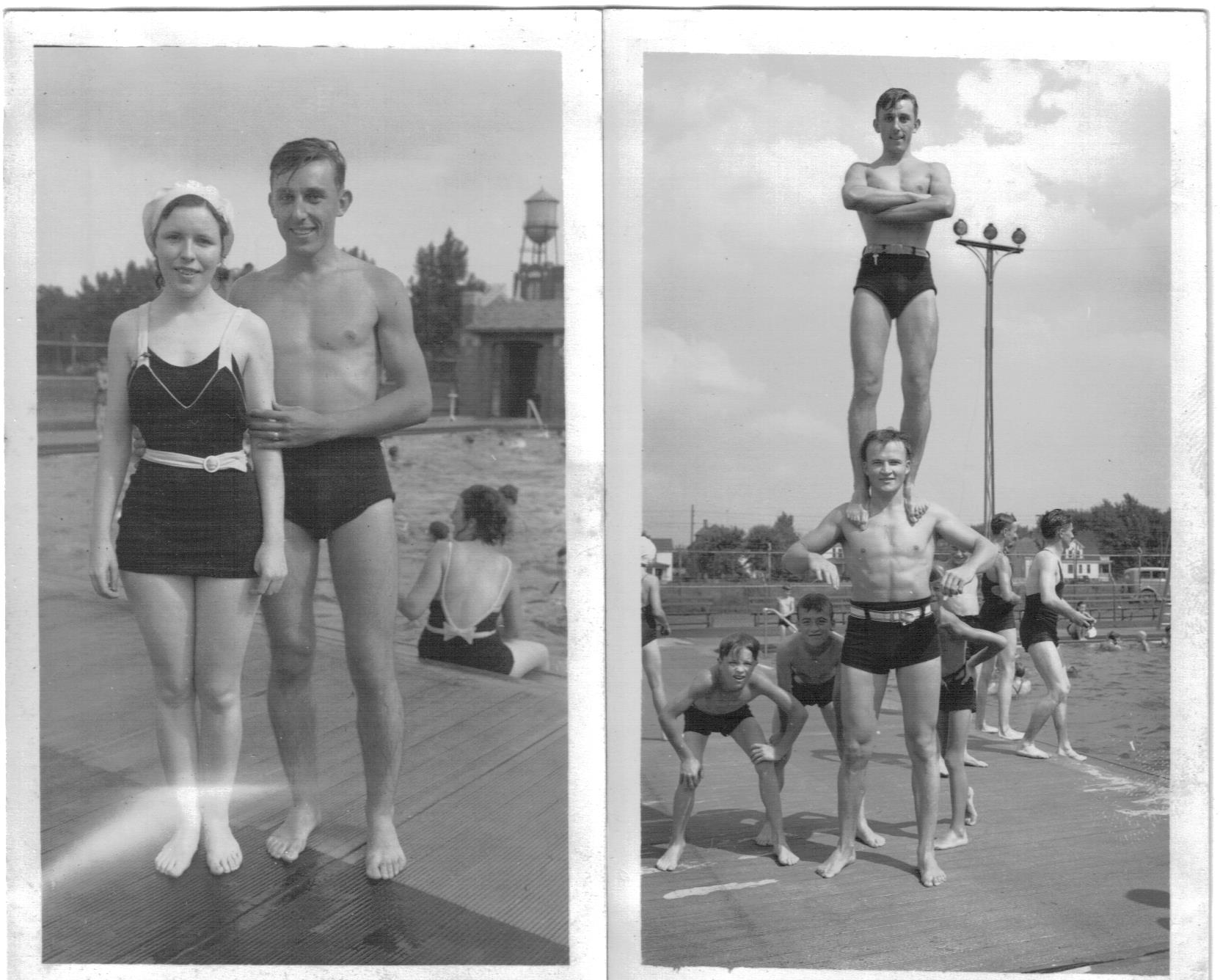
On the physical side, Kathy reports that Tony was a 75-year member of the YMCA and swam regularly for exercise and pleasure. When young, he was also a high-diver at  Memorial Pool near Converse and Ninth Street. Throughout his career as a skilled model-maker for electrical instruments, Tony swam laps for 1.5 miles three times a week after work, until about 6:30 p.m.

His factory career started when he was 18 and his mother packed him a suitcase and sent him to Chicago to work for Westinghouse. One day in Chicago, Tony was knocked off the side of a streetcar, hitting his head on the pavement, suffering through a coma, and finally, permanent hearing loss in his right ear. During those Chicago years, Kathy reports that Tony stayed in touch with his mother and his fiancée in Springfield by riding his prized motorcycle all 400 miles of the round trip.

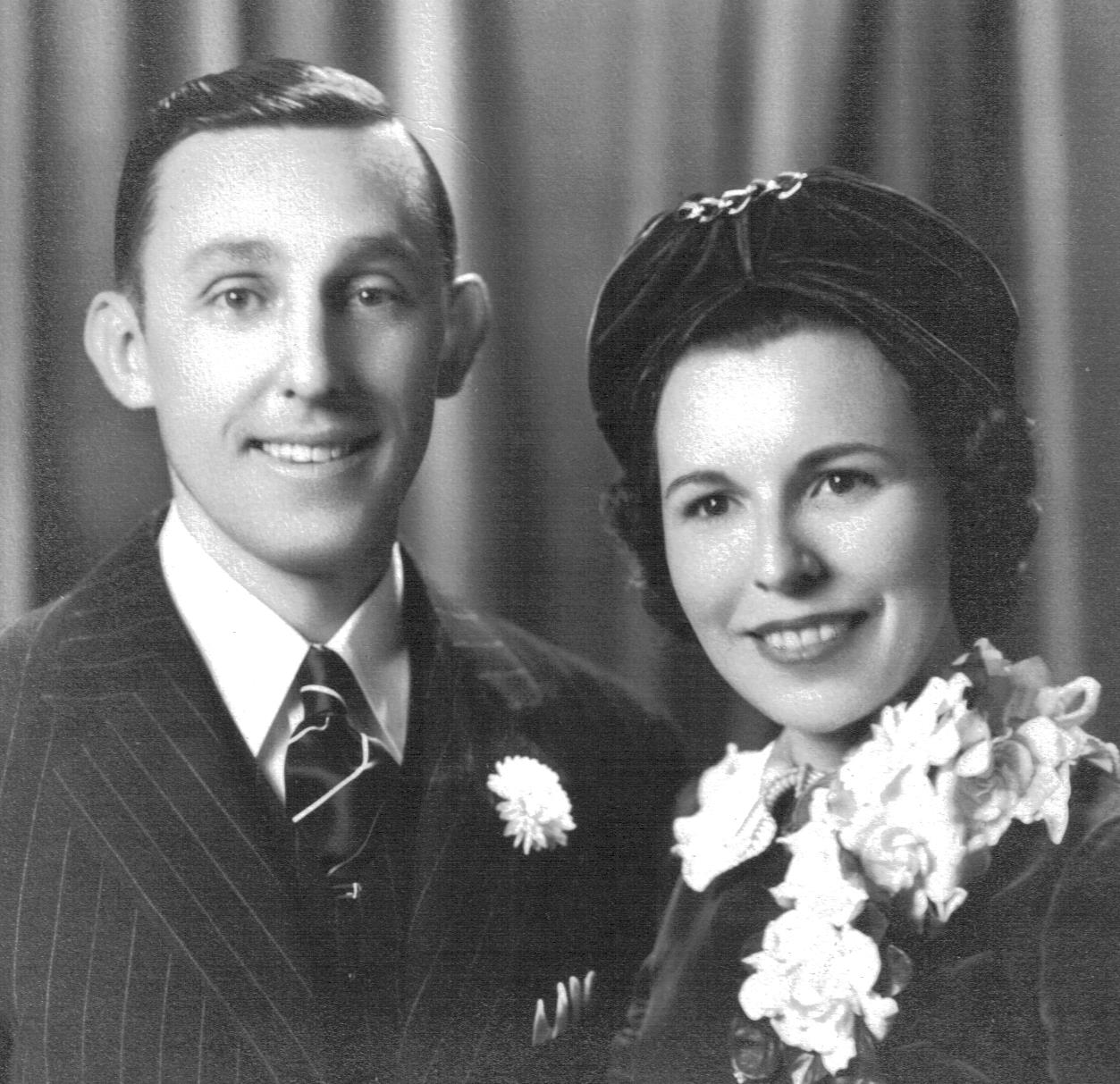
Later, he returned to Springfield to marry his long-time sweetheart, Kathy’s aunt Teresa Mullen, on Nov. 18, 1940, and work in a riding lawn mower manufacturing company called Heineke on East Jefferson. At the outbreak of World War II, when Heineke switched to war production, Tony’s boss considered him so valuable to the war effort that he secured him an exemption from the draft.

Memorial Pool or Muscle Beach? On left, young Teresa and Tony Witkins. On right, Tony atop strong man.

Memorial Pool or Muscle Beach? On left, young Teresa and Tony Witkins. On right, one strong man (Tony) atop another.

Later, Tony worked for the Electrotype Co. and the John W. Hobbs company at 11th and Ash streets, which was later bought by Honeywell and shuttered in 2010. For years, the 100,000-square-foot factory made controls, switches, lighting systems, battery meters, and indicators for the transportation industry. Tony was the skilled maker of prototypes or models for these products.

Tony had met his future wife Teresa when they were in seventh grade. The two were skilled ballroom dancers, and at one time were even offered jobs as dancers on a cruise ship. Sometime after Tony returned to Springfield from Chicago in the late 1930s, Tony built the couple a home in the 2000 block of North Seventh, even digging the basement by hand. Kathy says that’s because Tony wanted to make sure that he and Teresa had a home they could move into as soon as they were married, which was not the case for most couples as the Depression dragged on through the 1930s.

Helen and Karal Waitkunas, likely with children Bernice, Tony, Francis and Veronica, plus unknown woman.

Helen and Karal Waitkunas holding Veronica, with children (l to r) Frances, Tony, and Bernice–plus unknown woman, 1919.

Blessed with a Wonderful Home

On the home front, Kathy says “Tony liked to eat pickled pigs feet and head cheese, which I would never touch! Our meals were mostly braised, one-pot meals like pork loin, cabbage and potatoes, roast beef and potatoes, and baked chicken. My aunt did not cook anything exotic! In fact, she did not teach me to cook, even though I wanted to learn. She told me, if you can read, you can cook. End of story!”

Though Kathy’s young life started in turmoil with her mother’s death and father’s re-marriage, she says, “I was truly blessed by my wonderful aunt and uncle. If it hadn’t been for them, no telling what would have happened to me. I will always feel close to them and their story.”

Rocking My Book Launch!

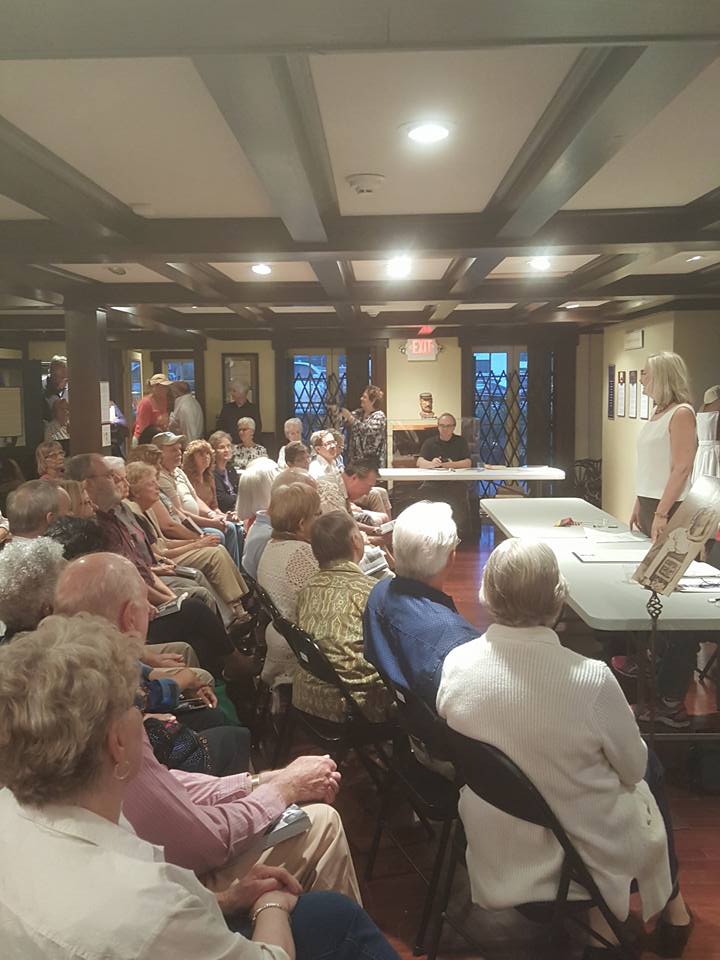
Speaking at the Elijah Iles House, Springfield, Sept. 23, 2015.

Speaking at the Elijah Iles House, Springfield, Sept. 23, 2015.

More than 60 people attended the first public presentation of my book, “A Century of Lithuanians in Springfield, Illinois”  last night. The room was so packed that Senator Dick Durbin’s wife Loretta had to sit out of sight, but hopefully, not out of earshot, on the stairs.

The event was held in the beautifully-appointed basement of the Elijah Iles House–the oldest surviving home in Springfield, where Abraham Lincoln once socialized and played cards.

The best thing about the evening was finally being with the Lithuanian-Americans for whom I had spent so many lonely hours writing the book–feeling their excitement and seeing how important it was to them. For 90 minutes, I was the sold-out author of a best-seller. Does it get any better than that?

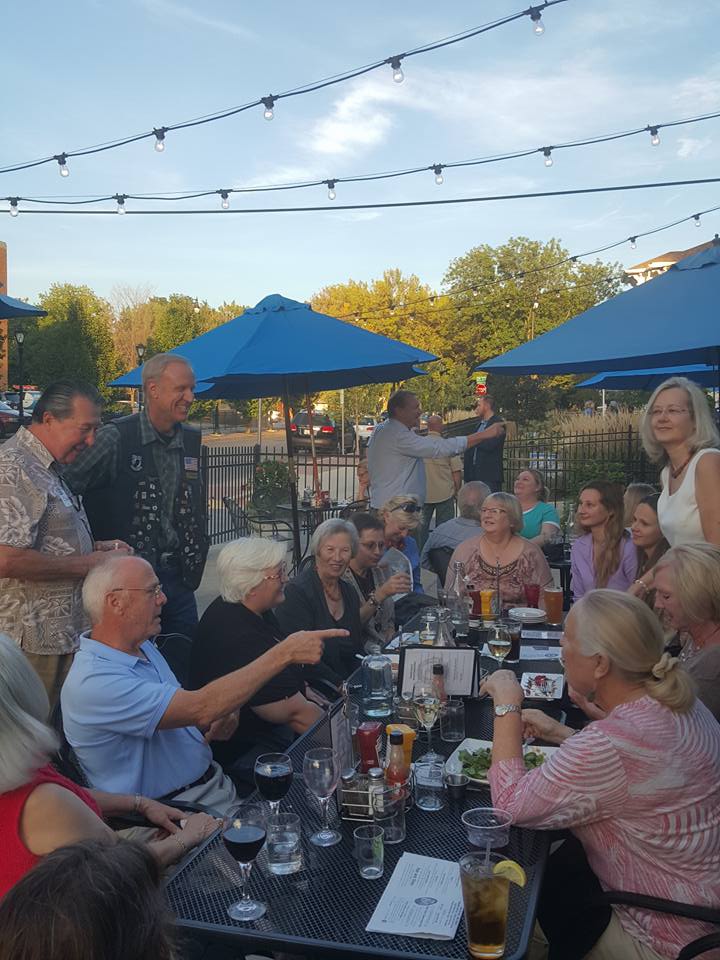
Gov. Bruce Rauner was invited to stop by our book “pre-party” at an outdoor restaurant downtown. In the photo below, I am standing (in white at right) to shout across the table to him about our Lithuanian-American group and our history in Springfield. He asked the name of my book and probably won’t find the title hard to remember.

book.preparty.Rauner.09.23.15

Some in our group posed for selfies. Others quietly gritted their teeth. Politics aside, it added to my evening to be able to have the unexpected opportunity to put Lithuania on the governor’s radar, even in such a small way.

Two sisters traveled all the way from St. Paul, Minnesota to be here for the launch: Terri White and Kathy White DeGrote–descendants of Springfield’s Lithuanian Gilletties-Cooper family. Other attendees at the book presentation were Bob Narmont, Connie Klutnick and her sister Sue Tin, Romualda Sidlauskas Capranica and her daughter Diane, Joan Naumovich, Kathy Begando, Pamela Shadis, Kristina Mucinskas, Pat Towner and Barb Devine, and Sandy and Claudio Pecori. Lithuanian-American Club officers Rick Dunham and Irena Sorrells, who took both of these photos, also shared in the occasion.

My dedicated volunteer book researcher Tom Mann attended with his wife Mary (Naumovich) Mann, and so did Melinda McDonald, the original inspiration for my blog and my most faithful supporter, brain trust, and idea bank through the entire life cycle of my book project. Couldn’t have done it without them!

Three members of the Kaylor clan from Riverton and Linda Mann Fleming of Taylorville also honored us with their presence.

Thank you so much, everyone who shared this very special evening. I woke up this morning with the afterglow of knowing that at least for Lithuanians Springfield, I have produced a book that is unique in all the world.

My Book Is Published

A Century of Lithuanians in Springfield, Illinois: Best of the Blog,” is finally available for $15.95 plus shipping on Amazon.com and at this link: https://www.createspace.com/5493567 .  However, I request that people in Springfield buy the book directly from me for $15 a copy to save shipping costs for themselves and boost my earnings per copy. Just contact me at:  sandybaksys@gmail.com

Brought to life by ceaseless toil–and a $1,725 professional page design sponsored by more than 30 donors–the book will soon be reviewed in Draugas News (monthly) and the Lithuanian language Draugas newspaper.

I will present the book publicly for the first time 7 p.m. Wednesday, Sept. 23, at the Elijah Iles House in downtown Springfield. It’s a free public event, but registration is requested at:  http://ileshouse.org/event-2035661

I am also scheduled to present the book to the Sangamo Club Literary Circle at a luncheon on Nov. 10 (cost is $22, R.S.V.P. to 544-1793).

A chapter from the book, “Who Put the Mack in McDonald’s, Springfield?” will appear in the September-October issue of Lithuanian Heritage magazine.

So many readers of this blog participated in the creation of the book in so many ways that if the final product receives anything like that same support, “A Century of Lithuanians in Springfield” will become a treasured keepsake of our individual families and our collective history for years to come. At least that is my hope. So, please don’t hesitate to introduce the book to members of your family or anyone whom you think would not come to it on their own.

With lots of images and topics broken down into brief chapters and even sub-chapters, the book is designed to be an easy read for those with limited interest who may want to skip around or not read the entire book. It’s also designed to be a good read start to finish.

Please join me in extending thanks to the generous donors who made the book’s professional page design possible:

Platinum
Ben & Grazina Zemaitis

Gold
William Cellini, Jr.
Kathleen Farney
Betty Gedman
Maria Race
John (Steve) White
Terri White
August Wisnosky, Jr.

Silver
Cindy Baksys

Terry Baksys and Bill Byrd
Regina Buedel
The Chepulis Family
Linda Gladu
Amy Green
The Lithuanian-American Club
Tom & Mary Mann
Kent & Susan Massie
Irena Ivoskute Sorrells

Bronze
Elaine Alane
Diane Barbour
Nancy Chapin
Joyce Downey
Draugas Publishing
David Grimm
Careen Jennings
Mike Kienzler
Elaine Kuhn
Georgeann Madison
Glenn Manning
Dan Naumovich
Barbara Pelan
Patty Shillington
Patricia (Chepulis) Wade
Samuel Wheeler

Fr. Yunker College Scholarships 2015-2016

In spring 2015, Carolyn and Jim Naumovich’s daughter Colleen became one of seven descendants of parishioners of St. Vincent de Paul (Lithuanian) Catholic Church in Springfield to win a Fr. Yunker college scholarship.  Colleen is a new junior at Saint Mary’s College (Notre Dame, Ind.) majoring in political science.

Recently, the Catholic Diocese of Springfield announced that a new round of scholarships will be awarded for the current school year based on an application posted on its foundation website:

Click to access Lithuanian_Student_Assistance_Fund_2015_Application.pdf

Colleen Naumovich

Colleen Naumovich

Completed applications are due back to diocese on Sept. 15, 2015.  Let’s show the scholarship’s administrators that there is still plenty of interest in and support for it among descendants of Springfield’s Lithuanian-American community.

According to diocesan newspaper the Catholic Times, other winners of the Fr. Yunker scholarship last spring were:

  • Catalina Abad, daughter of Michael Anthony Abad and Ana Constanza Sanchez (and granddaughter of Violeta Abramikas Abad), a student at Purdue University;
  • Vanessa Abad, daughter of Michael Anthony Abad and Ana Constanza Sanchez (and another granddaughter of Violeta). She attends Valparaiso University;
  • Michael J. Barron, son of Michael and Dina Barron and a University of Notre Dame student;
  • Adrian B. Cobiella, daughter of Mario and Kristen Cobiella (and granddaughter of Sharon and Bud Darran), a University of North Florida student;
  • Kayla E. Dierkes, daughter of Alec and Kathleen Dierkes and a student at the University of Illinois Springfield.
  • Colin T. Warren, son of James and Dianne Warren (and Bud and Sharon’s grandson), a student at Indiana University of Pennsylvania.

According to the March 27, 2015 Catholic Times:

“The Father Yunker Lithuanian Student Assistance Fund was established many years ago through the generosity of Father Stanley O. Yunker (long-time pastor of St. Vincent de Paul Church) who, upon his death, designated a portion of his estate for a trust to fund college scholarships for children of Lithuanian descent. Students can apply for this scholarship during each of the first four years of college, and it is based, in part, on the student’s financial need and other pertinent criteria.”

Father John Nolan, V.F., pastor, Church of the Little Flower,and Jean Johnson, diocesan superintendent of Catholic Schools, serve on the board of the diocese’s Foundation for the People, which administers the Father Yunker Student Assistance Fund.

Lithuanian by Many Names

Mary (Blaskie) Novick with her Schmidt granddaughter.  Circa 1930.

Mary (Blaskie) Novick with a granddaughter. Circa 1930.

One of my readers, Careen Jennings, recently submitted an extremely well-researched account of her Lithuanian immigrant great-grandparents, the Blaskie-Novicks, who lived in the Springfield area from the 1890s through the 1930s. Their son Billy Novick (1912-1928), Careen’s great-great uncle, contracted polio and until he died at 16, had to crawl everywhere on his belly because his family couldn’t afford a wheelchair. Unbelievable, but true.

In another section of her story, Careen shares no fewer than 13 different spellings of her paternal great-grandmother Mary’s maiden name (probably originally Blaskavicius) uncovered through her research:

“On Mary’s son Billy’s 1912 birth certificate, it is spelled Bluskonis. The Springfield city directories from 1917 to 1930 use the following spellings: Blesk, Blaskie, Blaski, Bluski, and Bluskie. The 1920 census uses Bluskie. The 1930 census gives three spellings: Blecki, Bleckie, and Bleakie. On daughter Margaret’s marriage certificate, she spells her mother’s maiden name as Bluske. Ancestry.com gives a spelling of Blaskavicius, but cites no source for this spelling. And on Mary’s death certificate her father’s last name is recorded as Blaskavich. The spelling that works on Google searches is Blaskovich. There are probably more variations that I haven’t found yet.”

This huge variability in post-immigration spellings is a common obstacle, if not also somewhat unique, to Lithuanian-American genealogy, compared with researching surnames more amenable to English translation and pronunciation (Italian, for example).

Where did such variability come from? Attempts at phonetic translation and truncation to comply with the norms of a new language. Widespread illiteracy among first-wave Lithuanian immigrants, as well as the lack of emphasis these impoverished immigrants, along with the officials who dealt with them, would have placed upon correctly recording their vital information.

Lithuanian or Pole?

For many Lithuanian immigrant families whose surnames were permanently converted to endings like “vich,” “vitch,” and “ski” or “sky,” the issue was polonization. Some of my readers have suggested that these transformations were made in the passenger registries of ships that were carrying mostly Polish immigrants. It is also a fact that for hundreds of years under the Polish-Lithuanian Commonwealth, and even under the Russian Empire that followed, Polish remained “high” culture vs. Lithuanian and Poles the dominant nobility both within and outside the Catholic church.

Under the circumstances, it would have made sense for lower-class Lithuanians, even in the process of their own national awakening, to reach for higher “Polish” status, or at the very least, to conform with it. Last but not least, there was the phenomenon of affinity. Both Polish and Lithuanian were targeted by the 40-year language ban that banned publishing in the Roman alphabet. As the Polish-Lithuanian Catholic church and its village schools also came under Russian attack during this period (1863-1904), Poles and Lithuanians had more in common than any other groups in the Lithuanian “province” of the Russian Empire. Perhaps that’s why Poles and Lithuanians also tended to settle together in the same neighborhoods after immigrating to Springfield.

In any event, the incredible surname variability that Careen discovered is also an obvious tribute to the wide net she cast in her research, which involved many different dates and types of genealogy records.

Fetching Hot Water and Coal

The story of Careen’s paternal great-grandparents shares many elements with other first-wave immigrants who arrived during Springfield’s coal boom. Lithuanians Mary M. Blaskie (1869-1938) and her husband Edward Peter Novick (1865-1936), the son of Michael Novick (Lith. Navickas?) and Anna Bagdonis, both immigrated in the early 1890s.

The couple initially lived in a series of small mining towns north of Springfield: Spring Valley (Bureau County), Athens (Menard County), and possibly Cherry (Bureau County). By the time they arrived in Springfield in 1917, their 23-year-old (eldest child) Mary Louise had already married, after working as a live-in domestic servant from the age of 15 for wealthy Springfield families located on West Lawrence and South Grand Ave.

According to Careen, the Novick family first appears in the Springfield City Directory in 1917, at which time they lived at 1919 E. Cook St., a home that was owned by Mary Louise’s husband, August Schmidt. This indicates that the two families were probably living together. Then in 1918, the Novicks rented their own home at 1945 E. Lawrence, where they resided until 1922, when records show they owned a home at 1808 E. Jackson. Although the house on East Jackson had no electricity or running water, the Blaskie-Novicks lived there until around 1936.

Grandson John Edward Schmidt in front of the Novick house on East Jackson.

Grandson John Edward Schmidt in front of the Novick house on East Jackson.

Hot water for baths was fetched two blocks away at the entrance to the coal mine where Edward worked. Careen writes, “Coal was used for cooking and heating, and during the winter wife Mary would go with her grandson John, a spry child, who would climb the coal cars on the railroad track and knock large chunks of coal to the ground for his grandmother to pick up and put into her wheelbarrow.”

Elsewhere in this blog, I have noted that immigrants were arrested for picking up coal that had fallen along the tracks from rail cars leaving the mines. However, Careen reports that even as a child, her father John could be sent by himself with a wheelbarrow to collect fallen coal. Perhaps enforcement was more lax with regard to children, and the family knew this. Or, maybe there was some trick or quick escape any of the Novicks could employ, since they lived a distance of only two houses from the tracks.

Leaving School to Work

Like many coal-mining immigrant families of the time, they shared poor accommodations and needed every member who could possibly do so to work. Ed, Sr.’s, mine operated only during the heating season, from October to April, so that is the only time he had a mining income. A whistle in the morning signaled that there would be work that day.

“During the summer, the family lived on odd jobs that Ed could get, what they could grow in their small back yard, and two-day-old baked goods,” Careen writes. But it was necessary for all the children to work and contribute their earnings, as well. In addition to Mary Louise’s work as a domestic servant, which required her to leave school after fifth grade, son Edward, Jr., only finished sixth grade and was working as a truck driver by age 18 and a coal miner by age 20.

According to Springfield city directories, Stella (Vitalena), the youngest daughter, was working as a driller at Metor Work (?) in 1930, an operator at Sangamo Electric in 1931, and a nurse in 1934. Careen writes, “Tragically, Stella had a mental breakdown when she was still a young woman (schizophrenia?) and spent most of her life after that in the Jacksonville Insane Asylum, as it was then called.”

Polio without a Wheelchair

Additionally, Careen draws for us perhaps that saddest picture I have yet encountered writing this blog. “Billy, the youngest surviving son (two of the family’s children died in infancy), was paralyzed from polio. The family had no money to buy a wheelchair,” she writes, “so he dragged himself around with his arms, holding his head up so he could see. His mother strained herself to lift and help her dear son many times a day, which, especially as he grew into a teenager, caused her to develop enlarged veins in her neck and arms.

“Billy had no schooling, no tutoring, and no friends, but he taught himself to read from the newspaper comics. He died at 16 from complications of polio, loved by a family too impoverished to help him. Their feelings for Billy are clear almost a century later from this photo of his grave covered with flowers.”

Young Billy Novick's grave, 1928.

Young Billy Novick’s grave, 1928.

When I read this sad anecdote, I wonder if young Billy’s fate might have been worse in the U.S. than it would have been in Lithuania, where isolated in the countryside, he might never have contracted polio.

The Blaskie-Novick Grandparents

Careen’s father John Schmidt (son of August and Mary Louise (Novick) Schmidt) and his sister were often cared for by their immigrant grandparents Edward and Mary during the 1920s. Careen reports that this was while the children’s mother Mary Louise, who had once worked as a domestic, now worked as a waitress at the Abe Lincoln Hotel, where many prominent politicians of the time dined.

“The elder Novicks went to bed early, so unless the grandchildren were sleeping over, they never babysat after 6 p.m. (Possibly the lack of electricity had something to do with their early bedtime.) Careen’s father John remembered that his immigrant grandparents never learned English, and when he was young he could understand Lithuanian.”

Careen continues, “Even when John was 88, he still remembered a Lithuanian sentence that translates: ‘Be good or I’ll beat your bottom.’ Children and grandchildren of immigrants had to learn that life was tough. John also learned to swear in Lithuanian, doubtless from his grandfather.

“John remembered that his grandparents, especially his grandmother, had a passionate hatred for Russians. Considering Lithuania’s history, she had reason. Another vivid memory for John was of the delicious beet barscai (borsht) that his grandmother made. Unfortunately, her particular recipe has been lost. Mary (Blaskie) Novick’s entire life was built around her home and children, and her husband never ‘let’ her go anywhere except church.”

Death by Miner’s Lung Disease

By the 1930 census, immigrant Ed, Sr., was no longer employed due to mining-related lung disease. According to this census, although both Ed and Mary could speak English, neither could read or write. Neither had become naturalized U.S. citizens.

Careen writes: “John remembered his grandfather Ed sitting in a rocking chair on their small front porch on Sundays, happily drunk and singing Lithuanian songs. He made his own beer, skimming off the froth on top to taste as it brewed. He had no social life (‘never went anywhere’) and probably had little else to bring him joy.

“When he spent the night at the Novick house, John remembered his grandfather coughing all night and spitting into a bucket of ashes. After twenty years in the mines, Edward was disabled by several chronic lung diseases. He stopped working in July 1928—the same month that son Billy died—and lived for eight years unable to work.

According to his death certificate, Lithuanian immigrant Edward Novick died at about age 71 on April 11, 1936 from a lethal cocktail of lung diseases: mycocarditis, bronchitis, bronchiectasis with emphysema, and asthma. His death certificate states that his lung diseases were not related to his occupation. This is, of course, a transparent lie and may have influenced grandson John to become a lifelong pro-union Democrat.”

Mary’s Brother William Blaskie

Immigrant Mary’s brother William was also a miner who registered for the World War I draft on June 5, 1917. His birthplace was listed as Marijampole, Lithuania, from which he arrived in the U.S. in 1911. On the 1920 census, he stated that he had applied for U.S. citizenship, could speak English and owned a home with no mortgage.

William Blaskie worked as a “shot firer” at the coal mine, or a “blaster” who used black powder to bring down the walls of coal from 5 to 11 p.m. at night so that chunks of coal could be loaded by crews on the morning shift. The dangerous nature of his job might have resulted in higher pay and could have accounted for his home ownership so soon after immigration, Careen writes.

“In 1940 William Blaskie’s two sons were in their early 20s and still living at home, though one worked full time and the other was looking for work. On his World War II draft registration dated April 27, 1942, William was 51 and still working for Peabody Coal.”

Editor’s Note: Careen’s father John Edward Schmidt (1916-2005) grew up in Springfield but spent his late childhood in Bluffs, Ill. He served in the Navy during World War II, and after the war, he built a motel in Decatur. He spent the rest of his working life in the motel business, his second and last motel being the Intown in Decatur. According to Careen, John retained strong ties to Springfield throughout his life because his parents August and Mary Louise remained here, along with his only sibling, a sister.

A Decatur native, Careen remembers many a Sunday spent with relatives in Springfield. She left Illinois for college and eventually ended up in small-town Eastern Connecticut, where she taught high school for nearly 40 years.