• Welcome!
  • An indelible role in our history
    • Historical Background, Influences
      • First Lithuanians in Springfield
      • Freedom and Assimilation
      • Divisions and Decline
      • The Mining Life
        • Honoring Central Illinois Mine Casualties
        • The Mine Wars
      • A Second Wave of Immigration: the ‘DPs’
      • Behind the Iron Curtain
      • “Singing Revolution”
        • “The Other Dream Team”
    • Lithuanian Historical Marker Dedication
      • Lithuanians in Springfield Historical Marker
      • A Time to Remember
      • Historical Marker Dedication Program
      • Photo Gallery
      • Marker ceremony noted in Shimkus newsletter
  • Elder Isolation is Elder Abuse
    • Open Letter to Ill. Gov. Pritzker, AG Raoul
    • Open Letter to Illinois Elder Abuse Task Force
  • Sandy’s Blog: News and Profiles
  • Voices of the “Third Wave”
    • Christmas Memories
    • Remembering January 1991
  • Springfield Lithuanian Families
    • Bakunas, Gestaut, Shadis, Petrokas, Chepulis
    • Local Lithuanians Prompt Newspaper Story
    • Stuches, Gillette, Cooper, Chesnut
    • Tisckos, Miller, Wisnosky
    • Treinis, Nevada, Yuskavich
    • Andruskevitch-Shoudis-Moser
      • Weddings
    • Baksys-Yamont
      • Singing Revolution Activities, U.S.
    • Banzin – Liutkus – Kellus – Gestautas
      • Memories
      • Trips to Lithuania and an appreciation of ancestry
    • Giedrys-Kudirka
    • Janners (Jankauskas), Gossrow
    • Kwedar, Olshevsky, Shupenus
    • Lelys, Lilles
      • 1970 Wedding, St. Vincent de Paul Church
    • Turasky, Yakst, Brazas, Stockus
    • Mankus-Tonila
      • Maria Fry Race & Tonilas
    • Zemaitis, Zubkus
    • Casper, Yanor, Walentukonis
    • Rackauskas immigration
    • Treinis-Banaitis
    • Bubnis, Guthrie, Walker
    • Grigsby, Dumbris
    • Missavich-Stankavich
    • Welch, Wilcauskis, Valentanovich
    • Stasukinas, Staken, Bubblis, Poskevicius
  • St. Vincent de Paul Lithuanian Catholic Church
    • St. Vincent de Paul murals resurface
    • Lithuanian Independence Day, 1950
    • People of the Church
    • People of the Church 2
    • People of the Church 3
    • People of the Church 4
    • Fr. Yunker College Scholars
      • Patricia Visnesky and Cynthia R. Baksys
      • Amanda Rackauskas Ross and Elaine (Manning) Kuhn
      • Barbara Blazis, John Dombroski, Patricia Naumovich, Mary Sitki
      • Diane D. Baksys and Emily Warren
  • Business & Professions
    • Journalist Matt Buedel
    • U.S. Senator Richard J. Durbin
    • Chernis: Midwest Demolition
    • Lobbyist “Limey” Nargelenas
      • Horace Mann CEO Marita Zuraitis
    • Nurse Joan Naumovich
    • Tony J. Yuscius, Advanced Digital Media
    • Business Writer Dan Naumovich
    • Teacher Elaine Kuhn
    • Power Co. Executive Maria Race
      • Pediatric Dentist Mary Ann Rackauskas
        • Nurse Debbie Ritter
    • Radio Host Sam Madonia
    • Turasky Meats
      • Tureskis Cleaners
  • The Lithuanian-American Club
    • Founding and Founders
    • Club Lobbies for Lithuanian Independence: Letter to President Bush
    • Recipes / Food
    • Travel

Lithuanians in Springfield, Illinois

Lithuanians in Springfield, Illinois

Monthly Archives: March 2018

Part III: Lithuania’s Greatest Generation

26 Monday Mar 2018

Posted by sandyb52 in Sandy's Blog

≈ 1 Comment

The book “We Thought We’d Be Back Soon” contains 18 oral histories of Lithuanians who became war refugees between 1940 and 1944. Next month, my review of “We Thought…” will be published in the English-language monthly, Draugas News. Please read below for the third and last in my series on this wonderful book.

Chori. Wehnen, Germany camp. Pijus Cepulis Collection, dpcamps.org

Lithuanian choir, Wehnen ‘DP’ Camp, Germany. Courtesy of Pijus Cepulis Collection, dpcamps.org

‘Little Lithuania’ in the Displaced Persons Camps

Almost every refugee in this book recounts the sudden and remarkable flowering of Lithuanian culture and education–including schools, drama troupes and choirs–as soon as war refugees sorted themselves into their own national groups within the system of post-war “displaced persons” camps.  What is truly remarkable is that these feats of national and cultural assertiveness occurred literally as soon as the camps were organized.

Lithuanian elementary and high schools and Lithuanian Scouts with hand-sewn uniforms were already appearing the same month that the war ended, in barracks where food was still scarce and shelter primitive.  What could this be except Lithuania re-created by refugees with nothing left but their passionate desire to return home soon?

Certainly Germany was not home, but its postwar camps were an immediate collection point for those only recently exiled: the closest spot in time and space to home, where atomized individuals could reunite in their major expression of communal desire.

Of course, it helped that so many of the exiles were leading Lithuanian academics, educators, and cultural figures. One can imagine them living and organizing by their wits in a place where they are not entitled to anything but the most basic sustenance–and almost everything has been consumed by war.

UNRRA TEAM 569, 1 dollar Lithuanian camp currency, SCHEINFELD, Germany. Source icollector

One dollar, Lithuanian camp currency, Scheinfeld, Germany camp administered by the United Nations Relief and Rehabilitation Administration (UNRRA).  Courtesy of icollector.com

Yet educator Jonas Kavaliunas tells us that a Lithuanian school already had been organized by May 10, 1945, in the Freibug camp(s), and the same month, in Tubingen. He details the printing of one of the first Lithuanian grammar texts in Stuttgart in December 1945—as well as the difficulty of obtaining paper, ink, and a functional printing press for the job. “The idea (of organizing schools in the camps, where hunger was a daily experience), was that returning to Lithuania in a short time, our children wouldn’t have lost a year (of schooling).”

Joana Krutuliene recalls, “All of that activity was so vibrant, people were exceptionally creative.  Having nothing, really, they were capable of doing, working, acting in concert…establishing schools…The artistic ensembles (choirs and drama groups) made us feel alive, united us in some way…Such a vital life, such a desire to survive, to be active.”

Conflicting Views of the First Wave

It is also in the camps that many “DP”s have their first encounters with Lithuanian-Americans of, or descended from, ‘first wave’ immigrants (who had arrived 1880-1914). Usually these are only passing mentions of help from Lithuanian-American priests, Army translators or common soldiers.
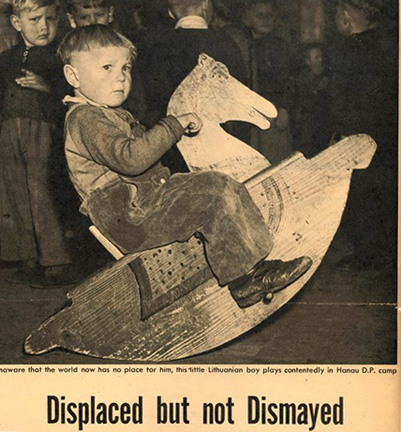
rockinghorse.Lithuanian Research and Studies Center Inc archives Hanau 1947 publication unknown

Lithuanian ‘DP’ child on wooden rocking-horse in Hanau, Germany camp, 1947. Clipping courtesy of Lithuanian Research and Studies Center, Chicago.

Once in the United States, many of the same “DP”s complain of  “first-wavers” from a more primitive Lithuania who don’t understand them or the more advanced Lithuania from which they have come. The farmer Taoras tells of “a good-hearted man of the old emigration” who helps him advance at work in Chicago–to the point where all the other “first-wavers” on the job burn with envy. (My father had a similar experience when he improved himself too fast for his American-born first cousins.)

Yet almost every refugee in this collection ultimately is sponsored by a member or descendant of the Lithuanian “first wave” under the U.S. Displaced Persons Act of 1948, from which the shorthand “DP” derives.  Krutuliene sums it up best when she says, “I appreciate (those) Lithuanians…so much because when we got here, there was already something here for us: there were parishes already, churches already. Their Lithuanian heritage had survived, and I regret that somehow we didn’t end up making very much of a connection with them.”

Whatever their differences, the “DP” (“second wave”) immigrants did build on the institutions of the first. Their tremendous post-settlement achievement in building dozens of “heritage” schools, choirs, dance ensembles and summer camps was based in already-established Lithuanian Catholic parishes. It was from this “first wave” base that the “DP”s preserved and passed on the great cultural revival of newly independent Lithuania (1918-1940) they were a part of before being displaced.

Starting Over in America

In many ways, we can think of the flowering of “DP” heritage institutions in resettlement as an echo of that passionate, first flowering of Lithuanian culture in the camps. By the late 1940s, the camps were being dismantled and it was time for those who had united in creative, communal striving to be dispersed around the world to re-start their lives from nothing but hard work.  Certainly this campaign of resettlement from post-war Germany  was preferable to any forcible return to the refugees’ Soviet-controlled homeland.

However, it dispersed people who had just reunited as a national community and who wanted more and more passionately to remain together, as a national group, the clearer it became that they could not “go back soon.” As a result, in the short term, resettlement seemed to me a second diaspora even sadder and more radical than the first, tearing apart friends and even families who had somehow managed to stay together while fleeing Lithuania or to reunite in tremendous cultural enterprise in the camps.

Many separations were due to the rules of immigration or refugee sponsorship in the host countries. For example, my father was separated from his brothers and sister to arrive alone to a sponsor in Springfield, Illinois. In the book, there is the story of a female Lithuanian doctor who has to leave her handicapped daughter in an institution in Italy in order to immigrate to the United States (after being able to keep her daughter with her through the entire flight from Lithuania and her time in the camps.)


DISPLACED PERSONS FROM LITHUANIA ARRIVING IN AUSTRALIA, Image Copyright Western Australian Museum

Lithuanian ‘DP’s arriving in Australia. Copyright Western Australian Museum.jpeg

Furthermore, without anything like their first geographic “collection point” in Germany,  this second dispersal and permanent resettlement of refugees in the U.S., Canada, Australia, Great Britain, and South America required “DP”s to create their own new  “collection points.” Geographic dispersal as a result of host nations’ immigration and sponsorship rules–as well as more local work, career and housing conditions–was a  formidable centrifugal force.

Yet even without all or most of their peers from the camps–and with less time and energy due to the demands of constant work to support themselves and their families without even the primitive support once provided by the camps—the “DP” refugees still managed to build new “Little Lithuanias” all over the world.

Lithuania’s ‘Greatest Generation’

I don’t know if this makes the “DP”s Lithuania’s “Greatest Generation” alongside tens of thousands of their peers who stayed behind and died fighting the Soviets as partisans. But I fully understand the impulse to consider them such.  Even in their later years, after decades of work and struggle in the U.S., Lithuanian refugees in this collection—just like my retired factory worker father–are still thinking of how they can help their beloved native land and their relatives there.

Despite her personal losses and drastic uprooting as a young woman, Krutuliene muses, “It’s good that a part of us is here in immigration” because of the ability to financially support relatives back home–and from 1948-1991 to agitate for independence in ways impossible inside the U.S.S.R.

Petras Aleksa recalls, “My idea (after immigrating) wasn’t to have a job or money—it was important to make my own contribution to Lithuania.”

Damusis, a chemist on the verge of giving his homeland a cement industry at the time it lost independence, describes how advancing Lithuania through one’s highest educational and professional potential “was a rallying cry, and not just for me…Everyone (in the “DP” generation), no matter what they did, made something good of it (for Lithuania.) Twenty-two years of independence provided the impetus for this.”

Kavaliunas, the lifelong educator, concludes, “20 years of independence (1918-1940) imparted (so much) to Lithuanians, instilling in them the love of country—this was the huge capital that they brought with them from Lithuania.”

First published in Lithuanian in 2014, “We Thought We’d Be Back Soon” became available in English in 2017–just in time for the 2018 centennial of the restoration of a modern and independent Lithuanian state. There could hardly be a better time to hear the voices of the generation forged in the heady patriotism, passion for education, and service to country that independence inspired—so many lives inspired by one great idea.


Thanks to William Cellini, Jr., for retrieving the images for these posts from various websites.

Please write to sandybaksys@gmail.com if you live in the Springfield area and would like a copy of the book for $15 plus shipping. “We Thought We Would Be Back Soon” can also be purchased on Amazon.com

Part II: ‘We Thought We’d Be Back Soon’

24 Saturday Mar 2018

Posted by sandyb52 in Sandy's Blog

≈ 1 Comment

The book “We Thought We’d Be Back Soon” contains 18 oral histories of Lithuanians who became war refugees between 1940 and 1944. Next month, my review of “We Thought…” will be published in the English-language monthly, Draugas News.

To celebrate this wonderful book and to commemorate the 70th anniversary of the law that permitted “displaced persons” or “DP”s like my father Vince to immigrate to the U.S., I’m publishing this second in a series of blog posts based on the book. Images for these post were contributed by William Cellini, Jr.

4 UNRRA Food Stores employees at the Lithuanian DP camp in Seedorf. Source albionmich.com

Lithuanian UNRRA food store employees, Seedorf  “DP” Camp, postwar Germany. Courtesy of Albionmich.com

History in the Human Voice

By its accumulation of  human detail,  “We Thought We’d Be Back Soon” enhances anything the reader may already have believed or known about the flight of the Lithuanian “DP” generation during WW II. Almost without effort, the descendants of  “DP”s will find gaps in their own family stories filled.

It’s as if a veil between the generations has been lifted, and we can suddenly see our “DP” parents or grandparents as they were when they were young during a desperate time in a different world. We are there. And certain images and anecdotes, different for each reader, will linger long after the reading is over.

On the humorous side, we have an invading Nazi column that stops on the outskirts of a Lithuanian town in June 1941 so the soldiers can shine their shoes and shave before presenting themselves as occupiers.

And for the heart-wrenching, we have the story of the Lithuanian infant born into such want, with only a sheet to be swaddled in, that she dies on a train passing through Berlin in late  1944 and is buried by German strangers in between bombardments.

There is the Lithuanian railroad manager who refuses passage on one of Lithuania’s last departing, overcrowded trains to the wife and children of his Soviet-deported and executed co-worker–while filling two rail cars with his personal possessions.

There is hapless Juozas Taoras, the farmer, who in 1945 is forced to flee his first good job with servicemen in the American occupation zone to escape arrest as a Nazi sympathizer–simply because he has dared equate Stalin with Hitler.

Personally, I will never forget the brave grocery shop girl who’s exiled to Siberia in 1941 after she dares tell the wives of two occupying Russian officers not to butt in line because there was plenty of food in Lithuania before the Soviets emptied store shelves.

And, there is one unforgettable anecdote about the Red Army’s campaign of rape in conquered Germany. In it, a desperate Lithuanian “DP” mother protects herself and two young girls by screaming in broken Russian that she is not German but Lithuanian–and can’t wait to go home now that Lithuania is Soviet-“liberated.”

Falling Back with Germans—or Nazis?

As a fractal of the bigger “Why leave Lithuania” question, the modern American reader, perhaps attaching guilt-by-association to Lithuanians falling back on the same roads, trains, and ships as Nazi forces, might wonder, “Why flee into German lands?” The answers here are often not explicit because of the obvious duality of the dilemma of Lithuanians caught between Stalin and Hitler.

However, bookkeeper Brone Parbaciene, whose husband has been tortured and mutilated to death by the NKVD at Rainiai Forest, lays it out straight: “I had already suffered at the hands of the Russians, so I fled to the other side, which took us in.”

Valerija Sileikiene explains,  “We thought: two devils–one’s brown and the other’s red. Let’s choose the brown devil.” Nevertheless, as refugee families flee deeper into “German lands,” their life-and-death need for work-linked food ration cards and housing–as well as transit papers to reunite with their involuntary inducted husbands–makes it  impossible to see these refugee’s German hosts as uniformly evil.

A Range of German Experiences

We have callous Nazi-loving estate owners who force Lithuanians to work for insufficient food and sleep with their children in filthy pigsties. We have soldiers who shoot hungry refugees whose only crime was to enter abandoned Konigsberg / Karalauciaus homes from which German farmers have fled. But we also have small German farmers, soldiers, bureaucrats, and midwives who help to feed, clothe, and shelter a flood of anti-Soviet refugees amid the shared hardships of war.

One Lithuanian mother gratefully remembers how her toddler received an egg every day, despite German food shortages. Another mother is efficiently delivered of her placenta, post-childbirth on the open road, by a German Army doctor in retreat with his unit who refuses any payment. German police who initially insist penniless refugees pay their own train fares to an interrogation point proceed to lend them the cash to do so—which the refugees conscientiously repay.

The Survival Advantages of Language

Over and again, German culture and language proficiency permits Lithuanian professionals and intellectuals to bargain for what they need from harried authorities and locate and take refuge with friends and relatives already living in “German lands” (meaning Konigsberg and occupied Poland as well as Germany, itself).

However, the helpful German connections possessed by urban Lithuanians who have higher education or have worked in interwar German-owned businesses–or for example, under Lithuania’s German occupation railroad authority–are lacking among rural Lithuanian refugees—with negative results.  Not understanding or speaking German, perhaps my farm father and his brothers didn’t even know they were being inducted until they were spirited by train to Innsbruck, Austria, in December 1944 for basic training. (Christmas always seemed difficult for Dad because he I think he remembered doing push-ups interminably in the bitter cold on Christmas morning 1944 because several other inductees had disobeyed their German officers and refused to fall out.)

Even if Dad and his brothers had understood they were being inducted, perhaps it was no different from when they had all been taken against their wills in Lithuania to dig German trenches and foxholes, later escaping under fire. Once these young men had lost everything and become refugees, perhaps they felt they had to bow to the unknown purpose Germany had for them as the price for their escape from a known and far worse Soviet fate.

By no means could men who had been limited to their farm and village world have taken advantage of professional or extended family connections already living in Germany.  Nor did they have an alternative trade or profession in war-time short supply. (Lithuanian doctors like Juozas Meskauskas and Janina Jakseviciene were immediately put to work in understaffed civilian hospitals and clinics.)

A Farmer’s Unique Trauma

In fact, subsistence Lithuanian farmers like my father experienced unique trauma in their flight from homesteads whose improvement had been the work of their entire lives—the land and its cycles, their entire world. For these rural refugees, the reality of all they were leaving hit hardest at being relieved, as soon as they crossed Lithuania’s western border, of their wagons and horses. (Often, milk cows had already been left behind on the road because they couldn’t keep pace with horses).

Farmer Taoras tells how, before leaving for a point further from the front, he and his wife go to see the horses they were forced to sell the day before to the German Army:

“(At first) when we fled, we weren’t sorry for anything, just to get away faster,” he recalls. But as the couple approaches their horses, the animals see and recognize them. Having gone unfed and tied to a rail all day and night, the horses begin neighing and pawing expectantly, hoping that their longtime owners will feed them.

Helplessly, Taoras recalls, “We came up and stroked them…and both my wife and I began to cry because they had pulled so faithfully, they had pulled so much that they were now skin and bones…It was an abandonment. Our last asset was the horses.”

Coming Next:  Part III of “We Thought We’d Be Back Soon.”  Read how Lithuanian refugees established “Little Lithuanias” in their postwar “DP” Camps and then started all over again in America.


“We Thought We’d Be Back Soon”

23 Friday Mar 2018

Posted by sandyb52 in Sandy's Blog

≈ 3 Comments

The book “We Thought We’d Be Back Soon” contains 18 oral histories of Lithuanians who became war refugees between 1940 and 1944. Next month, my review of “We Thought…” will be published in the English-language monthly, Draugas News.

To celebrate this wonderful book and to commemorate the 70th anniversary of the law that permitted “displaced persons” or “DP”s like my father Vince to immigrate to the U.S., I’m publishing this first in a series of blog posts based on the book. Images for these post were contributed by William Cellini, Jr.

8 Soup Line Whenen Camp, Germany. Soruce Pijus Cepulis Collection, dpcamps.org

Lithuanian Scouts learning how to cook & eat “in the field.” Whenen DP Camp, post-war Germany. Pijus Cepulis Collection, DPcamps.org.

Part I:  From Allied POW to American ‘Home Guard’

As traumatized survivors of three invasions of their homeland (Soviets in 1940, Nazis in 1941, and Soviets, again, in 1944), members of Lithuania’s “DP” generation were famously tight-lipped about their World War II refugee experiences.

Until my father Vince was in his 70s and 80s, I learned few details of his flight from the family farm near Vidukle, Lithuania, in October 1944, at age 25, with two horses, a small carriage with a milk cow tied to the back–and only about half of his eight brothers and sisters.

Dad’s “oral history” was taken piecemeal by multiple daughters over many years and was never written down. As a result, we are probably lucky to have learned of Dad’s involuntary induction into a support unit of the German Army in December 1944, his winter 1945 capture by the U.S. Army, and his subsequent 16 months of starvation and hard labor as a POW under various Allied commands.

Dad’s fateful somersault, upon his release in June 1946, from starved and abused POW to service in the U.S. Army “Home Guard,” is reminiscent of the incredible refugee journey at the center of the book, “The 25th Hour.” But there are many similar twists of fate in the Lithuanian oral histories that comprise this collection selected and edited by Dalia Stake Anysas, Dalia Cidzikaite, and Laima Petrauskas Vanderstoep.

A Tapestry of Refugee Experience

Taken in the mid-to-late 1990s, some 50 years after the events being remembered, these personal histories provide a tapestry of war-time experiences disparate in their details. However, more than a few of the stories are so richly detailed that they stand as microcosms of the whole.

In features common to many, fleeing men are separated from their families and forced to dig foxholes under Soviet artillery fire, much as cars and farm animals have previously been requisitioned for the German war effort. (The struggle of Lithuanian civilians to remain non-combatants begins with Lithuanian resistance to the formation of a Lithuanian SS unit, to which the Nazi occupation authority responds by closing Lithuanian universities.)

Everywhere on the refugee road are Lithuanian women fleeing with small children, sometimes giving birth in open wagons in the cold and rain.  As well, there is the unique vulnerability of minors wandering World War II’s killing fields without parental guidance or protection.

More than anything, we experience the refugees’ constant struggle with hunger—and to a lesser degree, exposure to the elements, plus the difficulty of transit further and further west as the Soviet Army advances.

‘Why Did You Leave?’

To the big question, “Why did you leave?” the subjects’ answers are almost unanimous. Those who fled– everyone from intellectuals, teachers and other professionals to farmers–knew they had been slated for a second round of mass deportations to Siberia that the Soviets did not have time to implement before being driven out of Lithuania by the German Army in June 1941.

The atrocity-level treatment of deportees, combined with the brutal NKVD torture and murder of Lithuanian detainees in places like Rainiai Forest, sowed a lasting terror among tens of thousands more so-called “enemies of the state” who could expect similar treatment upon the Russians’ return in 1944.

Inextricably tied to this “why” is the question of how long the refugees expected to be gone. A few interviews are especially insightful in explaining why none of these young refugees who ended up exiled for the rest of their lives expected, when they fled, to be gone for more than a few months.

Over and over, the reader’s sense is that the decision to leave in its full scope and finality was never actually made. For many of the subjects, flight was a series of immediate survival steps without an overarching plan.

 ‘Who Could Have Known?’

At the same time, Russia’s military alliance with the Western powers, as well as the presence of U.S. troops in Germany, implied to the mass of Lithuanian refugees fleeing in summer and autumn 1944 a degree of Western influence over Russia sufficient to restore Lithuanian independence at war’s end and a quick return home.

To return, the refugees needed Lithuania’s borders to return, which unfortunately, didn’t happen for almost 50 years. Confidence in Western influence over the situation first began to erode as the “DP”s witnessed Russian soldiers crossing freely from the Russian zone into the British, French, and American occupation zones in post-war Germany.

New DP Camp Map

Post-war Allied Occupation Zones: graphic located and enhanced by William Cellini, Jr.


To the refugees’ chagrin, Soviet political commissars also were allowed freely to roam the displaced persons (“DP”) camps, arguing and cajoling for the frightened émigrés’ return. Initially, according to these witnesses, some Russians, Balts, and Belorussians were forcibly transported to the Russian zone before the other Allied powers were brought to their senses.

According to Adolfas Damusis, a lifesaving “no forced repatriation policy” was obtained with the help of Lithuanians—perhaps exiled officials of the VLIK–working within UNRRA, the United Nations Relief and Rehabilitation Administration that operated the camps.

Brone Urboniene relates how some Yugoslav and Ukrainian “DP”s decided to fight back, attacking, overturning and burning the jeep of Russian political commissars entering their camp to “register” refugees for repatriation. “In the jeep’s trunk, they (the frightened and enraged “DP”s) found all kinds of photographs and lists of us all, the refugees there. And that happened…in the American zone in Munich…There (must have been) people among us who worked for them (the Soviets).

What They Left Behind, and Why

Within the context of the short-term absence the refugees anticipated, Jonas Kavaliunas explains that sick family members, parents—even minor children—were left behind on extended family members’ farms. In the short-term, it was assumed the physically weak would be better off with plenty to eat than on a trek into the unknown. Other evidence of the “DP” expectation of a quick return is found in the universal practice of quickly burying valuables on the homestead that were also assumed to be safer there: china dishes, store-bought Sunday clothes. (Partial impetus for this might been the ragged appearance and “beggarly” behavior of the Soviet Army during its initial occupation of Lithuania in 1940.)

The burial of one family’s supply of lard near Siauliai (flour, bacon and lard turn out to be life-saving supplies) is indicative of another phenomenon. For many refugees, far more than any global decision to abandon the homeland, retreat was a spontaneous series of stops and starts that reflected the advance of the Soviet Army and the hope that leaving Lithuania altogether could be avoided, or at least delayed. In more ways than one, falling back farther and farther meant leaving more and more behind.

In many cases, only that final spasm of retreat across Lithuania’s western border in horse-drawn wagon or on foot invokes the big-picture finality that spurs one refugee to scoop up a handful of soil to carry with her into exile. Others strain for that last glimpse of home through a train’s darkened windows.

Look for Part II of this blog series on, “We Thought We’d Be Back Soon.” Also, please contact sandybaksys@gmail.com or comment here if you live in the Springfield area and would like to purchase a soft-cover copy of the book for $15 plus bulk shipping.

Blogroll

  • Enos Park Neighborhood Improvement Association
  • Illinois State Historical Society

Lithuanian Websites

  • Amber Reunion
  • Lithuanian World Center
  • Lithuanian-American Club of Central Illinois
  • Lithuanian-American Community, Inc.
  • Lithuanian-American Publications
  • Lithuanians Of Arizona
  • LTnews.net
  • LTUWorld
  • The Lithuania Tribune

St. Vincent’s murals resurface

Two of the murals from St. Vincent de Paul's Catholic Church have resurfaced. Take a look!

Search

Enter your email address to follow this blog and receive notifications of new posts by email.

Join 142 other subscribers

E-mail us!

Questions or comments? Please e-mail sandybaksys@gmail.com.

Email us!

Questions or comments? Please e-mail sandybaksys@gmail.com.

Blog at WordPress.com.

Privacy & Cookies: This site uses cookies. By continuing to use this website, you agree to their use.
To find out more, including how to control cookies, see here: Cookie Policy
  • Subscribe Subscribed
    • Lithuanians in Springfield, Illinois
    • Join 142 other subscribers
    • Already have a WordPress.com account? Log in now.
    • Lithuanians in Springfield, Illinois
    • Subscribe Subscribed
    • Sign up
    • Log in
    • Report this content
    • View site in Reader
    • Manage subscriptions
    • Collapse this bar
 

Loading Comments...