My ‘Best of Blog’ Book

Dear Readers:

My “best of blog” book, “Lithuanians in Springfield, Illinois” has been three years in the making.

Now you can stand with me in my 1,000 hours of research and writing. You can reach with me across time to join hands with our all-but-forgotten immigrant ancestors and their lost age.

How?  By supporting my “crowdfunding” campaign for the book’s design costs. After putting in so much time and effort, I recently learned that quality, professional page design at a cost of $1,300 or more will be needed to attractively incorporate into my text the tremendous wealth of historical family photos that will lend their unique character to my book, just as they do to this blog.

Please consider a donation of $10, $15, or $20 to my campaign, at this link. 

https://www.indiegogo.com/projects/lithuanians-in-springfield-illinois/x/10729176

The whole philosophy of crowdfunding is that many hands make light work!

So, please share my campaign link and talk to others who might be able to contribute.

Except for one chapter and a round of proof editing, my text is already complete and being submitted in stages to a professional designer who is moonlighting from his day job. My target publication via CreateSpace and availability on Amazon.com is late summer/autumn 2015.

I have already received hundreds of dollars towards my $1,500 in projected costs (including ISBN numbers), so the target amount for this crowdfunding campaign is definitely reachable.

Thank you to my donors to date:  Maria (Fry) Race, Barb Pelan, Terri White, Kathleen Farney, William Cellini, Jr., and Mike Kienzler.

Thank you to everyone who pitches in to help design a truly attractive and unforgettable book about “Lithuanians in Springfield, Illinois.” Together, we can make it happen!

‘My Son, Please Come Home’

Following Ann Wisnosky’s account of elders left behind in Lithuania, forcing immigrant families here to rely on neighbors in lieu of parents and grandparents, the piece below hints at the sorrows and difficulties faced by those left behind. In this well-researched article (using Springfield city directories and passport and draft records, among other sources), we see parents hoping to see long-lost children before they die. We also find immigrants in circumstances that make even one, final visit to the homeland next to impossible.

Letters from 1920s Lithuania: A Call to Come Home

By William Cellini, Jr.

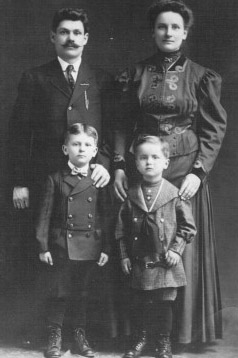
A photo from home: family of Nancy Benikati (Pazemetsky), July 15, 1909.

A photo from home: Lithuanian family of immigrant Nancy (Benikas) Pazemetsky, July 15, 1909.

Among the millions of European emigrants who came to the U.S. in the early twentieth century, Lithuanians stand out due to the precarious situations forcing them to leave their homeland. Most emigrants of the Catholic faith left to escape religious persecution by the Russian Orthodox Church and the Russian czarist regime.

Lithuanian men tended to emigrate due to military conscription that began in 1874 under Czar Alexander II. Conscription meant Lithuanian males were obligated to fight for Russia in the disastrous Russo-Japanese War of 1904-05 and in World War I. Politically, Lithuania was under the Russian Empire and had been since 1795.

As a result, Lithuanians chose to re-make their lives in other parts of Europe and in the Americas with no intention of ever returning to their homeland. However, in February 1918 when an independent Lithuanian nation was declared, Lithuanian-Americans had to make a decision about returning, especially when family members wrote letters pleading for them to come home.

Some of these letters contained entreaties from elderly parents wishing to see their children one last time. Other letters conveyed urgency in business matters that had surfaced since the emigrant left. Lithuanian-Americans who did manage to visit, or return for good in the period following World War I, found a Lithuania free from czarist domination and for the most part, free of Polish insurrection.

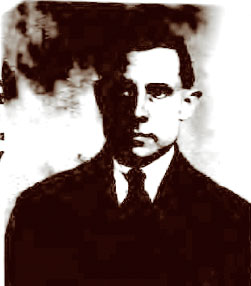
Passport photo, Enoch Yakobasky, Ancestry.com

Passport photo, Enoch Yakobasky, Ancestry.com

Enoch Yakobasky (perhaps born Ignas Jakubauskas) was a Springfield resident who had emigrated from Lithuania to the U.S. in 1893. He initially worked as a coal miner in Pittston, Pennsylvania, where he was a boarder in the home of a Lithuanian family. By 1915, Yakobasky was living in Springfield, listed in the Springfield City Directory as single and a coal miner. He registered for the draft during WWI, but due to his age (birth year listed as 1873), it is doubtful he served in the U.S. military.

In 1921, Enoch received a letter from his parents in Lithuania pleading with him to come back. They wanted nothing more than to “see you while we are alive, you might not find us alive by the next spring.” Yakobasky was 48 years old and  unmarried, living at the corner of South 12th and Laurel Streets. His lawyer translated into English the letter from his parents, and a part of their message contains reassurances about life in the newly independent Lithuania.

“As you ask about the Government of Lithuania, we must reply, stating that the newspapers are stating untruth about it, because the poor people and working people are fully defended, they may go wherever they please, no one beats them or puts them in jail without reason.”

Other comments carry a different tone: “The master class is now more oppressed than the poor peoples; you should not mind the papers and should come back home, so many have already done and no harm is done to them…”

Yakobasky letter, translated.  Ancestry.com

Yakobasky letter, translated. Ancestry.com

Some remarks convey a sense of class struggle while providing evidence of how bad conditions had been for the poor at the time immigrants left. My interpretation of the reference to the reversal of fortune for the “master class” is speculative. However, it may have been tied to events the year prior when Lithuania was embroiled in a war with Poland over control of the regions of Vilnius, Suwałki and Klaipeda.

That war occurred during the same era as the Soviet-Polish War, when the Red Army attempted to use Poland as a conduit for spreading communism into Germany. Lithuania was assisted by the Red Army in its desire to re-incorporate the city of Vilnius into the Lithuanian state. (Lithuania later lost Vilnius to the Poles, and so Kaunas became Lithuania’s provisional capital from 1920 until 1939).

The letter from Enoch’s parents indicates that he has previously promised but failed to visit, and that they are expecting some financial assistance that has not yet arrived. It’s not surprising that Lithuanian immigrants would have made remittances to elderly parents when able, in the long tradition of foreign workers on U.S. soil.

Whether Enoch made the requested visit, and perhaps even remained with his aging parents, is unknown. He does seem to have left Springfield in the 1920s, as he is not listed or located in Springfield’s city directories from 1923 to 1930.

William Grabusky Passport photo, Ancestry.com

William Grabusky Passport photo, Ancestry.com

William Grabusky (perhaps Viljamas Grabauskas) was a Lithuanian-American who emigrated to the U.S. in 1906 from the village of Pilviškiai, Marijampolė County. He obtained U.S. citizenship on September 20, 1916 in Springfield, Illinois. Previously, he had resided in Mahanoy City, Penn., where he worked as a coal miner. During WWI, William and his wife, Ellen, lived on Springfield’s north side. On his draft card, he is listed as a ‘”coal digger” with the “Jones & Adams” Mine. That mine was located off Clear Lake Avenue and was an employment hub for many north end miners.

His birth year is listed as 1882. In 1916, he and his wife suffered the death of their infant son, Notbett (Norbert). The funeral was held at St. Vincent de Paul Church, officiated by the Rev. John Czuberkis. In 1921, William’s parents wrote him a letter from Lithuania asking him to visit. From their reply, it seems William had initiated the idea: “Son, as you wanted to come and see us, well if you could come and see us now, because we are old and weak.”

Grabusky was 40 years old when he received the letter. His passport paperwork indicates it was the first time he was applying for a travel document. Considering that he had resided in the United States since 1906, his parents must have been very pleased that he was making a visit after a separation of at least 15 years.

Their letter goes on to say, “…Your sisters and brother-in-law would be very glad; as we love to see the sun shine, thats [sic] how we want to see you…”

In a part of his letter to his lawyer, William indicates there are other letters from his family and they, too, could be used for his passport application: “…I will send you the letters they wrote me, and I have the lines marked for you as evidence, as they say ‘we are waiting for you to come home and see us.’ ” Perhaps evidence was needed to obtain a passport quickly; it seems William’s application was signed December 16, 1921 and his departure date was listed as Jan. 20, 1922.

Per information from the U.S. Census and Springfield City Directory, by 1930, William and his wife Helen were living on North 8th Street. He was working as a coal miner and Ellen is listed as a ‘janitress’ at the Lincoln Theater downtown. On March 19, 1932, William died of the complications of pneumonia. His body was buried in the abbey vault at Oak Ridge Cemetery.

According to his obituary, he was survived by his wife and by two sisters in Lithuania, Madeline and Agnes, but no parents. Perhaps he had been able to visit them before they died.

Antanas Senkus, passport photo.  Ancestry.com

Antanas Senkus, passport photo. Ancestry.com

Antanas Senkus emigrated to the U.S. from Scotland. According to his U.S. passport application, he was born in the village of Raguva, Panevėžys County. After his arrival in the U.S., he initially settled in Pennsylvania, where he became a naturalized citizen in 1914. In 1918, Antanas and his wife Marijona (family name, Rusinaukus/Ružinauskas) were listed in the Springfield City Directory living on city’s north side. His recorded occupation is “coal miner” with the “Jones and Adams Company.”

By 1920, the couple is listed as having three children. In 1921, Antanas received a letter from his father in Lithuania asking him to come and visit. “[I] am letting you know, son, that I have been sick and in bed since November 1920, so [I] am asking you, dear son, to be so good as to come home as soon as you possibly can as I want to see you, as it is 20 years since I saw you.”

His father’s letter also contains directions on how to get to their village, “Papilvui” (possibly the village of Papilvis in Kaunas County). The elder Senkus closes his letter saying, “[I] am 66 years old but have no health. Since Christmas, I am not able to walk, only sit down. Please write to me as soon as you receive this letter…Hoping this find [sic] you in good health, we are anxiously waiting.”

There is no record, however, of Antanas making the trip overseas to visit his father and family. He died in 1936 and Marijona died in 1954. Both of them are buried at Oak Ridge Cemetery in Springfield.

Another photo from the old country: Julia (Stockus) Wisnosky family between the wars. (The size of the house and dress of the people marks them as relatively well off.)

Another photo from the old country: Julia Stockus (Wisnosky) family between the wars. (The size of the house and dress of the people marks them as relatively successful.)

Emigration Is Forever…

The ease of transatlantic travel in the twenty-first century may obscure the obstacles to even one trip back home by a poor Lithuanian coal miner in the early twentieth century. In reading these letters, it’s important to see beyond the emotional appeal of family reunification to understand the many practical obstacles that often made immigration a one-way trip, rendering it impossible for long-separated parents and adult children to see each other even once after decades of separation.

All three of the men mentioned in this piece were coal miners earning meager wages, at times barely enough to support their families. Coal mining in the early 20th Century was not a full-time or even a year-round occupation, and during the summer, miners normally took odd jobs to maintain an income. In short, they could take no break from the struggle to support themselves (20-28 days just for the two-way transatlantic voyage, not to mention travel to and from an Eastern U.S. port and then a European port and the immigrant’s final destination in Lithuania).

A steamship ticket for a round-trip voyage to Europe, presumably in third-class (steerage), would have cost $80 to $90 in the 1920s. That is about $1,100.00 in today’s dollars, and a significant portion of a coal miner’s annual wages. Many other tickets and travel costs would also have been required.

Photographic ‘Visits

Consequently, no matter how much parents and children yearned for a reunion,  such a trip involved great personal sacrifice. It could only be afforded at the cost of more basic necessities and the very progress the emigrant had hoped to make by leaving his homeland, and had earned with decades of hard and risky labor and painful sacrifice.

Modern digital communications have changed these harsh facts of early twentieth century emigration, allowing Lithuanians scattered across Europe and America today to stay in close touch with their relatives and homeland. First-wave Lithuanian immigrants could rely only on letters (using “scribes” when they were illiterate), and photographs. Photos exaggerating the dignity and success attained in America, and photos of the old homestead and village in Lithuania, by necessity took the place of in-person visitation and became precious keepsakes of long-lost family members.

A Galman (Galminas) family death in Lithuania. Undated.

A Galman (Galminas) family death in Lithuania. Undated.

Sadly, many immigrants’ final “visit” with their long-lost parents  took the form of a  funeral photograph, with open casket and neighbors and relatives from the village gathered around. In some especially tragic cases, the open-casket photo that crossed the Atlantic was of the unfortunate immigrant who had predeceased his or her elderly parents.

Sources

Barkan, E. R. (2013). Immigrants in American history: Arrival, adaptation, and integration. Santa Barbara, California: ABC-CLIO.

Kasekamp, A. (2010). A history of the Baltic States. New York: Palgrave Macmillan.

Senn, A. E. (1967). The great powers, Lithuania and the Vilna question  1920-1928. Leiden: E.J. Brill.

Ancestry.com

Illinois State Journal, January 1916.

Illinois State Journal, March 1932.

Jefferson’s Directory of the City of Springfield, Illinois. Springfield, 991.: Jefferson’s Printing Co., Springfield, IL. 1918.

Jennings, W., & Conley, P. T. (2013). Aboard the Fabre Line to Providence: Immigration to Rhode Island.

Lithuanian Women in Marriage & Divorce

Bernice (Mazika) Kavirt

Delores’ mother Bernice (Mazika) Kavirt

Delores Kavirt grew up in Springfield, the daughter of a miner and bootlegger with an ocean-going background. Delores’ father William Bernard Kavirt (Kavish or Kavishia) was born in Lithuania in 1893. In 1932, after seven children and nine years of marriage, he deserted his family, apparently for the freedom to go back to light, wind, and spray–instead of the dark, subterranean world of mining–as his successful bootlegging business was about to expire.

I would also guess that the strains of the Great Depression had their own impact on the staying power of this husband and father– even if the impending demise of Prohibition and the illegal alcohol trade in 1933 was probably the straw that broke the camel’s back. “My dad left us for reasons unknown and for a destination we never determined when we were all still quite young,” Delores recalled. “He wanted to take my brother Willie with him. But my mother made it quite clear that he was not going to do that, throwing a pot of boiling hot water at him to drive home her point.”

Women Handicapped in Marriage, Divorce

So far, I have not written about the deleterious impact of the harsh mining life on marital formation and duration among first-wave Lithuanian immigrants and their offspring. The story of Delores (“Dolly”) Kavirt’s parents demonstrates that marriage was perhaps first and foremost an economic alliance–until it was a liability.

The Kavirt kids, front row, left to right: Delores, Alice and Willie. Back row, left to right: Bernice and Lillian. Late 1930s.

The Kavirt kids, front row, left to right: Delores, Alice and Willie. Back row, left to right: Bernice and Lillian. Late 1930s.

Getting married was many times easier than getting a divorce, making desertion a ready alternative for husbands, but leaving wives with many children and little English in severe economic distress. Such women seem to have had the choice either of going it alone under the conditions of desertion or, if they could locate their AWOL husbands, securing a costly and difficult legal divorce —and afterwards, if they could stomach it–another marriage.

Lithuanian gender relations of the time also handicapped women both in marriage and divorce. Men learned at least broken English in the mines. However, girls and women not allowed to stray beyond the cloistered world of home, church and a domestic position in a private home became fiancées, wives and mothers who did not speak or read much English, and who knew little of the ways of men–or the world.

Seeking Two Divorces at Once

A March 1, 1933 article in the Illinois State Journal shows Delores’ mother Bernice (Mazika) Kavirt making the case that in 1923, when she was an inexperienced and uneducated 19-year-old Lithuanian girl, William Kavirt tricked her into marrying him after her previous marriage (at age 16 or 17?) ended in desertion. In an unusual twist that likely occasioned newspaper coverage, Bernice was making her case not for just one divorce, but two.

After William Kavirt deserted her in 1932, perhaps it was necessary, in order to receive food aid for her children, to be a divorced rather than a twice-deserted woman whose latter husband, at least, could be considered financially responsible under the law, even if he was AWOL and contributed no support.

It is also true that shedding herself of all legal marital relationship would have freed Bernice to marry again. However, she does not appear to have re-married until 1947, well after she had struggled through raising her five surviving children alone through the trough of the Great Depression. The odds of finding a man who would raise another man’s five children in hard times were probably so long that they made re-marriage  impossible.Anna (Sleveski) Mazika with her granddaughter Lillian Kavirt. Circa 1930.

Anna (Sleveski) Mazika with her granddaughter Lillian Kavirt. Circa 1930.

It couldn’t have been easy to publicly expose her dual-marriage, dual-divorce predicament by going to court, particularly after the brutal death of her mother Anna as a pedestrian hit by a car the same year husband William deserted the family in 1932. (All this, after Bernice’s infant son Edward died at two months of age in 1931).

By 1933, Bernice (Bertha) was in court in separate suits. One was for $10,000 in damages for her mother’s wrongful death. The other was for dual-divorce, making quite believable her claim of having suffered a nervous breakdown in 1932 after encountering her missing husband on the street, only to have him thumb his nose at her and her demand either to come home and resume his family responsibilities or give her a divorce.

The passage below from the March 1 1933 Journal article hints that, in addition to breaking Bernice’s nerves, William may also have forced her hand by threatening to publicly expose the fact of her dual marriages if she tried to sue him for divorce.

“Mrs. Kavirt met Kavirt on the street here after his desertion and informed him that she would file a divorce bill if he did not return to their home and their five children at 1025 N. 14th Street. Kavirt ridiculed that plan, and revealed that they had never been legally married because her first husband had never secured a divorce.”

Victim of Marital Manipulation?

Bernice (Mazika) Kavirt was born in Hazelton or Minersville, Pennsylvania in 1901 or 1904, the daughter of Michael and Anna (Sleveski) Mazika, both born in Lithuania. Twice married by age 19, was this barely educated young woman the victim of marriage manipulation, as she pleaded in her divorce suit? Or had she known or guessed when she married for the second time, to William Kavirt, that she was not legally severed from her first husband, Alfred Platukas, despite what she described as Kavirt’s assurances to the contrary? (These were given, Bernice testified, after Kavirt made a show of traveling to Pennsylvania for several weeks to ascertain her first husband’s whereabouts, then returning to report that Platukas had secured a divorce from Bernice in Detroit.)

We will never know for sure what young Bernice knew or chose to overlook. What is certain is that even if she had tried to make legal marriage work in her favor, it had not, resulting in two desertions, various costly legal knots to untie, seven live births and five surviving children in just nine years, plus sole financial responsibility for her children at age 29. Platukas and Kavirt, meanwhile, had been able to enter, then abandon marriages that became too burdensome for them.

Bernice Kavirt with her daughter Bernice (Kavirt) Manning's children Glenn and Alice, 1950s.

Bernice (Mazika) Kavirt with her daughter Bernice (Kavirt) Manning’s children Alice and Glenn, 1955.

Bernice’s daughter Delores was the youngest of the five Kavirt siblings who grew up first on North 14th Street, then in a stone bungalow on Griffiths Avenue near Peoria Road.  Two other children, including (the aforementioned Edward and) Alice, who was only four when she died, had both perished by the time their father left. Delores recalled: “After Dad left, Momma had to rely on public relief and cleaning homes. I was still too young to be left at home, so she had to take me wherever she needed to go.”

Saved by Jewish Kindness

“Momma used to tell the story of how, growing up in Pennsylvania, she had also tagged along with her Lithuanian immigrant mother Anna, cleaning the homes of well-to-do members of the Pennsylvania Jewish community. Then, as a single mother of five,” Delores recalled, “my mother experienced the same consideration by members of the Springfield Jewish community.

“I can remember walking downtown with Momma to the public relief office and then taking our food stamps to Cohen’s and other grocery stores. The purchase of candy with food stamps was forbidden, and my mother abided by that. However, quite often, the storekeepers would hand me a small bag of free candy as I exited.

“At about the same time, the authorities wanted to split up our family because they thought our Momma couldn’t adequately care for all of us. But with the help of a local attorney named Templeton, whom I think was Jewish, Momma was able to resist that action and keep us all together with her under one roof. For the help of that attorney and those previously mentioned acts of kindness by Jewish homeowners and storekeepers, I hold those of the Jewish faith in high regard,” Delores said.

According to Delores’ nephew Glenn Manning, Bernice Kavirt also struck a care-giving deal to keep a roof over her children’s heads. It was after husband William left that the family moved from North 14th Street to the aforementioned stone house on Griffiths Ave., which was owned by John Yuscius. Elderly and infirm, John let Bernice and her children live with him in exchange for Bernice’s care.

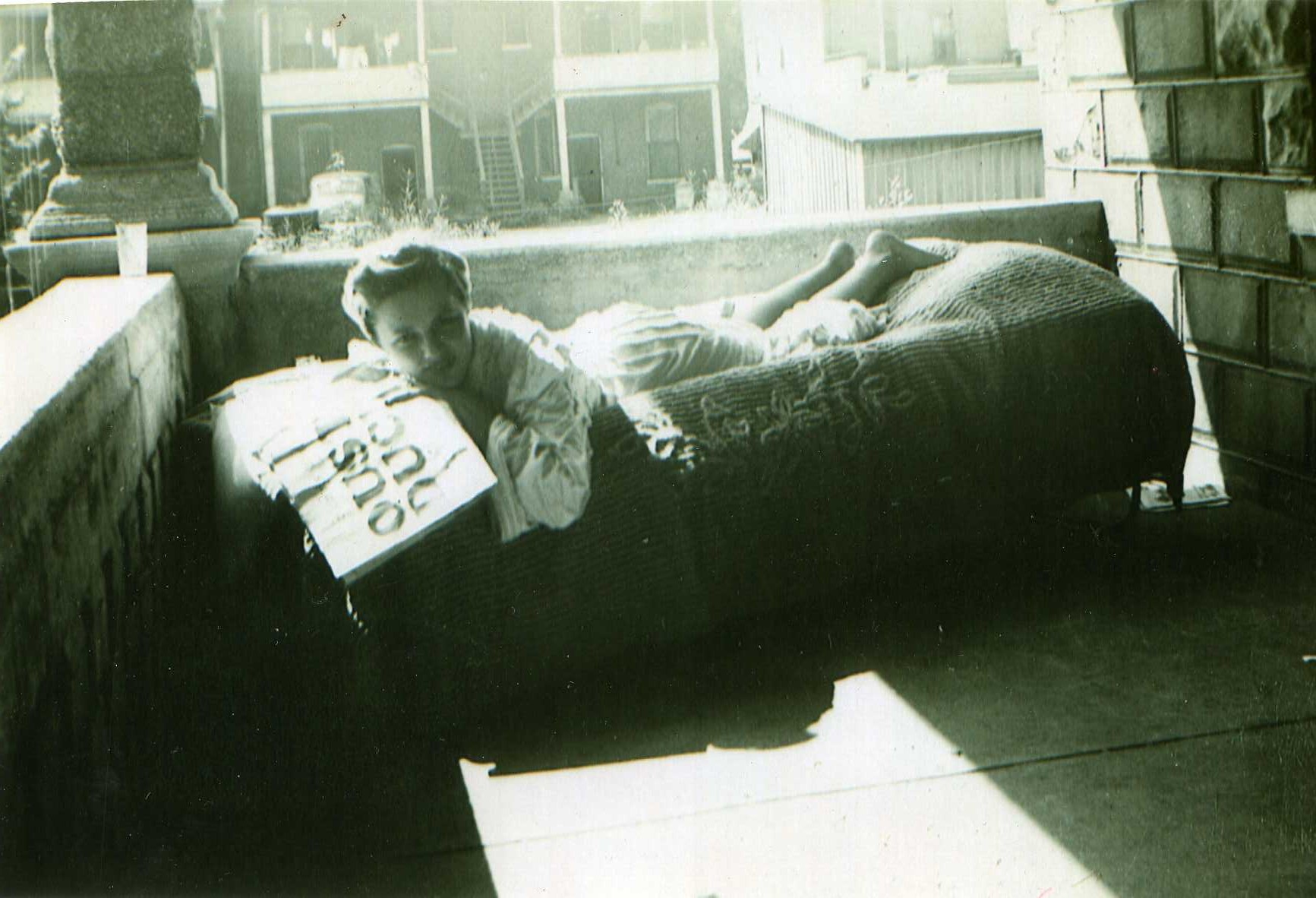
Bernice (Kavirt) Manning, daughter of Bernice and Willam Kavirt, on porch of Griffiths Ave. home, 1940s.

Bernice (Kavirt) Manning, daughter of Bernice and Willam Kavirt, on porch of Griffiths Ave. home, 1940s.

Grandmother Anna Hit by Car 

Maternal grandmother Anna Mazika had moved from Pennsylvania to live with her daughter Bernice, and probably, care for the children while husband William was still with the family. But one Saturday in 1932, according to the Illinois State Journal, while Anna was walking home from confession at St. Vincent de Paul Church, she was struck and killed, as she was crossing 9th St. at Enos Ave, by the car of a man from Ft. Wayne, Ind., who was reported in the Journal to have been traveling more than 55 mph.

According to Delores, “Anna’s spiritual needs were attended on the spot by Fr. Yunker (St. Vincent’s pastor).” The newspaper reported that Bernice (Bertha) sued the driver for $10,000, but I could find no follow-up article giving the result of that suit. According to the Journal, a coroner’s jury created the opening for a civil suit by rendering an “open verdict,” neither blaming nor exonerating the driver.

Bringing up Baby (Hooch)

During Prohibition, which included the entire term of the Mazika-Kavirt marriage, William Kavirt and a brother who lived nearby bootlegged together from the Kavirt home on North 14th. “They were known for producing some very good rye whiskey,” Delores said. “My mother was tasked with transporting the product of their labors from our house to our uncle’s house on North 9th Street, sometimes using a baby stroller as cover – the ‘hooch’ hidden under a blanket.”

In addition, according to Delores’ nephew Glenn, “William and Bernice used to keep a rabbit hutch out back. Some whiskey customers would bring over their rabbits for breeding as a cover for picking up whiskey.” Delores recalled: “Because of this business relationship between Dad and our uncle, as my siblings and I grew into young adults, we turned to our uncle’s family for answers about our father. But they always claimed no knowledge of his whereabouts.”

The beautiful Delores Kavirt showing a palomino horse named Pardner, 1940s.

The beautiful Delores Kavirt showing a palomino horse named “Pardner,” 1940s.

Horses and Houses

“As a grade schooler,” Delores recalled, “I fell in love with horses. It helped that there was a sale barn only a couple of blocks from our home on Griffiths Avenue. I didn’t care as much about extracurricular school functions and dating as I did for caring for and riding horses. I showed horses occasionally but enjoyed simply riding them more. So when my husband and I built our first home in the country in 1969, I had my own horse for a while, ‘Amigo.’

Around the corner from the Griffiths Ave. home, on Peoria Road, Delores recalls a row of stores that included a Piggly Wiggly grocery. Near neighbors were the Malinski and Stankavich families, including five Stankavich sisters: Nellie, Vickie, Fritzi, Eleanor and Martha—and a brother named Stanley. Delores married Edward (Eddie) Lomprez  in 1948 at St. Patrick’s Church. He worked in the construction trades most of his life, eventually retiring from UIS. Together, the couple built three and a half homes, not counting the first place they lived: a remodeled chicken coop in Eddie’s Grandma’s large backyard in Clear Lake Village (called the “Dogpatch.”)

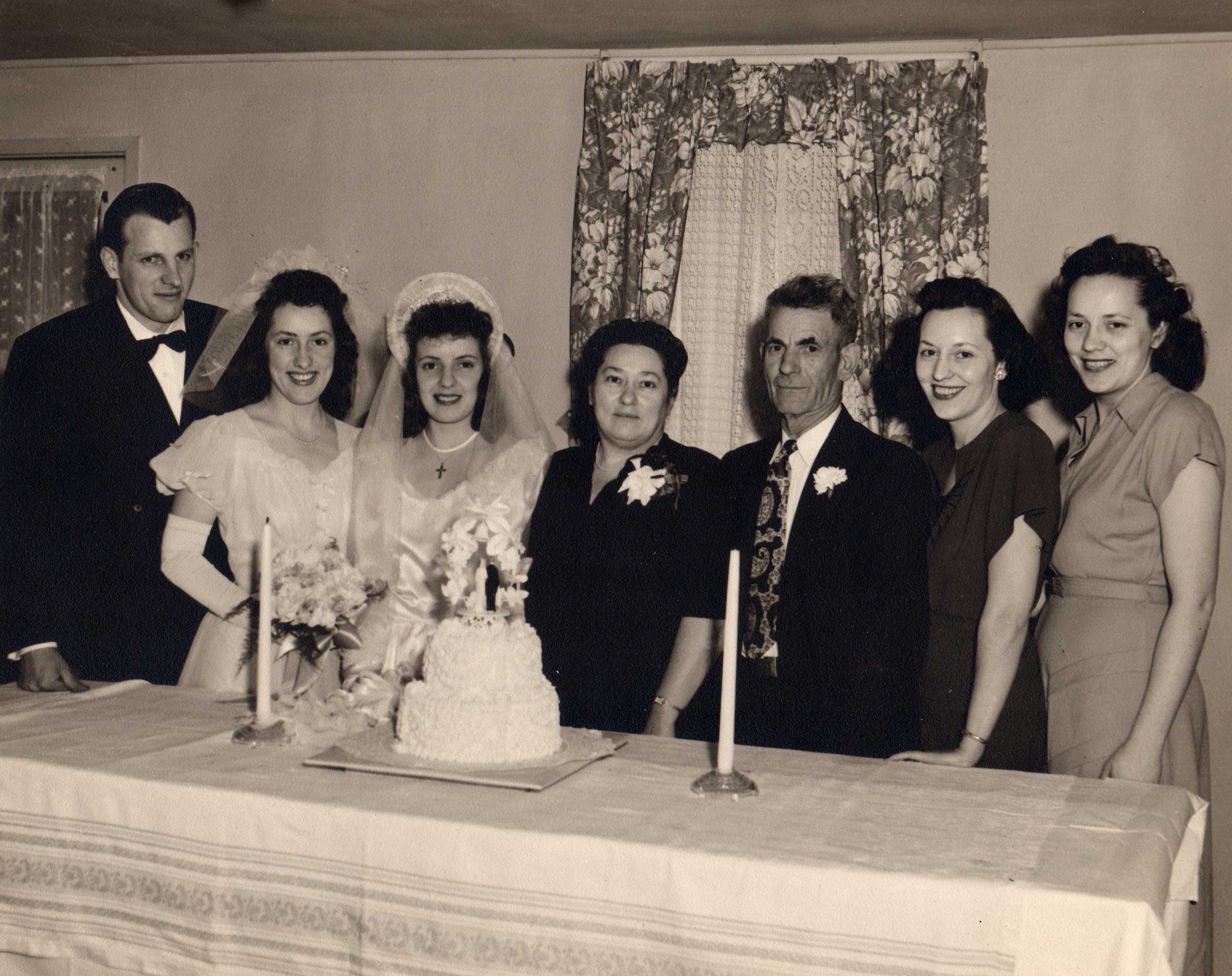
Delores Kavirt and Edward Lomprez wedding, with Kavirt siblings, 1940s.

Delores Kavirt wedding, with Kavirt siblings and her mother, Bernice, and third husband, Johnny Terasse, late 1940s.

Delores and Eddie’s second house was “garage home” that they built on a lot given by Eddie’s dad. After Eddie was drafted into the Korean War and returned, Delores recalled, “We caught a lucky break and were able to construct our first, real home as the result of bad luck suffered by my only brother and favorite sibling, Willie.”

Tragedy Befalls ‘Wild’ Willie

A St. James Trade School football and basketball star, Willie also had survived his service in World War II and returned to working multiple shifts at Pillsbury Mill. Delores had loaned Willie some money so that he could build himself a home. “For reasons we never knew, the home under construction burned to the ground in the spring of 1954. Willie, 27, was uninsured and lost his desire to rebuild. He insisted I take the title to his lot as repayment for his loan. I resisted that and encouraged Willie to rebuild. However, he refused, and I ended up with a nice lot–and a basement full of debris from the fire, which Eddie and I cleared by hand.”

Willie Kavirt, St. James Trade School football star, 1940s.

Willie Kavirt, St. James Trade School football star, 1940s.

Delores recalls her only brother’s wild side. “He liked to stay out late and gamble. I’d bug him from time to time about marrying and settling down. He always said, ‘No, my lifestyle now would just make some woman miserable…I’ll wait.’ “By then, several of my nieces and nephews had been born. Willie referred to them all as ‘little corned beef and cabbages.’

“Although he seemed to like the little ones and may have ended up a father someday, tragedy struck early one morning, only a few months after the fire that destroyed Willie’s home. He and a friend drove their car into the path of a truck and were pronounced dead at the scene. It was such a horrible accident that it was not even possible to determine who had been driving.”

The Illinois State Journal reported the accident occurred at Route 4 and old U.S. Route 66, at the northwest corner of the Illinois State Fairgrounds. The trailer-truck dragged Willie and his friend’s car 150 feet into a ditch, where the the cab of the truck shot up, then crashed down on top of the car. The August 25, 1954 Journal article reports, “It required nearly two hours for three wreckers to lift the truck from the car and extricate the bodies.” Although the truck driver reported the car ran a stop sign, he was cited for speeding.

Five Acres near Rochester

Delores (Kavirt) Lomprez is now the last of her siblings: Lillian (husband Joe Trello), Alice (husband Al McKenzie) and Bernice (husband Albert Manning). Lillian lived on North 22nd Street, worked at Sangamo Electric and retired from the cafeteria at St. Aloysius School. She had one child, Phillip. Alice worked at The Springfield Shoe Factory and had one child, Allen Wayne. Bernice worked at Memorial Medical Center and had four children: Alice, Glenn, Elaine and Bryan. Delores worked at Sangamo Electric and retired from the cafeteria at Rochester Schools.

“Up until the time Eddie died, we enjoyed a large vegetable garden, raising chickens and maintaining five acres at our second rural home. (Nephew Glenn Manning also says the rural spread included a woodworking shop, a grape arbor and a working windmill.) My husband and I never had children, but we did have the pleasure of many visits, including being summer hosts for our nieces and nephews, mostly on the Lithuanian side of the family.

“Momma (Bernice Mazika Kavirt) lost her eyesight due to diabetes, so later on in life she came to live with Eddie and me. She had her own room in our ranch-style house and got along quite well by feel. In our second careers, Eddie and I worked opposite shifts, which allowed one of us to be at home with Momma most of the time.”

As for the Lithuanian-American twice-deserted wife and mother who struggled to take care of her children alone and prevented them from being adopted out during the Great Depression, Delores says, “To this day, I wear a necklace with a pewter angel to remind me of my dear Momma. She is one of my angels.”

Leftist Lithuanians

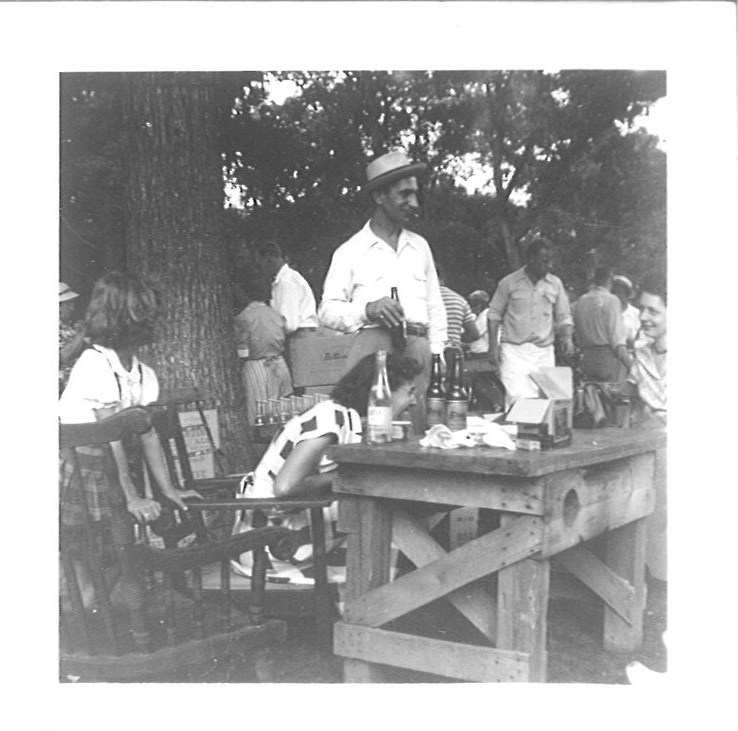
Frank Pakey dancing at "Lithuanian Lodge" picnic, 1950s.

Frank Pakey dancing at “Lithuanian Lodge” picnic, 1950s.

From the 1930s through the late 1950s, Springfield seems to have been home to the “Lithuanian Lodge,” a.k.a, the local lodge of the leftist fraternal benefit society known as the Association of Lithuanian Workers (ALW). In October 1949, the Illinois State Journal ran an announcement of a lodge picnic at the Pakutinskas (Pakutinsky or Pakey) farm on Mechanicsburg Road about seven miles east of the city.

Wikipedia says the ALW was established in June 1930 as a communist-leaning splinter of the Lithuanian Alliance of America. I quickly get lost in the alphabet soup of twentieth century American leftist organizations with Lithuanian-language branches, not to mention exclusively Lithuanian left-wing groups.

However, two facts about leftist Lithuanian immigrants of the first wave seem interesting: According to some sources, Lithuanians frequently constituted the largest foreign language group on the early American left. Second, although illiteracy was the rule among first-wave Lithuanians, it seems that many of those who were educated gravitated to socialist organizing and publishing.

Frank Pakey chatting up the ladies at "Lithuanian Lodge" picnic, 1950s.

Frank Pakey chatting up the ladies at “Lithuanian Lodge” picnic, 1950s.

For example, according to Wikipedia, the Amerikos Lietuvių Socialistų Sąjunga (American Lithuanian Socialist Union or ALSS), was established in 1904 by Lithuanian immigrants, and did not affiliate with the Socialist Party of America until 1915. Although independent, the Laisvė (Freedom) newspaper affiliated with the ALSS. It was called “one of the most influential and longest-running radical Lithuanian-language newspapers in the United States, issued daily from 1919 through 1958.”

When the Socialist Party of America split in 1919, its communist-leaning Lithuanian Socialist Federation branch moved en mass into the newly formed Communist Party of America, and Laisvė became an organ of the CPA. (The “lodge” or ALW had its own national publication, Tiesa (Truth).

Communists Down on the Farm

Joseph Pakutinskas, left, Herrin coal miner, 1910s.

Joseph Pakutinskas, left, Herrin, Ill. coal miner, 1910s.

A local man who wrote for Laisvė during the 1930s under the pen name, “Urbana Farmer,” was Joseph Pakutinskas (Pakutinsky), who owned the aforementioned 80-acre farm on Mechanicsburg Road with his son Frank Pakey. Joseph and his wife Anna Janusauskis were born in Lithuania in the 1880s, and immigrated to the U.S. around 1907. According to grandson Donald Pakey, Joseph was a coal miner in the Herrin area and later a farmer in Champaign County before settling in Sangamon County.

What Don, a physics professor at Eastern Illinois University, remembers from family lore are his grandfather’s radical writings for Laisvė and the lively summer picnics of the Lithuanian Lodge on the Pakey farm. The Pakeys even had a cement slab laid in the picnic area to create an outdoor dance floor.

When he was a toddler, Don joined the picnics in a play pen, where he was not alone. A goat that his older sister Emily bought from one of the Lithuanian-American women for three cents was small enough to squeeze in through the bars of the pen and play with him. Although he was too young to remember, Don’s guess is that the Lithuanian Lodge Pakey farm picnics ended when his grandmother Anna died in 1958.

Don Pakey in playpen, sister Emily and "the goat." Pakey farm, 1950s.

Don Pakey in playpen, sister Emily and “the goat.” Pakey farm, 1950s.

“Then, in the early 1960s, my grandfather, whom we called “Pa,” had the first of several strokes,” Don recalled, “and he couldn’t really talk after that. He lived with us there on the farm till he died in 1969. I only have memories of my grandfather wandering around the farm and doing light farm work. However, Emily has good memories of talking to ‘Mamita,’ as we called our grandmother, and her flocks of baby turkeys. Mamita didn’t know a lot of English, but they did talk.”

Don’s father Frank and Uncle Pete attended the University of Illinois in the 1930s and fought in World War II.

Hard Times on the Left

Immigrant leftist organizations provided self-help and cultural resources, like libraries, choirs and drama clubs.  But even more important, they served as vehicles, often in concert with labor unions, for the struggle against the shameless exploitation of unskilled immigrant workers in mines and factories.

"Mamita" (Anna Janusauskis Pakutinskas) with her baby turkeys, Pakey farm, 1950s.

“Mamita” (Anna Janusauskis Pakutinskas) with her baby turkeys, Pakey farm, 1950s.

To the extent that the U.S. government served more powerful corporate and national interests, immigrant socialist and communist organizations were feared, from their inception, as real or potential enemies of the state. During World War I, they organized pacifist opposition that was an open threat to the draft. As a result, Congress passed the Espionage Act of 1917, subjecting those who opposed or interfered with America’s war effort to jail time and/or deportation.

In fear of the radical foreign language press, the Sedition Act was passed in 1918 to include even opinion that cast the government or the war effort in a negative light. Although the Sedition Act was repealed in 1920, the Espionage Act was upheld by the Supreme Court, and beginning that same year, a succession of U.S. laws closed the spigot of mass immigration from Southern and Eastern Europe that had fueled so much growth on the American left.

After the Russian revolution, American leftists tied their leadership, philosophy and actions to that single existing example of communist government, the U.S.S.R. This was less of a perceived threat during World War II, when the U.S. allied with the Soviet Union to defeat fascism. However, with the beginning of the Cold War, organized communism in the U.S. was actively suppressed. Most of us have heard of McCarthyism and the Hollywood blacklisting of Communist Party members and sympathizers.

Outdoor dance floor at Pakey farm picnic of the "Lithuanian Lodge," 1950s.  Lithuanian leftist groups supported racial equality and were racially integrated.

Outdoor dance floor at Pakey farm picnic of the “Lithuanian Lodge,” 1950s. Lithuanian leftist groups supported racial equality and were racially integrated.

Additionally, according to Don, “The Internet tells us of the June 23, 1947 Taft-Hartley Labor-Management Relations Act, passed by Congress over President Truman’s veto, which sharply curtailed the rights of organized labor while forcing unions to purge communists from their ranks. Likewise, on Nov. 2, 1949, the Congress of Industrial Organizations (CIO) voted at its national convention to revoke the charter of the United Electrical Workers, the CIO’s third largest union, for failing to purge itself of communist influence. Ultimately, 12 left-leaning unions, and countless individual left-wing organizers, were booted from the CIO.”

Stalin and the Abuses of Communism

Leftist party ties (in some cases, slavish ties) to Soviet leaders and policies made them not only a perceived threat to the U.S. government, but also stubbornly blind to the Siberian gulag of Soviet dictator Josef Stalin. The left’s blind allegiance to the U.S.S.R., including the 1940 Soviet re-conquest of Lithuania, was a fundamental cause of conflict and division in Lithuanian-American communities like Springfield’s.

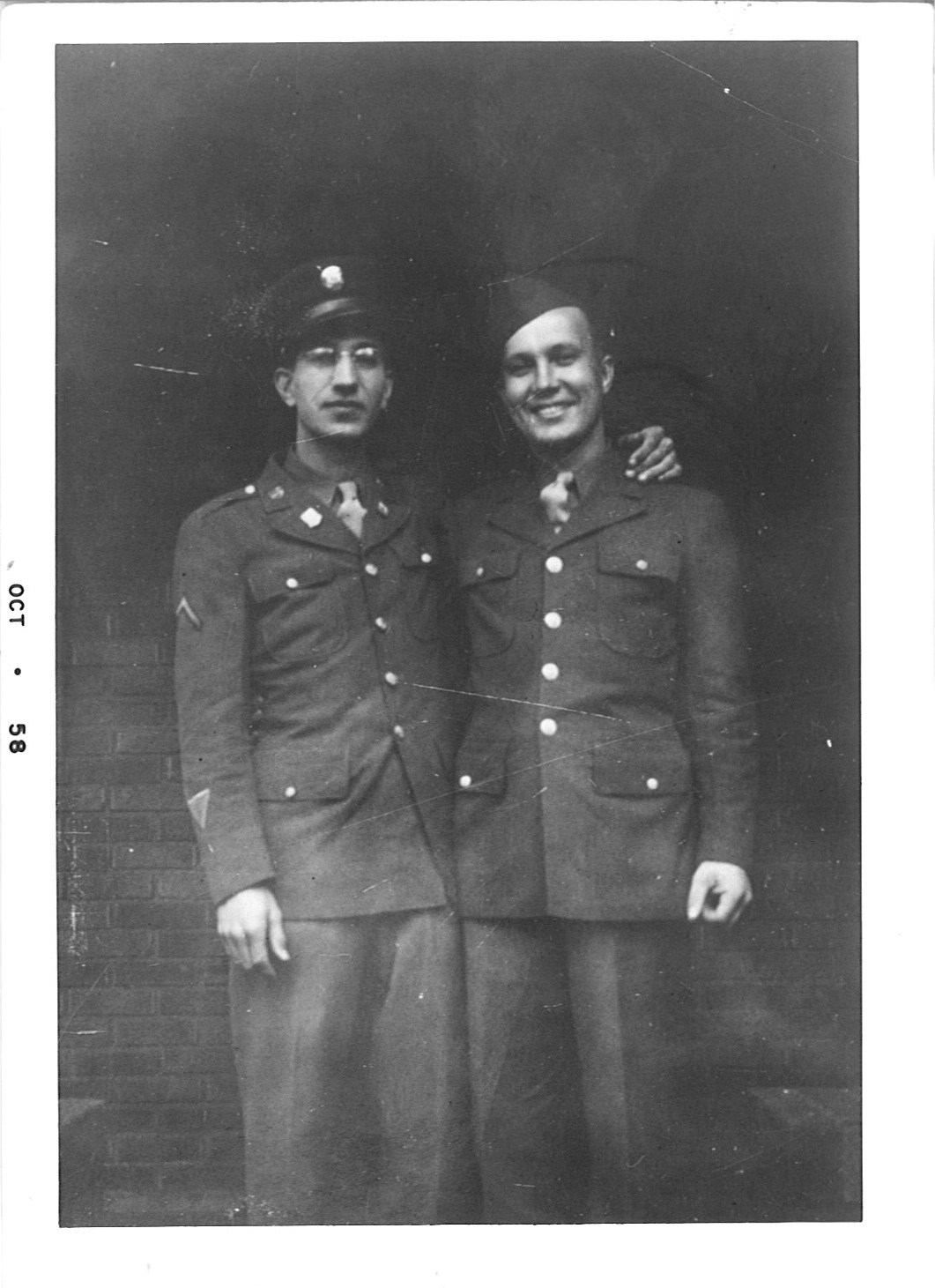
From left:  brothers Frank and Pete Pakey in uniform, World War II.

From left: brothers Frank and Pete Pakey in U.S. Army uniforms, World War II.

With the arrival after World War II of Lithuanian eye witnesses to Soviet brutality, in the form of displaced persons (DPs) like my father, it had to become increasingly precarious to remain a Lithuanian-American Stalinist. Yet decades of true-believer orthodoxy and a lifetime of struggle probably made it emotionally hard even to listen to such witnesses, let alone embrace what they said.

For Dad’s part, living through one Soviet occupation in 1940 and narrowly escaping another in 1944–fleeing thousands of miles into exile and losing his homeland and way of life in the bargain–only to encounter Lithuanian-American communists parading on stage in Springfield in Red Army uniforms, had to be nothing less than traumatic.

Dad recalled the sight well into his 90s, and I believe the large and devoted leftist contingent within the Lithuanian community here played a role in his estrangement from that community. It couldn’t have felt safe to mingle with Stalinists who were hostile to all evidence of the rape of Lithuania, and who might have had contacts– through international communist organizations–that were a danger to family back home and abroad. (During the 1980s I learned that the Lithuanian family members of those who had fled to the West were persecuted and spied on until the very end of the Cold War.)

Brother against Brother

To this day, it strikes me as grotesque that the twentieth century’s first two waves of Lithuanian immigration to the U.S. had to be divided, brother against brother, by two contradictory visions and experiences of communism. For many first-wavers like Joseph Pakutinskas, communism probably was first and foremost about building a world where working people weren’t oppressed by company bosses and their political hacks. (Joseph’s leftist leanings also could have had roots in Lithuania’s anti-czarist movements of the late 1800s.) Yet Lithuanian-American communists’ hierarchical subordination to the Soviet Communist Party, even to the extent of embracing the Soviet conquest of Lithuania, was the ultimate fatal flaw.

Anna and Joseph Pakutinskas, circa 1950.

Anna and Joseph Pakutinskas, circa 1950.

Political divisions pitting brother against brother were obvious from the beginning of the Lithuanian first wave, and may even have partially driven the founding (1906-1911) of Springfield’s St. Vincent de Paul (Lithuanian) Catholic Church. By the late 1910s and the early 1920s, Catholics based at the church also had organized the Knights of Lithuania and the Lithuanian Roman Catholic Alliance of Labor (it seem likely, at least in part) to counter Lithuanian leftist organizing, complete with the same kind of cultural activities that the leftist groups used to attract and uplift their members. (See Knights of Music, Baseball, Picnics.)

Despite being similarly impacted by assimilation and the death of the first-wave immigrants who formed their backbone, Lithuanian leftist associations in Springfield seem to have declined more precipitously than Lithuanian Catholic groups.  This may have been partially due to tendencies towards schism on the national level, and Cold War era attacks on the organized left. However, second-wave immigrants no doubt provided new blood for the parishes, while at the same time undermining the left’s core reliance on the moral superiority of the U.S.S.R.

Trans-generational upward mobility through education, the success of labor unions, and increasing access to white collar professions in Springfield also incrementally stole much of the left’s thunder. The break-up of the Soviet Union in 1991– ironically, on the force of determined Lithuanian, Latvian and Estonian independence movements–precipitated the ultimate crisis for the Lithuanian-American left, along with leftist movements around the world.

Beautiful & Driven: Julia Stockus Wisnosky

I just received a photo of Julia Wisnosky (Vysniauskas) that made me think, “This must have been the most beautiful Lithuanian-American girl in Springfield.” Granted, that would have been some contest back in the 1920s and ‘30s, based on the photos I’ve seen.

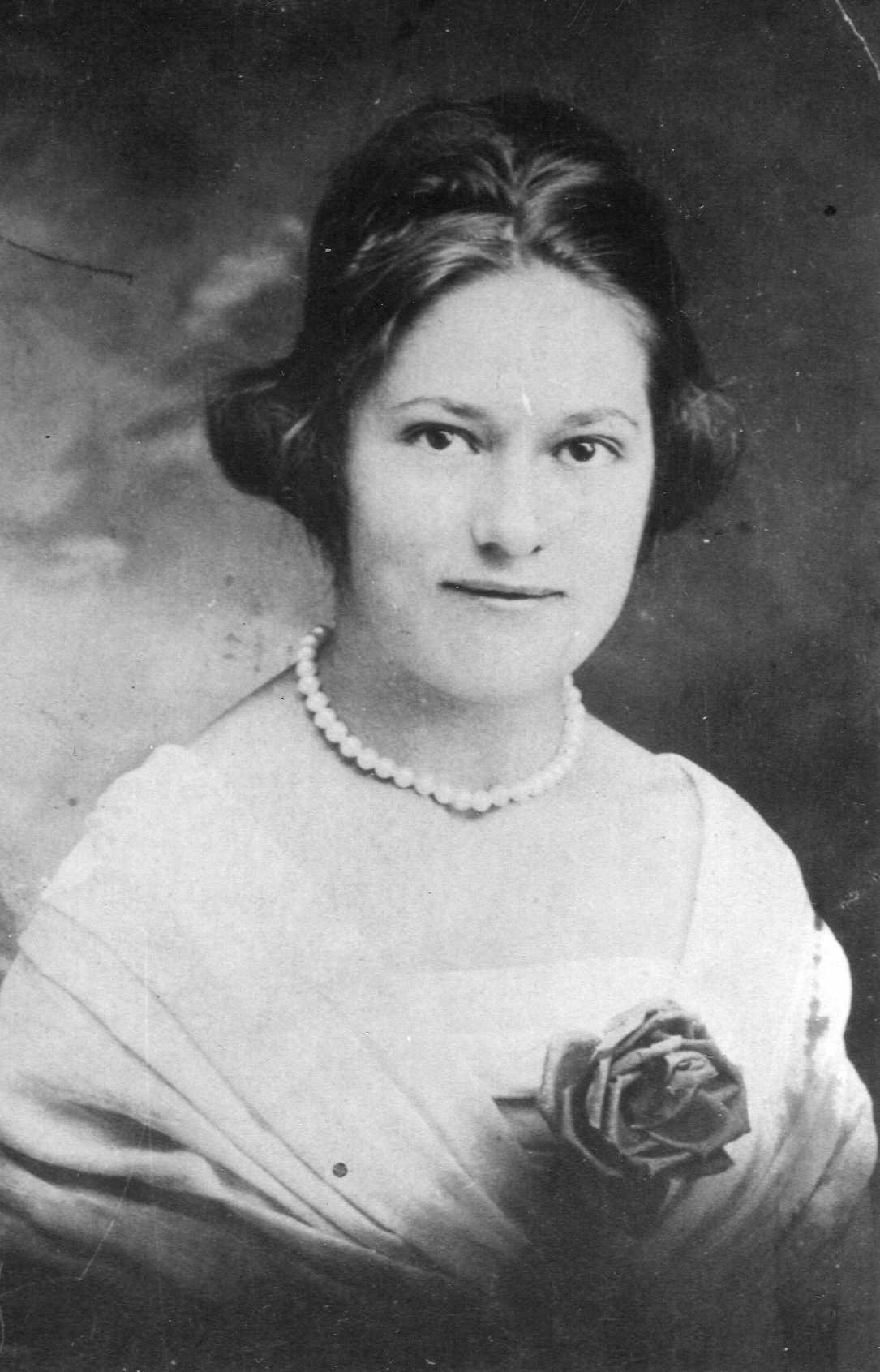
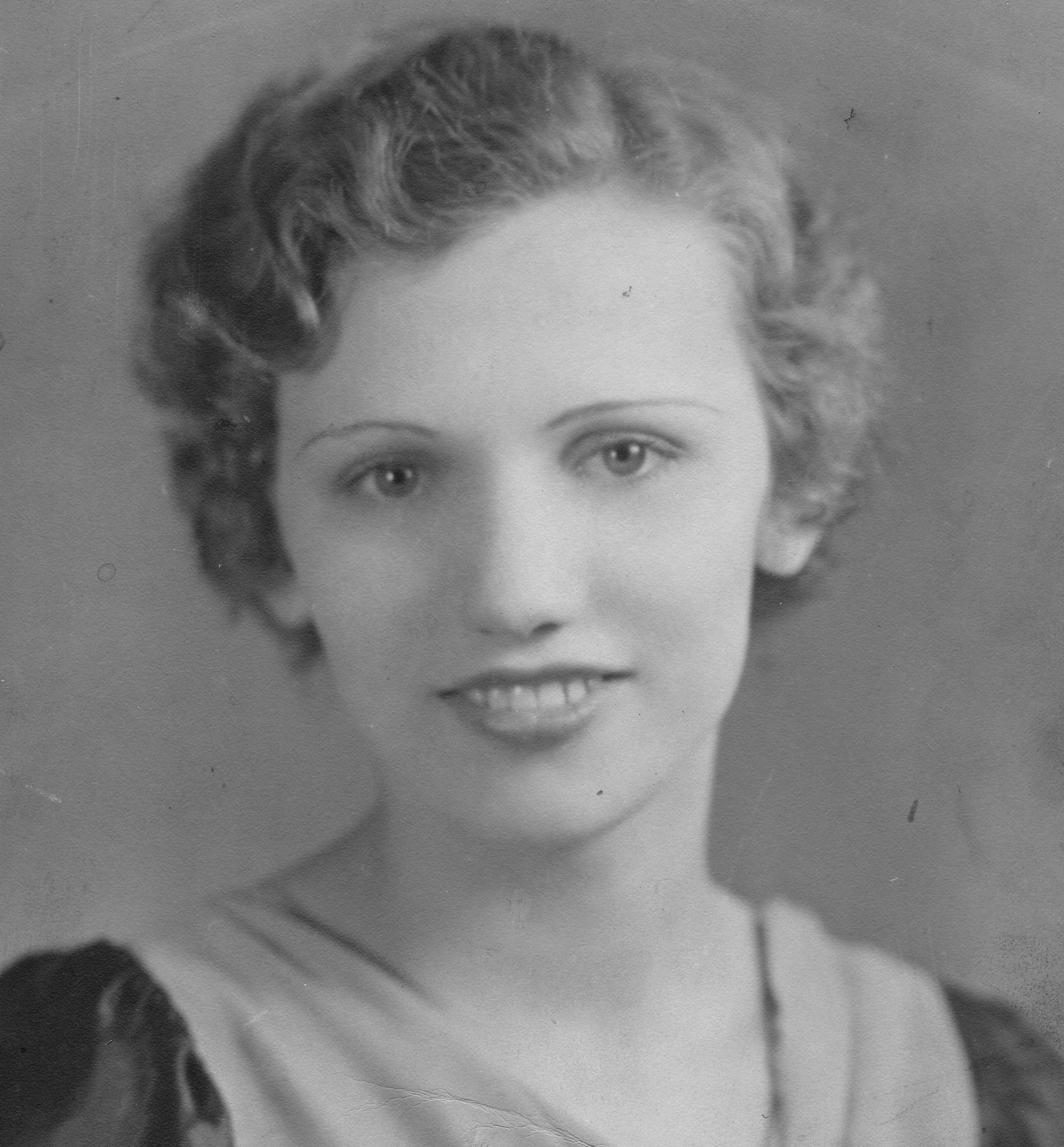
Julia Stockus (Wisnosky) at 16, 1931.

Julia Stockus (Wisnosky) at 16, 1933.

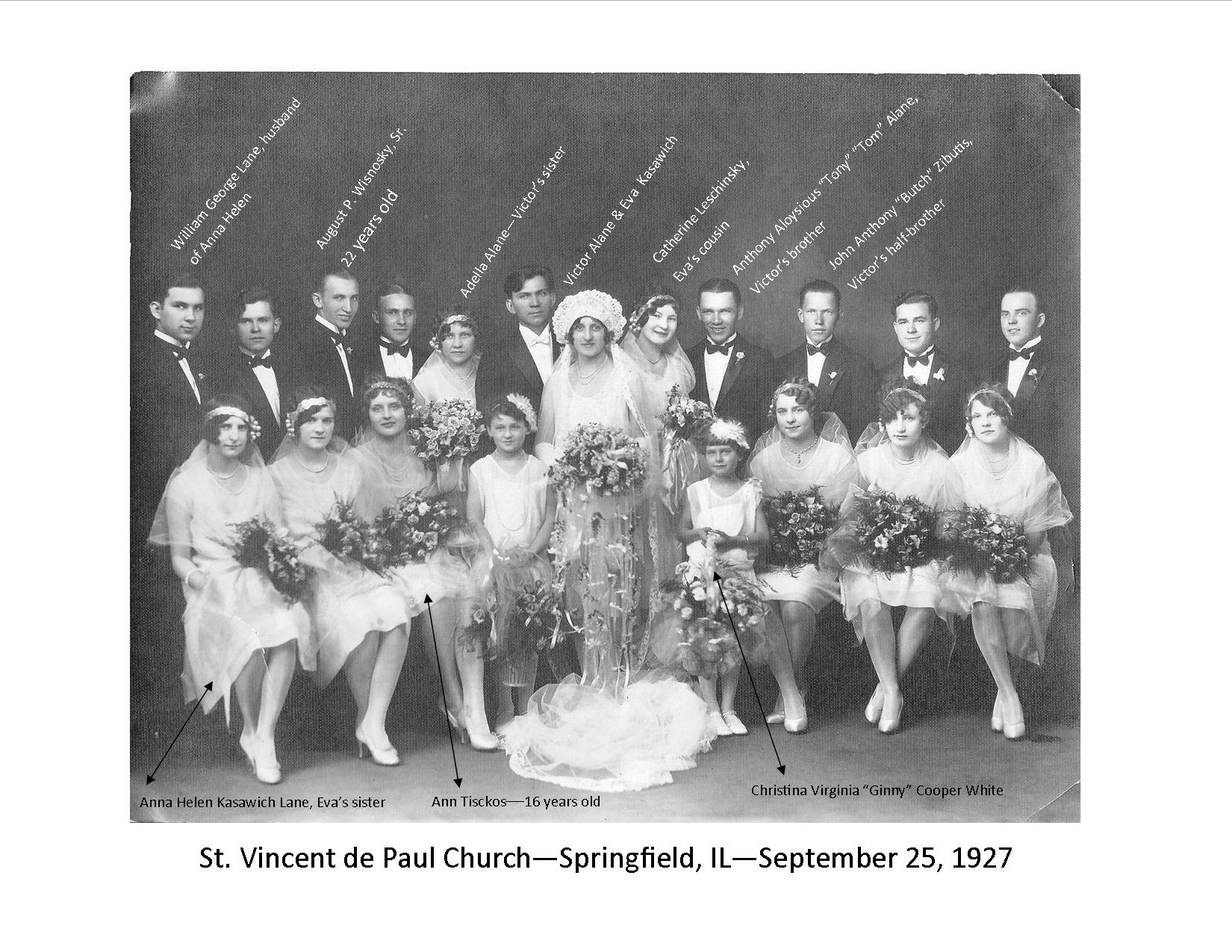
First, there’s 16-year-old Ann Tisckos (later Wisnosky) in her Kasawich-Alane wedding party photo.  And, then there’s the famous Anna (Gudausky) Frisch, whose brother owned “Butch’s” Tavern, then Butch’s Steakhouse. Renowned in her time as the most beautiful Lithuanian-American girl in Springfield, Anna only burnished her legend by marrying “up” and going off to live in The Big Apple. However, in the presence of this portrait of the young Julia Stockus, I find myself transported back to a two-room home without indoor plumbing across from the state fairgrounds on Peoria Rd. And there, behind the gilded image, stands a disappointed young girl who has had to end her education with grade school so she can help support her family by taking in laundry. How will she fulfill her dream of moving beyond the hard life of her immigrant parents?  How will she even keep up with the other girls and boys she knows from school? According to daughter Janice (Wisnosky) Kansy, it’s such a blow that, even after catching up with night classes, Julia will always keep secret the fact that she never went to high school.

Julia behind the counter at the Woolworth's soda fountain, downtown, Fifth and Monroe Strs., 1930s.

Julia behind the counter at the Woolworth’s soda fountain, downtown, Fifth and Monroe St., 1930s.

A Challenging Start Julia’s childhood was difficult in many ways: Parents who drank too much. Appendicitis. A lightning strike on her home in which she was cut (but not on the face) by flying glass. And who knows how many other dangers to the safety and self-esteem of a young girl lurked in her rough immigrant neighborhood—along with the warm embrace of grandparents, aunts, uncles and cousins right next door and across the alley. Maybe all the hardship and roughness around the edges—outhouses and chickens in the backyard, hand-made material goods, public drunkenness and fights—are precisely what explain that veritable glamour shot of a 16-year-old girl with a far from glamorous life. Image According to her daughter Janice, Julia grew up to be a talented seamstress, department manager, and founder of Springfield’s still-surviving Lithuanian-American Club. She also sponsored a Lithuanian DP family, was mother to an adopted daughter and two of her own biological children, and took in two World War II Lithuanian orphans (all while paying meticulous attention to her appearance, which is hard for me even to imagine). These details bring into focus a woman making her way down the paths of beauty and homemaking traditional for her time, while also nurturing a drive for  importance in the wider world.

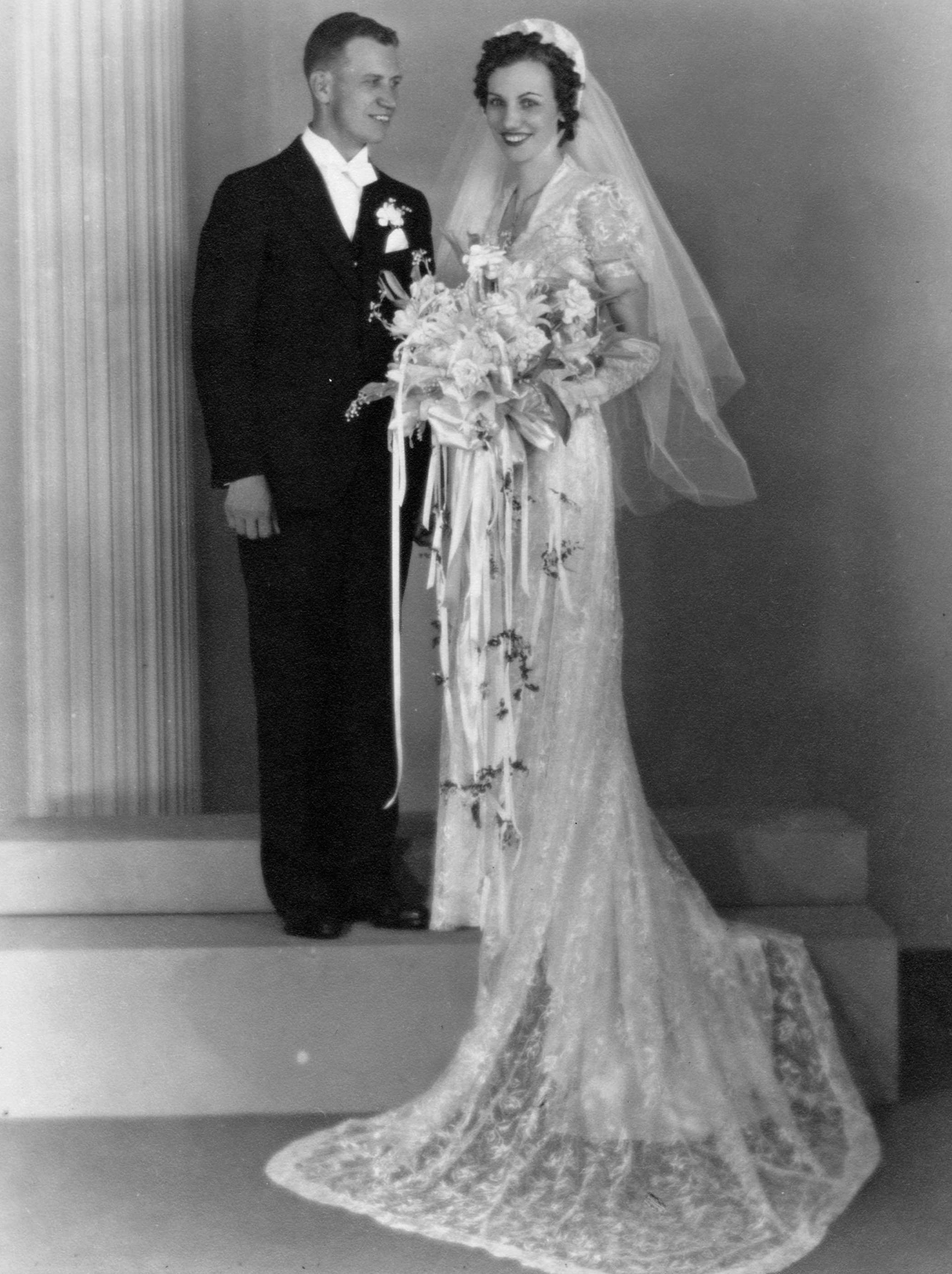
George and Julia (Stockus) Wisnosky wedding, 1930s.

George and Julia (Stockus) Wisnosky wedding, 1930s.

From Childless to Five Children Julia was born in 1917 in Springfield, the daughter of Lithuanian coal miner Anton (Antanas) Stockus and Verna Backovitch. She attended Ridgely Elementary School. Introduced by a cousin, at around age 20, she married George Wisnosky, Jr. (brother of Augie, Sr., Ann and Joe, who died of leukemia at 18). The wedding took place at St. Vincent de Paul Lithuanian Catholic Church. Julia’s father-in-law, George, Sr. was a founder of St. Vincent’s, and Lithuanian was the principal language in his home. Thus, by relating to her in-laws, especially her mother-in-law, Julia learned her life’s best Lithuanian, according to Janice. During her first 11 years of marriage, Julia did not conceive, and was told she probably could not. So she and George adopted their first daughter, three-month-old Georgeann, born in Pana. Just after World War II, they sponsored a DP family, the Sidlauskases, housing the couple with two boys in an apartment building they owned, probably on Lowell Ave.

Illinois State Journal-Register

Illinois State Journal-Register

Hearing from the Sidlauskases about two distantly-related orphan children, Romualda and Vytautas (Vito) Sidlauskas, who were still living in a DP camp in Germany, Julia and George also arranged to take Romualda and Vito in. And, as you might guess, in almost no time, Julia miraculously conceived her first child, Janice, with whom she was pregnant the day she and George took little Georgeann to the train station to meet the Sidlauskas children. Soon afterwards, Julia also had a son, in the space of a few short years, going straight from a sentence of lifelong childlessness to house full of five children. Working in Town and on the Farm For most of their married life, Julia and her postal worker husband moved often. Janice remembers the family’s longest stint in one place: nine years owning and working a farm off Route 54 in Barkley (Sherman postal address). George Wisnosky, Jr. had wanted to be a doctor, but had had to quit U of I after two years to work off family medical bills. On the farm, Janice reports that George or Julia would work in town while the other worked the farm, caring for the animals: a horse and a goat, but mostly pigs and cows that were sold for slaughter. After George got disabled by arthritis, Julia worked full-time as a secretary at Grant Middle School. (I am almost certain Julia preferred working in an office, while retaining the guts and versatility from her youth to do manual labor when necessary.) Keeping up Appearances Julia.sewingJanice recalls: “My mom was quite a seamstress. She made all our Easter clothes, even my brother’s suit. She was very into the home, re-finishing furniture and decorating, and she loved clothes. She really cared how she looked.” Here I think back to Julia’s parents’ generation, whose everyday immigrant reality of hard, physical work was redeemed by their Sunday fashions. And I get two completely opposite pictures of Julia in my mind: one in muddy farm clothes, and the other in this “Easter parade” with her children. Maybe these “down-in-the-mud” work-a-day identities were precisely what made dressing up necessary, a kind of antidote. And, ironically, Americans only stopped dressing up to be seen in public, at church, movies, shopping, etc., when their lives became cleaner, wealthier, easier, and they no longer had so much about themselves to prove.

Top from left: Vito and Romualda Sidlauskas, Julia Wisnosky. Bottom from left: Julia's son, daughters Janice and Georgeann, 1950s.

Top from left: Vito and Romualda Sidlauskas, Julia Wisnosky. Bottom from left: Julia’s son, daughters Janice and Georgeann, 1950s.

Happy Times at St. Vincent’s “My folks never had a babysitter,” Janice recalls. “They never went out, just once on New Year’s Eve, to a big party at someone’s house.” These parties were hosted in the basements of friends from St. Vincent de Paul’s, usually by Ann (Wisnosky) Urbanckas, George’s sister, or his brother Augie, Sr. and their spouses Al and Ann, respectively. Peter and Bernice Kurila and John and Adela Arnish also hosted some of the basement parties. The St. Vincent’s friends and relatives were a tight group who shared the ups and downs of life and many happy social times. “The church used to have an annual spring bazaar that they all worked at. There was also a tradition that on Easter Sunday, there would be a progressive dinner starting with coffee and rolls at Fr. Yunker’s house after Mass. Then everybody would go from house to house to eat different foods and visit for half the day.”

one of the New Year's  basement parties

one of the New Year’s basement parties

Lithuanian Club Founder Two of Julia’s proudest achievements outside the home are both mentioned in her obituary, dated August 11, 2004. The first was her rise to director of the audio/visual department at Scottsdale Community College in Arizona, where she and George initially retired. Her second achievement came after retiring from that college job in 1980. It appears that after a few years back in Springfield Julia needed a new challenge: helping to found a new Lithuanian-American Club as a social and cultural outlet for those who had once been members of St. Vincent de Paul Church. When St. Vincent’s was closed and demolished by the diocese over parishioners’ protests, those who still wanted to continue as practicing Catholics had no choice but to move on to other parishes. But they still kept their ethnic social ties from their St. Vincent’s days. That’s how enough of a core ethnic group remained, 16 years after their church’s demise, to form the new Lithuanian-American Club.

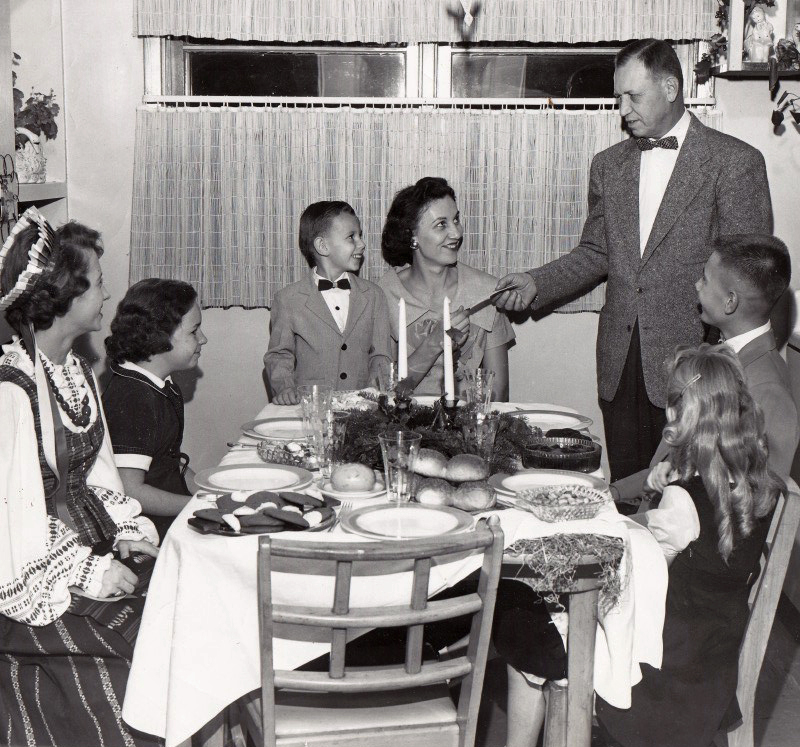
A Lithuanian dinner at the Wisnosky house, original glossy photo given to the family by the State Journal-Register.

A traditional Lithuanian Kucios dinner at the Wisnosky house, featuring evergreen branches under the tablecloth and Christmas wafers. Original glossy photo given to the family by the State Journal-Register.

Although Julia was the one who made the call to Tom Mack and suggested others for that founding meeting in Tom’s office, she deferred to him as first president of the club, taking the office of founding vice-president. Over the years, Julia served the club in many roles, along with her daughter Georgeann and foster daughter Romualda (Sidlauskas) Capranica. “I remember buying her a corsage to wear to the first Lithuanian-American Club Dinner-Dance,” says Janice, who, as a molecular biologist, held posts at various universities and research labs out of state. Now a part-time teacher of chemistry and biology at a community college north of Seattle, Janice recalls how firmly both her parents clung to their ideal of an education. For her father George, this was manifest as a desire for his kids to earn degrees from the University of Illinois, where his dream of becoming a doctor had been cut short so many years ago.

Knights of Music, Baseball, Picnics

Was it ever fun to be a Lithuanian immigrant in Springfield? Yes, thanks to a variety of social, sports and political organizations and their “musical” schedules of activities.

Back in the 1920s, music was at the core of almost every Springfield Lithuanian gathering. There were elaborate musical programs at Sunday high mass on Easter and Christmas. Operas and operettas were performed by Lithuanian voices and musicians for the general public at the Springfield High School Auditorium and the Knights of Columbus Hall. And Lithuanian folk songs were sung by 60-100 voices at summer picnics that also featured extremely competitive men’s fast-pitch baseball and women’s softball.

The Lithuanian-language operetta, “L’Tevyne” (“The Homeland”), composed and staged here in August 1923 by St. Vincent de Paul’s famous organist Alexandras J. Aleksis, dramatized the “uplifting power” of music to regenerate a badly degraded Lithuanian nation—if not in the homeland, then on U.S. soil. No one knew the poverty, ignorance, alcoholism and crime endemic among Lithuanian immigrants better than more educated Lithuanian elites and those who were the conscience of their community.

Crucially, in the late 1910s and early 1920s, these individuals decided to seize the cultural, political and artistic freedoms available to every American– even while economic progress remained elusive–to elevate themselves and their Lithuanian countrymen above the daily degradations and deprivations of the struggle to survive. The banner under which they organized belonged to the Knights of Lithuania, with local branch 48 sometimes being called the K of L of St. Vincent de Paul Church.

To multiply the impact of their cultural enrichment campaign, the talented and dedicated souls who poured their hearts into the Knights also decided to model Lithuanian cultural elevation as broadly as possible, to both the Lithuanian-American masses and the American public at large. The success of the Knights’ famous choir and their frequent exhibitions of musical virtuosity in projecting a more refined image of Lithuanian immigrants, both to themselves and others, is obvious in an August 1923 State Journal-Register article proclaiming, “An intense love for music is a national characteristic of the Lithuanian people.”

It’s true that music had remained part of the Lithuanian character even when stripped for generations to its most primitive core. Even when denied the spelling of their own names, Lithuanians never lost the music and words of their folk songs or dainos for work, birth, weddings and funerals. Maybe that’s why Professor Aleksis, the most famous Lithuanian “music man” ever to grace Springfield, so perfectly embodied the campaign for progress through cultural and spiritual enrichment. Certainly no one I’ve read of in Springfield wielded the power of music for ethnic self-help with more missionary zeal.

Aleksis and the Knights of Lithuania
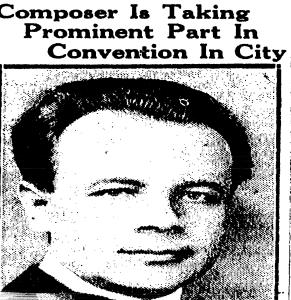
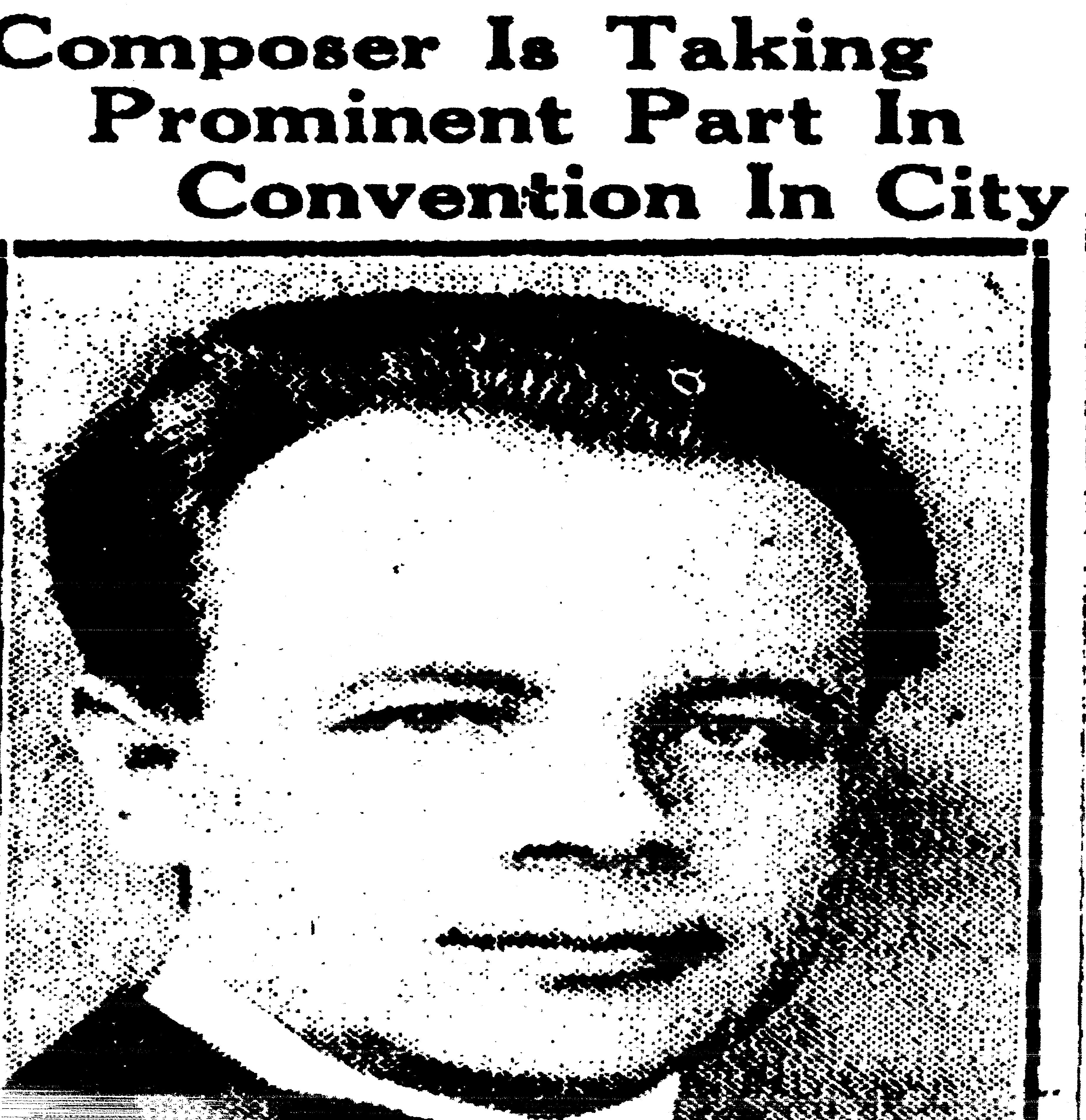
Professor Alexandras Aleksis, Illinois State Journal, August 22, 1923.

Professor Alexandras Aleksis, Illinois State Journal, August 22, 1923.

A graduate of the Warsaw Conservatory who was born in Lithuania in 1886, Aleksis appears to have arrived from Detroit on July 1, 1921 to work as organist and music director for St. Vincent de Paul Lithuanian Catholic Church. Within two weeks, he was elected president of the pre-existing (and expressly Roman Catholic) Knights of Lithuania, Branch 48 in Springfield, and became director of the Knights’ 60-voice choir that performed in national costume.

In one Illinois State Journal account, Aleksis was identified as the first president of the Knights of Lithuania national organization and composer of the Knights’ national anthem. The Knights’ current website identifies Aleksis as having been named a member of great honor (just three years after the organization’s founding) in 1916, when he was organist at Chicago’s Providence of God Parish.

No doubt he played a major role in securing a great honor for Springfield’s Lithuanian community when in August 1923, the 800,000-member K of L held its national convention here. That three-day event (Aug. 22-24) in the hall of the Illinois House of Representatives was attended by 200 delegates from 14 states. “Prominent men of the Lithuanian race in the U.S. were among the delegates participating in what is probably the most usual and unique convention ever held in Springfield,” the newspaper reported.

The ambassador to the U.S. from the newly recognized Republic of Lithuania made a point of giving a eulogy of Abraham Lincoln at Lincoln’s Tomb. Aleksis’s operetta “L’Tevyne” (book by Edward Silelio) was presented by the best local and Chicago Lithuanian-American voices at the Springfield High School Auditorium. The operetta dramatized how drinking, carousing Lithuanian men could be civilized and elevated by the uplifting influences of education, music and art. The rousing grand finale of the operetta, when singers triumphantly waving the American flag filled the stage, echoed the business side of the K of L convention, which was conducted completely in English, according to newspaper reports, and capped by a resolution that all prospective members henceforth should first attain U.S. citizenship. (The convention also again elected Aleksis its national president for the coming year.)

It Takes a Choir

So many local Lithuanian immigrants and their children lent their voices to the local Knights of Lithuania choir (renowned as one of the best in the city) to enrich and uplift their fellow immigrants—and so many great local Lithuanian-American singers and musicians served as leaders of the local chapter of the K of L.

Ann (Mosteika) Foster, St. Vincent de Paul Church organist and music director, 1933-1972.  St. Vincent de Paul Jubilee Book, 1956.

Ann (Mosteika) Foster, St. Vincent de Paul Church organist and music director, 1933-1972. St. Vincent de Paul Jubilee Book, 1956.

Anthony and Catherine (Gillette) Cooper were K of L national delegates, and sang in the group’s choir and concerts, including Anthony’s turn as a memorable bad guy in “L’Tevyne” (he was also local K of C chapter president when Aleksis arrived from Detroit). Albinas Kuprevicius was elected the local Knights’ financial secretary in 1921, the same year that Aleksis was made president, Joe Miller vice-president, Helen Beveridge secretary, and Julia Gedman (Lukitis) treasurer. Catherine Cooper also was a leader of the Lithuanian Roman Catholic Women’s Alliance Chapter 56.

Julia Gedman, a talented dancer, singer and piano soloist for many of the group’s programs, was re-elected treasurer of the local Knights and a national K of L trustee in 1923. Also in 1923, Josephine Sugent, a soprano who soloed in many of the choir’s programs, was elected second vice president of the K of L’s national athletic division, which was headed by Joe Miller of Springfield. Anna Gudauskas (Gudausky), elected a local K of L trustee with Peter Stirbis in 1921, that same year became the only woman from Springfield elected a K of L national officer (second secretary).

Not only did the K of L appear to give women a chance to play very active leadership roles; in the group’s Springfield leadership, we again see an almost evangelical confluence of music with social activism. Almost all of the K of L male leaders were also members of its choir: Joe Miller, Peter and Alex Stirbis, Anthony Cooper, Charles Ruplankas, Anthony Zelvis and (later) John Adomaitis.

Other female voices were Anna, Mary, Helen and Petronella Marciulionis, Anna Mosteika (mother of Ann (Mosteika) Foster, who would serve as St. Vincent de Paul’s longest-term organist and choir director from 1933 until the church closed on Dec. 31, 1971), Helen Beveridge and Estella and Helen Brazaitis, described by the newspaper as a “well-known Springfield soprano.”

The 10-piece Grigas orchestra accompanied the Knights of Lithuania choir when it performed at St. Vincent’s and other venues. Stanley Grigas played the violin and Charles the clarinet and saxophone (they also operated the Grigas Bros. grocery on North Ninth St). “Banker to Lithuanians” Augustus (Vysniauskas) Wisnosky, Sr., his immigrant father George Wisnosky, and my father’s own first cousin Benedict Yamont, Jr., played in the violin section. Bertha and Gertrude Miller (Milleris) played piano at a 1924 benefit for the Lithuanians of Vilnius commemorating the Polish takeover of Lithuania’s historic capital in 1922. Also active in that musical observance were: John Grustas, P. Burcikas, and A. Kazlauskas, chairman of the event.

Eighty new K of L members were initiated at a meeting on April 18, 1922. Joseph Loda and Anthony Cooper were credited with bringing in the most new members. (The Knight’s local “junior” chapter was led by Adolphina Stanslovas).

Faces of the St. Vincent de Paul

Faces of the St. Vincent de Paul “Knights of Lithuania” chapter, circa 1924, from the 1956 parish Jubilee book.

Professor Aleksis, who staged/conducted many of his own compositions, like “Shed No Tears,” “Going There,” and “Love,” also put on the Russian opera “Nastute” (sung in English) only months after his arrival in Springfield. In 1922, through his connections with the Rev. Dr. F. M. Kemesis, a member of the Lithuanian Legation in Washington, D.C., Aleksis also organized a Springfield Chapter of the Lithuanian Roman Catholic Alliance of Labor, Branch 101. In January 1923, the local chapter, headed by A. Kazlauskas, organized a presentation by Rev. Kemesis in Springfield entitled, The Catholic Church and Labor.”

Baseball, Passion, and Politics

The Knights organized a formidable men’s baseball team, which played against a K of L women’s team without keeping score as the main event of the K of L’s annual picnic July 25, 1921 at the Nokes dairy farm east of Springfield. The picnic, like anything else Lithuanians did back then, also included 100 voices singing Lithuanian folk songs, according to newspaper reports.

Unless I have my dates wrong, picnics and baseball at Lincoln Park and Camp Lincoln were frequent summertime events. Another Knights’ picnic, held on July 31, 1921 as a benefit for the Lithuanian National Relief Fund Chapter 69, featured a “fast amateur baseball game” between the Knights and Chicago-Springfield Coal Co., with Joe Miller as pitcher and (probably Victor Alane) “V. Allenis” as catcher. An Aug. 21, 1921 K of L picnic was billed as featuring a “girls’ game.”

The Knights’ annual picnic must have been a standout affair to be described in a 1922 newspaper article as “one of the big events of the outdoor season in this city.”

Although men’s vs. women’s games might not have been about keeping score, competitive passions ran high during the K of L men’s regular weekly fast-pitch baseball games against teams mounted by other K of L chapters in Chicago and Waukegan, and against local business, church and municipal teams in Rochester, Chatham, Jacksonville, Loami, Pawnee, Dawson, Havana, Kincaid, and Waverly. Home games were often at Watches Field. The “Virden Slovaks” seem to have been particular challenges for the Knights, who carpooled to many “away” games.

On April 17, 1922, the Myers Brothers team claimed an official municipal league win for what K of L captain Joe Miller said was only a practice game granted by the Knights when Myers was looking for a field to play on. The dispute continued to be played out on the baseball diamond and in the newspaper when Myers’ coach subsequently moved to deny official status to his team’s defeat by the Knights in their regularly scheduled game July 22, 1922.

Knights of Lithuania youth basketball team with sponsor.  John Zibutis back row, left edge.

Knights of Lithuania youth basketball team with sponsor. John Zibutis back row, left edge.

Newspaper accounts also describe a much anticipated Knights’ game against a “colored” men’s team called George Neal’s Union Giants. The Giants had their own east-side ballpark, which the Knights were said to be contemplating “taking over” in August 1922. Due to the success of adult amateur baseball, a “Kidsville” league was also established with Myers Brothers, the Knights and others sponsoring their own junior teams. In 1924, the Knights junior team, managed by saloon-keeper Simon (Sam) Lapinski, Sr., won the city-wide Kidsville title.

As for the Knights, an earlier team organized by Joe Miller and noted for its dominance on the diamond seemed to have had few Lithuanian players, leading to a brouhaha that included Knights members not attending that team’s only home game in May or June 1921–followed by a directive that henceforth, the team would include only Lithuanian players. Defending the promotional value to the organization of his winning Knights’ team in newspaper reports, Miller took his team outside the Knights for a short period while he barnstormed to become the K of L’s national athletic director. Once he achieved that position, he returned to the field with a new local K of L team that featured J., W, and T. Grigiskis, and other players by the names of Koski, Laskaudis, Oleseskis, Kutskill, Ballon, Laukitis and Chestnut. Still other Knights baseball players of the 1920s were surnamed Diksonas, Lukitis, Denkevicius, Keturaki, Marcinkus, Tamoliunas, Repaitis, and Bokainis.

Passing the Baton

Perhaps the Knights were negatively impacted in their recruiting by the requirement, after Aug. 1923, of U.S. citizenship for new members, at a time when an exodus of many immigrant coal mining families from Springfield was caused by mass mine mechanization and loss of jobs. It is clear that a choir/corps of Knights musical activists held concert after carnival after party after picnic in the early- to mid-1920s to raise the group’s profile among their countrymen and in the community. Joe Miller, who seems to have been quite a promoter, did the same through baseball. But by the 1930s, the group appeared much smaller on the public stage.

And by 1926, Professor Aleksis had already moved on—perhaps because of his restless artistic spirit and the inherently small pond that Springfield represented (with St. Vincent’s accompanying small organist salary that had to be in decline with the exodus of local mining families). I would also not discount politics and growing friction in the ranks of the Knights (who were divided between St. Aloysius and St. Vincent’s parishioners) between labor unionism/socialism and conservative Roman Catholicism during the lead-up to the Central Illinois “Mine Wars” (1932-36). It is likely that growing socialist-communist sentiment among disenfranchised labor was not favored at the church, long before the U.S.S.R conquest of the Lithuanian homeland in 1940.

By 1925, newspaper reports describe an operetta, “Sylvia,” directed by St. Vincent’s new organist Anthony Kvedaras (Kwedar?) in English at the Knights of Columbus Auditorium to benefit the church. (Anna Mosteika, Anna Gudausky and Vera Lanauskas were among the singers.)

The K of L Chapter 48 officers that year were: Spiritual Advisor the Rev. Stanley O. Yunker (Junkeris), who had become St. Vincent’s pastor in 1923; President John Adomaitis, Vice-President Victor Alaunis (Alane), Financial Secretary Catherine Cooper, Secretary Anna Gudauskas; Trustees Helen Shupenas and John Thomas; and Treasurer August Visnauskas (Augie Wisnosky, Sr.), Marshals Anthony Gridzuis and A. Kuperis. Josephine Sugent, Miss Gudauskas, Mrs. Cooper and Julia Svinkonif (Swinkunas?) did the “hostess” heavy-lifting for the officers’ installation meeting that also discussed the need for an “extensive membership drive,” according to the newspaper. I should mention that a core group of female friends (Gedman-Lukitis, Gudauskas, Sugent) appears to have kept the Knights and other Lithuanian Catholic organizations, including he Lithuanian Roman Catholic Women’s Alliance, going for at least 20 years.

The female cadre that formed the backbone of  St. Vincent de Paul's  many clubs, including the K of L. Circa 1930. Church 1956 Jubilee book.

The female cadre that formed the backbone of St. Vincent de Paul’s many clubs, including the K of L. Circa 1930. Church 1956 Jubilee book.

One hundred K of L members reportedly attended the group’s 20th anniversary banquet and dance in the roof garden of the Elks Club in 1936. Fr. Yunker gave the invocation and keynoted a speech about the Knights’ history and principles, while Miss Bernice Brazaitis presided as president of the club and “toastmistress.”

Lithuanian Song Festival

Professor Aleksis, called one of the “outstanding Lithuanian musicians, composers, and teachers of music in the United States” by the Aug. 10. 1942 Illinois State Journal, went on to organize the Lithuanian League of Choirs in Chicago, and to conduct four choirs and give studio lessons in his then-home with wife Marcella in Watertown, Conn. (Marcella was named a Knights member of great honor in 1968.) The professor died at age 97 in 1983 in Connecticut.

But before that, he played another important role in the musical history of Lithuanian America. As a member of the American-Lithuanian Roman Catholic Organists Alliance, Professor Aleksis helped organize the repertoire of the first national Lithuanian Song Festival in 1955. The festival featured performances in the Chicago Coliseum by 34 choirs and about 1,200 singers and raised $22,000 for Lithuanian causes. For more about the song festival, please go to: https://www.dainusvente.org/en/more/history

According to the dainusvente website, Vladas Jakubėnas, a music critic, wrote about the first Lithuanian Song Festival in the journal “Aidas:”
“The repertoire was not just sung by the unified choir – some songs were sung only by women, some only by men, and some by select choirs. On the day of the Festival, a cool summer suddenly turned hot, with temperatures reaching 100 degrees. The Coliseum had no air conditioning, and the heat was almost unbearable in the sold-out arena. In the end, however, a moral victory had been achieved. With the success of the first Lithuanian Song Festival, American and Canadian Lithuanians achieved self-respect and encouragement for future cultural projects.”

Apparently, ethnic uplift and self-help through cultural enterprise (specifically, music) wasn’t just for Springfield in the 1920s, but rather, a major and ongoing tradition in Lithuanian-American life.

In memory of Prof. Aleksis and the other full-time St. Vincent de Paul organists/choir directors, including Ann (Mosteika) Foster, Anthony Kvedaras, Stanley Zylius, Joseph Karecka, part-time organists Roman Hodalski and the Rev. J. Cullen O’Brien–and every member of their dedicated choirs.

The church choir with names, from 1956 Jubilee book
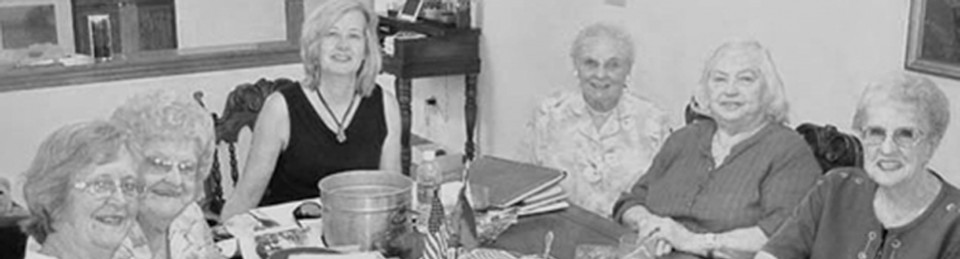
The church choir with names, from 1956 Jubilee book

A Life Worth $20

On July 17, 1917 in Taylorville, the wife of a Lithuanian miner, Mrs. Victoria Abroms (Abramaitis?) committed suicide, leaving behind two small children, because she had lost a precious $20 bill. It is difficult to imagine the depths of poverty and domestic violence that left this young mother no other escape from the crisis of losing about five days of mining wages—likely saved from household expenses over weeks or months.

The Illinois State Journal reported that, “fearing her husband’s wrath,” Mrs. Abroms drank carbolic acid and died almost instantly. Derived from coal tar, carbolic acid, or phenol, was used back then as an antiseptic, especially in soaps. (Mrs. Abroms probably made her own soap and had a ready supply.) During World War II, the Nazis used injections of phenol in individual executions of thousands of prisoners. Toxic to the central nervous system, it causes severe muscle spasms, then sudden collapse and loss of consciousness.

Killed for Stealing Grapes

Many other Lithuanian immigrants of the “first wave” experienced not opportunity in their new land, but a stacked deck. It’s likely they would have had an even rougher go of it back in the Lithuania of that time. Nevertheless, it’s important to remember that for some, immigration was not a panacea, or even, ultimately, a path to survival.

According to the Illinois State Journal, Anton (Antanas) Garulis was shot to death while running with a basket of stolen grapes from the fruit farm of J.W. Cogdall east of Springfield in August 1906. Probably an under-employed coal miner, Garulis was with another unidentified man when caught in the act of grape thievery by 17-year-old Dwight Cogdall. Young Cogdall ordered the men to stop, and when they ran, he started shooting with a revolver.

Garulis was hit above the hip, and the bullet “went high,” injuring internal organs and causing him to die later in the hospital. His young shooter posted bail on a warrant of manslaughter that was issued as “a matter of form.” I believe the boy ultimately was not tried.

Jailed for Scavenging Coal

In October 1905, Lithuanian immigrant Samuel Buckewitch (Bukevicius?), of the Ridgely neighborhood on Springfield’s north side, was convicted of larceny for picking up fallen coal along the railroad tracks running from the Jones & Adams mine.

Although the four bushels of coal found in his home, no doubt stored for winter, were worth only 28 cents, his fine and court costs amounted to $9.10. According to the Illinois State Journal, this penalty was enough to have bought a whole wagon load of coal (if Buckewitch had had that much cash in the first place). It is not known whether he was able to scrape together enough from friends and relatives to pay the fine, or whether he went to jail just for trying to stay warm.

Stealing Flour for Hungry Children

“Their husbands were out of work, their children were hungry, and so they stole,” reported the Jan. 23, 1918 Illinois State Register. But stealing from a railcar is a federal crime, and the railroad does not forgive.

Four Lithuanian women, “three with babies clinging to their skirts,” pleaded guilty in federal court in Springfield, having been shipped here from Granite City, where they were arrested for stealing flour from railcars “engaged in interstate traffic.” Mary Kovich, Mary Savaoda, Katie Kranachivic, and Ann Artolian were their reported names (perhaps the newspaper was wrong and only two were Lithuanian: Kovich and Kranachivic).

Mrs. Kovich’s 13-year-old daughter was brought along to act as court interpreter in English, Serbian, and Bohemian, in addition to Lithuanian. The four arrested women each pleaded guilty and were charged the minimum fine: $25 plus court costs, according to the newspaper. However, none could pay, so they were remanded to the county jail in Carlinville to serve 30 days.

On the bright side, federal authorities in Springfield treated the women and children kindly, letting them bunk in a courthouse conference room instead of the jail while they were here, and buying “stockings and dresses for the babies.” (One can only wonder how poorly they were clothed.) Newspaper accounts also featured a charitable tone, even suggesting “that the fines of the women may be paid for them by charitable citizens.”

If not, I wonder if the children would have served jail sentences with their mothers.

Killed by Mentally Unstable Boarder

Miners’ wives were usually expected to earn extra income for the family by “boarding” multiple single miners along with their own families. Informant Jerry Stasukinas points out that for lonely immigrant miners who could not find Lithuanian wives and make families  in America, the family boarding them could become like their own family, the children of the house like their own children. In families where the father had died in the mines, boarders could prove essential to the widow and children’s survival, in some cases, by bootlegging.

Around half of the Lithuanian immigrant males who belonged to the Lithuanian Catholic church in Springfield in the 1910s were single and very likely boarders. And even when it was symbiotic for economic reasons, this exposure to sometimes rough-living or un-hinged  men in close quarters could drastically raise the potential for domestic abuse of women and children.

According to reports in the Illinois State Journal, on Feb. 9, 1926 Alice Tamoszaitis (Tamosaitis or Tamosaitiene), 37, born in Lithuania, was shot and killed at 6:30 a.m. in her home at 1604 E. Carpenter by Charles Kaziusis, while the defendant was apparently “laboring under some delusion with murderous intent.”

The grave of Alice Tamoszaitis (Tamosaitiene), Calvary Cemetery. Headstone translation, correcting for misspellings:  Alesė Tamošaitienė, June 1891 to February 9, 1926, Laukuvos Parish. Three Will Pray (or Pray Three Times), Rest in Peace.

The grave of Alice Tamoszaitis (Tamosaitiene), Calvary Cemetery. Headstone translation, correcting for misspellings: Alesė Tamošaitienė, June 1891 to February 9, 1926, Laukuvos Parish. Three Will Pray (or Pray Three Times), Rest in Peace.

I first spotted this information last year in a Sangamon County Coroner’s inquest book while I was looking up the facts of another immigrant’s death. Then just a few weeks ago, while perusing a newspaper article (shared by Tom Mann) for information on a miner’s death, I spotted a column by A.L. Bowen that must have been referencing the Tamoszaitis murder. Dated March 11, 1926, just weeks after the crime, Bowen’s column described how an un-named mother and wife was killed by a boarder who rushed into the dining room of her humble home, brandishing a revolver. “Pointing it at the mother, he accused her of placing poison in his food, and before the eyes of (her) husband and children, shot her down and turned the gun upon himself,” Bowen wrote.
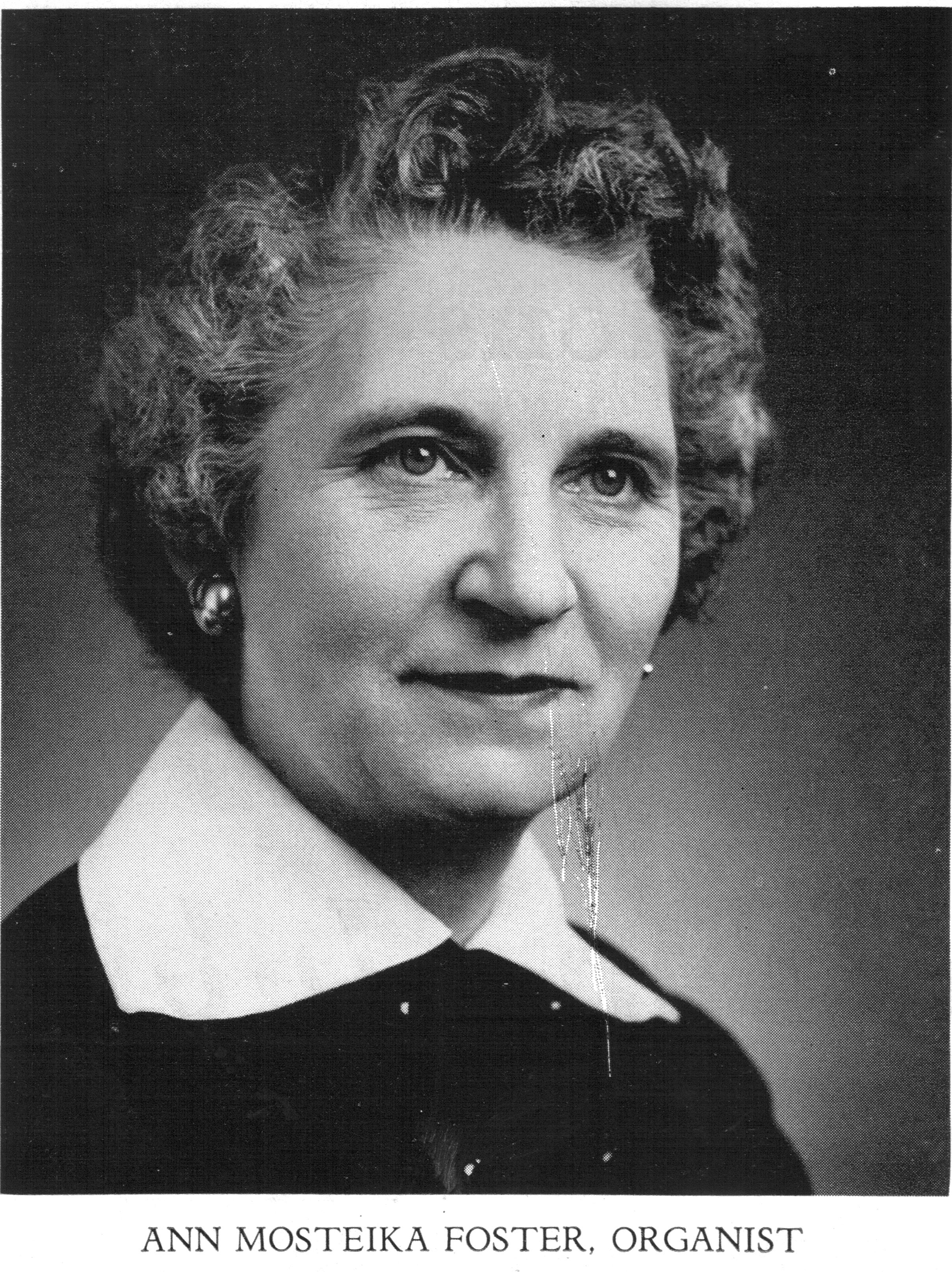
Besides timing, another reason why I think this refers to the Tamoszaitis case is that official newspaper accounts of her fatal shooting note that the killer subsequently shot himself and was taken to the hospital.

In lamenting the tragic shooting death of a wife and mother, Bowen noted, in language familiar to our own age, that the husband and neighbors had noticed the shooter acting strangely for some time. “Underlying symptoms of a dangerous (mental) disease,” he wrote, “were recognized but not understood.” Bowen went on to draw parallels between mental/nervous illnesses more rampant than tuberculosis, yet much less understood, diagnosed and treated.

“Isn’t it strange how much attention we give to physical disease, but how little we give to mental?” he asked. “The killing of this woman adds another accusing finger at our failure to understand that part of our health that means the most to us.”

Alice Tamoszaitis (Tamosaitiene) grave in disrepair, Calvary Cemetery

Alice Tamoszaitis (Tamosaitiene) grave in disrepair, Calvary Cemetery

Due to the rigors of the mining life and the scant emotional and educational reserves many Lithuanian immigrants undoubtedly brought to that life, which were progressively eroded, I shudder now to think of the potential abuse of immigrant women and children at the hands of their own countrymen within their own homes and neighborhoods.

Again, my sincere thanks to Tom Mann for unearthing these stories, which I share out of respect for the truth and the lives of the people involved. May they rest in the peace they did not enjoy in life.

What Did They Look Like–100 Years Ago?
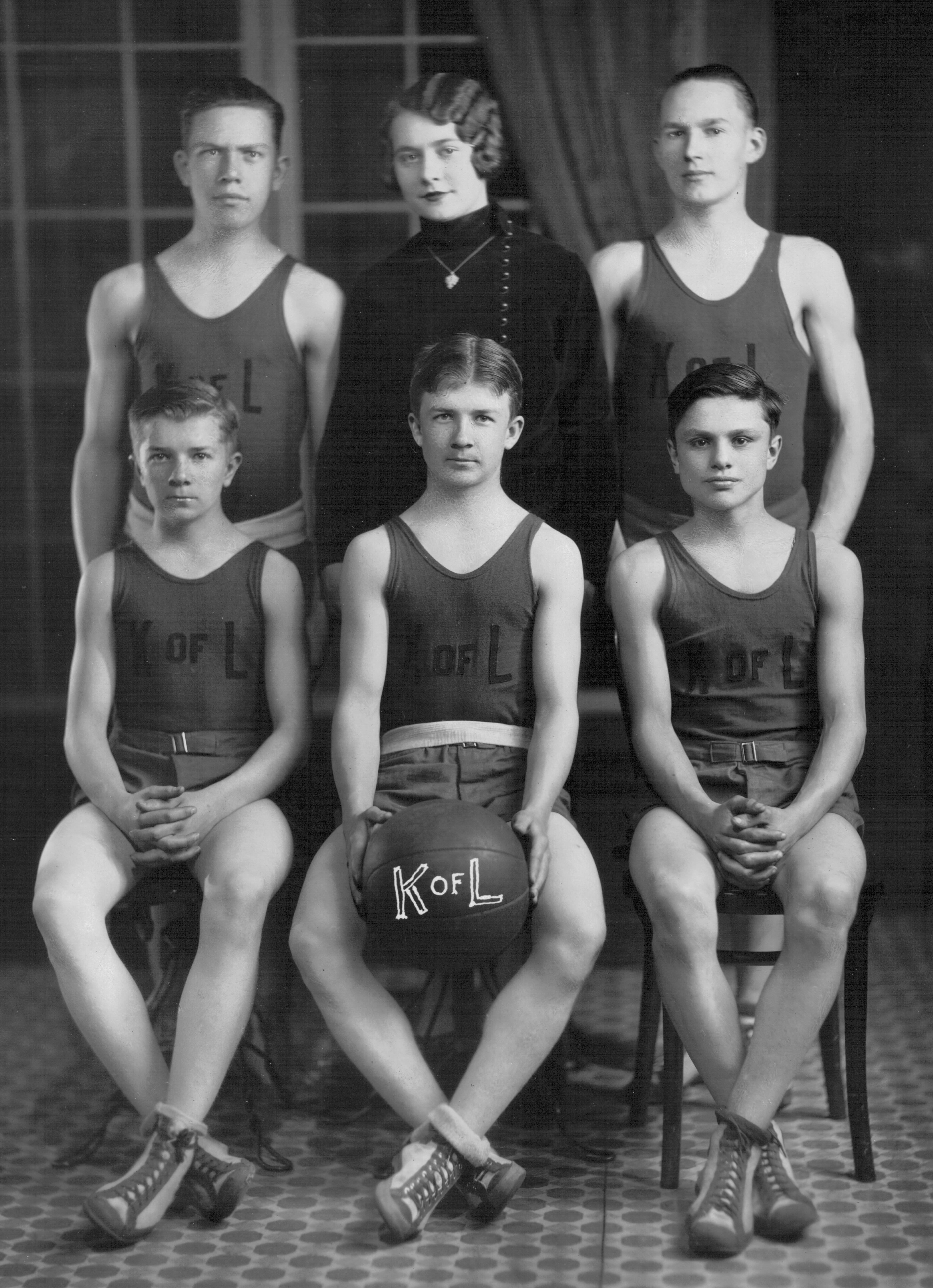
national costume, often woven from flax. blogspot.com

national costume, often woven from flax. blogspot.com

In February 1913, Illinois State Journal-Register columnist Octavia Roberts made and wrote about a visit to St. Vincent de Paul Lithuanian Catholic Church.  Her “Through Feminine Eyes” column gives us our best eye witness account today of what first-wave Lithuanian immigrants looked like 100 years ago.

Sunday mass at the church was packed, with people standing in the aisles and in front of the vestibules, some of them for a full two hours (a longer mass than most of us have ever endured). Men and boys sat on one side of the church, women and girls on the other. It’s not surprising to read that, according to Roberts, the “majority had blue or gray eyes,” and “were a handsome, sturdy people.”

St. Vincent de Paul's First Holy Communion, circa 1920.

St. Vincent de Paul’s First Holy Communion, circa 1920.

The writer makes much, indeed, of the men’s thick and wavy hair. Although she doesn’t say, I imagine the congregation she observed that day was uniformly young. Elders with balding pates–uncles. aunts, parents and grandparents–had mostly been left behind because the light at the end of the immigrant’s tunnel back then could only potentially be reached through a lifetime of hard, manual labor—impossible for the old or weak. “As for the women,” Miss Roberts writes, “their pretty hats covered up their faces according to the mode of the year.”

Lithuanian married women's head-dress.  Courtesy of Reflections from a Flaxen Past, by Kati Reeder Meek.

Lithuanian married women’s head-dress. Courtesy of Reflections from a Flaxen Past, by Kati Reeder Meek.

She goes on to marvel at “how well-dressed”  the female Lithuanian immigrant was after invariably arriving in America “in a full skirt with waist of contrasting material worn in her province, with her head tied up in a bright handkerchief and her goods in great square of cloth, knotted at the corners.” Remarkably, “in an incredibly short time,” these immigrant women “would put away the clothes of the old country and be dressed in the latest fashions of America.”

Lithuanian woman's holiday "costume," courtesy of Reflections from a Flaxen Past, by Kati Reeder Meek.

Lithuanian woman’s holiday “costume,” courtesy of Reflections from a Flaxen Past, by Kati Reeder Meek.

Putting on the New

I like this passage on many levels. Probably the most important meaning is only hinted at:  That before coming to America, Lithuanian immigrants knew only homespun clothing in a cash-poor economy where you didn’t wear it, use it, or eat it unless you grew it or made it yourself. According to Roberts’ article, prior to immigrating, most Lithuanian men were poor, landless agricultural workers (on large estates) earning only about $30 a year. Women no doubt had even less, if any, cash, and it was their job to spin all the family’s clothes from flax, a little cotton, and lots of wool.

It hardly takes much imagination to conceive of these immigrant women’s excitement at being part of a town economy where families had several hundred dollars a year, and retail options for spending it. Since their cash was still far from sufficient,  immigrants still made, not bought, much of what they needed, including cultivating most of their own food, just like in the old country. Critical, non-cash subsistence skills still made the difference between success and failure.

But the habit of having at least one set of store-bought clothes for Sunday mass, for those who could afford it, was likely a habit carried over from the home country, only to be more fully expressed when economics made that possible. And you can bet that one or two fine and fashionable Sunday outfits would have seemed like a necessary dividing line between the old life and the new–at the very least to show that all that had been left behind–given up–was worth it. That they were moving forward in life.

As for St. Vincent’s well-dressed immigrant ladies the day Roberts visited, once married, none was permitted the public exposure of singing in the church choir. That meant the female choir Roberts observed in early 1913 was composed of the few, small girls too young to marry in a culture where the girls married young. However, if this photo dated that same year is correct, due to its pastor’s efforts, St. Vincent’s had an adult mixed-voice choir only months later, perhaps composed of unmarried adult women or women with their husbands. (By the 1920s, it was one of the finest church choirs in the city.)

The first church choir, late1913, St. Vincent de Paul Lithuanian Catholic Church.

The first church choir, late 1913, St. Vincent de Paul Lithuanian Catholic Church.

Homespun to ‘Home Clothes

One of the last things my homespun-wearing, subsistence-farming Lithuanian father did before fleeing the advancing Russians in 1944 was to bury his store-bought Sunday suit and shoes in a cardboard box– never doubting, of course, that he would return. (Our grandmother’s china dishes are also still somewhere underground on our lost Baksys land–musu jame.)

Dad’s homespun customs, which I never understood growing up, were echoed in our family’s pronounced distinction between “home clothes” and school or church attire. Before we were of the age when we could take more control over our personal appearance, this went beyond formal vs. informal or school vs. play. Until I was 7 or 8, Dad wouldn’t even let his daughters wear pants in the winter or shorts in the summer–his rule for girls was dresses, no matter what the other kids wore.

I also still remember, as a kindergartener, the shame of being ambushed in my “home clothes” when a neighbor boy unexpectedly packed his birthday party with our classmates in full party dress. And, I still think, to this day, that our family’s “immigrant” difference was most firmly established in my mind by our clothes, and our reaching, as girls, for a normalcy and belonging that was always just out of reach–through clothes that were also always somehow just out of reach.

Clothed in Dignity (and Glory?)

Mary Yamont (Marija Baksyte Jomantiene) with husband and sons Benny (left) and Joseph, circa 1909.

Mary Yamont (Marija Baksyte Jomantiene) with husband and sons Benny (left) and Joseph, circa 1909.

I’m sure others have noticed that poor Lithuanian coal miners and their wives always seemed to take amazingly glamorous “portrait” photos. I puzzled for years over this apparent discrepancy between what I knew about the economic status of my Great Aunt Mary Yamont (or Marija Baksyte Jomantiene) and her coal-mining husband, Benedict, Sr., and their full sartorial splendor in a family portrait in 1908 or 1909.

It seems improbable that all of our ancestors somehow made and lost millions by the time we met them.  And even if true in some cases, great reversals of fortune could hardly explain the pure number of photos wherein glamorous immigrant dress seems to belie verbal histories of poverty. Doubtless these photo portraits aimed to show families at their most solemn, dignified and successful.

Also, in true poverty, limited photographic resources would hardly be wasted on papering the world with that era’s version of the goofy Polaroid snapshot—or today’s proliferation of digital “selfies.” To the contrary, it actually seems logical to me that poverty, itself, and trying to make “bella figura” to the people back home, can explain the extravagance of early 20th Century weddings and other high photographic occasions that were exceptions to the daily grind of hard, manual labor.

I’ve even heard that photographers traveled with glamorous wardrobes to entice the poor to become temporary poseurs to wealth.  And, what better than a photograph to render wistful permanence to a dead-ended miner or laundress’s unfulfilled dream of ease and luxury—never to become real in this life? Image

Lithuanian Sunday church, their own church that was like a piece of their own home soil, was also a place to dream, and to begin to self-actualize, with the support of community and the many social clubs and Lithuanian Catholic lay societies.  Fr. John Czuberkis spoke to columnist Roberts of organizing a larger mixed choir, sports and drama clubs.

Pastor of St. Vincent’s during the parish’s peak years for growth and membership (1909-1919), Father C. knew what a different,  more fully human identity meant to his parishioners, even if that was achievable only at Sunday church–or on special occasions, for example, when the men donned the full regalia of the “Vytautas, Grand Duke of Lithuania Society.”

It’s interesting to ponder what role the individual public statement–and group reinforcement—of Sunday costume likely played for people who had shed so much, and were in the process of clothing themselves anew, in every sense of those words. I’ll bet Ms. Roberts, the writer, never knew her visit to St. Vincent’s would inspire such a meditation on the  social meanings–and the elevating power of clothing–100 years later. My thanks to Tom Mann for finding and sharing Octavia Robert’s article from 1913.

The parish men's

The parish men’s “Vytautas, Grand Duke of Lithuania Society,” 1914.

A Miner and His Museum

Will (Stankus) Stone (seated) and Ted Fleming in the Christian County Coal Miners' Museum, November 2014

Will (Stankus) Stone (seated) and Ted Fleming in the Christian County Coal Miners’ Museum, November 2014

The Christian County Coal Miners’ Museum, located on the east side of the square in Taylorville, was founded on June 22, 2003 by retired Lithuanian-American miners William (Stankus) Stone and Ron Verbiski. Although the museum is temporarily closed, I had the good fortune to visit its collections with Will Stone, 81, and his retired miner son-in-law, Ted Fleming, the day after Thanksgiving 2014. (I just learned that Will died the very day this post went live on Jan. 3, 2015.)

Anna Dabulski Stankus (Stone)

Anna Dabulski Stankus (Stone)

Born in 1933, Will was the son of Lithuanian immigrants Enoch (Stankus) Stone and Anna Dabulski of Bulpitt, a small Lithuanian-American enclave just outside Kincaid in Christian County, south of Springfield. Enoch came to the United States from Lithuania around 1926 at the age of 38 and married Anna five years later, in 1931. The couple had two sons, and Enoch was employed at Peabody Coal Co. No. 7 in the South Fork area near Kincaid.

William (Stankus) Stone

William (Stankus) Stone

Enoch’s son Will also grew up to become a Christian County coal miner. But first, he was a star Kincaid High School athlete known throughout area sport conferences for his agility in football, basketball and track. He made all-state teams in both football and basketball and was a longtime holder of the state’s shot put record. Upon graduating high school in 1953, he was awarded a full scholarship to play football at the University of Arkansas. However, family needs led him back to Bulpitt to support his widowed mother, and after working several factory jobs, Will started mining at Peabody No. 10 (Pawnee) in 1960, from which he retired in 1991.

will Stone, #66, Kincaid High School football player, circa 1952.

will Stone, #66, Kincaid High School football player, circa 1952.

Will leaves behind his wifeJoAnn (Tonks) Stone, two step-children and numerous step-grandchildren. At about the same time he opened the coal miner’s museum, he placed a granite monument to himself and his fellow miners on the north lawn of Taylorville’s courthouse.

The non-profit museum that Will personally operated since its opening, and in which he said he invested about $10,000, is currently in transition to different management and a new location.

Taylorville newspaper article announcing the museum's opening, 2003.

Taylorville newspaper article announcing the museum’s opening, 2003.

However, the museum’s three tightly-packed rooms and one long hallway still store a wide variety of memorabilia related to coal mining and its importance to Christian County (which was, not by coincidence, ground zero for the infamous Central Illinois “Mine Wars” 1932-36.) Several articles on display that caught my attention were about Mine War “martyrs” from the Progressive Miners of America, the new union that formed from former United Mine Workers of America members in 1932 to strike Peabody Coal. During the “Wars,” dozens of deaths resulted from gunfights and other violent clashes, most of them in the so-called “Midland Tract” around Taylorville where many Peabody mines were located. The county jail in Taylorville was often full of arrested miners, and the city’s newspaper was bombed.

Museum's text about PMA martyrs, the "Mine Wars," 1932-36.

Museum’s text about PMA martyrs, the “Mine Wars,” 1932-36.

Three of the PMA martyrs mentioned in the museum were Andy Gyenes of Tovey, who was shot and killed in 1932, and Mrs. Emma Cumerlato, who was killed by a stray bullet on the porch of a Kincaid home in 1933 (in the same melee at the entrance of Peabody No. 7 in which PMA miner Vincent Rodems was also killed.) Joseph Sigler was described as the “only law man shot and killed in Taylorville” during the violence, in 1934.

Miners’ uniforms and equipment, including hats with carbide headlamps, lunch pails, gas detectors and emergency oxygen generators, were also on display.

Hallway, Christian County Coal Miners' Museum

Hallway, Christian County Coal Miners’ Museum

Will made a point of mentioning to me with great pride that Peabody #7 in Kincaid had the highest production numbers (tonnage) in the world at the peak of its operation. Despite mining’s difficult conditions, which improved after the 1930s, Will clearly showed the pride in hard work and production—and his miners’ union, the UMWA–that characterize the profession. I am very happy I got the chance to meet him, even briefly, and visit the coal miners’ museum he loved.

Honoring Central Illinois Mine Casualties

Coal mining was extremely hazardous work during the early years of the 20th century, when labor was cheap and plentiful, and workplace protections few. After ”shot-firers” blasted the coal seams apart (or took down the walls of coal), other men and loaded “trips” of cars full of coal. Timbermen timbered ceilings to create stable passageways and work “rooms,” but as you’ll see from the casualties below, rock or slate falls were common causes of death and injury. “Clod men” cleaned the rooms and passageways of fallen slate.
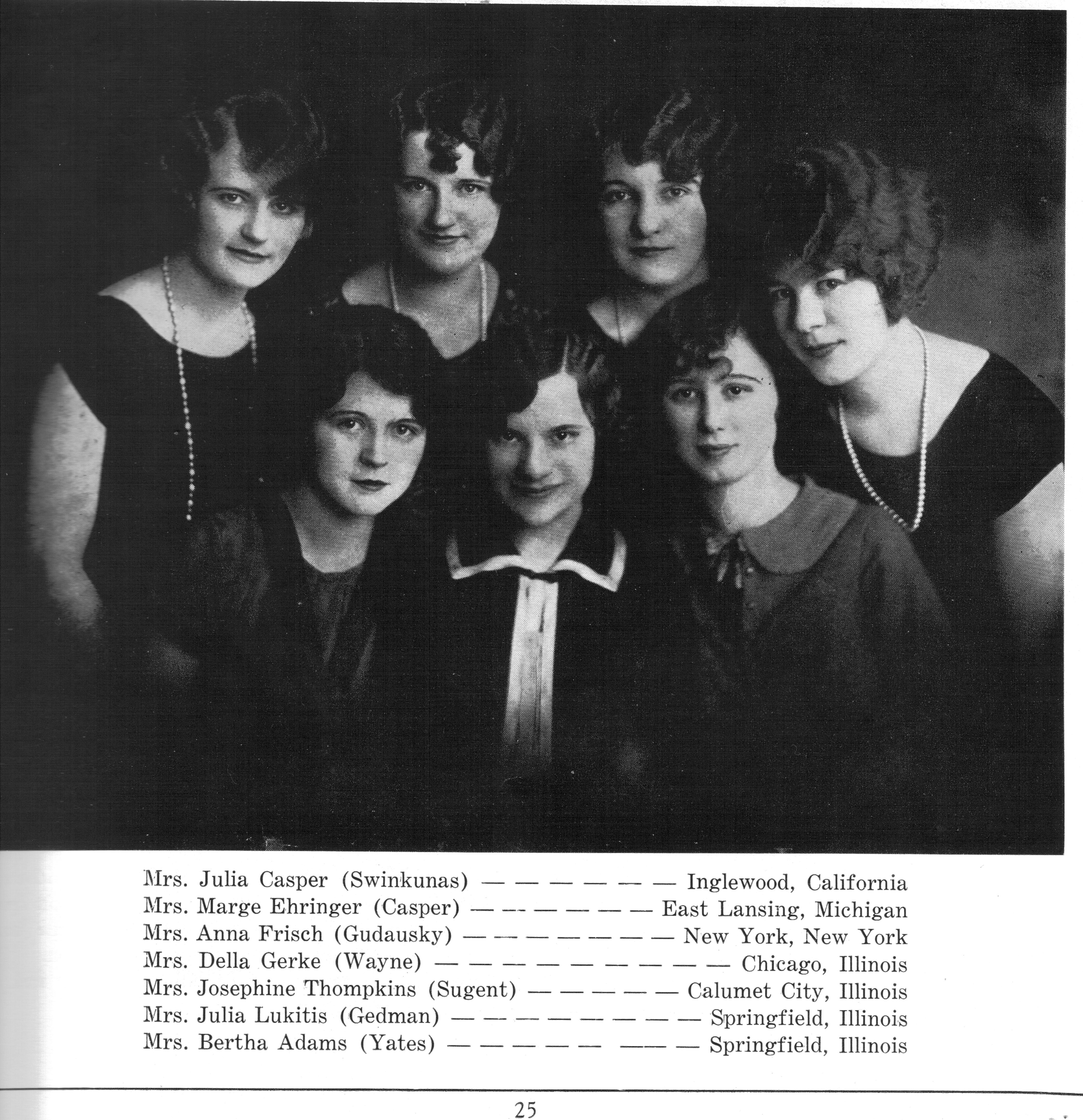
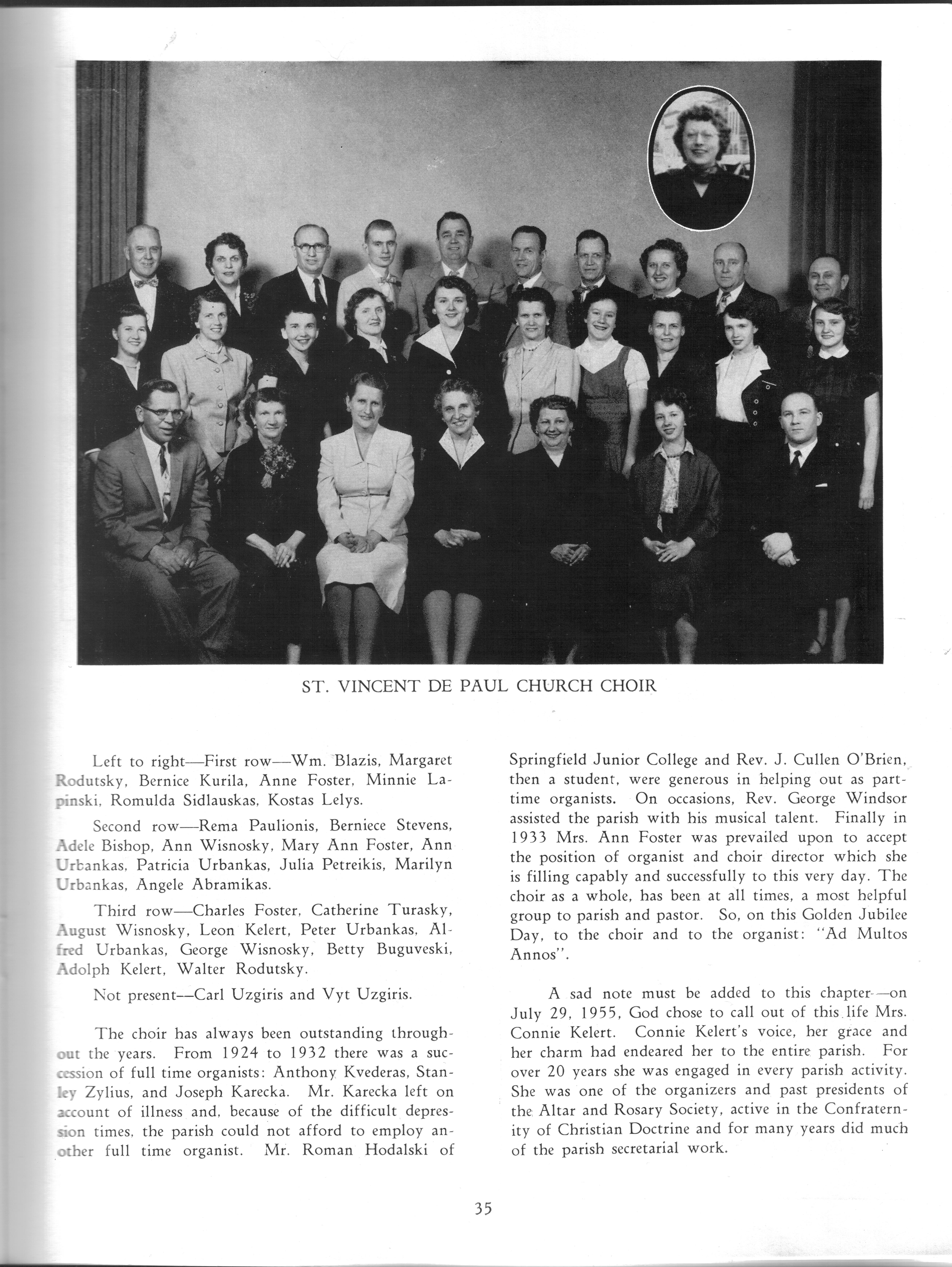
In the early days, mules were used to haul the trips (or cars) to the surface. Men got to go home after their 10+ hour shifts. The mules spent their entire lives in cramped and dark underground stables, frequently perishing in fires. Unfortunately, men and mules were generally alike in the eyes of the mine owners and bosses, except, as one mine boss was famously quoted as saying, “I have to pay to replace a mule.”

In fact, human casualties were so common that some historical records only log accidents in which two or more miners died. Public blame usually fell on victims, despite routinely dangerous working conditions that would never pass muster today (mainly improperly timbered or buttressed walls and ceilings, explosive coal dust and deadly gases called “afterdamp.” ) There were no death or injury benefits from the company, only from the newly founded union, for surviving families or the disabled.

Advertisement for "colored' miners from the southern states to mine coal in Virden, plus Mother Jones images. Christian County Coal Miners' Museum, 2014.

Advertisement for “colored’ miners from the southern states to mine coal in Virden, plus Mother Jones images. Christian County Coal Miners’ Museum, 2014.

The local Lithuanian-American casualties at the new Web page I just assembled (please scroll down at https://lithspringfield.com/an-indelible-role-in-our-history/lithuanian-local-history-2/the-mining-life/honoring-central-illinois-mine-casualties/) were almost all immigrants. These dead are dwarfed in number by the much larger group of miners who were crippled or maimed in mine accidents or lost years of health and life due to the complications of black lung. (I personally remember the 1990s Springfield funeral of Lithuanian-born miner Tadas Rizutis, a friend of my father’s, who was crippled during a rock fall in a coal mine in the 1960s.)

Most of the deaths I recorded are from Sangamon County, although a few are from Christian and Macoupin counties, and several from the catastrophic Centralia Mine Disaster. We have this listing thanks to the meticulous research of newspaper articles and genealogy websites by retired Springfield police officer Tom Mann. Among the sources he combed were archives of the State Journal-Register and the Sangamon County Coal Mine Fatalities web pages from “Wayne’s World of History and Genealogy.” The ethnicity of each miner was verified by newspaper or U.S. Census records. (Unfortunately, birth towns and cities were almost never recorded by either of these sources.) Please see http://hinton-gen.com/coal/sangamonfatal.html

Bankers to Lithuanians

For decades after their arrival in Springfield, the amount of wealth that Lithuanian immigrants could accumulate was limited by low wages, minimal credit, un- and under-employment, and the lingering effects of the Great Depression. However, after World War II, two sons of Lithuanian immigrants, August P. Wisnosky, Sr. and Walter Rodutskey, began to help put more money in their countrymen’s pockets as “bankers to Lithuanians.”

 St. Vincent de Paul Jubilee book, 1956.

St. Vincent de Paul Jubilee book, 1956.

Augie P. Wisnosky, Sr. & Illinois National Bank

August “Gus” was born in 1906, the son of Lithuanian immigrants George and Anna (Prapuolenis) Wisnosky (Visnauskas). A graduate of Ridgely Grade School and Springfield High School, where he took general business courses, including typing, Gus joined Illinois National Bank (INB) when he was 18 years old in 1924. It took 15 years, but around 1940, he was appointed assistant teller. By 1945 he was head teller, and in 1952, he became a loan officer. Gus was promoted to assistant vice president in 1957. He retired from the bank in 1970 after a career of 46 years.

It seems hardly a coincidence to me now that Gus’s bank, INB, was the only one that would take seriously the application for a $100,000 loan from uneducated Lithuanian immigrant John (Makarauskas) Mack and make the loan that in 1957 launched the Mack fast-food empire which later included all eight of Springfield’s first McDonald’s restaurants. In gratitude, the Mack McDonald’s franchise went on to do all its subsequent banking with INB.

Gus’s bank also went on to garner a large share of the Lithuanian-American community’s banking business, reportedly based on Gus’s openness to Lithuanian-American borrowers who might have been discriminated against or not treated as positively elsewhere. Don’t get me wrong–it’s likely that Gus extended the same fairness, human insight and business savvy to all his customers. Otherwise, one can’t imagine him being promoted to the C-suite. However, it’s also clear that Lithuanian-Americans in Springfield knew Gus would help them get a fair hearing and a fair deal, and so they became loyal account-holders and recommended INB to their friends and relatives.

Ann Tisckos and Gus Wisnosky wedding, 1930s.

Young Ann Tisckos and Gus Wisnosky at Kasawich-Alane wedding, 1927.

Along the way, just like Lithuanian immigrant attorney Isidor Yacktis, Gus became a shining representative of his ethnic community within much larger, city-wide organizations, such as the Community Chest, Elks Club, Knights of Columbus (K of C), and ultimately, the Sangamon County Board of Supervisors (1957-65). He participated in many civic organizations as well, such as the Springfield Art Association, Illinois State Museum Society, and Abraham Lincoln Association.

Gus seems to have been active in these multi-ethnic organizations (for instance, the K of C’s Major League Bowlers and its annual Lake Springfield Festival at Villa Maria, featuring sail and motorboat races) while also remaining a pillar of his own ethnic community.

Following in the footsteps of his father George, who was grand marshal in 1911 of the pageant/parade celebrating the opening of the St. Vincent de Paul Lithuanian Catholic Church, Gus worked mightily in 1971 as head of a committee of parishioners striving to save the church from closure and demolition by the Catholic Diocese of Springfield. Gus had been a lifelong parishioner, violinist, choir member, and 22-year trustee of the church until its last days. Tragically, his death in February 1972 at age 66 followed by only one month his beloved church’s closing, so that his funeral mass had to be held elsewhere.

 Click to see young Augie and his wife-to-be Ann Tisckos in this photo of the Alane-Kasawich wedding party, 1927.

Click to see young Gus and his wife-to-be Ann Tisckos in this photo of the Alane-Kasawich wedding party, 1927.

Augie Wisnosky at the 40- year tribute to the Old State Capitol project, March 25, 2008.

Augie Wisnosky at the 40- year tribute to the Old State Capitol project, March 25, 2008.

Gus and wife Ann’s son John went on to become an art professor at the University of Hawaii. Son August, Jr. “Augie” was a distinguished local architect with Graham, O’Shea & Wisnosky. He was resident architect for two years at the site of the most ambitious historical renovation ever undertaken in Springfield (1966-68): the stone-by-stone deconstruction and rebuilding of the Old State Capitol downtown (where Abraham Lincoln delivered his “House Divided” speech.) You can also read here about the immigrant childhood of Gus’s incomparable wife Ann (Tisckos) Wisnosky: https://lithspringfield.com/2014/06/07/an-immigrant-childhood-ann-tisckos-wisnosky/

Walter Rodutskey & Sacred Heart (Heartland) Credit Union

By coincidence, both Gus Wisnosky and Walter Rodutskey got into their positions to loan money to Lithuanians just as the end of World War II and the baby boom ignited the long and steady economic expansion that finally made real prosperity possible—if not for the immigrants who had come to Springfield 50 years earlier, at least for their children and grandchildren.

The Shenendoah, Pennsylvania-born son of immigrants Kazimieras and Frances (Matulaitis) Rodutskey, Walter was a bonafide working man: a machinist at construction machinery maker Allis Chalmers for 25 years. In 1946 he joined with famous “labor priest” Fr. John Brockmeier of Sacred Heart Church to become an organizing director of what was first known as Sacred Heart Parish Credit Union.

In Fr. Brockmeier’s words: “There is a tie-in between labor unions and credit unions. Both tend to improve the standard of living for the working class.” Fr. Brockmeier’s life combined labor organizing and arbitrating labor disputes with founding banks, credit unions and chambers of commerce in a civic, Christian spirit that encouraged people to work together and rely on each other through a variety of organizations in addition to their parish church.

At the same time, when Fr. Brockmeier, Rodutskey and others founded their new credit union by pooling initial deposits into the modest sum of just $102.74, they put Sacred Heart parish at the center of this new effort at collective financial self-help by locating the credit union inside the parish office. In the beginning, the credit union cost 25 cents to join, was open to any family with one Catholic spouse, and made loans ranging from just $10-$300. By 1950, it had assets of $53,518.48 and 276 members. Office hours were Monday evenings at Sacred Heart, “7 p.m. to close,” according to historical documents graciously provided by today’s Heartland Credit Union (Sacred Heart’s successor).

By 1996, the credit union had main offices on South Grand and Glenwood Ave. and an administrative branch on West White Oaks Dr. Membership had climbed to 7,700, deposits to $13.2 million, and loan amounts accordingly. Walter Rodutskey, who retired from the credit union in 1984 after 30 straight years of board service, played an important role in this non-profit banking institution, often as the board’s secretary. He was so committed to the credit union movement that he also served as an officer of the Springfield Chapter of Credit Unions, which included representatives of most of the city’s largest employee groups, including Pillsbury Mills, Sangamo Electric, Bell Telephone, and public unions for teachers and firefighters.

Walter died at age 88 just three days after the death of Margaret, his wife of 40 years, in January 1991. The credit union that he helped found was led into the new millennium by Springfield Lithuanian-American Ed Gvazdinskas.

Thanks to Tom Mann for more great newspaper archives research, without which this post would not have been possible.