Winning Carnival Glass

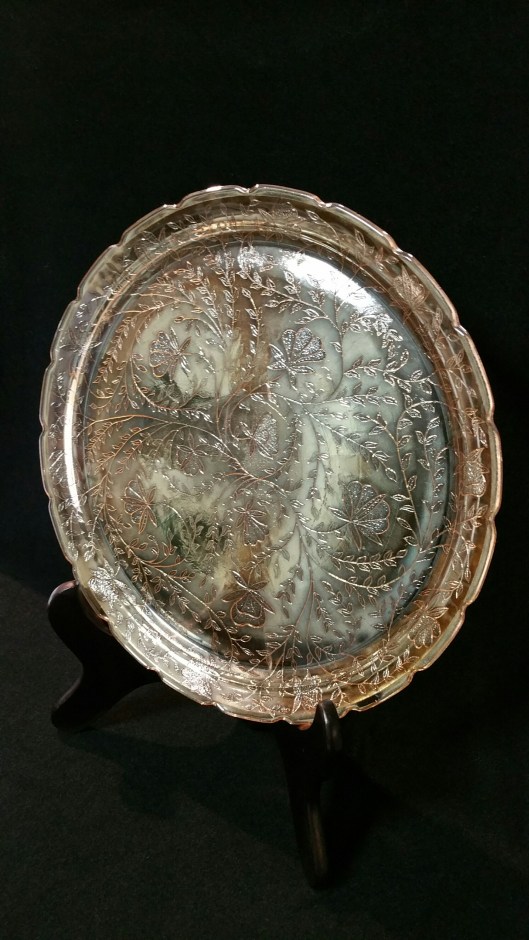
depression-glass-won-at-the-springfield-state-fair-by-dick-alane-iridescent-jeannette-iris-9in-dinner-plate

9-inch plate: pressed, irridized carnival glass in the Jeanette Iris pattern. Won at the Ill. State Fair by Dick Alane.

Elaine Alane is the daughter-in-law of  Vic and Eva (Kasawich) Alane, those children of immigrants who famously became husband and wife in the 1927 “Three-Day Lithuanian Wedding” detailed on this blog and in my book, “A Century of Lithuanians in Springfield, Illinois.”

During the State Fair this year, Elaine wrote from Wisconsin with some family memories:

My husband Dick Alane, Vic and Eva’s son, has many fond memories of the Fair. He would go every day. At that time the Alane family lived on Marland Avenue and it was a very easy walk to the fairgrounds. His favorite foods were corn dogs and French fries, but only the fries from the vendor near the Grandstand –he cannot recall the name but says that they only sold fries.

Dick loved to play the carnival  games in Happy Hollow and especially liked to shoot nickels for prizes consisting of the now collectible carnival (also called Depression) glass. He won lots of it and would often have to take a trip home to drop off his loot. His mother Eva  saved a lot of the glassware he won, and we still have and use some of it in our home.

depression-glass-won-at-the-springfield-state-fair-by-dick-alane-iridescent-jeannette-floragold-13-in-plate

13-inch plate: pressed, irridized carnival glass in the Jeanette Florigold pattern. Won by Dick Alane at the Ill. State Fair.

One night Dick, who was a high school varsity basketball player, and two of his friends went to the Fair and were shooting baskets for prizes. You had to sink 3 baskets in a row to win a prize, and Dick was able to sink 9 in a row before he was not allowed to shoot anymore…He went back the next day and said he couldn’t hit anything.

Dick’s folks also took in boarders during Fair time (like the Chernis-Urbanckas family). Dick and his father Vic would often sleep in the basement to free up rooms for the Fairgoers to use. Dick’s immigrant mother Eva would also enter quilts in the Fair’s arts & crafts contests.

Urbanckas State Fair Stories

Urbanckas, Mary, state fair Troy Mathews of the Chernis-Urbanckas clan shared his family’s long and happy association with the Illinois State Fair in the State Journal-Register newspaper on Aug. 19, 2016. I’ve pasted the text of that article below for those who missed it. I would have loved to have worked–exhibited or marched in a parade–at the Fair as a young person. (Looks like my family should have known the Urbanckases!)  Mary (Chernis) Urbanckas  is pictured above with her “Best in Show” hobby entry and ribbon, 2006.

Guest Column: State Fair near and dear to family’s heart

http://www.sj-r.com/opinion/20160819/guest-column-state-fair-near-and-dear-to-familys-heart/?Start=2

By Troy Mathews

Mary Urbanckas was born Aug. 16, 1916. Pete Urbanckas, her husband, was born Aug. 14, 1915 — both during State Fair Week. Mary and Pete, my grandparents, shared a great love for the Illinois State Fair and taught its importance and traditions to our family.

Historically, fair guests often boarded at families’ homes near the fairgrounds. Guests were charged a nominal fee to have all the comforts of home while here at the fair, such as telephone, television, hot showers, fresh sheets and a home-cooked breakfast. For 30 years, from the 1950s through the 1980s, Pete and Mary Urbanckas welcomed Illinois State Fair guests to stay at their residence. In the late 1980s, the price of a room was slightly under $20 a day. Some of their guests included the virtuoso pianist Stephanie Trick and her parents; Gene Montgomery, who drove a customized 1970s Cadillac as a starter car for harness races; Mr. Bloomstein, who sold Americana items; a man named “Uncle,” whom my grandmother said carried a great deal of money; and Bob Vono of the Orange Treat stand.

Pete’s brother and sister-in-law, Al and Anne Urbanckas, also invited guests to stay at their home on North Sixth Street, one block from the Fair. Their guest list included “the butter cow lady” Norma “Duffy” Lyon, who created the Illinois State Fair Cow for more than 30 years in the 1950s.

The fair was always reliable for income. Everyone always seemed to find a job at the fair. My grandmother worked in the fairgrounds at Clara’s Cafeteria on Main Street, with her daughters, Donna Frost and Pat Mathews, my mother. Mary and Donna poured plentiful cups of coffee and Pat spilled plentiful cups of coffee. Mary’s brother, Stanley Chernis, worked for the U.S. Postal Service as a clerk in the fairgrounds. At that time, the post office was located where the Illinois Fire Museum is currently located. Al Urbanckas popped popcorn in the Dairy Building. And I currently work for Illinois State Fair Security.

In 1936, the tallest man on record, Robert Wadlow, visited the State Fair. My grandfather, Pete, hoped to meet him, and did. During his visit, Wadlow briefly became unsteady and my grandfather helped stabilize him until he regained his footing. My grandfather always said Wadlow was grand in stature and heart, friendly and kind.

In 1993, Pete and Mary’s grandson, my brother, Scott Mathews, drove the car carrying the Grand Marshals in the State Fair parade, an experience that he said was an honor.

In her 90s, Mary, my grandmother, was asked to be Grand Marshal in the parade. Although honored, she said that she was shy and declined.

Over the years, my family also has enjoyed the experiences of winning multiple ribbons and awards from exhibits. Two of the most memorable include my grandmother, Mary, winning Best of Show in Hobbies in 2006, and her daughter, my mom Pat, repeating the same award 10 years later.

Our family has made so many friends over the years, from performers to exhibitors at the Illinois State Fair. Over the years, it has been a reliable source of family fun. The fair is a venue to show off the best the state has to offer, from breakthroughs in technology and agriculture to inventions in American and ethnic foods.
My grandmother, Mary, died in 2013. She would have turned 100 during this Fair week.During this week, we think of her and the many lasting memories our family has made because of the State Fair.— Troy Mathews is a Springfield resident.

Lithuanian Booth Returns to Ethnic Village at Illinois State Fair!

LithuaniaFlag


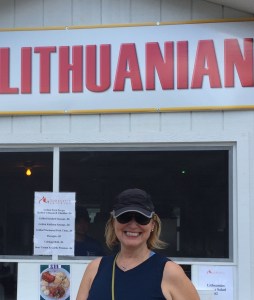
When the 2016 Illinois State Fair opens its gates tonight, there will be a momentous change in Ethnic Village: for the first time in decades, a food booth will bear the “Lithuanian” name and colors. For those of you who don’t know, Lithuanian immigrant families had a close and longstanding connection to the Fair.

Such families once lived all along the southern and eastern borders of the Fairgrounds in a “Little Lithuania” neighborhood that stretched north, south, east, and west from the intersection of Sangamon Avenue and Peoria Road. As a result, many old-time fair-goers remember buying soda, water and lemonade from Lithuanian-American locals,  who also took advantage of their proximity to the Fairgrounds to park cars in their yards.

Turasky Catering Switches Polish Booth to Lithuanian This Year

Growing up, my own family’s first stop early on Children’s Day at the Fair would be 2102 Peoria Road, the home of my Great Aunt (Teta) Mary Yamont, to park our car, visit, and receive our Fair spending money of $5 per child from Teta, her son Joe and daughter Mary.

TuraskysCatering_Logo_onWhite

“Little Tony” Turasky, Lithuanian-American owner of Turasky’s Catering, formerly operated his Ethnic Village booth as “Polish.” Much of his new Lithuanian menu seems interchangeable with the booth’s former Polish offerings–undoubtedly, to encourage a certain continuity in his clientele.

Yet the return of such a visible Lithuanian presence to Springfield’s public square, after such a long absence, is still a major cause for fun and celebration. And if you like high-quality Turasky meats, this booth is for you!

I’m asking everyone to PLEASE stop by the Lithuanian booth in Ethnic Village and sample its meaty offerings, and while you’re there, please also snap a photo with yourselves and the Lithuanian colors/name to be shared on this blog. (Please don’t forget to e-mail the names of those photographed, along with your attached jpeg photo file, to sandybaksys@gmail.com.)

Please also share with my readers any Fair memories you have with your Lithuanian ancestors.

Tony provided us an advance copy of his menu below::

Turasky's Truck

Grilled Pork Burger Stuffed w/Bacon & Cheddar

Grilled Smoked Sausage

Grilled Kielbasa Sausage

 Grilled Marinated Pork Chop

 Pierogies

Cabbage Rolls

‘Polish’ by mistake?

I spotted an obituary of a 102-year-old woman, Victoria Alice (Buskis) Houston. whose parents were Anna Klemovich and Adam (probably Adomas) Buskis. She had siblings Anthony, Joseph, Edward and Anna.

In one part of the obit, it says Victoria made “Polish chicken and dumplings.” Yet there was no mention of her likely 100 percent Lithuanian heritage. This made me wonder if her descendants were/are not aware of their own Lithuanian heritage  (and “Lithuanian” chicken and dumplings!).

Does anyone know this family, or remember whether they were ever members of the Lithuanian-American Club (maybe back in the early 1990s)?

Victoria lived at Heritage Health for more than 10 years, and her funeral mass was at St. Cabrini on Aug. 1.  Here’s her obituary:

http://www.legacy.com/obituaries/sj-r/obituary.aspx?n=victoria-alice-houston&pid=180827440&fhid=7772


David Broida and Family: A Mercantile Success Story

By William Cellini, Jr.

Broida Family c. 1915. H. B. Broida family collection copy

David and Anna (Machnovitz) Broida family, circa 1915.

Decades before the Holocaust of the 1930s and 1940s ravaged Jewish communities across Europe and Russia, there was a persecution of Russian Jews that followed the assassination of Tsar Alexander II in 1881. His assassination by revolutionary socialists sparked pogroms and restrictive laws against Jews living in the Russian Empire including the Litvak community. Litvaks (the Yiddish word for the Jews of Lithuania) were deprived of their rights as citizens as a result of the restrictions. As a result of those hindrances, the period of the 1880s to the 1910s was a time of mass emigration by Jews in Russia. In fact, the first Jews to emigrate from the Russian Empire were Litvaks. (Bernheimer, C. S. (1905). The Russian Jew in the United States: Studies of social conditions in New York, Philadelphia, and Chicago, with a description of rural settlements. New York: J.S. Ozer., P. 26); (Lithuanian Jews Make Big Impact in South Africa. Reuters, Jun. 12, 1998)

David Broida was part of the Litvak masses and he emigrated in 1888 ultimately settling in the Midwest with his wife, Anna Machnovitz, and their children. David was the eldest son of Jacob and Hannah (Weinstein) Broida from the village of Eišiškės in southeastern Lithuania, a community with a 900-year-old Jewish shtetl. The family arrived in Springfield after first spending time in Cincinnati, Ohio. David worked as a cigar maker in Cincinnati, so when he arrived in Springfield, he continued the trade.

The family first lived on East Reynolds Street in a predominately African American neighborhood and by 1906, they moved to 401 North 14th near Mason Street into another predominately African American neighborhood known as the “badlands” northeast of Springfield’s Levee district. (Ancestry.com, 1900 U.S. Federal Census); (There Was Once a World: A 900-Year Chronicle of the Shtetl of Eishyshok., Little, Brown & Co., 1999); (City of Springfield Directory, R.L. Polk & Co., 1905); (City of Springfield Directory, R.L. Polk & Co., 1906); (Selby, P. (1912). Historical Encyclopedia of Illinois, Vol. 2. Chicago: Munsell Pub. Co.)

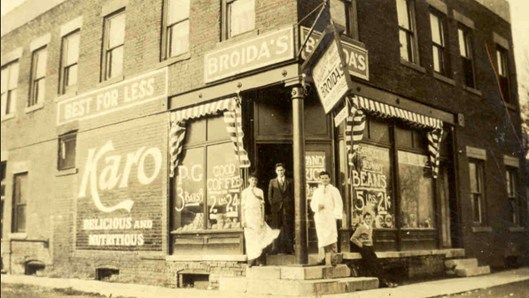
Broida Grocery Herman, Bud and Joe c. 1934. H. B. Broida family collection copy

Broida’s Grocery with Eddie, Herman, and Joe, 1934.

In the badlands, David opened a tavern at 14th and Mason but within a year, the neighborhood took-up a petition to have his license revoked. Greatest criticism came from Rev. Jason Bundy, the pastor of St. John’s African Methodist Episcopal Church. His congregation was across the street and it faced the tavern. According to news reports in the archives of the Illinois State Journal-Register, it was either Broida or Bundy who offered a bribe to stop the anti-tavern petition from going to the city council; however, the details about the incident are unclear in the press of that period. What is known is that David Broida ultimately lost his liquor license and he transformed the tavern into a butcher shop and grocery store in 1907 around the same time his younger brother Morris opened his clothing store in the 2000 block of Peoria Road. These two stores were the start of the Broida family retail business in Springfield. (ISJ, Feb. 5, 1907, P. 7)

Among the heavy concentration of European and Russian Jews who emigrated to the U.S., portions of their community achieved an impressive upward mobility within two generations after emigration. The Broida family typified the early-20th century immigrant success story, as they were an exemplary face among the small Litvak community in Springfield.

David fast became a popular and successful merchant in town and he opened a second store at 1900 South 15th street in the early 1900s. Dealing with the public afforded him a degree of notoriety, and so he ran for alderman in Springfield’s 1st Ward. However, before the campaign got underway, his brother Morris went bankrupt over a bad business deal. Creditors claimed he was hiding over $12,000 and sued him in federal court. Morris was ordered to pay a reduced settlement but could not produce the money, and so the judge gave him an eight-month jail sentence on account of contempt.In the aftermath, Morris and his family left Springfield and moved to St. Louis. For David, his campaign for Alderman was not successful. He came in third behind two challengers; one of them a Lithuanian-born tavern owner named William Botwinis. (Broida’s General Stores. ISR, Dec. 5, 1909, P. 63); (Want Broida to Produce $15,000. ISR, Jan. 19, 1915, P. 6);(Broida Case Taken Under Advisement. ISR, Jun. 18, 1915, P. 9); (Ancestry.com); (WWI Draft Registration of Max Broida, Ancestry.com)

Perhaps a bit over confident about his initial political foray, David again ran as a candidate for the city council in the February 1911 primary. According to the Historical Encyclopedia of Illinois, Broida gave a statement to the press saying he’d, “put his whole time and attention to fulfilling the duties of the job to see that the city was given a clean government”. He was not alone in thinking about a political career that winter. Following Springfield’s vote to replace the aldermanic form of government with a commission form, a crowded field of 105 candidates vied for only four open seats on the new city council. After obtaining a mere 183 votes in the primary, David likely realized that politics was not in his best interest. (Historical Encyclopedia of Illinois, Vol. 2, 1912); (How the Candidates Finished in City’s First Commission Primary. ISR, Mar. 1, 1911, p. 1)

After his 1911 election disappointment, he again tried his hand at the tavern business by opening a wholesale liquor store in the 700 block of East Washington Street, the heart of Springfield’s Levee. According to the 1910 Springfield City Directory, the site had been a tavern previously operated by the Lithuanian-born Joseph Meiron. Try as he may, David Broida did not succeed in operating a liquor store and a grocery at the same time and he abandoned the Washington street location less than a year into the venture. Creditors later sued him for payments he owed on the liquor stock. As a side note, city directories indicate the address of the liquor store on East Washington was later named the “Joseph Sutkaitis Saloon” pointing to continued Lithuanian connections in the Levee district during that era. (ISJ, Oct. 24, 1914, P. 7); (Council Makes Generator Award. ISR, Jun. 30, 1914, P. 6)

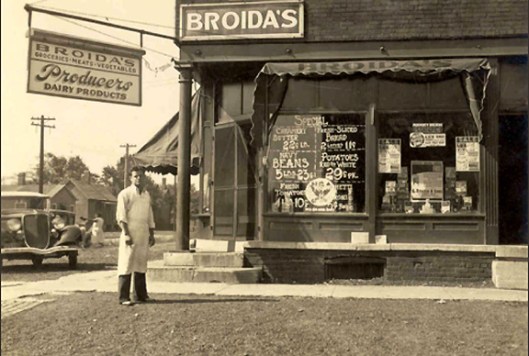
Herman 'Bud' Broida, c. 1933, 1934 401 North 14th copy

Herman “Bud” Broida’s Market, 401 N. 14th St., circa 1934.

David’s strength was best put to use selling retail goods and he moved his grocery to 14th and Cook streets while retaining his building on Mason so he could rent it to tenants for extra income. By 1916, his grocery business was going so well he built a two-story brick complex at the Cook Street site and the family lived in an annex connected to the store. The building served as Broida’s Grocery for many years and eventually David’s sons, Eddie, Herman and Joe, all lent a hand working at their father’s grocery (Building Permits. ISR, Dec. 20, 1916, p. 12).

In 1924, David Broida passed away at the age of 49 and was buried at Beth Hamedrosh Hagodol Cemetery in St. Louis. According to Joe’s daughter, the family belonged to Temple B’rith Sholom, one of three temples in Springfield that existed before WWII. After David’s passing, his wife Anna moved to St. Louis to be with her daughter Ida (Broida) Dorman. Anna passed away in St. Louis in 1952. Of all the Broida sons, it was Herman who expanded the grocery business by re-opening their father’s location at 14th and Mason in 1932. In addition, the brothers built “Broida’s Store #2” on Springfield’s west side at 1308 South College Street. Herman eventually moved out of state leaving Joe and Eddie to tend to the grocery businesses. (Obituary, Mrs. Anna Broida. ISJ, Dec. 2, 1952, P. 16); (Springfield City Directory, Jefferson’s Printing and Stationary Co., 1931); (Springfield City Directory, H.L. Williamson Co., 1934)

The two brothers carried-on but struggled as chain grocery stores gradually replaced family-run independents in the period after the Great Depression. Turning away from the grocery business, the brothers began selling furniture. They each opened a series of home furnishing stores across Springfield and Eddie was the first to open a store on East Washington. He died in Springfield in 1978 at the age of 71.

Broida College and South Grand store 1967

Broida’s (vacant) College and South Grand Avenue location, 1967.

According to Joe Broida’s daughter, her father tried to keep the grocery at 14th and Mason in operation but by the 1940s, the badlands neighborhood was razed to build the John Hay Homes, a subsidized multi-family apartment complex, so Joe moved his operation to Cook Street and renovated the old grocery store there by re-branding it, “Re-Nu Furniture and Appliances”. He later opened Southtown Furniture in 1963 and remained there until his retirement in 1982. He died in Arizona in 1995. (Eddie I. Broida obit. ISJR, Dec. 5, 1978, P. 28); (Workers Begin Razing of Buildings in Vast Housing Project. ISJ, Aug. 8, 1940, P. 4); (Broida Store Opening. ISJ, Oct. 30, 1963, P. 9); (Ancestry.com, Social Security Death Index)

All photos except College Street store courtesy of the H.B. Broida family collection.

Lithuanian Grocer Kaston Stockus & The Fairview

Kohlrus Foods.1512N15th40a-730x700

Kohlrus & Sons Grocery at the corner of Converse and 15th Street was opened in 1932 by the maternal grandfather of Sandy Baksys. Sandy’s mother Josephine left school and went to work in the store in 1934 when she was 15. Photo circa 1940, courtesy of the Sangamon Valley Collection, Lincoln Library, Springfield.

By William Cellini, Jr.

Prior to chain grocery stores, food retailing was independently owned and operated. The so-called “corner grocery” was smaller and more primitive, with wooden barrels filled with grain and dried fruits, where mice and roaches often congregated. Inconsistent pricing of goods and a lack of refrigeration often meant customers were offered a limited selection.

In family-owned operations, the grocer’s family often lived behind or above the store. Springfield had an abundance of independent, family-owned and operated stores prior to World War II. Depending on the demographic of a neighborhood, immigrants who’d been in the country for less than a generation owned many of the stores.

Such was the case with a Lithuanian-born immigrant named Kaston Stockus [Lithuanian variant, Kastantus Stočkus]. Kaston and his family operated a grocery at the corner of 16th St. and Sangamon Ave. in the 1910s when the neighborhood was unofficially called “Little Lithuania.”  This is the same corner–the same building, in fact–that generations of Springfieldians associate with a neighborhood eatery called The Fairview Tavern, known for its cabbage rolls, chicken and noodles, ham and beans and other comfort food.

The Palusinski  family owned and operated The Fairview for decades. Their connection to the building was through Kaston Stockus’ daughter Ella, who married Alex Palusinski in 1939. Alex and Ella ran The Fairview until their retirement in the 1980s. 

Before Kaston’s grocery or the Fairview ever existed, Sangamon Avenue was the northern-most boundary of Ridgely Village, an unincorporated section of Springfield until 1907.  In the 1880s, it was the Ridgely family of Sangamon County that developed land northeast of Springfield and incorporated a village there with a town hall, a mill, a school, company housing for workers, and several modest home sites.  

Charles Ridgely helped develop the village and owned several coalfield operations in Sangamon County.  

By the early 1900s when Lithuanian immigrants moved into Ridgely to supply manpower to nearby coal mines, the village had a complement of taverns and stores. Kaston Stockus emigrated to the U.S. in 1899 from Šiauliai County, Lithuania, and he became a citizen in 1904. He lived at 16th and Sangamon in Ridgely in a multi-level building that ultimately became his grocery.

The owner of that building was Anton Martzen, a Lithuanian-born tavern operator from Taylorville who had moved to Sangamon County after his tavern burned down. In 1909, Martzen opened a tavern on the first floor. The U.S. Census of 1910 indicates he also ran a boarding house in the building for miners and Kaston Stockus was a resident there with the occupation of “butcher.”

In 1913, Kaston bought Martzen’s property and began operating his own grocery and butcher shop on the first floor. Prior to Springfield’s prohibition code of 1917, the neighborhood around Sangamon Avenue had 12 taverns that brought in roughly $5,000 per annum in revenue for the City of Springfield. Since alcohol sales were decidedly more lucrative than the sale of groceries alone, Kaston also applied for, and was granted, a liquor license. 

Kaston and Caroline Stockus, c. mid-1930s.with cow

In 1915, he married Karolina Compardo, the daughter of Wincenty ‘William’ and Sofia (Balis) Compardo [Komperda], a family from the Austro-Hungarian Empire. Kaston and Karolina had a daughter, Ella (1916-2001), and a son, Raymond (1935-2016). The Stockus family lived with the Compardo family at 2129 North 16th Street. 

The United States’ entry into WWI aroused a spirit of patriotic fervor.  Many immigrants joined the military to speed-up the formalization of their petitions for citizenship.  Kaston registered with the military board of Sangamon County but was over the age to be called-up for regular conscription.  Instead of becoming a soldier, he became a home front hero during the Third Liberty Loan drive, when a group of foreign-born residents purchased $3,000 worth of government war bonds at a fundraising drive held by the “foreign-speaking people’s committee on liberty loan work.”

The Springfield committee gathered residents formerly of Lithuania, Austria, Germany, Croatia, Poland, Italy, and Syria.  Out of all the attendees at the loan rally, the Illinois State Register proclaimed, “the Lithuanian Kaston Stockus, Seventeenth and Sangamon [had] the largest purchase, taking a $500 bond.”  Such an amount was not only proof of his patriotism but testimony to his success as a grocer.  The newspaper also noted the event speakers included, “Rev. Father John Czuberkis of St. Vincent de Paul (Lithuanian Catholic) Church and Rev. Father Francis Mazir of St. Barbara’s (Slavic) Church.”  

In 1921, Kaston received a letter from his father in Lithuania pleading with him to return “home” for one last visit.  Lithuanian-Americans often received letters from family overseas asking them to return home after Lithuania’s declaration of independence in 1918.  Kaston’s letter from his father asked him, “If it is possible than [sic] I ask you to come home as my life is miserable.”  In addition, the letter asked Kaston not to send money to his family because it would make things “hard” for his father.  After receiving the letter, Kaston, his wife Karolina and their daughter Ella immediately sailed for Europe.

The Illinois State Journal featured an article about their voyage indicating the family had, “left town for New York City to visit friends and relatives in Antwerp, Belgium and Hamburg, Germany.”  While the article mentioned no travel to Lithuania, Kaston’s passport application (per archival research) indicates the family did visit Lithuania.  The family returned in September 1922 on the S.S. Berengaria, according to the Ellis Island’s website.  

In the 1930s, the Great Depression brought economic strife to the United States.  In Central Illinois, the Great Depression was also marked by violent labor unrest between the Progressive Miners of America and the United Mine Workers of America, culminating in pitched battles in the streets and mines. Kaston was effectively caught in the middle of a mine battle in March of 1933 when National Guard troops surrounded miners striking at the Peerless Mine (near Ridgely) and cut off Sangamon Avenue to patrons of his store.

Fairview Tavern Opening Aug. 1951, ISJ, Aug. 3, 51, P. 20

Illinois State Journal, 1951.

Storeowners all along the avenue protested to the Assistant Attorney General against the presence of the guardsmen. They said the troops “paralyzed their business between the hours of 3 and 6 o’clock each afternoon.”  Per newspaper accounts of the era, a committee of businessmen met and drafted a formal protest.  Kaston Stockus and Tony Yucus, a grocer at 1700 Sangamon Avenue, were part of the committee.  

Eventually, the route was re-opened and by the end of the 1930s, Illinois miners reached a tentative, statewide agreement to end the violence.  In 1939, Kaston’s daughter Ella married Alex Palusinski, a Polish-American, who clerked at the Stockus grocery.  After Kaston died in 1944, Alex opened a tavern inside the former grocery, calling it “Al and Joe’s.” By the time Kaston’s wife Karolina died in 1957, Alex had ownership of the building but leased the tavern to entrepreneurs.

During WWII, the tavern went through several names and in December 1945, an Italian immigrant named Vincent Nebuloni and his son-in-law Tony Stockus (no known relationship to Kaston), opened the “Jolly End Tavern” on the site. Tony Stockus was a WWII veteran who worked the coal mines in Springfield and was looking for a chance to get out of mining and make a better life for his family.

Tony Stockus WWII infantry sergeant.Mary Stockus Roach

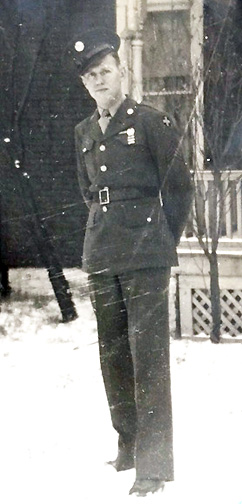
Tony Stockus, WW II infantry sergeant. Courtesy of Mary (Stockus) Roach.

Stockus and Nebuloni operated the Jolly End until 1950 when a local resident named Louie Viele opened his own bar in the space and christened it, “The Fairview Tavern.” Viele maintained his operation until his uncle, Ercole “Bouser” Viele, acquired it in 1954. By the mid-1960s, Alex and Ella Palusinski took over and turned it into the long-celebrated Fairview Restaurant. After changing owners over the years, the Fairview ultimately closed around 2019.

Springfield’s Battle for Booze

Image

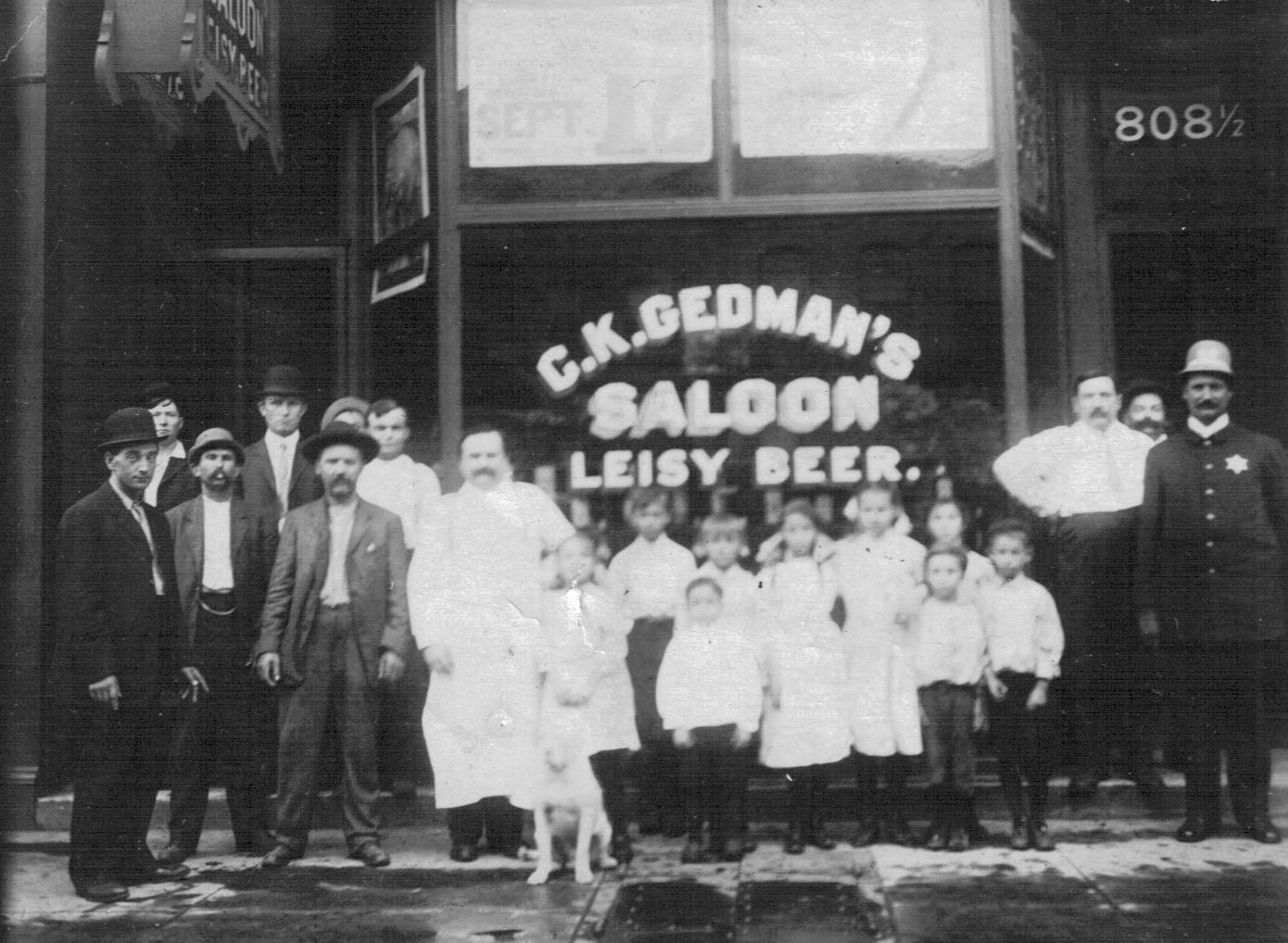
Charles Gedman Saloon, 808 E. Washington, 1908. Courtesy of Rita (Lukitis) Marley.

For two solid decades before the national Prohibition Act, Springfield was convulsed by its own local battle over booze. This wet-dry war pitted a largely native Protestant temperance movement against saloon owners and their patrons, who notably included thousands of newly arrived Catholic immigrant laborers from Southern and Eastern Europe.

Continuous wet-dry political battles from 1900 to 1917 threatened the very basis of the legal and regulated alcohol trade. Such extended insecurity about the direction of the law no doubt undermined its relevance in some minds. For this and other reasons, the clandestine illegal alcohol business so famous during national Prohibition actually began here decades earlier.   

Even while alcohol remained legal, poor immigrants who saw opportunity in home brew, as well as those who couldn’t get a liquor license or live by its terms–conducted so-called “blind pigs,” selling illegally from the backrooms of stores and the attics of homes. Along with this pervasive small-scale disregard of alcohol regulation, Springfield’s extended wet-dry conflict also seems to have spawned significant political influence-peddling, as well as the beginnings of larger-scale bootlegging by violent criminals. At least one Lithuanian immigrant tavern owner, Joe Yucas, who cut his teeth defying municipal alcohol regulations, then local prohibition, moved on to defying federal Prohibition.

What follows is a history of alcohol politics in Springfield’s pre-Prohibition period.  

From Saloons to Grocery Backrooms: The Ebb and Flow of Liquor in Early Twentieth Century Springfield

 By William Cellini, Jr.

Citizens of Springfield, Ill., have long-preferred their city to be a liquor-friendly, “wet” town, as evidenced by their voting for and approval of alcohol sales and consumption laws. As a politically important city since the mid-1800s, Illinois politicians and Springfieldians alike contributed to the livelihood of the town’s entertainment venues, dining spots, and its profitable tavern business and vice quarter downtown.

But tavern life, and vice that at times accompanied it, also caused backlash from the community. Local temperance ordinances trace back to the 1840s, when a ‘lid’ law was passed in Springfield barring grocery stores from selling liquor on Sunday and prohibiting patrons from consuming inside the stores. This so-called “lid” also applied to the hours a tavern owner could serve patrons.1

That early Sunday ban was followed statewide restrictions on liquor in 1851.2 This so-called “Quart Law” prohibiting sales of alcohol in containers less than one quart and sales to minors younger than 18 was repealed only two years later in 1853.3 Thus, the die was cast for the back-and-forth battle that even reportedly involved Abraham Lincoln and fellow Springfield lawyer Benjamin S. Edwards in drafting the language of an anti-alcohol referendum in 1855 that failed to pass in all Illinois counties.4

The Anti-Saloon League

Around the turn of the century, local temperance advocates began to make in-roads through the Springfield chapter of the national Anti-Saloon League, founded in Ohio in 1898 by Protestant clergy and laypeople.5 The League’s aim was to eliminate taverns by electing prohibitionist candidates. In Illinois, it helped place a local option measure on a statewide ballot in 1901, whereby permits for taverns and liquor sales would be decided by the percentage of voters of any ward, township, city or county during a regular election. While the local option of 1901 did not pass, an option law did pass in 1907 following a campaign exposing crime, prostitution and the impact of alcoholism and vice on family life in Springfield.6,7

In the early twentieth century, alcohol-fueled violence ran rampant throughout Springfield, and taverns factored into the problem. After the statewide passage of the 1907 local option, a referendum on tavern regulation was offered to voters in the 1908 Sangamon County township elections. Springfield (Capital Township) voted to keep its taverns open and its liquor flowing. Two more local-option temperance campaigns failed in 1910 and 1914 (even with women voting in 1914), so that Springfield was not voted ‘dry’ until an April 1917 referendum.8

The Prelude to Citywide Prohibition: Springfield’s Booze Borders

Supply and demand of alcohol was at the heart of the wet vs. dry conflict. By 1904, the city had over 170 taverns throughout its neighborhoods and downtown. Twenty-five were on East Washington Street alone, in a section known as the Levee. This was the city’s vice quarter, lined with pawnshops, bordellos, flop houses, gambling dens and small eateries. Three taverns owned by Lithuanian immigrants by the name of Gedmins, Povilaitis and Rogalis were located in the 800 to 817 block of East Washington. East of that block was the predominately African-American section of the Levee.9

The Levee was only part of a larger tavern district spanning numerous blocks downtown.10 Taverns in the downtown district operated six days a week but closed on Sunday per the lid law. If a tavern served alcohol on Sunday, the operator could be fined or jailed by the city. In 1905, Alderman Gustave Timm, a barber of German descent, unsuccessfully introduced an ordinance to require any new taverns outside the downtown district to show proven support from the neighborhood in the form of residents’ signatures.11
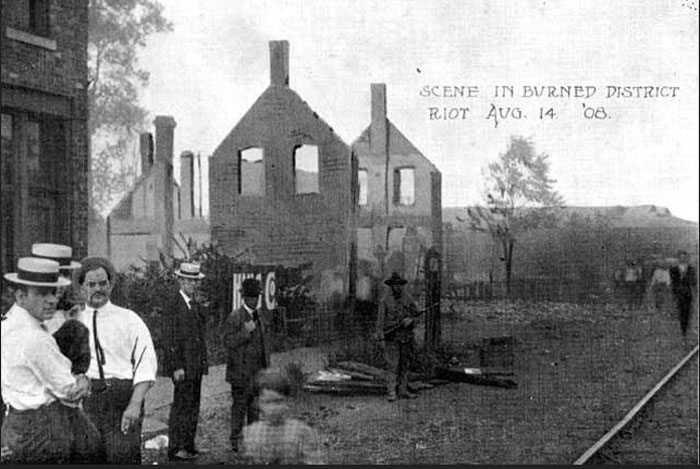
Riot Postcard. credit sangamoncountyhistory.org

Aftermath of the 1908 Springfield (white) Race Riot. Courtesy of SangamonLink.org.

City Taverns and the 1908 Race Riot

 In 1908, Springfield’s first local option referendum resulted in Capital Township casting 1,902 more pro-wet votes that pro-dry ones, defeating the so-called “Anti-Saloon” initiative.12 That August, alcohol played a role in the infamous white mob action known as the 1908 Springfield Race Riot. The trouble started when a crowd of white men and women congregated outside Springfield’s jail, calling for the hand-over of two African-American prisoners awaiting sentencing for the alleged murder of a white man and the alleged rape of a white woman. When the crowd learned the prisoners had been relocated out of town, they became enraged and destroyed a restaurant and the automobile of the white man who had aided in the prisoners’ transfer.

Then they went on a rampage, attacking and decimating the African-American section of the Levee while destroying nearby white-owned businesses in the process.  “Barrels of liquor were thrown into the streets and bottled goods were carried away. The whiskey served as fuel…”13  After they finished with the Levee, the mob also unleashed its violence on a low-income, mixed-race neighborhood just east of the Levee known as “the bad lands,” setting ablaze African-American and white-owned homes.14

Immediately after the race riot, downtown taverns were closed under the order of the Chief of Police, who issued this warning: “Close that place down and do not open it again until you see the mayor.” Twenty-three taverns in various locations were found to have been in violation of the lid law and were ordered closed by the city because they had sold liquor immediately after the riots began.  It was not until February 1909 that taverns in the city operated normally and the regular midnight lid was reinstated.15

Lithuanian Victims of the Race Riot

Following the unrest, deaths and injuries were reported in the Illinois State Journal, and at least one injured man listed was Lithuanian. His name was reported as “Alex Botwinis,” but likely his given name was Alex Povilaitis, the bartender and owner of 800 E. Washington St. when it was attacked by the mob.16

Julius Rogalis of 817 East Washington Street holds the distinction of being the only Lithuanian tavern owner in the Levee mentioned in detail by accounts of the riot published August 14-16. This is because Rogalis was arrested with two other men loitering inside his tavern in the aftermath of the riot on the morning of August 15th, presumably surveying the damage.

A tavern at 808 E. Washington was owned by Lithuanian immigrant Charles Gedmins or Gedman (see photo at the top of this post), but no mention of it is made in news coverage of the riot. As for the destruction of homes, although the bad lands were home to Lithuanian immigrant families, Lithuanian surnames are not included on the list of those whose homes were gutted by fire and looting during the riot.

The Votes Remain the Same

On April 5, 1910, another local option alcohol referendum was offered to citizens. Both sides predicted victory. Ernest Scrogin, Superintendent of the Illinois Anti-Saloon League, suggested only voter fraud could prevent a “dry” victory. Harold Webb, Secretary of the Manufactures’ and Merchants’ Association, predicted victory, but with hesitation.17  Webb’s uncertainty was washed away on a flood of pro-alcohol votes.

The post-election headline in the Illinois State Register declared, “Wets Win in Springfield By 1,432, and Capture Many Cities Throughout State.”18 Henry Davidson, Commissioner of Public Health and Safety, got a portion of his own version of a tavern ordinance handed to voters in a special election in 1911.   Nearly 10,000 voters took to the polls and yet again, the prohibitionists lost. Even so-called ‘dry districts’ joined in the overwhelming rejection of more tavern regulations.19

The War on Vice and the 1914 Referendum

1914 was an election year and in advance of the vote, crime-fighting became a political issue. Mayor John Schnepp declared a war on “saloon cafés.” These cafés were rooms above taverns that women could patronize during serving hours, circumventing a city code that prohibited women from entering taverns.20 Gambling took some heat as well when Schnepp used his licensing authority against a myriad of gaming dens across town.21

Temperance advocates took advantage of the anti-vice political climate to place another anti-alcohol referendum on the ballot.22 To the prohibitionists, women voters were now an important demographic. “[Temperance support] centered upon the woman vote, which was a new factor projected into the wet and dry issue…” 23  According to SangamonLink, the digital repository of the Sangamon County Historical Society, “A carefully calibrated legislative strategy in Springfield (had) led to Illinois becoming, in 1913, the first state east of the Mississippi to grant women the right to vote.”24

Although women had ‘limited’ voting power, (Illinois’ ratification of the 19th Amendment to the Constitution didn’t occur until 1919), the “dry” forces counted on their votes to swing the outcome of the referendum. After the votes were counted, the tally took aback local prohibitionists and tavern supporters alike: A majority of both female and male voters had cast their ballot to keep taverns open in both Springfield and Sangamon County.25

The 1917 Wet v. Dry Campaign

In 1917, prohibitionists and liquor interests battled it out in still another referendum. This time, each side looked to the female vote. Prohibitionists brought in Jason Hammond, an out-of-town strategist and pro-temperance organizer to craft their campaign messaging. Hammond assigned a captain and assistants to canvass each of Springfield’s 57 precincts, block by block, to assess temperance support.  The Anti-Saloon League of Chicago also contributed resources to the local campaign.26
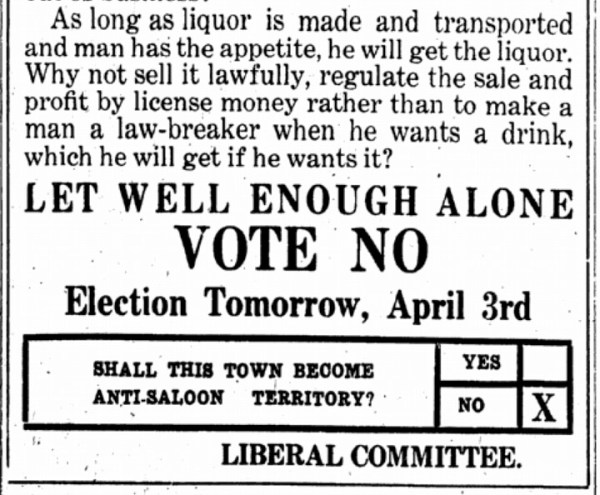
Booze.Vote NO on April 3, 1917 ISR, Apr. 2, 1917, p. 10

A public relations battle broke out in Springfield’s two leading newspapers between the Dry Committee and pro-tavern “Liberal Committee.” The dry message cited social ills like crowded jails, shattered family life and hard-earned money drunk away, largely sidestepping their traditional resort to Christian arguments. Meanwhile, the Liberal Committee argued that going dry would actually unleash higher levels of temptation, crime, and immorality, pleading with voters to “…regulate the sale (of alcohol) and profit by the license money rather than make a man a law-breaker when he wants a drink…”

For entrepreneurial immigrant and native tavern-owners relying on their saloon income to escape erratic, dangerous and low-paying factory and coal mining jobs, prohibition was the ultimate threat. “[The prohibitionists] propose to vote us out, take away our source of livelihood, and destroy both our property and business without recompense, which is not American fair play.”27, 28

The fact that city pensions were supported by tavern licensing fees also likely contributed to a reluctance to completely shut down Springfield’s taverns. In 1912, the Illinois State Register had reported, “the police pension [had] increased by $2,000, as it is the law that $10 of every [tavern] license shall be given to that fund.  The firemen’s pension fund [also] increased by $500, as $250 of each license is given to that fund.”29 Springfield’s elected commissioners (in the city’s new system of commission government) wondered how to make up the shortfall in pension contributions should tavern licensing fees disappear after an anti-tavern vote.

Booze.GOES DRY ILLINOIS STATE REGISTER, Wednesday, April 4, 1917

That April, a reported 22,000 voters went to the polls in Springfield in spite of the fact that President Woodrow Wilson asked for a declaration of war against Germany the day before the election. This time, Springfield voted to put itself “squarely in the prohibition column,” the largest city in Illinois to do so at that time. The majority carried by only 469 votes, and as the temperance forces had long hoped, women made the difference, at last pushing the prohibition tally over the top.30

Vote totals were 10,764 for prohibition versus 10,295 against. Illinois law set midnight May 4th as the death knell for taverns in Springfield. 31

Leading up to the 1917 dry vote, some tavern owners and liquor interests anticipated that city-wide temperance would merely drive the alcohol trade underground. The website SangamonLink sums up what happened: “The 1916 city directory listed 208 saloons in Springfield; they all vanished in the 1918 directory, but were replaced by 80 “soft drink” parlors, a classification brand new to the directory that year. The Leland Hotel became a tea room, and some other taverns were, at least nominally, converted to pool halls, groceries, and other establishments where a knowledgeable patron could get an alcoholic drink with a knowing nod or password.”32

Prohibition Goes National

In many ways, Springfield looked ahead when it enacted citywide prohibition as early as 1917, owing to the fact that the U.S. temperance movement did not achieve ultimate victory until passage of the National Prohibition Act (a.k.a The Volstead Act) in January 1919. The Act took effect in January 1920 and prohibited the manufacture, sale and consumption of liquor nationwide.

CityCouncilPassedLiquorOrd. ISJ, Dec.3, 1933 P1

Illinois State Journal, Dec. 3, 1933.

What followed was a period rife with bootlegging, gang wars, and countless police raids, arrests, and fines, mostly imposed on normal citizens for small-time alcohol-related infractions. Prohibition also led to tens of thousands of deaths from methyl or wood alcohol–as well as industrial alcohol that the government ordered poisoned in a tragically misguided program to discourage its theft and sale for spirit consumption by criminal gangs.

In the depths of the Great Depression, the National Prohibition Act was repealed by the federal government so that alcohol sales could be taxed to help pay for desperately needed public relief and jobs programs. National Prohibition finally ended in December 1933.33

Works Cited

1). Grocery Ordinance. Sangamo Journal, May 23, 1844. P. 3

2). City Ordinance. Illinois Daily Journal, Aug. 28,1852, P. 3

3). Grossman, J. R., Keating, et.al. (2004). The encyclopedia of Chicago. Chicago: University of Chicago Press. accessed March 15, 2016, http://www.encyclopedia.chicagohistory.org/pages/1238.html

4). White, C. T. (1921). Lincoln and prohibition. New York: Abingdon Press. PP.141-143. accessed March 16, 2016, https://books.google.com/books

5). Grossman, J. R., Keating, et.al. (2004). The encyclopedia of Chicago. Chicago: University of Chicago Press. accessed March 22, 2016, http://www.encyclopedia.chicagohistory.org/pages/1238.html

6). Talks Local Option Law. Illinois State Journal, Nov. 25, 1901, P.2

7). SangamonLink http://sangamoncountyhistory.org/wp/?p=8193, accessed March 15, 2016.

8). Ibid.

9).  City of Springfield Directory, R.L. Polk & Co., 1904.

10).  Aldermen Go To Decatur: Saloon District Defined. Illinois State Register, Oct. 16, 1905, P.7

11).  Mayor’s Veto Decides Scale Against Timm Ordinance. Illinois State Register, Oct. 31, 1905, P.5

12).  SangamonLink http://sangamoncountyhistory.org/wp/?p=8193, accessed March 20, 2016.

13). Levee District is Laid Waste. Illinois State Journal, Aug. 15, 1908, P.1

14).  Senechal, R. R. (2008). In Lincoln’s Shadow: The 1908 Race Riot in Springfield, Illinois. Southern Illinois University Press. P.16

15). Midnight Lid “Pryed” Loose.  Illinois State Register, Feb. 21, 1909, P. 1

16). City of Springfield Directory, R.L. Polk & Co., 1908.

17). To-Day Is Election Day.  Illinois State Register, Apr. 5, 1910, P. 1

18). SangamonLink http://sangamoncountyhistory.org/wp/?p=8193, accessed March 19, 2016.

19).  Voters of City Decide Further Regulation of Saloons Not Necessary. Illinois State Journal, Dec. 15, 1911. P. 1

20). Pseudo Cafes Are Interdicted. Illinois State Register, Jan. 1, 1914, P. 11

21). Ibid.

22). Wet and Dry Fight Opens in this City.  Illinois State Register, Jan. 2, 1914, P. 2

23). Sweeping Victory of Saloon Forces, Favored by Big Number of Women’s Vote, is Surprise. Illinois State Journal, April 8, 1914, P. 1

24). SangamonLink http://sangamoncountyhistory.org/wp/?p=8193, accessed March 15, 2016.

25). Sweeping Victory of Saloon Forces, Favored by Big Number of Women’s Vote, is Surprise. Illinois State Journal, April 8, 1914, P. 1

26). ‘Drys’ Map Out Campaign Units. Illinois State Register, Feb. 7, 1917, P. 12

27). The Real Question For the Voters on April 3rd.  Illinois State Register, Apr. 2, 1917, P. 10

28). Many Guesses As Fight For Dry City Ends. Illinois State Register, Apr. 1, 1917, P. 1

29). Will Have $50,000 in Treasury. Illinois State Register, Jun. 28, 1912, P. 5

30). Saloons Voted Out By Women; Majority 469. Illinois State Register, Apr. 4, 1917, P. 1

31). SangamonLink http://sangamoncountyhistory.org/wp/?p=8193, accessed March 15, 2016.

32). Ibid.

33). Kyvig, D. E. (2000). Repealing national prohibition. Kent, Ohio: Kent State University Press. PP. 178-179
Lady of Birds and Lost Little Ones

Image

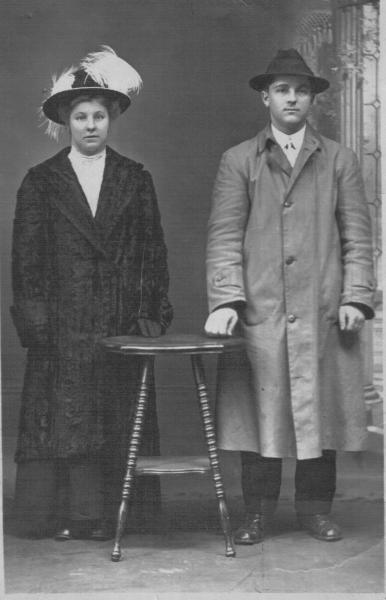
Mary Ann and Antanas Yezdauskas, Springfield, 1912.

The day in 1912 when she first arrived in Springfield, 16-year-old Lithuanian immigrant Mary Ann Yezdauskas was greeted and taken by her brother to buy a brand new coat and hat at elegant Bressmer’s Department Store. Then sister and brother posed together in their finery at the Herbert George Photo Studio. The purpose? To chronicle for  anxious parents back home the major milestone just reached by a young daughter who had safely weathered her voyage to join an older brother already established in the United States.

A copy of the photo sent home to Mary Ann’s parents Antanina and Vincas Yezdauskas (Yezdauski) survives today, along with the refurbished steamer trunk that carried Mary Ann’s possessions across the Atlantic. Following is the story of this immigrant wife and mother from an era of formidable housework and few labor-saving devices: a story of strenuous toil and lost children that undoubtedly was shared by many immigrant women.

Meeting, Marrying

After arriving in Springfield, Mary Ann first lived with her unmarried older brother, Antanas (Anthony), who had paid her passage to America and welcomed her to Springfield. According to daughter Helen (Sitki) Rackauskas, Mary Ann worked at Springfield’s International Shoe Company, then at her aunt Emma Gedman’s Saloon at 808 E. Washington.

Image

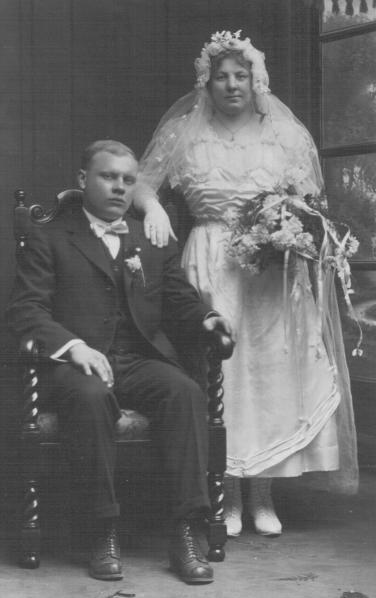
Wedding Day, Anthony J. Sitki and Mary Ann Yezdauskas, 1918.

While a barmaid, Mary Ann met coal miners who came to the saloon to cash their paychecks. One of them was Lithuanian-American Anthony J. Sitki, whom she married in 1918 at St. Vincent de Paul Church. Anthony was born in 1896 in the coal-mining town Scranton, Penn., to Lithuanian immigrants Annie (Valentine) and her coal-miner husband Adolph Stozygowski-Sitki.

Child Deaths and Debts

It wouldn’t be fair to say that Mary Ann’s hardships began with marriage and childbearing, since already as a young person and perhaps even a child, she had known a life of hard work. However, according to daughter Helen, Mary Ann’s greatest sufferings were as a mother who lost five of her seven offspring as either infants or children. Compounding these losses, each new burial loaded significant, new debt onto the struggling family, requiring decades of weekly funeral home payments nearly as crushing–and enduring–as a mother’s grief.

Daughter Helen, now more than 90-years-old, can still remember her parents’ struggle to pay, especially when her miner father didn’t have work. No matter how young and tiny the deceased child or infant, certain corners could not be cut. This made serial infant mortality not just an emotional tragedy, but a financial one, as well, for many immigrant families.
After Mass every Sunday, Helen remembers going with her mother to visit her siblings’ graves. “It was a sad childhood,” she says, especially remembering how her sister Josephine died at age 12, screaming in the agony of peritonitis in a hospital that could not help her after her appendix burst.

‘Bird Lady’

Perhaps it was the souls of her lost little ones that Mary Ann was thinking of when she began to love and raise songbirds and exotic flowers. By the time Helen and Raymond grew up and left home, their mother had so many canaries, African violets, and other exotic indoor flowers, that husband Anthony enclosed the back porch of the family home at 1820 S. 16th to create a special room for the living things his wife tended with so much love and care.

For a time, Helen recalls, her mother even experimented with capturing native songbirds like cardinals in a special cage, freeing them when she could not get them to sing or mate in captivity. Mary Ann “loved the outdoors” and had the most talented green thumb in the neighborhood. “She just really loved, and was really good at raising living things.  She was able to grow flowers nobody else could,” Helen recalls. Also able to grow the most challenging plants from mere cuttings, Mary Ann attracted the attention of the African-American greenhouse operator at 16th and South Grand, who unsuccessfully asked her to work for him, and then inherited her prized hibiscus after she died.

Yezdauskas departure

At left: Mary Ann Yezdauskas with her mother Antanina, father Vincas, and little sister and brother before departing Lithuania. Circa 1912.


Cooking and Keeping House

Helen remembers home food production—especially her mother’s backyard farm with rows of vegetables, cherry trees, chickens and geese. Amid the constant work of collecting eggs and baking bread and pies, Mary Ann canned hundreds of quarts of green beans and mushrooms. She made blood sausage and  various “head cheese”-like dishes, such as jellied pigs’ feet or pigs’ feet in aspic (košeliena). She prepared the grated potato casserole kugelis, cold and hot beet soup, and many other Lithuanian dishes, including potato pancakes for meatless Fridays.

Sunday chicken dinners were a feature of Lithuanian immigrant life all over Springfield, but “bird lady” Mary Ann would not slaughter her own chickens. Helen recalls that a Russian neighbor was called in for this task.

Easter featured blood soup made from fresh blood drained from the neck of a slaughtered goose, mixed with vinegar to keep it from coagulating. The blood later was cooked with prunes and plums.

Nothing from their animals was wasted. So during long winter nights with no television, Helen says she and her mother and her brother Raymond would huddle in the basement and pull the down off goose feathers to make pillows. “Mom kept a barrel in the backyard where the feathers were washed and then dried on a grate in the sun during the summer,” Helen recalls. “Then in the winter, when it got cold, several nights a week, we would go into the basement and sit next to the furnace, plucking the feathers. It would take two whole winters of all of us working to make maybe one pillow.”

Besides that, the labor-intensive job that Helen liked least was pitting cherries for homemade pies. Her mother-in-law performed another tedious household chore that I have never heard of: stretching curtains. And before the days of professional carpet cleaners, Helen reports that her mother Mary Ann would wet and crumple into balls torn newspapers, throw them on the rugs, and then sweep them across the rugs to collect dust and dirt.  Rugs were also taken into the basement to be beaten.

Wedding Traditions from the Old Country

After Helen graduated from Feitshan’s High School and Brown’s Business College and went to work at the Illinois Department of Finance, she met and married Lithuanian-American George Rackauskas. On her wedding day in the 1948, her parents met the newlyweds at the door to their home on South 16th, for the reception, holding a tray.

On the tray was a dish of salt, several pieces of rye bread, and spicy, warm vyritos (made with whiskey) in a shot glass. “George and I dipped a piece of bread in salt and ate it, then drank a shot of vyritos,” Helen says. The bread symbolized good times, the salt, bad times, and the vyritos, marital happiness.

Father Casimir Andruskevitch, who had grown up in the parish, married Helen and George at St. Vincent de Paul’s, where Anthony and Mary Ann had been married 30 years earlier. Two cooks were hired to serve chicken, ham, kielbasa, barrels of beer, and other foods in the basement of the home on South 16th.

John Mezeilis played the accordion, and the reception lasted for two days, according to Helen. She’s not sure whether this encompassed both daytime and night-time, since she and her groom departed the first night in his 1939 Pontiac. Helen reports that they would have gone farther than St. Louis if their car hadn’t broken down.

Rackauskas.Helen.Lindsay.Amanda

From left: Helen (Sitki) Rackauskas with granddaughters Lindsay and Amanda, 2015.

Poverty and ‘Mine Wars’

Helen recalls that her father had mine work only from September to February, when the operators and their customers had stockpiled enough coal to last until the following autumn. It was a cruel system for the mine worker and his family.

As a child, Helen remembers her parents receiving letters from the county with stickers that entitled the children to a form of public aid: free shoes and winter coats from the upscale Myers Brothers Department Store. “We were old enough to be embarrassed, but happy to be getting such nice things,” Helen recalls. “Myers was a really expensive store.”

To help her mother learn English, Helen’s father bought her a radio soon after they were married, and insisted she respond in English even when the children spoke to her in Lithuanian. Originally illiterate, Mary Ann had taught herself to read and write from library books by the time Helen and Raymond were in high school, and remained a lifelong patron of the public library branch on South Grand Avenue.

During the 1932-36 “Mine Wars,” Helen says her father Anthony stayed with the United Mine Workers of America. This put him at some risk from striking Progressive Miners of America. One morning before Anthony was going to drive to work, a friend called to warn that some Progressives were waiting at the corner of 16th and Cornell to club his car.

Anthony took another route. But that night, Helen recalls, somebody threw bricks through the window where her baby brother Raymond was sleeping in his crib.

President Roosevelt’s Works Progress Authority (WPA) provided striking and working miners alike some extra income with the building of Lake Springfield. Helen says her father bicycled to the construction site to help install riprap.

Helen’s father Anthony died in 1951 at age 55 from a heart attack somewhat related to mining. Another miner had been arguing with him while driving back from their Peabody jobs in Taylorville. After the other miner got physical, Anthony got out of the car and collapsed suddenly and died right at his own front door. He had an underlying heart condition that had secured him a reprieve from working underground, so that he had been working “up top” his last day at the mine.

A daily Mass-goer who still, in her 50s, wore her hair in long braids, Mary Ann never got over her husband’s death. She had high blood pressure. But no one anticipated the fatal heart attack that struck her down at age 56 in 1952, after only one year of living without her beloved Anthony.

Today, the steamer trunk that accompanied Mary Ann (Yezdauskas) Sitki to America more than 100 years ago is a cherished fixture in the Springfield living room of her granddaughter, Mary Ann Rackauskas, D.D.S.  Mary Ann’s two daughters also are proud Lithuanian-Americans raised on many stories about their grandparents and great-grandparents. Amanda is completing her training to be a plastic surgeon, and Lindsay is a marketing professional in Shanghai, China.  (Mary Ann has a brother, Greg, who is also a dentist.)

Rackauskas.maryLindsayAmanda

From left: Helen’s daughter Mary Ann Rackauskas, D.D.S., with Lindsay and Amanda on Lindsay’s wedding day, 2015.