• Welcome!
  • An indelible role in our history
    • Historical Background, Influences
      • First Lithuanians in Springfield
      • Freedom and Assimilation
      • Divisions and Decline
      • The Mining Life
        • Honoring Central Illinois Mine Casualties
        • The Mine Wars
      • A Second Wave of Immigration: the ‘DPs’
      • Behind the Iron Curtain
      • “Singing Revolution”
        • “The Other Dream Team”
    • Lithuanian Historical Marker Dedication
      • Lithuanians in Springfield Historical Marker
      • A Time to Remember
      • Historical Marker Dedication Program
      • Photo Gallery
      • Marker ceremony noted in Shimkus newsletter
  • Elder Isolation is Elder Abuse
    • Open Letter to Ill. Gov. Pritzker, AG Raoul
    • Open Letter to Illinois Elder Abuse Task Force
  • Sandy’s Blog: News and Profiles
  • Voices of the “Third Wave”
    • Christmas Memories
    • Remembering January 1991
  • Springfield Lithuanian Families
    • Bakunas, Gestaut, Shadis, Petrokas, Chepulis
    • Local Lithuanians Prompt Newspaper Story
    • Stuches, Gillette, Cooper, Chesnut
    • Tisckos, Miller, Wisnosky
    • Treinis, Nevada, Yuskavich
    • Andruskevitch-Shoudis-Moser
      • Weddings
    • Baksys-Yamont
      • Singing Revolution Activities, U.S.
    • Banzin – Liutkus – Kellus – Gestautas
      • Memories
      • Trips to Lithuania and an appreciation of ancestry
    • Giedrys-Kudirka
    • Janners (Jankauskas), Gossrow
    • Kwedar, Olshevsky, Shupenus
    • Lelys, Lilles
      • 1970 Wedding, St. Vincent de Paul Church
    • Turasky, Yakst, Brazas, Stockus
    • Mankus-Tonila
      • Maria Fry Race & Tonilas
    • Zemaitis, Zubkus
    • Casper, Yanor, Walentukonis
    • Rackauskas immigration
    • Treinis-Banaitis
    • Bubnis, Guthrie, Walker
    • Grigsby, Dumbris
    • Missavich-Stankavich
    • Welch, Wilcauskis, Valentanovich
    • Stasukinas, Staken, Bubblis, Poskevicius
  • St. Vincent de Paul Lithuanian Catholic Church
    • St. Vincent de Paul murals resurface
    • Lithuanian Independence Day, 1950
    • People of the Church
    • People of the Church 2
    • People of the Church 3
    • People of the Church 4
    • Fr. Yunker College Scholars
      • Patricia Visnesky and Cynthia R. Baksys
      • Amanda Rackauskas Ross and Elaine (Manning) Kuhn
      • Barbara Blazis, John Dombroski, Patricia Naumovich, Mary Sitki
      • Diane D. Baksys and Emily Warren
  • Business & Professions
    • Journalist Matt Buedel
    • U.S. Senator Richard J. Durbin
    • Chernis: Midwest Demolition
    • Lobbyist “Limey” Nargelenas
      • Horace Mann CEO Marita Zuraitis
    • Nurse Joan Naumovich
    • Tony J. Yuscius, Advanced Digital Media
    • Business Writer Dan Naumovich
    • Teacher Elaine Kuhn
    • Power Co. Executive Maria Race
      • Pediatric Dentist Mary Ann Rackauskas
        • Nurse Debbie Ritter
    • Radio Host Sam Madonia
    • Turasky Meats
      • Tureskis Cleaners
  • The Lithuanian-American Club
    • Founding and Founders
    • Club Lobbies for Lithuanian Independence: Letter to President Bush
    • Recipes / Food
    • Travel

Lithuanians in Springfield, Illinois

Lithuanians in Springfield, Illinois

Monthly Archives: August 2016

Urbanckas State Fair Stories

28 Sunday Aug 2016

Posted by sandyb52 in Sandy's Blog

≈ 3 Comments

Urbanckas, Mary, state fair Troy Mathews of the Chernis-Urbanckas clan shared his family’s long and happy association with the Illinois State Fair in the State Journal-Register newspaper on Aug. 19, 2016. I’ve pasted the text of that article below for those who missed it. I would have loved to have worked–exhibited or marched in a parade–at the Fair as a young person. (Looks like my family should have known the Urbanckases!)  Mary (Chernis) Urbanckas  is pictured above with her “Best in Show” hobby entry and ribbon, 2006.

Guest Column: State Fair near and dear to family’s heart

http://www.sj-r.com/opinion/20160819/guest-column-state-fair-near-and-dear-to-familys-heart/?Start=2

By Troy Mathews

Mary Urbanckas was born Aug. 16, 1916. Pete Urbanckas, her husband, was born Aug. 14, 1915 — both during State Fair Week. Mary and Pete, my grandparents, shared a great love for the Illinois State Fair and taught its importance and traditions to our family.

Historically, fair guests often boarded at families’ homes near the fairgrounds. Guests were charged a nominal fee to have all the comforts of home while here at the fair, such as telephone, television, hot showers, fresh sheets and a home-cooked breakfast. For 30 years, from the 1950s through the 1980s, Pete and Mary Urbanckas welcomed Illinois State Fair guests to stay at their residence. In the late 1980s, the price of a room was slightly under $20 a day. Some of their guests included the virtuoso pianist Stephanie Trick and her parents; Gene Montgomery, who drove a customized 1970s Cadillac as a starter car for harness races; Mr. Bloomstein, who sold Americana items; a man named “Uncle,” whom my grandmother said carried a great deal of money; and Bob Vono of the Orange Treat stand.

Pete’s brother and sister-in-law, Al and Anne Urbanckas, also invited guests to stay at their home on North Sixth Street, one block from the Fair. Their guest list included “the butter cow lady” Norma “Duffy” Lyon, who created the Illinois State Fair Cow for more than 30 years in the 1950s.

The fair was always reliable for income. Everyone always seemed to find a job at the fair. My grandmother worked in the fairgrounds at Clara’s Cafeteria on Main Street, with her daughters, Donna Frost and Pat Mathews, my mother. Mary and Donna poured plentiful cups of coffee and Pat spilled plentiful cups of coffee. Mary’s brother, Stanley Chernis, worked for the U.S. Postal Service as a clerk in the fairgrounds. At that time, the post office was located where the Illinois Fire Museum is currently located. Al Urbanckas popped popcorn in the Dairy Building. And I currently work for Illinois State Fair Security.

In 1936, the tallest man on record, Robert Wadlow, visited the State Fair. My grandfather, Pete, hoped to meet him, and did. During his visit, Wadlow briefly became unsteady and my grandfather helped stabilize him until he regained his footing. My grandfather always said Wadlow was grand in stature and heart, friendly and kind.

In 1993, Pete and Mary’s grandson, my brother, Scott Mathews, drove the car carrying the Grand Marshals in the State Fair parade, an experience that he said was an honor.

In her 90s, Mary, my grandmother, was asked to be Grand Marshal in the parade. Although honored, she said that she was shy and declined.

Over the years, my family also has enjoyed the experiences of winning multiple ribbons and awards from exhibits. Two of the most memorable include my grandmother, Mary, winning Best of Show in Hobbies in 2006, and her daughter, my mom Pat, repeating the same award 10 years later.

Our family has made so many friends over the years, from performers to exhibitors at the Illinois State Fair. Over the years, it has been a reliable source of family fun. The fair is a venue to show off the best the state has to offer, from breakthroughs in technology and agriculture to inventions in American and ethnic foods.
My grandmother, Mary, died in 2013. She would have turned 100 during this Fair week.During this week, we think of her and the many lasting memories our family has made because of the State Fair.— Troy Mathews is a Springfield resident.

Lithuanian booth gets visitor

17 Wednesday Aug 2016

Posted by sandyb52 in Sandy's Blog

≈ Leave a comment

Here is a photo that proud Lithuanian-American Diane Rutledge sent me this evening from Ethnic Village at the Illinois State Fair. I hope to someday tell her immigrant family story on this blog. Svekas!

Rutledge.booth.08.17.16


Photo of Lithuanian Booth, Ethnic Village, Illinois State Fair

14 Sunday Aug 2016

Posted by sandyb52 in Sandy's Blog

≈ 4 Comments

Lithuanian Booth Returns to Ethnic Village at Illinois State Fair!

11 Thursday Aug 2016

Posted by sandyb52 in Sandy's Blog

≈ 3 Comments

LithuaniaFlag


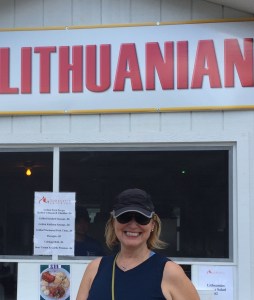
When the 2016 Illinois State Fair opens its gates tonight, there will be a momentous change in Ethnic Village: for the first time in decades, a food booth will bear the “Lithuanian” name and colors. For those of you who don’t know, Lithuanian immigrant families had a close and longstanding connection to the Fair.

Such families once lived all along the southern and eastern borders of the Fairgrounds in a “Little Lithuania” neighborhood that stretched north, south, east, and west from the intersection of Sangamon Avenue and Peoria Road. As a result, many old-time fair-goers remember buying soda, water and lemonade from Lithuanian-American locals,  who also took advantage of their proximity to the Fairgrounds to park cars in their yards.

Turasky Catering Switches Polish Booth to Lithuanian This Year

Growing up, my own family’s first stop early on Children’s Day at the Fair would be 2102 Peoria Road, the home of my Great Aunt (Teta) Mary Yamont, to park our car, visit, and receive our Fair spending money of $5 per child from Teta, her son Joe and daughter Mary.

TuraskysCatering_Logo_onWhite

“Little Tony” Turasky, Lithuanian-American owner of Turasky’s Catering, formerly operated his Ethnic Village booth as “Polish.” Much of his new Lithuanian menu seems interchangeable with the booth’s former Polish offerings–undoubtedly, to encourage a certain continuity in his clientele.

Yet the return of such a visible Lithuanian presence to Springfield’s public square, after such a long absence, is still a major cause for fun and celebration. And if you like high-quality Turasky meats, this booth is for you!

I’m asking everyone to PLEASE stop by the Lithuanian booth in Ethnic Village and sample its meaty offerings, and while you’re there, please also snap a photo with yourselves and the Lithuanian colors/name to be shared on this blog. (Please don’t forget to e-mail the names of those photographed, along with your attached jpeg photo file, to sandybaksys@gmail.com.)

Please also share with my readers any Fair memories you have with your Lithuanian ancestors.

Tony provided us an advance copy of his menu below::

Turasky's Truck

Grilled Pork Burger Stuffed w/Bacon & Cheddar

Grilled Smoked Sausage

Grilled Kielbasa Sausage

 Grilled Marinated Pork Chop

 Pierogies

Cabbage Rolls

‘Polish’ by mistake?

06 Saturday Aug 2016

Posted by sandyb52 in Sandy's Blog

≈ 2 Comments

I spotted an obituary of a 102-year-old woman, Victoria Alice (Buskis) Houston. whose parents were Anna Klemovich and Adam (probably Adomas) Buskis. She had siblings Anthony, Joseph, Edward and Anna.

In one part of the obit, it says Victoria made “Polish chicken and dumplings.” Yet there was no mention of her likely 100 percent Lithuanian heritage. This made me wonder if her descendants were/are not aware of their own Lithuanian heritage  (and “Lithuanian” chicken and dumplings!).

Does anyone know this family, or remember whether they were ever members of the Lithuanian-American Club (maybe back in the early 1990s)?

Victoria lived at Heritage Health for more than 10 years, and her funeral mass was at St. Cabrini on Aug. 1.  Here’s her obituary:

http://www.legacy.com/obituaries/sj-r/obituary.aspx?n=victoria-alice-houston&pid=180827440&fhid=7772


David Broida and Family: A Mercantile Success Story

03 Wednesday Aug 2016

Posted by sandyb52 in Sandy's Blog

≈ 8 Comments

By William Cellini, Jr.

Broida Family c. 1915. H. B. Broida family collection copy

David and Anna (Machnovitz) Broida family, circa 1915.

Decades before the Holocaust of the 1930s and 1940s ravaged Jewish communities across Europe and Russia, there was a persecution of Russian Jews that followed the assassination of Tsar Alexander II in 1881. His assassination by revolutionary socialists sparked pogroms and restrictive laws against Jews living in the Russian Empire including the Litvak community. Litvaks (the Yiddish word for the Jews of Lithuania) were deprived of their rights as citizens as a result of the restrictions. As a result of those hindrances, the period of the 1880s to the 1910s was a time of mass emigration by Jews in Russia. In fact, the first Jews to emigrate from the Russian Empire were Litvaks. (Bernheimer, C. S. (1905). The Russian Jew in the United States: Studies of social conditions in New York, Philadelphia, and Chicago, with a description of rural settlements. New York: J.S. Ozer., P. 26); (Lithuanian Jews Make Big Impact in South Africa. Reuters, Jun. 12, 1998)

David Broida was part of the Litvak masses and he emigrated in 1888 ultimately settling in the Midwest with his wife, Anna Machnovitz, and their children. David was the eldest son of Jacob and Hannah (Weinstein) Broida from the village of Eišiškės in southeastern Lithuania, a community with a 900-year-old Jewish shtetl. The family arrived in Springfield after first spending time in Cincinnati, Ohio. David worked as a cigar maker in Cincinnati, so when he arrived in Springfield, he continued the trade.

The family first lived on East Reynolds Street in a predominately African American neighborhood and by 1906, they moved to 401 North 14th near Mason Street into another predominately African American neighborhood known as the “badlands” northeast of Springfield’s Levee district. (Ancestry.com, 1900 U.S. Federal Census); (There Was Once a World: A 900-Year Chronicle of the Shtetl of Eishyshok., Little, Brown & Co., 1999); (City of Springfield Directory, R.L. Polk & Co., 1905); (City of Springfield Directory, R.L. Polk & Co., 1906); (Selby, P. (1912). Historical Encyclopedia of Illinois, Vol. 2. Chicago: Munsell Pub. Co.)
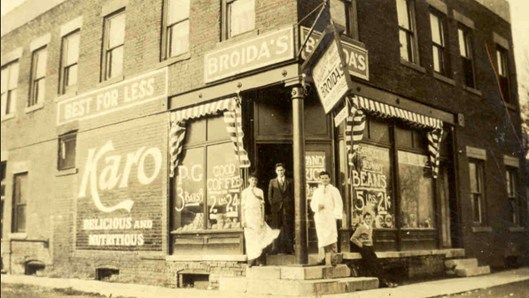
Broida Grocery Herman, Bud and Joe c. 1934. H. B. Broida family collection copy

Broida’s Grocery with Eddie, Herman, and Joe, 1934.

In the badlands, David opened a tavern at 14th and Mason but within a year, the neighborhood took-up a petition to have his license revoked. Greatest criticism came from Rev. Jason Bundy, the pastor of St. John’s African Methodist Episcopal Church. His congregation was across the street and it faced the tavern. According to news reports in the archives of the Illinois State Journal-Register, it was either Broida or Bundy who offered a bribe to stop the anti-tavern petition from going to the city council; however, the details about the incident are unclear in the press of that period. What is known is that David Broida ultimately lost his liquor license and he transformed the tavern into a butcher shop and grocery store in 1907 around the same time his younger brother Morris opened his clothing store in the 2000 block of Peoria Road. These two stores were the start of the Broida family retail business in Springfield. (ISJ, Feb. 5, 1907, P. 7)

Among the heavy concentration of European and Russian Jews who emigrated to the U.S., portions of their community achieved an impressive upward mobility within two generations after emigration. The Broida family typified the early-20th century immigrant success story, as they were an exemplary face among the small Litvak community in Springfield.

David fast became a popular and successful merchant in town and he opened a second store at 1900 South 15th street in the early 1900s. Dealing with the public afforded him a degree of notoriety, and so he ran for alderman in Springfield’s 1st Ward. However, before the campaign got underway, his brother Morris went bankrupt over a bad business deal. Creditors claimed he was hiding over $12,000 and sued him in federal court. Morris was ordered to pay a reduced settlement but could not produce the money, and so the judge gave him an eight-month jail sentence on account of contempt.In the aftermath, Morris and his family left Springfield and moved to St. Louis. For David, his campaign for Alderman was not successful. He came in third behind two challengers; one of them a Lithuanian-born tavern owner named William Botwinis. (Broida’s General Stores. ISR, Dec. 5, 1909, P. 63); (Want Broida to Produce $15,000. ISR, Jan. 19, 1915, P. 6);(Broida Case Taken Under Advisement. ISR, Jun. 18, 1915, P. 9); (Ancestry.com); (WWI Draft Registration of Max Broida, Ancestry.com)

Perhaps a bit over confident about his initial political foray, David again ran as a candidate for the city council in the February 1911 primary. According to the Historical Encyclopedia of Illinois, Broida gave a statement to the press saying he’d, “put his whole time and attention to fulfilling the duties of the job to see that the city was given a clean government”. He was not alone in thinking about a political career that winter. Following Springfield’s vote to replace the aldermanic form of government with a commission form, a crowded field of 105 candidates vied for only four open seats on the new city council. After obtaining a mere 183 votes in the primary, David likely realized that politics was not in his best interest. (Historical Encyclopedia of Illinois, Vol. 2, 1912); (How the Candidates Finished in City’s First Commission Primary. ISR, Mar. 1, 1911, p. 1)

After his 1911 election disappointment, he again tried his hand at the tavern business by opening a wholesale liquor store in the 700 block of East Washington Street, the heart of Springfield’s Levee. According to the 1910 Springfield City Directory, the site had been a tavern previously operated by the Lithuanian-born Joseph Meiron. Try as he may, David Broida did not succeed in operating a liquor store and a grocery at the same time and he abandoned the Washington street location less than a year into the venture. Creditors later sued him for payments he owed on the liquor stock. As a side note, city directories indicate the address of the liquor store on East Washington was later named the “Joseph Sutkaitis Saloon” pointing to continued Lithuanian connections in the Levee district during that era. (ISJ, Oct. 24, 1914, P. 7); (Council Makes Generator Award. ISR, Jun. 30, 1914, P. 6)
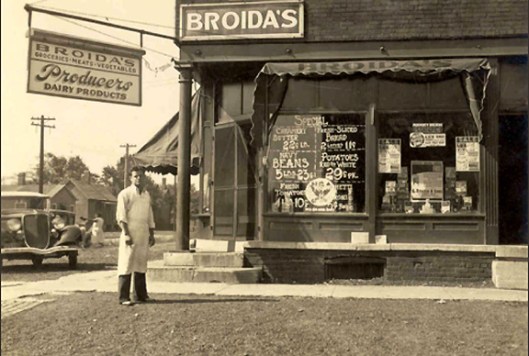
Herman 'Bud' Broida, c. 1933, 1934 401 North 14th copy

Herman “Bud” Broida’s Market, 401 N. 14th St., circa 1934.

David’s strength was best put to use selling retail goods and he moved his grocery to 14th and Cook streets while retaining his building on Mason so he could rent it to tenants for extra income. By 1916, his grocery business was going so well he built a two-story brick complex at the Cook Street site and the family lived in an annex connected to the store. The building served as Broida’s Grocery for many years and eventually David’s sons, Eddie, Herman and Joe, all lent a hand working at their father’s grocery (Building Permits. ISR, Dec. 20, 1916, p. 12).

In 1924, David Broida passed away at the age of 49 and was buried at Beth Hamedrosh Hagodol Cemetery in St. Louis. According to Joe’s daughter, the family belonged to Temple B’rith Sholom, one of three temples in Springfield that existed before WWII. After David’s passing, his wife Anna moved to St. Louis to be with her daughter Ida (Broida) Dorman. Anna passed away in St. Louis in 1952. Of all the Broida sons, it was Herman who expanded the grocery business by re-opening their father’s location at 14th and Mason in 1932. In addition, the brothers built “Broida’s Store #2” on Springfield’s west side at 1308 South College Street. Herman eventually moved out of state leaving Joe and Eddie to tend to the grocery businesses. (Obituary, Mrs. Anna Broida. ISJ, Dec. 2, 1952, P. 16); (Springfield City Directory, Jefferson’s Printing and Stationary Co., 1931); (Springfield City Directory, H.L. Williamson Co., 1934)

The two brothers carried-on but struggled as chain grocery stores gradually replaced family-run independents in the period after the Great Depression. Turning away from the grocery business, the brothers began selling furniture. They each opened a series of home furnishing stores across Springfield and Eddie was the first to open a store on East Washington. He died in Springfield in 1978 at the age of 71.

Broida College and South Grand store 1967

Broida’s (vacant) College and South Grand Avenue location, 1967.

According to Joe Broida’s daughter, her father tried to keep the grocery at 14th and Mason in operation but by the 1940s, the badlands neighborhood was razed to build the John Hay Homes, a subsidized multi-family apartment complex, so Joe moved his operation to Cook Street and renovated the old grocery store there by re-branding it, “Re-Nu Furniture and Appliances”. He later opened Southtown Furniture in 1963 and remained there until his retirement in 1982. He died in Arizona in 1995. (Eddie I. Broida obit. ISJR, Dec. 5, 1978, P. 28); (Workers Begin Razing of Buildings in Vast Housing Project. ISJ, Aug. 8, 1940, P. 4); (Broida Store Opening. ISJ, Oct. 30, 1963, P. 9); (Ancestry.com, Social Security Death Index)

All photos except College Street store courtesy of the H.B. Broida family collection.
Blogroll

  • Enos Park Neighborhood Improvement Association
  • Illinois State Historical Society

Lithuanian Websites

  • Amber Reunion
  • Lithuanian World Center
  • Lithuanian-American Club of Central Illinois
  • Lithuanian-American Community, Inc.
  • Lithuanian-American Publications
  • Lithuanians Of Arizona
  • LTnews.net
  • LTUWorld
  • The Lithuania Tribune

St. Vincent’s murals resurface

Two of the murals from St. Vincent de Paul's Catholic Church have resurfaced. Take a look!

Search

Enter your email address to follow this blog and receive notifications of new posts by email.

Join 142 other subscribers

E-mail us!

Questions or comments? Please e-mail sandybaksys@gmail.com.

Email us!

Questions or comments? Please e-mail sandybaksys@gmail.com.

Create a free website or blog at WordPress.com.

Privacy & Cookies: This site uses cookies. By continuing to use this website, you agree to their use.
To find out more, including how to control cookies, see here: Cookie Policy
  • Subscribe Subscribed
    • Lithuanians in Springfield, Illinois
    • Join 142 other subscribers
    • Already have a WordPress.com account? Log in now.
    • Lithuanians in Springfield, Illinois
    • Subscribe Subscribed
    • Sign up
    • Log in
    • Report this content
    • View site in Reader
    • Manage subscriptions
    • Collapse this bar
 

Loading Comments...