• Welcome!
  • An indelible role in our history
    • Historical Background, Influences
      • First Lithuanians in Springfield
      • Freedom and Assimilation
      • Divisions and Decline
      • The Mining Life
        • Honoring Central Illinois Mine Casualties
        • The Mine Wars
      • A Second Wave of Immigration: the ‘DPs’
      • Behind the Iron Curtain
      • “Singing Revolution”
        • “The Other Dream Team”
    • Lithuanian Historical Marker Dedication
      • Lithuanians in Springfield Historical Marker
      • A Time to Remember
      • Historical Marker Dedication Program
      • Photo Gallery
      • Marker ceremony noted in Shimkus newsletter
  • Elder Isolation is Elder Abuse
    • Open Letter to Ill. Gov. Pritzker, AG Raoul
    • Open Letter to Illinois Elder Abuse Task Force
  • Sandy’s Blog: News and Profiles
  • Voices of the “Third Wave”
    • Christmas Memories
    • Remembering January 1991
  • Springfield Lithuanian Families
    • Bakunas, Gestaut, Shadis, Petrokas, Chepulis
    • Local Lithuanians Prompt Newspaper Story
    • Stuches, Gillette, Cooper, Chesnut
    • Tisckos, Miller, Wisnosky
    • Treinis, Nevada, Yuskavich
    • Andruskevitch-Shoudis-Moser
      • Weddings
    • Baksys-Yamont
      • Singing Revolution Activities, U.S.
    • Banzin – Liutkus – Kellus – Gestautas
      • Memories
      • Trips to Lithuania and an appreciation of ancestry
    • Giedrys-Kudirka
    • Janners (Jankauskas), Gossrow
    • Kwedar, Olshevsky, Shupenus
    • Lelys, Lilles
      • 1970 Wedding, St. Vincent de Paul Church
    • Turasky, Yakst, Brazas, Stockus
    • Mankus-Tonila
      • Maria Fry Race & Tonilas
    • Zemaitis, Zubkus
    • Casper, Yanor, Walentukonis
    • Rackauskas immigration
    • Treinis-Banaitis
    • Bubnis, Guthrie, Walker
    • Grigsby, Dumbris
    • Missavich-Stankavich
    • Welch, Wilcauskis, Valentanovich
    • Stasukinas, Staken, Bubblis, Poskevicius
  • St. Vincent de Paul Lithuanian Catholic Church
    • St. Vincent de Paul murals resurface
    • Lithuanian Independence Day, 1950
    • People of the Church
    • People of the Church 2
    • People of the Church 3
    • People of the Church 4
    • Fr. Yunker College Scholars
      • Patricia Visnesky and Cynthia R. Baksys
      • Amanda Rackauskas Ross and Elaine (Manning) Kuhn
      • Barbara Blazis, John Dombroski, Patricia Naumovich, Mary Sitki
      • Diane D. Baksys and Emily Warren
  • Business & Professions
    • Journalist Matt Buedel
    • U.S. Senator Richard J. Durbin
    • Chernis: Midwest Demolition
    • Lobbyist “Limey” Nargelenas
      • Horace Mann CEO Marita Zuraitis
    • Nurse Joan Naumovich
    • Tony J. Yuscius, Advanced Digital Media
    • Business Writer Dan Naumovich
    • Teacher Elaine Kuhn
    • Power Co. Executive Maria Race
      • Pediatric Dentist Mary Ann Rackauskas
        • Nurse Debbie Ritter
    • Radio Host Sam Madonia
    • Turasky Meats
      • Tureskis Cleaners
  • The Lithuanian-American Club
    • Founding and Founders
    • Club Lobbies for Lithuanian Independence: Letter to President Bush
    • Recipes / Food
    • Travel

Lithuanians in Springfield, Illinois

Lithuanians in Springfield, Illinois

Monthly Archives: September 2014

Joe Koncius & Lithuanian Language School

30 Tuesday Sep 2014

Posted by sandyb52 in Sandy's Blog

≈ 5 Comments

Joseph Koncius, former Springfield Lithuanian language school teacher, with his wife Giedre and daughters (l to r) Maria and Ruta. Circa 1970.

Joseph Koncius, former Springfield Lithuanian language school teacher, with his wife Giedre and daughters (l to r) Maria and Ruta. Circa 1970.

Usually when you meet a person born in the U.S. who speaks Lithuanian, it turns out that they grew up in the Chicago area and went to Lithuanian Saturday school in Marquette Park or Lemont. Few know there was a once a small Lithuanian Saturday school in Springfield for children of the post-World War II immigrants, called displaced persons or “DPs.”

Violeta Abramikas Abad of Ohio, a former child DP, tells me that the Uzgiris DP family hosted such a school in their Springfield home from 1949 through about 1957. This made sense, since the Uzgirises had three of the seven children attending the school—and the largest study table.

After writing so much about the illiteracy that blighted the lives of “first wave,” turn-of-the-century Lithuanian immigrants, I must underscore the dedication to education that was a hallmark of the “second wave” of Lithuanian immigrants after World War II, like the Uzgiris, Paulionis, and Sidlauskas families. Even my immigrant father, who grew up on a subsistence farm in the Lithuanian countryside between the Wars, benefited from the mandate of the newly independent Lithuanian republic to begin providing the universal education that the Lithuanian people long had been denied, first under feudalism, then the Russian czars.

As a country boy needed for hours of farm-work every day, my father didn’t get further than the government’s mandatory three years of reading, writing, and math. Reading was limited to a few books and a weekly or monthly newspaper read by kerosene lamp or candlelight after a long day’s work. Dad later prided himself on learning English well enough to read the State Journal-Register every day, and in fact, regarded our daily newspaper—any daily newspaper– as a kind of gift.

Other Lithuanians who ended up in the U.S. after 1948 were urban professionals with far more education, and evinced a singled-minded pursuit of higher education for their children, even in the DP camps of war-ravaged Germany. Springfield’s Lithuanian Saturday school was a direct outgrowth. And one remarkable man who helped organize the school, my father’s friend Joseph (Juozas) Koncius, embodied the quest for education like no one else.
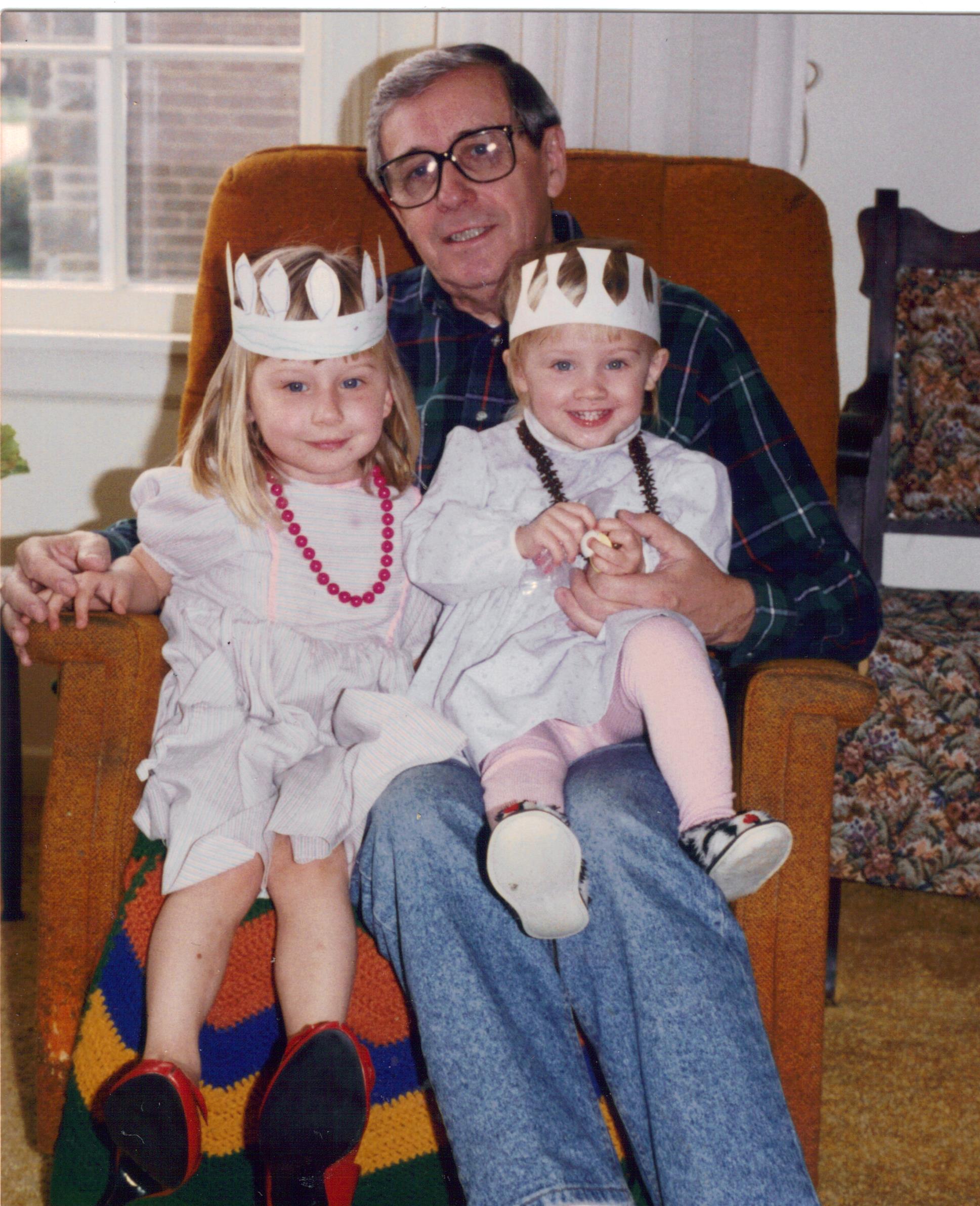
Joe with his "princess" granddaughters Sigita and Ina.  Circa 1990

Joe with his “princess” granddaughters Sigita and Ina. Circa 1990

Neither one of countless immigrant professionals reduced to manual labor by insurmountable language barriers, nor a young child just starting school, Joe was in the midst of his high school education in Silales, Lithuania when World War II intervened. Somehow, he managed to complete his gymnasium studies as a displaced person in Eichstätt, Germany in 1946. Joe then went on to study philosophy and pedagogy at Eichstätt College. And, with other Lithuanian students in Eichstätt, he edited a chronicle called “Ukonas” before immigrating to Springfield in 1949.

In Springfield, Joe was one of several single men living in apartments owned by Sam Lapinski, Jr. on or near East Washington St. That’s when 25-year-old Joe somehow met my still-single 30-year-old father Vince, and the two pal-ed around in Dad’s car. Already fluent in Lithuanian, French, German, and Russian, Joe doubtless impressed Dad with his dream of being admitted to a U.S. college to become a language teacher. But first he had to learn still another language—English.

In the meantime, Joe put his new pedagogy skills to work for the first time by helping the Uzgiris family organize Springfield’s Lithuanian Saturday school. From about 1950 to 1957, Violeta remembers attending the school at the Uzgiris home every Saturday morning from 9 a.m. to noon, along with Rimgaile (daughter of August) Paulionis, as well as young Egidijus, Sarunas, and O’Tilija Uzgiris. Older Uzgiris brother Vytas taught, in addition to teachers Joe Koncius and Stase Sidlauskas (whose sons Audrys and Jonas Sidlauskas also attended the school) and a single man, Mr. Spetyla. Violeta remembers studying the history of Lithuania along with Lithuanian grammar, reading and writing.

In the early 1950s, Joe achieved his dream and was admitted to the University of Illinois Champaign-Urbana, where he graduated in 1956 with a master’s degree in education and a certification to teach the French language. Already qualified in German, after further study Joe earned the necessary certification also to teach Russian. Then from 1956-1987, he made his career teaching French, German, and Russian at Riverside-Brookfield High School in the Chicago area, and heading the school’s Foreign Languages Department.
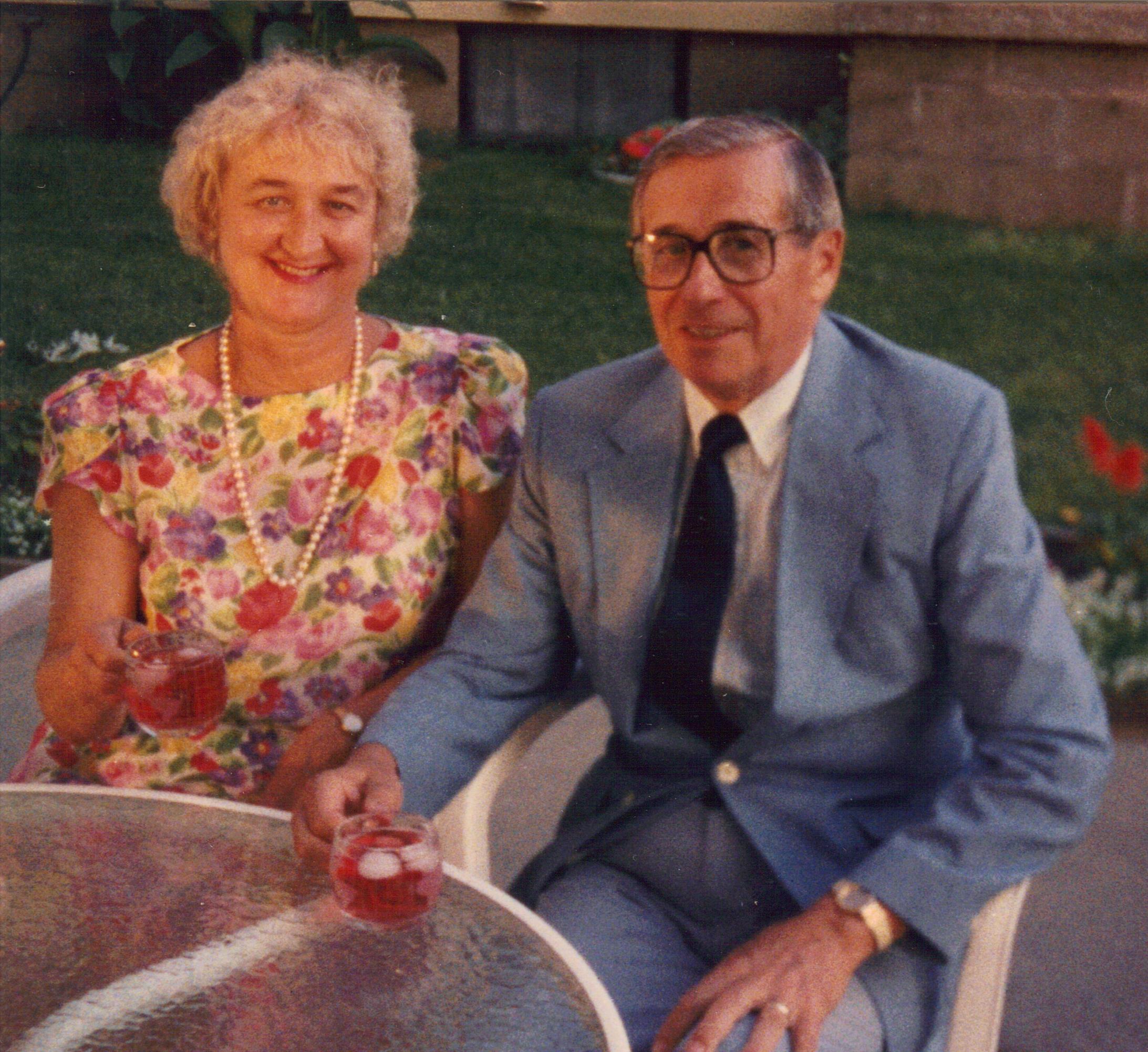
Joe and wife Giedre, 1990s.

Joe and wife Giedre, 1990s.

Even after Joe’s death in Lemont, Ill. on Sept. 10 this year, his dedication to education continued with a request for memorial donations to Child’s Gate to Learning, a charity supporting education in Lithuania. Joe also lived his life-long Lithuanian patriotism in service to numerous Lithuanian-American organizations, serving as secretary of the Lithuanian Foundation and media/publicity chair for the Lithuanian Opera in Chicago.

In 1989 he spearheaded a relief fund to rebuild the Catholic church in his hometown of Kaltinenu, Lithuania, after it burned. He also participated in a dental charity called the Lithuanian Fund for Healthy Teeth. And from 1956, he was a member of the Lithuanian Newcomers (Ateitininkai) society, where he held the honorary position of Kestutis and various posts on the board of directors. Joe captured his own life experiences in a memoir entitled, A Journey into a Secret Country.

Undoubtedly, his most enduring legacy is his impact as a teacher on thousands of language students, beginning, I am honored to say, here in Springfield. Joe, his surviving wife Giedre Teresa (Kizlauskaite); daughters Maria Bereckis and Ruta Salkliene; grandchildren Benjamin, Hanna, Ina and Sigita; great-granddaughter Matija; and nephews Arunas Koncius and Alfonsas Vitkevicius, would surely be proud to know how some of Joe’s first language students here in Springfield realized their own educational potential.
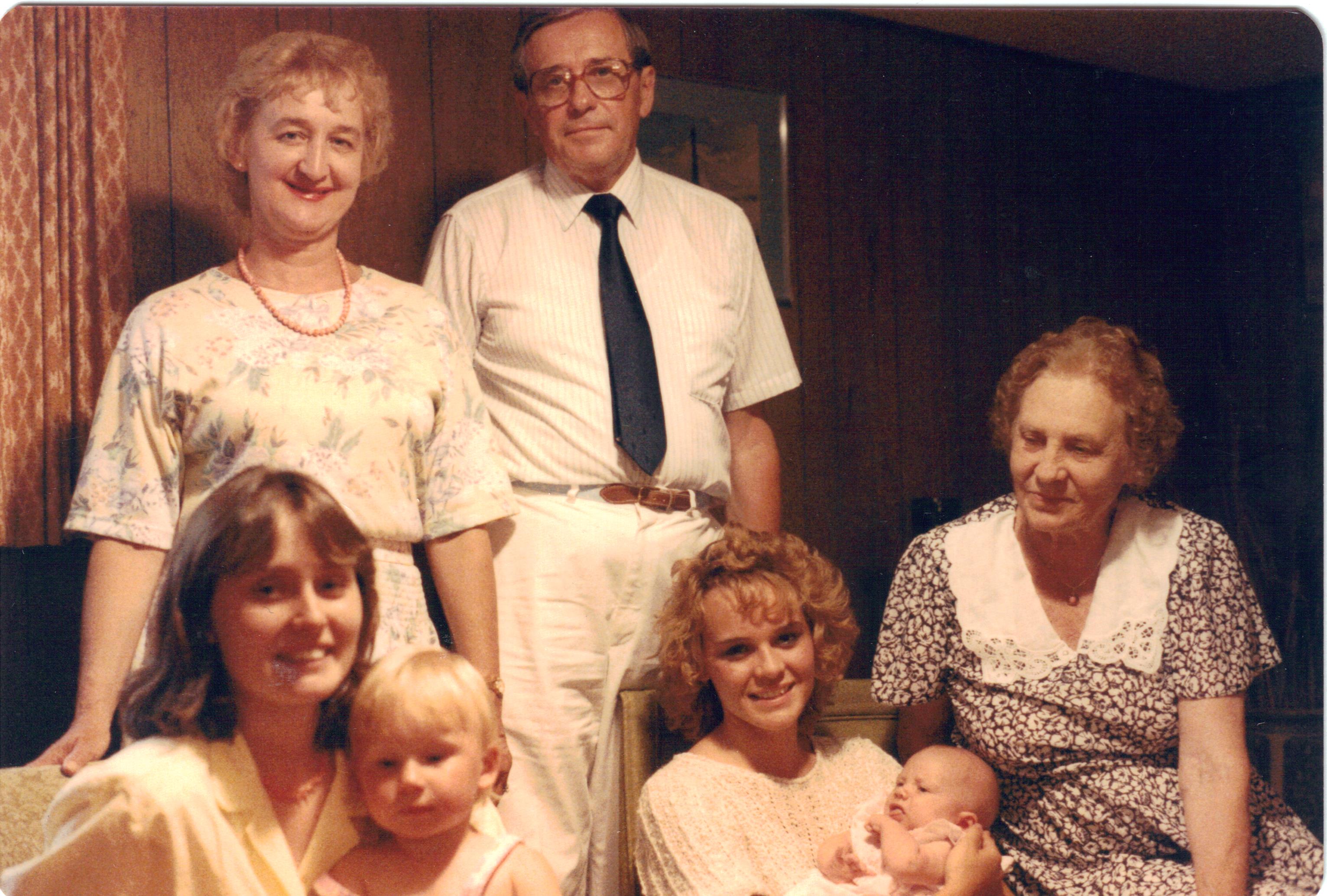
Joe, his wife Giedre, her mother Brone Kizlauskas (Kizlauskiene) and Koncius daughters (l to r) Ruta holding Sigita and Maria holding Ina. 1980s.

Joe, his wife Giedre, her mother Brone Kizlauskas (Kizlauskiene) and Koncius daughters (l to r) Ruta holding Sigita and Maria holding Ina. 1980s.

Vytas Uzgiris graduated from the U. of I. and became an M.D.; Sarunas Uzgiris also graduated from the U. of I. in mechanical engineering, went on to get his Ph.D. and become a university professor; Egidijus Uzgiris graduated U. of I. in engineering with highest academic honors, his name inscribed in the university’s Bronze Tablet for posterity; and finally, O’Tilija, the youngest and only girl, graduated from the U. of I. in Russian, which was in demand at the time, as Chinese is today. She earned her master’s degree and started work as a translator for the Chicago library system.

Dedicated to the memory of my father’s unforgettable friend, a gifted teacher who prevailed over great adversity to realize his dreams.
The Bernotas Family in Photos

23 Tuesday Sep 2014

Posted by sandyb52 in Sandy's Blog

≈ 5 Comments

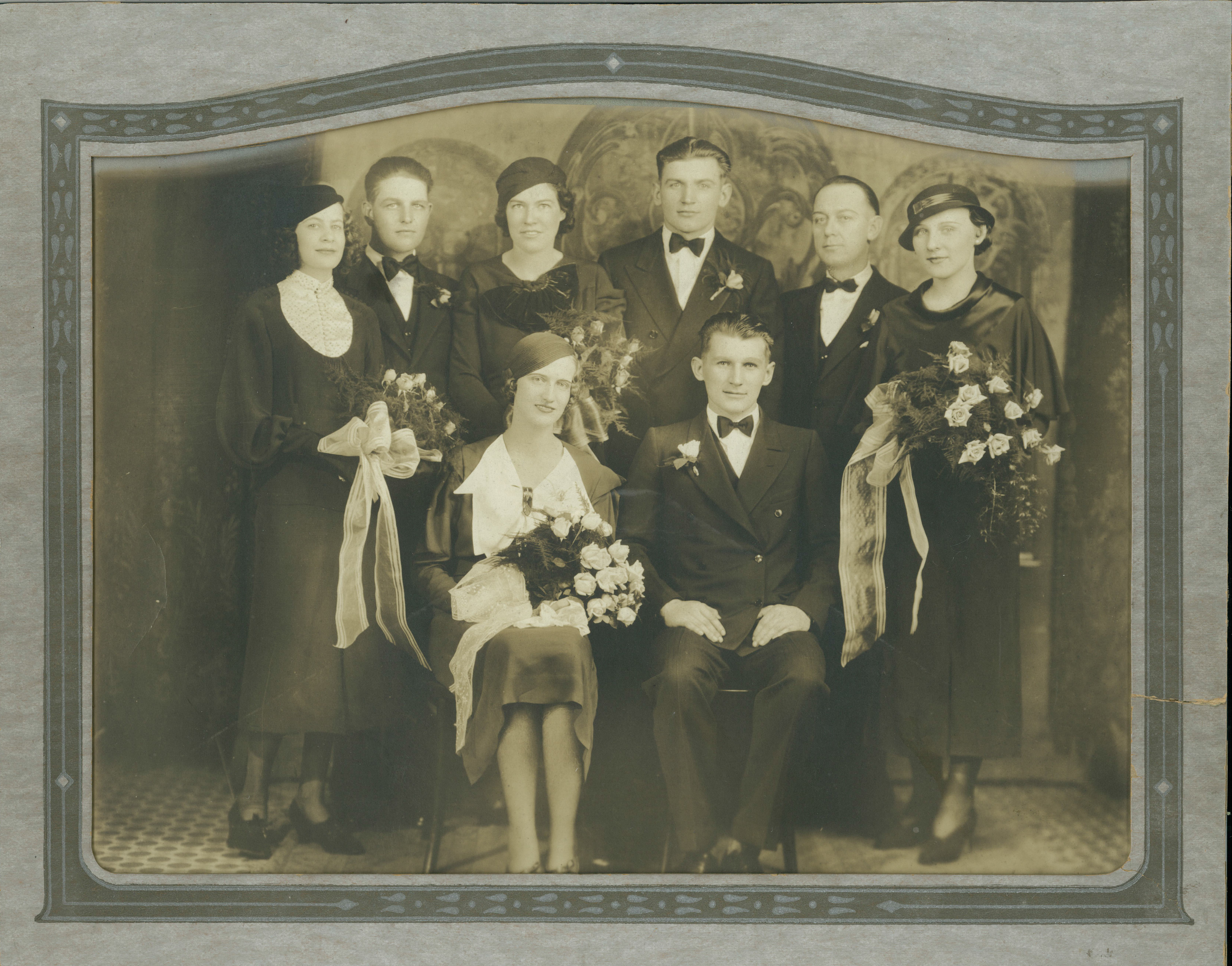
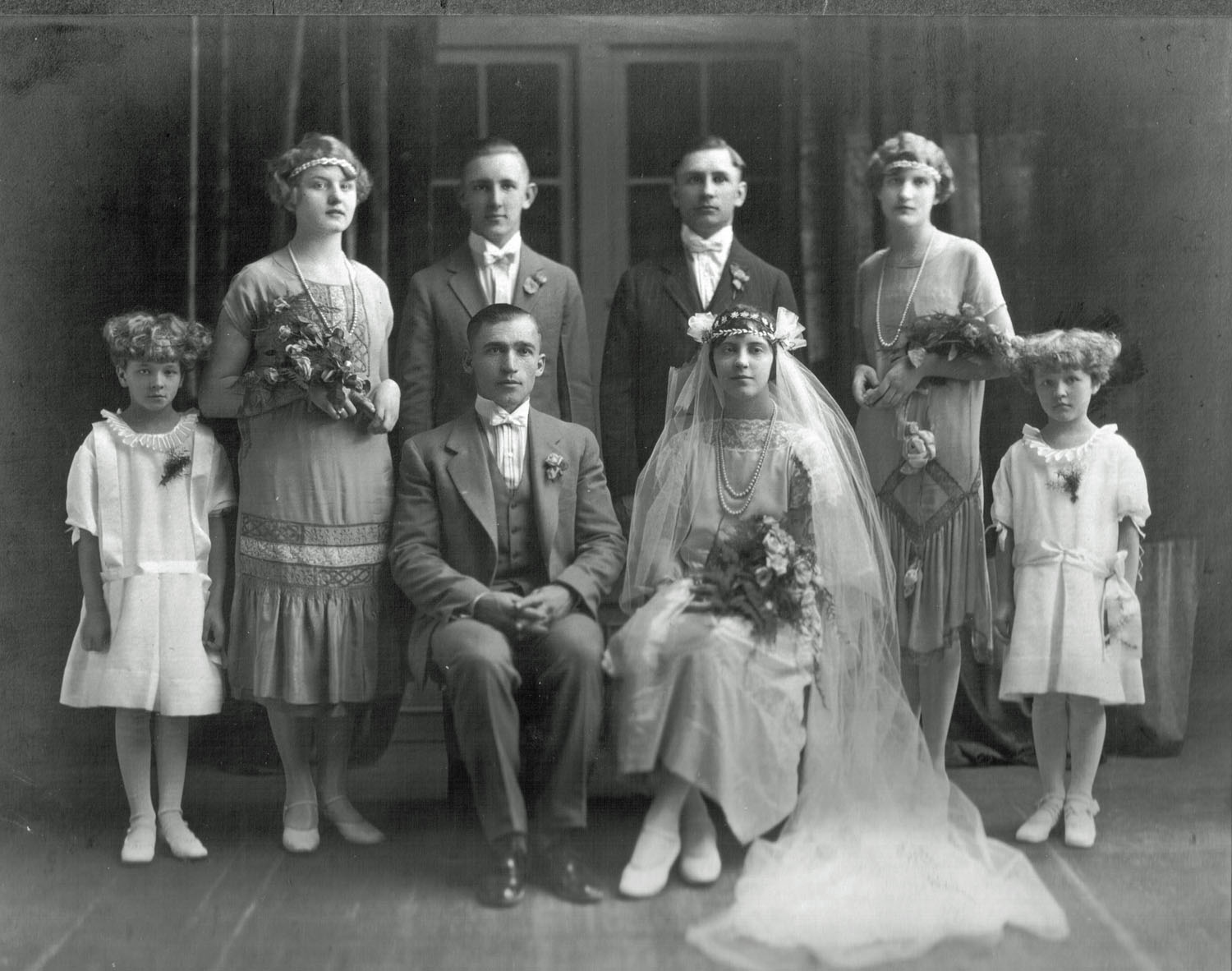
I believe this is the wedding of Anna Klimaitis and Peter Bernotas, 1916.

I believe this is the wedding of Anna Klimaitis and Peter Bernotas, 1916.

Peter (Petras) Bernotas, the son of Casimir (Kazimieras) Bernotas and Agatha Tisckos, was born in 1878 in Vilnius, Lithuania. He first immigrated to Chicago, where he became a naturalized U.S. citizen in 1905. At age 38 in 1916, Peter married 16-year-old Anna Klimaitis (Claimaitis?), daughter of Vincent (Vincas) and Anna (Ona) Matuliczuite (Matulis?) Klimaitis of Naumiestis, Lithuania. Matulis-Klimaitis daughters Anna (born 1900), Adella (born 1902), and Mary had all been born in the coalfield county of Lanark, Scotland, where their miner father and mother had immigrated after marrying in 1898 in Władysławowo, Poland.

Anna (Klimaitis) Bernotas with her mother, Anna (left) and her sister Adella (right).  Sitting man with fiddle possibly young Anna's husband Peter Bernotas.  Circa 1925.

Anna (Klimaitis) Bernotas with her mother, Anna (left) and her sister Adella (right). Sitting man with fiddle possibly young Anna’s husband Peter Bernotas. Circa 1925.

Coal miner Vincent Klimaitis preceded his family to central Illinois, and wife Anna and their three daughters followed him to the U.S. on the Anchor Line ship SS California out of Greenwich, Scotland in 1913. Given the age difference between Peter Bernotas and his young bride Anna, I wonder if maybe Anna’s father Vincent was a coal-field acquaintance of Peter and made the introduction. Bernotas clipping 001

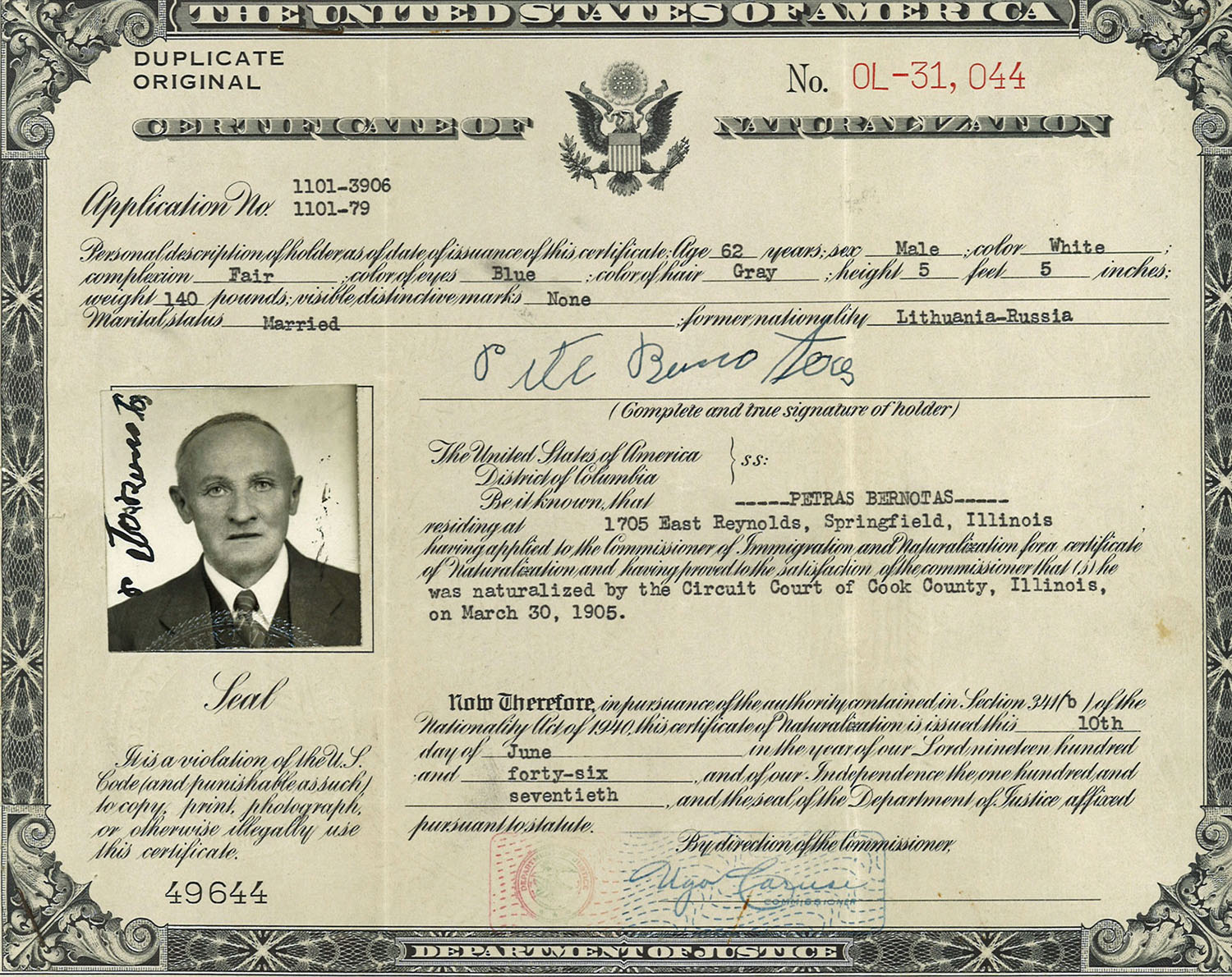
Photo of Peter Bernotas at age 68 in 1946.

Photo of Peter Bernotas at age 68 in 1946.

Two things are notable about this series of photos: first, the aging affects of coal mining and perhaps, related illnesses. You can see Peter Bernotas at 38 in his wedding photo, in his early 40s as the seated fiddler, at age 63 in his 25th wedding anniversary news clipping, and finally, at 68, and likely seriously ill, in his naturalization certificate photo. (From her 25th anniversary photo at age 41, one can also tell that being a miner’s wife has not been easy on Anna Klimaitis Bernotas). Peter’s naturalization certificate, itself, is interesting in that it appears to have been secured in his last days, 41 years after U.S. citizenship was legally granted. Maybe he wanted to have this precious document before he died, to pass down to his children? One can also tell from his signature that handwriting, and literacy, were likely achieved after he was an adult, as was the case with so many Lithuanian coal miners and their wives. After Peter Bernotas and Anna Klimaitis married in 1916 and went to live at 1705 E. Reynolds St., they had three children: Anthony Peter, born in 1917, Vetout (Vytautas), born in 1923, and Bernice (Bernotas) Stevens. The family attended St. Vincent de Paul Lithuanian Catholic Church, where Bernice appears in several photos.

St. Vincent de Paul Church sodality officers, circa 1940.

St. Vincent de Paul Church sodality officers, circa 1940.

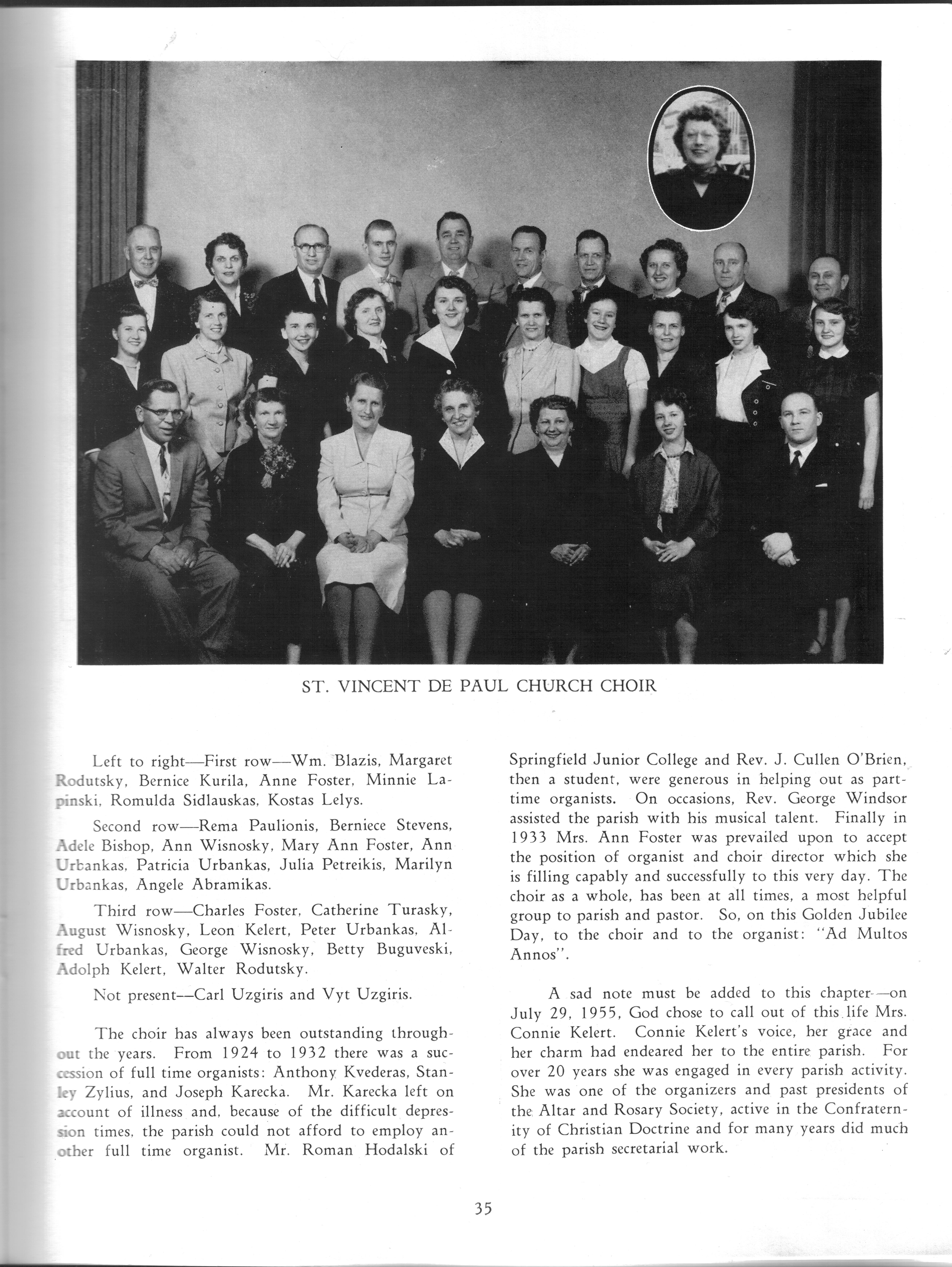
The church choir with names, from 1956 Jubilee book

The church choir with names, from 1956 Jubilee book.

Anthony Peter and Vetout Bernotas, circa 1940

Anthony Peter and Vetout Bernotas, circa 1940

All three of the Klimaitis-Bernotas offspring appear to have served in World War II: Anthony Peter as a U.S. Army corporal, Vetout in the U.S. Air Force, and Bernice as a Navy “Wave.” (Bernice later moved to California.)

Bernice Bernotas, World War II.

Bernice Bernotas, World War II.

Anthony married Dorothy Jane Hall and the couple had children Terrence Michael, Susan Marie, Denise Anne, and Stephen Anthony, who affectionately called their Grandma Anna “Nano.” After living at Nano’s on E. Reynolds for a time, Anthony and his wife Dorothy built their own home at 2437 E. Keys, in Grandview. He worked as a machinist at FiatAllis. The family attended St. Cabrini Church.

Bottom left: Bernice Stephens and Tony Tamoszaitis as godparents to newborn Susan Bernotas, early 1950s.  Bottom right, from left: Klimaitis sisters Adella, Mary, and Anna, 1968.

Bottom left: Bernice Stephens and Tony Tamoszaitis as godparents to newborn Susan Bernotas, early 1950s. Bottom right, from left: Klimaitis sisters Adella, Mary, and Anna, 1968.

Susan (Bernotas) Potter, the main informant for this piece, fondly remembers Nano’s Lithuanian cooking. Susan continues to make kugelis (kugele), “little ears” (asuki), and a dumpling dish she calls kalasky (koldunai?). She and her brothers also make the honey-citrus spiced whiskey drink viditas, especially for Christmas.

Front little guy:  Stephen Bernotas. Middle row, from left: Anna (Nano) Bernotas, Denise Bernotas Fox, Susan Bernotas Potter. Back row, from left:  Terry Bernotas, Dorothy Hall Bernotas, Anthony Peter Bernotas. Easter Sunday, April 10, 1966.

Front little guy: Stephen Bernotas.
Middle row, from left: Anna (Nano) Bernotas, Denise Bernotas Fox, Susan Bernotas Potter. Back row, from left: Terry Bernotas, Dorothy Hall Bernotas, Anthony Peter Bernotas. Easter Sunday, April 10, 1966.

A few interesting facts about the Klimaitis-Bernotas clan:

Adella (Klimaitis) Bernotas and Michael Makarauskas wedding, 1936.

Adella Klimaitis and Michael Makarauskas wedding, 1933.

In 1933 Adella, the sister of Anna (Klimaitis) Bernotas, married Michael Makarauskas, older brother of Springfield McDonald’s restaurant founder John Makarauskas. Michael of Smilga, Lithuania, sailed from the Latvian port of Liepāja in 1922 with his mother and younger brother, John, on the vessel Estonia. That was the year they were finally reunited with their father, who had immigrated to Springfield just before the outbreak of World War I, which ended up dividing the family for almost a decade.

possibly Michael and Adella Bernotas Makarauskas, left; John and Mary (Gidus) Mack, right.  Circa 1936

from left: Michael and Adella (Klimaitis) Makarauskas, John and Mary (Gidus) Mack, right. 1930s.

Adella and Michael Makarauskas’s 1933 marriage was ill-fated. Michael was killed in a railroad accident in 1936 or 1937. Records show Adella married again in 1938 to William J. Laukaitis (parents Joseph and Valeria Galinis Laukaitis), of Cherry, Illinois. William was a veteran of World War II and Korea. However, Adella and William divorced in 1943, and Adella was subsequently married for a third time, to Marshall Dirksen.

Riverton Riot

10 Wednesday Sep 2014

Posted by sandyb52 in Sandy's Blog

≈ 4 Comments

In the early years of the 20th Century, local newspapers reported Lithuanian ethnicity in crimes of violence, much as media later in the century reported race. As a newspaper reporter in the early 1980s, I remember how the practice of race identification in the news was debated before it changed, along with the custom of identifying all women as Mrs. or Miss.

However, it’s easy to see why a “Lithuanian” brawl could have seemed relevant to U.S.-born readers back when immigrant-on-immigrant crime in the impoverished neighborhoods, often called “patches,” where immigrant miners lived, socialized, drank and fought, so often stereotyped them in the news.

July-December 1906, the Illinois State Register covered a “Riverton Riot,” allegedly by three related Lithuanian saloon-keepers, that resulted in the near-death of the local marshal, John A. Cline. The prosecution side of the story was that Cline ordered Lithuanian immigrant Maude (Martha) Grigiski (Grigiskis) to close her Riverton saloon, which was illegally open on a Sunday. Maude reportedly refused, pulled a gun and backed Cline out of her yard. Then her husband, William, arrived, seized the officer’s club and started beating him over the head. Maude reportedly joined in the beating with the butt of her pistol, while brother-in-law Peter (Simon) Grigiskis arrived and allegedly started beating Cline with a brickbat.

The three Grigiskises were charged with assault and battery with intent to kill, and “riot.” They made bail of $1,200 each, apparently after William exited first and sold some property to bail out his wife. Marshal Cline received 56 stitches to close wounds on his scalp.

The newspaper reported “almost the entire village” was subpoenaed in the case, many as “character witnesses.“ Those who had not been subpoenaed came along to witness the proceedings, so that the courtroom was full even before the trial  began. The paper also reported, “Most of the witnesses in this case will be Lithuanians, and an interpreter will be necessitated.”

When the defense took the stand, the Grigiskises proceeded to make a case for their actions based on the alleged “immoral character” of Marshal Cline, which was attested by many (presumably Lithuanian) witnesses. William Grigiskis then testified that the assault was the result of Cline first attacking his wife. Maude testified that she had closed her saloon as ordered, but then Cline insisted they go back inside to see if anyone was still there, at which point he made advances and knocked her out with his revolver.

The real issue could have been the law closing saloons and taverns, frequently operated by immigrants for immigrants, on Sundays, back in the time of 70-hour, six-day work weeks, when Sunday was the only day off for workmen to drink and socialize–and for tavern-keepers to earn a living. In New York City back when Teddy Roosevelt was police commissioner, more than 10,000 German immigrants marched to oppose a similar Sunday tavern closing law. So, such bans were not only likely a precursor to Prohibition, they almost undoubtedly were aimed at immigrant workmen and tavern-keepers. In fact, Simon Grigiski had been fined $25, along with six Italian tavern-keepers, back in 1902 for the same offense, according to the newspaper.

After weeks of trial, on Dec. 29, 1906, the Illinois State Journal reported, Simon was acquitted, and William and Maude Grigiskis were convicted, denied a new trial, and fined $100 plus costs, each: a total judgment amounting to $400. (One has to wonder at a fine, only, for assaulting a lawman—maybe it was a compromise of some sort based on real doubts as to Cline’s character?)  It’s unknown if the Grigiskises were allowed to re-open their saloon.

Lithuanians Ralph Patkus, Tony Gabriel and Peter Soto were also reportedly arrested or charged with participating in the assault on Cline. One can almost imagine the whole Lithuanian neighborhood joining in a fight apparently in defense of their countrymen, and against a well-known and despised representative of the law. (The three other men were not tried.)

“One Carved at a Christening”

My favorite example of Lithuanian immigrant stereotyping in the news is: “Lithuanian Celebration in Devereaux ‘Patch’ Results in the Usual Quota of Cracked Pates.” This State Journal article from January 1910 goes on to report “a miniature riot, such as usually accompany Lithuanian christenings.”

The “Patch” was a poor immigrant neighborhood near the Devereaux Heights Peabody coal mine four miles north of Springfield. Lithuanian immigrant Charles Rokinh reportedly beat Tony Shodwit with a blackjack and cut him with a knife at the home of the christened infant (or maybe outside). The paper also reported, “Several swollen pates and blackened eyes are said to have resulted from the Sunday night celebration.”

Other Headlines

  • Luke Terlis testifies he did not mean to shoot Joe Timmis on July 4, 1906. “Terlis declares that the shooting was accidental, as the ball pierced his own hand before it struck his friend.” Both men are coal miners. “Their knowledge of the ways of this country is exceedingly limited, and they speak very broken English.”

According to the Illinois State Journal, Terlis offered a bribe of $20 not to be arrested when accosted at his Devereaux Patch boarding house by a deputy. Timmis and other witnesses agree that the shooting was accidental and occurred when Terlis tried to prove to a group of miners standing at the corner of Peoria Rd. and Sangamon Ave. that his gun was unloaded. Timmis’s wife later testifies that Terlis had made advances and wanted to do away with her husband, who was critically wounded in the gut.

  • Mike Krizonoski is charged with conducting a “blind pig” (operating a speakeasy) in Devereaux Patch, November 1911.
  • Lithuanian Mike Rester is charged with stabbing fellow Lithuanian Frank Kerns during a brawl at the Jacob Usman saloon in March 1907.
  • Charles Yotus pleads guilty to selling liquor in Devereaux Patch for three days before he was caught, September 1911.
  • Peter Akulaitis shoots and kills Joseph Linc in self-defense in the Ridgely neighborhood, September 1906. Linc was wielding a two-bladed pocketknife and cut Akulaitis severely before he was shot. The gun was believed to have been passed off to a friend in the crowd “who secreted it.”
  • John Lawrence and Eva Adamitis are both charged with assault with intent to kill in April 1946. Eva reportedly shot John in the face after he beat her in her home.
  • Lithuanians Charles Shadwich, Charles Tyrones, Pete Zolden, Joe Savage and Robert Skeets are arrested Christmas Eve 1911, for gambling (a dice game) on East Washington Street.

Many thanks to Tom Mann of Springfield for uncovering these headlines by generously investing his time in research.

Blogroll

  • Enos Park Neighborhood Improvement Association
  • Illinois State Historical Society

Lithuanian Websites

  • Amber Reunion
  • Lithuanian World Center
  • Lithuanian-American Club of Central Illinois
  • Lithuanian-American Community, Inc.
  • Lithuanian-American Publications
  • Lithuanians Of Arizona
  • LTnews.net
  • LTUWorld
  • The Lithuania Tribune

St. Vincent’s murals resurface

Two of the murals from St. Vincent de Paul's Catholic Church have resurfaced. Take a look!

Search

Enter your email address to follow this blog and receive notifications of new posts by email.

Join 141 other subscribers

E-mail us!

Questions or comments? Please e-mail sandybaksys@gmail.com.

Email us!

Questions or comments? Please e-mail sandybaksys@gmail.com.

Blog at WordPress.com.

Privacy & Cookies: This site uses cookies. By continuing to use this website, you agree to their use.
To find out more, including how to control cookies, see here: Cookie Policy
  • Subscribe Subscribed
    • Lithuanians in Springfield, Illinois
    • Join 141 other subscribers
    • Already have a WordPress.com account? Log in now.
    • Lithuanians in Springfield, Illinois
    • Subscribe Subscribed
    • Sign up
    • Log in
    • Report this content
    • View site in Reader
    • Manage subscriptions
    • Collapse this bar
 

Loading Comments...