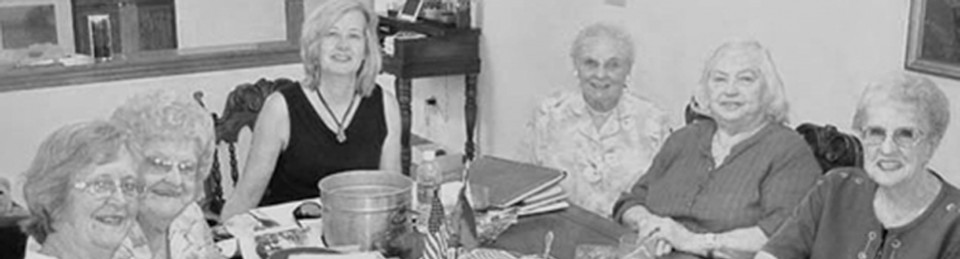

Graphic by William Cellini, Jr.
End of War, New Beginning for Lithuania
By William Cellini, Jr.
(Editor’s note: Read below of three Lithuanian immigrant soldiers who gave their lives, how a Lithuanian miner wanted to be a war hero so badly he impersonated one, and most important, how the devastation of the Great War finally led to independence for Lithuania. What a great finish to this three-part series by William Cellini, Jr., with research support from Tom Mann. Thank you! )
Seven months after Armistice Day, on June 25, 1919, thousands of Springfield citizens turned out for a spectacular “welcome home” parade for their World War I soldiers, who were just beginning to come home in large numbers. According to the Illinois State Journal of that date, the parade was “the most inspiring in local history.”

One year earlier, the same young soldiers had been under fire on the Western Front, turning the tide in favor of the Allies in what was called the “Hundred Days” campaign (August 8 to November 11, 1918). Fighting alongside the French & British in a memorable set of victories, the American Expeditionary Forces (AEF) brought exhausted Europeans critical reinforcement in terms of both personnel and supplies, helping to bring the four-year war to a speedy victory.
The Opportunities & Perils of Armistice
Like previous events in Europe, World War I provided Lithuania an opportunity to try to free itself from the czarist Russian Empire, after failed rebellions in 1830 and 1863. In fact, Lithuanian patriots began writing their “declaration of independence” a full year before the Great War’s Nov. 11, 1918 Armistice Agreement.
For the war’s combatants, Armistice was only a temporary measure to stop the fighting. U.S. forces, so integral to ending the war, were not even represented at the signing of the Armistice of Compiègne, in France. Expressing his displeasure over the situation, U.S. General John Pershing indicated to the press that the Armistice did not amount to a full surrender of the Central Powers and that it left too much ambiguity with respect to Germany’s military position.
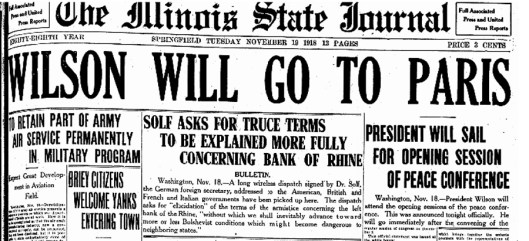
Six months of negotiations followed at the Peace Conference in Paris before a treaty to end the war was signed at the Palace of Versailles in June 1919. While President Woodrow Wilson remained in the background during peace negotiations, he did take part in talks on the Versailles Treaty and was reportedly “dismayed” by its stipulations.
The treaty forced Germany to disarm, to surrender territories in its colonies and relinquish land ceded by Russia (including Lithuania)–as well as give-up Alsace and Lorraine, two French provinces taken by Germany before the war; pay reparations equaling 20 billion gold marks and in-kind items like coal and cattle, and admit guilt for starting the war. In the 1920s, these measures fanned the flames of German right-wing militarism, leading to the formation of the National Socialist German Workers’ Party–known as the Nazis—thus laying the groundwork for the Second World War in just 20 years.
On the other side of Lithuania, geographically, Imperial Russia had been consumed by a civil war spawned by the Bolshevik Revolution of 1917. That conflict led to a collapse of the czarist government and ultimately, victory by the Bolsheviks, a socialist revolutionary party that went on to establish the Soviet Union.
Out of the Ashes: Lithuanian Independence
Prior to 1918, Lithuania had been under Imperial Russia’s oppressive control for 123 years. The modern nation-state of Lithuania, whose centenary will be celebrated in 2018, finally was established from the historical opportunities created by the Russian Revolution, World War I, and the Great War’s end on Nov. 11, 1918.
Local Lithuanian immigrants showed they were plugged into their homeland’s “awakening” when only 16 days after Armistice, they gathered at the Lincoln Library downtown to discuss restoration of Lithuania’s independence. Newspaper coverage of the event sponsored by the Women’s Council for Defense mentioned that Sangamon County had “about three thousand” Lithuanian immigrants with “fifteen hundred” living in Springfield.
Stuart Brown, a noted Springfield lawyer of the period and a Spanish-American War veteran, talked about the history of Lithuania and how the world war had devastated its terrain and population. “There are two (Lithuanian) provinces…which the armies of the Germans and Prussians have marched across nine times,” he said.
This devastation was to continue as Lithuania, after formally declaring independence on Feb 16, 1918, subsequently had to fight its so-called “Freedom Struggles” or Laisvės kovo that included three successive wars. The first was with Bolshevik forces (December 1918 – August 1919), the second with German-backed Russian soldiers (June 1919 – December 1919), and the last, with Poland (August 1920 – November 1920). Lithuanian immigrants in America, including almost certainly, Springfield, committed men and resources to help free their homeland.
Fr. John Czuberkis of Springfield’s St. Vincent de Paul (Lithuanian) Catholic Church also spoke at the Lincoln Library event. He talked about how he was born “during the worst period of Russian persecution, when the government suppressed the Lithuanian language.” While discussing freedom for his homeland, he also appealed to local Lithuanians to speak English so they’d “be more at home with the Americans” [while the] younger generation, he said, “needs to learn the Lithuanian language, so that they can assist their parents to learn the American ways.”

Spanish Flu Arrives Before Returning Soldiers
In December 1918, the first U.S. military forces began returning home. But it wasn’t until the spring of 1919 that U.S. forces began their full draw-down and sailed home from the same ports at Brest, St. Nazaire, and Bordeaux where they had landed in 1917 and 1918. An occupying force of about 15 divisions remained in Europe for post-war demilitarization, and to aid in the medical supervision of people suffering from the Spanish Influenza that first reached pandemic proportions in 1918 and continued circling the globe, killing millions, through the winter of 1919-20. In the United States alone, from only mid-September to mid-November 1918, approximately 370,000 cases of the flu were reported.

Returning combat soldiers affected by the horrors of the war found minimal opportunities for mental health treatment and support in this period. What today we call post-traumatic stress was then called “shell shock.” In March 1918, the Illinois State Journal published an article on the topic via its “Ask Uncle Harry” series.
“‘What kind of treatment is given the shell shock victims?’ asked Helen. “Practically no medicine at all,” replied Uncle Harry, “because the doctors realize that the trouble is not physical. The men are removed far from the firing line and kept in quiet places, great care being taken to see that they are not troubled or worried about anything. The best nerve specialists in all the warring countries have been studying shell shock cases ever since the war started…helping thousands of the victims.”
Nevertheless, medical knowledge at the time was insufficient to cure most shell-shocked soldiers, the most afflicted of whom spent their days shaking, blinking, and twitching more violently than if they’d had Parkinson’s.
Lithuanian Miner Impersonates Shell-Shocked War Hero
One Lithuanian soldier from Sangamon County reportedly used the war to claim a glory not rightly his. And he created a false, non-Lithuanian identity to do it. In November 1918, just before the end of the war, “Captain John B. Northcott of the U.S. Coast artillery” was caught hanging around Springfield’s Leland Hotel, telling “highly colored narratives as a hero of French battle fields, a graduate of several field hospitals and a victim of shell shock that made him forget all about his family,” according to news reports.
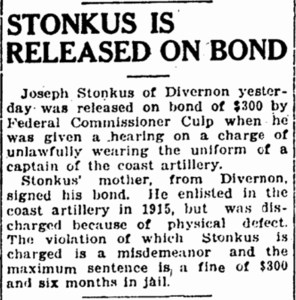
Walking about the hotel with a “swagger stick, overseas cap and natty uniform,” Northcott was arrested by police and interrogated at the Sangamon County jail. During questioning, the self-proclaimed captain admitted he was Joseph Stonkus, a Lithuanian-born coal miner from Divernon who had joined the army in 1915 but was mustered out of military service with “a bad eye condition” in September 1918 at Fort Worden, Wash. Stonkus was arrested that day on the misdemeanor charge of “unlawfully wearing an officer’s uniform.” His mother bailed him out of jail with a bond in the amount of $300.

Findagrave.com photo by Jean Stroven
Per news reports, Johnny Connors, the famed prizefighter and owner of Springfield’s popular Empire Hotel, had tipped-off police to Stonkus’s identity due to the fact that Stonkus had tried to “pass a bad check in Connors’ tavern several years ago.” Other hotel guests at the Leland questioned the validity of the grandiose stories told by the self-proclaimed captain.
Despite such challenges to his constructed identity, there are signs that Stonkus stuck to his American-born, Northcott “war hero” impersonation long after his arrest. Public records from Michigan indicate a John B. Northcott of Illinois (Private 1st Class in the Coastal Artillery) died in Muskegon County in 1939. He is listed as “born in New Mexico in 1893” and married to a woman named Marie Jensen. His headstone application, also from public records, indicates he joined the military in 1915 and was discharged in September 1918—two key details coinciding with Stonkus’ real life.
From Armistice Day to Veteran’s Day
On the first anniversary of Armistice, at eleven-o-clock on the morning of Tuesday, November 11, 1919, all activity in Springfield was ordered to cease for five minutes. Residents were asked to stand at attention, face east, and offer a silent prayer for U.S. soldiers “sleeping in France.” That evening, a festive program was held at the state arsenal (the Armory) downtown with a program that featured dancing and music. That November, similar events were held across the United States and in Europe.

The Illinois State Register, in writing about soldiers fallen in the Great War, predicted: “…[in] the future, appreciation of those acts of heroism will grow in the hearts of the people of this country. Posterity will preach these acts of heroism. Schools will teach them. The entire nation will honor them.” This ultimately came to pass with the creation of the national holiday of “Armistice Day” or “Veterans Day” on November 11.
According to Chris J. McDonald, Ph.D., of Lincoln Land Community College, Sangamon County lost 132 soldiers in World War I—11 percent of those inducted. Twenty-nine percent of those 132 casualties were from the Spanish flu—almost the same as the percentage of those killed in action or by wounds received in battle. (Professor McDonald is author of “Three Lying or Four Sitting – From the Front in a Ford: WWI Letters of Kent Dunlap Hagler,” available on amazon.com.)
Below are the final nine profiles in this series on local Lithuanian-American soldiers of World War I, including three who died. We remember them, and all our local soldiers who lost their lives in the Great War, on the war’s 100-year anniversary this year. May their sacrifices never be forgotten.

World War I monument, North Grand & 1st Street, Springfield, Ill.
Lithuanian Immigrants Who Served
Stanley Petrokas–Fought in Meuse-Argonne Offensive
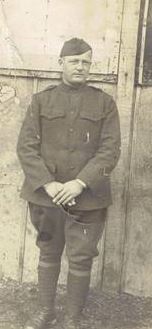
Stanley Walter Petrokas was born in 1892 in Laukuva, Lithuania, to Ignatius Petrokas and Barbara Gestaut. In 1910, at age 18, he fled Lithuania for the U.S., alone, to avoid being conscripted into the Russian army. According to granddaughter Patricia (Chepulis) Wade, in his 87 years in this country, Stanley never returned to his birthplace or had any of his siblings emigrate or come to visit him from Lithuania. According to Trish, he did correspond with his family.
Stanley was a coal miner when he was inducted into service in Springfield on June 25, 1918 and sailed for Europe on Sept. 15. He served in the Meuse-Argonne Offensive from Sept. 26 to November 10, 1918 and was honorably discharged at Camp Grant, Rockford, on July 7, 1919. His enlistment record shows he was awarded a Bronze Service Button.

Petrokas with daughters Silvia (left) and Ruth (right).
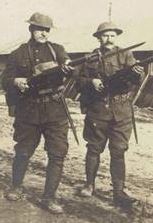
Petrokas on left
Stanley married Catherine Rice (Rieskevicius) (1899-1924) in 1920 and had two daughters: Sylvia (Petrokas) Chepulis (1921-2004) and Ruth Lustig, born in 1923. Years after his wife’s death in 1924, he married Marcele Mileryte (1902-1982) in 1950, but the couple had no children. (Marcele was born in Lithuania and had immigrated to the U.S. as a “displaced person” or “DP” in 1949).
Stanley worked in Springfield-area coal mines for about 40 years. He was hired as a janitor for the Illinois Air National Guard at Capitol Airport in the early 1950’s and worked there for 14 years. This enabled him to acquire a small pension, according to granddaughter Trish. He lived at 917 E. Phillips Ave. from 1922 until his death in 1979.
Joseph [Juozapas] Plaskas [Pleskus]–‘Slightly Wounded’
![Plaskas [Pleskus], Joseph [Juozapas]](https://lithspringfield.com/wp-content/uploads/2017/09/plaskas-pleskus-joseph-juozapas.jpg?w=253&h=300)
Born March 10, 1896 in Suvalkai County, Lithuania, and emigrated to the U.S. in 1914, apparently just in time for the war. He worked in Springfield as a coal miner and lived on the south side of town. Plaskas registered for the draft in June 1917 and his physical description indicated he was of medium build with gray eyes and brown hair. He was listed as single. Called to military service at Springfield in March 1918, Plaskas went overseas on May 11, 1918 with a machine gun company of the 119th Infantry.
Reported as “slightly wounded” overseas in December 1918 by the State Register newspaper, he returned to the U.S. via Saint-Nazaire, France, in March 1919 on the USS Huron with a detachment from Camp Grant’s 30th Division. He listed his “brother, John” as his nearest contact in Springfield. He was discharged on April 14, 1919. In 1920, he was working as a coal miner in Springfield and living with several boarders at 1803 South Renfro St. in the home of William and Martha Rutkens, a Lithuanian couple. Research indicates Plaskas likely left Springfield between 1920 and 1930.
Tony [Antanas] Pranchewicz [Pranckevičius] ∞ Killed by Spanish Flu
![Pranchewicz [Pranckevičius], Tony [Antanas] Photo](https://lithspringfield.com/wp-content/uploads/2017/09/pranchewicz-pranckevic48dius-tony-antanas-photo.jpg?w=267&h=300)
Pranchewicz died in October 1918 from influenza-pneumonia while in training at Camp Zachary Taylor, Ky. The flu became a pandemic in the final months of the war, striking troops in crowded training camps and on troop ships. Unlike with other flu outbreaks, the young and strong were particularly vulnerable. Researchers have since theorized that pneumonia quickly ensued due to “cytokine storms,” or over-reactions by healthy, young immune systems to the previously unknown swine flu virus, so that victims’ lungs quickly filled with fluid.

Tony was a member of Company C, 2nd Development Battalion, 159th Depot Brigade, and is buried at Calvary Cemetery in Springfield. Born c. 1894 in Lithuania, he was the son of Joseph and Rosa Pranchewicz who survived him, as did two sisters and an aunt, Mrs. Eva Linges. Tragically, two of Tony’s two sisters, Martha and Paulina, both died the same year as Tony. It seems likely that they were also killed by the flu pandemic that circled the globe through the winter of 1919-20, sparing no location, however remote.
Tony’s father passed away in 1945 and his mother died in 1957.
Charles Raczaitis—Gassed in Action, But Survived

Born March 1, 1889 in Pakonys, Vilnius district, Lithuania, and emigrated to the U.S. in 1908. Charles lived in Divernon and was a miner at the Madison Coal Company there. He registered for the draft in June 1917 and moved to Springfield, where he entered military service and was sent overseas on May 26, 1918 as a Private with Company B, 105th Engineers, 30th Infantry Division.
Raczaitis is recorded as having participated in the battles for Bellicourt, Montbrehain, Brancourt-le-Grand, Prémont, Busigny, Vaux-Andigny, La Selle River (likely the Hundred Days Offensive of 1918) and Maungliur [Mazinghien?]. He suffered gas poisoning while in action and returned to the U.S. via Saint-Nazaire, France, as a Private First Class on April 1, 1919. On the ship roster, he listed his “brother, Joe Raczaitis of Divernon” as his family contact in the U.S.
Charles was discharged in April 1919 at Camp Grant near Rockford. In a May 1919 State Journal article, he’s mentioned as receiving a $60 bonus for his service. He divorced his first wife in 1954 and later married Martha (McClosky) Shimalis, widow of Anton Shimalis. After a period of working in the coal mines, Raczaitis went on to own a tavern (“The Round Up”) on East Washington Street. He died in 1959 at age 71.
Walter A. Rauktis [Raukitas] ∞ Killed in Aisne-Marne Offensive
Born September 25, 1891 in Veikanus [Viekšniai], Lithuania. Prior to the war, Rauktis worked as a miner for the Jones & Adams coal mine on Springfield’s North End. When he registered for the draft in June 1917 he described himself as single, but with a mother and father who depended on him for support. He had blue eyes and light brown hair, per details from his draft registration card. A State Journal newspaper report, naming area soldiers in September 1917, listed him as: “Walter Rauktis of 2518 Peoria Road.” He trained at Camp Taylor, Ky.

Rauktis back row, right edge in this photo from the Illinois State Journal
Rauktis sailed from Hoboken, NJ, on May 10, 1918 with Company L in the 47th Infantry Regiment Regulars, 4th Division, and on July 29, 1918, he was killed in action in France. He is buried in the Oise-Aisne American Cemetery, according to the website americanbattlegraves.com.
Having served in the 47th Infantry, it is likely that he participated in the Aisne-Marne Offensive (the Second Battle of the Marne) that took place from July 15 to August 6, 1918. Thus, his burial in the Aisne cemetery makes sense. He was identified in a November 1917 photograph published in the Journal newspaper showing members in training with Battery A, 327th Field Artillery at Camp Zachary Taylor, Louisville, Ky.
Stephen Shvagzdis [Švagždys] ∞ Killed on Armistice Day
![Shvagzdis [Švagždys], Stephen Photo](https://lithspringfield.com/wp-content/uploads/2017/09/shvagzdis-c5a1vagc5bedys-stephen-photo.jpg?w=529)
Born c. 1888-90 most likely in Rozalimas, a village in Šiauliai County, Lithuania, Shvagzdis was the son of Mr. and Mrs. Michael Shvagzdis. He lived as a single man on East Jefferson Street (according to his 1917 draft registration) and entered military service on April 29, 1918.
From Springfield, he was sent to Camp Dix, NJ [today, Fort Dix], along with the first “colored” contingents coming out of the capital city. He sailed overseas on June 25, 1918 with Company K in the 148th Infantry Division, and was killed in action in the Meuse-Argonne Offensive right on Armistice Day, Nov. 11, 1918. According to the website Americanbattlegraves.com, his burial is in Plot D, Row 3, Grave 13 at the Somme American Cemetery in Bony, France.
While the date of death on his grave is November 1, Springfield newspaper accounts indicate he was one of three local soldiers killed on the 11th– the day of the Armistice. On Dec. 15, 1918, the Register asked readers to identify Shvagzdis and his family, as they were not listed in the city directory: “Neither the soldier nor his kin is listed…for the past five years. Frank Mazrim [Marzin] resides at 2001 East Adams Street, the address given as Shwagzdis.”

Stephen Shvagzdis grave
While further research indicates no evidence of Mr. and Mrs. Michael Shwagzdis living in Sangamon County, there was a Joseph Shwagzdis (born 1889 in “Rozaliua, Šiauliai, Lithuania”) who died in Springfield in 1960, but his relationship to Stephen’s family is not known. One informant for this blog mentioned a brother of Stephen who lived on Peoria Road.
John Joseph Straukas—Offered Promotion in the Field
Born August 25, 1890 in Plungės District, Telšiai County, Lithuania. Straukas emigrated to the U. S. from Liverpool in 1909 on the SS Baltic and was reportedly stoking the ship’s engines to pay for his passage. He lived with his aunt Lula Straukas Grigiski in Riverton, Illinois, at the time of his induction.
According to Straukas family history, John Joseph and his brother emigrated from Lithuania to avoid military conscription by the Russian czarist government. Ironically, nine years later, he was drafted into the U.S. Army to fight in World War I. Straukas entered service on June 25, 1918. He was trained at Camp Zachary Taylor, Ky., and served as a Private in the 29th Company, 8th Development Battalion. At Camp Taylor, he was issued a certificate of naturalization on July 20, 1918.

According to military records, he also trained at Fort Benjamin Harrison, Ind., and was sent overseas in September 1918 to take part in the Meuse-Argonne Offensive on the Western Front. While overseas he was placed into Company P, 5th Battalion, 22nd Engineers. According to family history, Straukas was offered, but rejected, a promotion to the rank of Corporal for valor in the field. After returning to the U.S., he was discharged in July 1919 at Camp Grant near Rockford. He married Esther Trow of Riverton and they had two daughters. He died in Springfield in 1973.
John Walrs—War Ended While in Training
Born Dec. 8, 1884 in Laukwas [Laukuva, Šilalė district], Lithuania. He emigrated in 1906 and lived at 2011 N. Sixth St. in Springfield. Walrs trained at Jefferson Barracks in Missouri after the Armistice was signed. He entered into official military service in July 1919 as a Private in the 7th Company, Second Battalion, 159th Depot Brigade. A newspaper description of his departure for training mentions he was placed in a motor transportation outfit. After basic training, he was stationed at Camp Normoyle, Texas. The 1920 U.S. Census lists as a Lithuanian with “Polish” as his native language. A bachelor all his life, he returned to Illinois and resided in Virden and died at 68 “at the Veteran’s Hospital at Jefferson Barracks, Missouri.”
Ignatz Wecksnis [Veiksnys?]—Still in Training at Armistice
Born April 22, 1886 in Udrinas, Suvalkai Region of Polish Lithuania. He registered for the draft in June 1917 at Springfield and listed his occupation as a miner working at the West End Coal Company. He entered service on June 25, 1918 in Springfield and received training at Camp Taylor, Ky.
Wecksnis was stationed at Camp Taylor when the Armistice was signed. He was discharged Dec. 10, 1918 with the rank of Private in the 27th Company Training Battalion, 159th Depot Brigade. In 1938, he divorced his wife and in 1949, his daughter and her two children were killed in a fire in Kansas. Coverage of the disaster mentioned that Wecksnis had moved to Wisconsin. He died in Florida in 1951 and is buried at Camp Butler National Cemetery in Sangamon County.
Stanley Willis [Wielis]—Saw Combat in France
Born c. 1893 in Kaunas, Lithuania, he entered military service in June 1918 at Chicago and was sent overseas on August 6, 1918 as a Private with Company E, 53rd Pioneer Infantry Regiment. He participated in the Saint-Mihiel and Meuse-Argonne Offensives and returned to the U.S. via Brest, France, in April 1919 on the USS New Hampshire after having served as a Wagoner in the Supply Company of the 53rd Pioneers.
On the ship manifest, Willis listed his “brother, Tony Wielis, 2011 North 16th Street, Springfield” as his local contact. The Springfield City Directory for 1915 indicates an “Antonio Willis” and “George Ambrose” [a.k.a. George Brazas] living at 2011 North 16th St., as well as a “Stanley Willus” on Peoria Road. The whereabouts of Stanley Willis after the war are unknown.
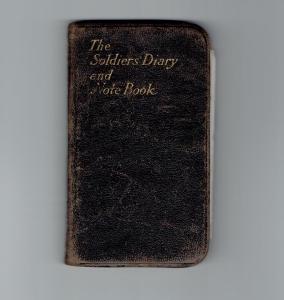
War diary of Stanley Petrokas, courtesy of Patricia Wade
Epilogue
The U.S. saw enthusiastic surges in volunteer service for the military during World War I, and yet segments of the population, against not just war in general, were vehemently opposed to entering a European conflict. Draft evaders in WWI were estimated, by one account, to be roughly 330,000 in number– a minor figure given 24 million men registered across the U.S. There was at least one Lithuanian immigrant from Sangamon County who may have been among the 330,000 draft resisters. His biography follows.
Pius Zvingilas [Žvingilas]
Born February 2, 1890 in the Suvalkai Region of Polish Lithuania, Zvingilas was in Springfield as early as 1910 per U.S. Census information. He registered for the draft in June 1917 and listed his occupation as “coal miner [at] Peabody Mine #6, Sherman, Illinois.”
Zvingilas was single, of medium height with brown hair and a light complexion, and he indicated no dependents. By all accounts, he was the appropriate age to be drafted. Furthermore, he had filed for citizenship prior to the war and this could have cost him what would otherwise have been his exemption, as an “alien” from the draft.
The Springfield City Directory of 1918 includes a “Pius Zvinglas [at] 205 1/2 North 6th Street” serving in the U.S. Army. Then, according to a 1921 Journal article on “slacker” men evading service during the war, Zvingilas is singled-out in the news as having been “determined to prevent his induction into service.”
The account came from Horace S. Reardon of the North Draft Board of Sangamon County. According to Reardon, Zvingilas appeared at the draft board “with a long and decidedly radical argument on why he should not join the thousands of men who were preparing to fight for America.”
Consequently, Zvingilas was placed on a slacker roll and his name was included on a list of draft evaders printed in the U.S. Congressional Record. However, arresting him proved elusive. “He’s gone, and we haven’t a trace of him,” Reardon quipped to the newspaper. Finding him may not have been too hard as he reportedly had brothers in Sangamon County at the time. Subsequent research indicates a “Pijus Zvinglas” died in 1958 and is buried in St. Gerturde Cemetery, Middlesex County, NJ.
If you have information on Zvingilas, please email this blog site. The correct facts about his military status are appreciated.



 Lithuanians in Springfield, Illinois