• Welcome!
  • An indelible role in our history
    • Historical Background, Influences
      • First Lithuanians in Springfield
      • Freedom and Assimilation
      • Divisions and Decline
      • The Mining Life
        • Honoring Central Illinois Mine Casualties
        • The Mine Wars
      • A Second Wave of Immigration: the ‘DPs’
      • Behind the Iron Curtain
      • “Singing Revolution”
        • “The Other Dream Team”
    • Lithuanian Historical Marker Dedication
      • Lithuanians in Springfield Historical Marker
      • A Time to Remember
      • Historical Marker Dedication Program
      • Photo Gallery
      • Marker ceremony noted in Shimkus newsletter
  • Elder Isolation is Elder Abuse
    • Open Letter to Ill. Gov. Pritzker, AG Raoul
    • Open Letter to Illinois Elder Abuse Task Force
  • Sandy’s Blog: News and Profiles
  • Voices of the “Third Wave”
    • Christmas Memories
    • Remembering January 1991
  • Springfield Lithuanian Families
    • Bakunas, Gestaut, Shadis, Petrokas, Chepulis
    • Local Lithuanians Prompt Newspaper Story
    • Stuches, Gillette, Cooper, Chesnut
    • Tisckos, Miller, Wisnosky
    • Treinis, Nevada, Yuskavich
    • Andruskevitch-Shoudis-Moser
      • Weddings
    • Baksys-Yamont
      • Singing Revolution Activities, U.S.
    • Banzin – Liutkus – Kellus – Gestautas
      • Memories
      • Trips to Lithuania and an appreciation of ancestry
    • Giedrys-Kudirka
    • Janners (Jankauskas), Gossrow
    • Kwedar, Olshevsky, Shupenus
    • Lelys, Lilles
      • 1970 Wedding, St. Vincent de Paul Church
    • Turasky, Yakst, Brazas, Stockus
    • Mankus-Tonila
      • Maria Fry Race & Tonilas
    • Zemaitis, Zubkus
    • Casper, Yanor, Walentukonis
    • Rackauskas immigration
    • Treinis-Banaitis
    • Bubnis, Guthrie, Walker
    • Grigsby, Dumbris
    • Missavich-Stankavich
    • Welch, Wilcauskis, Valentanovich
    • Stasukinas, Staken, Bubblis, Poskevicius
  • St. Vincent de Paul Lithuanian Catholic Church
    • St. Vincent de Paul murals resurface
    • Lithuanian Independence Day, 1950
    • People of the Church
    • People of the Church 2
    • People of the Church 3
    • People of the Church 4
    • Fr. Yunker College Scholars
      • Patricia Visnesky and Cynthia R. Baksys
      • Amanda Rackauskas Ross and Elaine (Manning) Kuhn
      • Barbara Blazis, John Dombroski, Patricia Naumovich, Mary Sitki
      • Diane D. Baksys and Emily Warren
  • Business & Professions
    • Journalist Matt Buedel
    • U.S. Senator Richard J. Durbin
    • Chernis: Midwest Demolition
    • Lobbyist “Limey” Nargelenas
      • Horace Mann CEO Marita Zuraitis
    • Nurse Joan Naumovich
    • Tony J. Yuscius, Advanced Digital Media
    • Business Writer Dan Naumovich
    • Teacher Elaine Kuhn
    • Power Co. Executive Maria Race
      • Pediatric Dentist Mary Ann Rackauskas
        • Nurse Debbie Ritter
    • Radio Host Sam Madonia
    • Turasky Meats
      • Tureskis Cleaners
  • The Lithuanian-American Club
    • Founding and Founders
    • Club Lobbies for Lithuanian Independence: Letter to President Bush
    • Recipes / Food
    • Travel

Lithuanians in Springfield, Illinois

Lithuanians in Springfield, Illinois

Monthly Archives: April 2015

‘My Son, Please Come Home’

27 Monday Apr 2015

Posted by sandyb52 in Sandy's Blog

≈ 2 Comments

Following Ann Wisnosky’s account of elders left behind in Lithuania, forcing immigrant families here to rely on neighbors in lieu of parents and grandparents, the piece below hints at the sorrows and difficulties faced by those left behind. In this well-researched article (using Springfield city directories and passport and draft records, among other sources), we see parents hoping to see long-lost children before they die. We also find immigrants in circumstances that make even one, final visit to the homeland next to impossible.

Letters from 1920s Lithuania: A Call to Come Home

By William Cellini, Jr.

A photo from home: family of Nancy Benikati (Pazemetsky), July 15, 1909.

A photo from home: Lithuanian family of immigrant Nancy (Benikas) Pazemetsky, July 15, 1909.

Among the millions of European emigrants who came to the U.S. in the early twentieth century, Lithuanians stand out due to the precarious situations forcing them to leave their homeland. Most emigrants of the Catholic faith left to escape religious persecution by the Russian Orthodox Church and the Russian czarist regime.

Lithuanian men tended to emigrate due to military conscription that began in 1874 under Czar Alexander II. Conscription meant Lithuanian males were obligated to fight for Russia in the disastrous Russo-Japanese War of 1904-05 and in World War I. Politically, Lithuania was under the Russian Empire and had been since 1795.

As a result, Lithuanians chose to re-make their lives in other parts of Europe and in the Americas with no intention of ever returning to their homeland. However, in February 1918 when an independent Lithuanian nation was declared, Lithuanian-Americans had to make a decision about returning, especially when family members wrote letters pleading for them to come home.

Some of these letters contained entreaties from elderly parents wishing to see their children one last time. Other letters conveyed urgency in business matters that had surfaced since the emigrant left. Lithuanian-Americans who did manage to visit, or return for good in the period following World War I, found a Lithuania free from czarist domination and for the most part, free of Polish insurrection.

Passport photo, Enoch Yakobasky, Ancestry.com

Passport photo, Enoch Yakobasky, Ancestry.com

Enoch Yakobasky (perhaps born Ignas Jakubauskas) was a Springfield resident who had emigrated from Lithuania to the U.S. in 1893. He initially worked as a coal miner in Pittston, Pennsylvania, where he was a boarder in the home of a Lithuanian family. By 1915, Yakobasky was living in Springfield, listed in the Springfield City Directory as single and a coal miner. He registered for the draft during WWI, but due to his age (birth year listed as 1873), it is doubtful he served in the U.S. military.

In 1921, Enoch received a letter from his parents in Lithuania pleading with him to come back. They wanted nothing more than to “see you while we are alive, you might not find us alive by the next spring.” Yakobasky was 48 years old and  unmarried, living at the corner of South 12th and Laurel Streets. His lawyer translated into English the letter from his parents, and a part of their message contains reassurances about life in the newly independent Lithuania.

“As you ask about the Government of Lithuania, we must reply, stating that the newspapers are stating untruth about it, because the poor people and working people are fully defended, they may go wherever they please, no one beats them or puts them in jail without reason.”

Other comments carry a different tone: “The master class is now more oppressed than the poor peoples; you should not mind the papers and should come back home, so many have already done and no harm is done to them…”

Yakobasky letter, translated.  Ancestry.com

Yakobasky letter, translated. Ancestry.com

Some remarks convey a sense of class struggle while providing evidence of how bad conditions had been for the poor at the time immigrants left. My interpretation of the reference to the reversal of fortune for the “master class” is speculative. However, it may have been tied to events the year prior when Lithuania was embroiled in a war with Poland over control of the regions of Vilnius, Suwałki and Klaipeda.

That war occurred during the same era as the Soviet-Polish War, when the Red Army attempted to use Poland as a conduit for spreading communism into Germany. Lithuania was assisted by the Red Army in its desire to re-incorporate the city of Vilnius into the Lithuanian state. (Lithuania later lost Vilnius to the Poles, and so Kaunas became Lithuania’s provisional capital from 1920 until 1939).

The letter from Enoch’s parents indicates that he has previously promised but failed to visit, and that they are expecting some financial assistance that has not yet arrived. It’s not surprising that Lithuanian immigrants would have made remittances to elderly parents when able, in the long tradition of foreign workers on U.S. soil.

Whether Enoch made the requested visit, and perhaps even remained with his aging parents, is unknown. He does seem to have left Springfield in the 1920s, as he is not listed or located in Springfield’s city directories from 1923 to 1930.
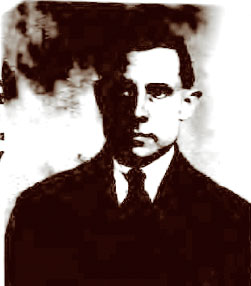
William Grabusky Passport photo, Ancestry.com

William Grabusky Passport photo, Ancestry.com

William Grabusky (perhaps Viljamas Grabauskas) was a Lithuanian-American who emigrated to the U.S. in 1906 from the village of Pilviškiai, Marijampolė County. He obtained U.S. citizenship on September 20, 1916 in Springfield, Illinois. Previously, he had resided in Mahanoy City, Penn., where he worked as a coal miner. During WWI, William and his wife, Ellen, lived on Springfield’s north side. On his draft card, he is listed as a ‘”coal digger” with the “Jones & Adams” Mine. That mine was located off Clear Lake Avenue and was an employment hub for many north end miners.

His birth year is listed as 1882. In 1916, he and his wife suffered the death of their infant son, Notbett (Norbert). The funeral was held at St. Vincent de Paul Church, officiated by the Rev. John Czuberkis. In 1921, William’s parents wrote him a letter from Lithuania asking him to visit. From their reply, it seems William had initiated the idea: “Son, as you wanted to come and see us, well if you could come and see us now, because we are old and weak.”

Grabusky was 40 years old when he received the letter. His passport paperwork indicates it was the first time he was applying for a travel document. Considering that he had resided in the United States since 1906, his parents must have been very pleased that he was making a visit after a separation of at least 15 years.

Their letter goes on to say, “…Your sisters and brother-in-law would be very glad; as we love to see the sun shine, thats [sic] how we want to see you…”

In a part of his letter to his lawyer, William indicates there are other letters from his family and they, too, could be used for his passport application: “…I will send you the letters they wrote me, and I have the lines marked for you as evidence, as they say ‘we are waiting for you to come home and see us.’ ” Perhaps evidence was needed to obtain a passport quickly; it seems William’s application was signed December 16, 1921 and his departure date was listed as Jan. 20, 1922.

Per information from the U.S. Census and Springfield City Directory, by 1930, William and his wife Helen were living on North 8th Street. He was working as a coal miner and Ellen is listed as a ‘janitress’ at the Lincoln Theater downtown. On March 19, 1932, William died of the complications of pneumonia. His body was buried in the abbey vault at Oak Ridge Cemetery.

According to his obituary, he was survived by his wife and by two sisters in Lithuania, Madeline and Agnes, but no parents. Perhaps he had been able to visit them before they died.

Antanas Senkus, passport photo.  Ancestry.com

Antanas Senkus, passport photo. Ancestry.com

Antanas Senkus emigrated to the U.S. from Scotland. According to his U.S. passport application, he was born in the village of Raguva, Panevėžys County. After his arrival in the U.S., he initially settled in Pennsylvania, where he became a naturalized citizen in 1914. In 1918, Antanas and his wife Marijona (family name, Rusinaukus/Ružinauskas) were listed in the Springfield City Directory living on city’s north side. His recorded occupation is “coal miner” with the “Jones and Adams Company.”

By 1920, the couple is listed as having three children. In 1921, Antanas received a letter from his father in Lithuania asking him to come and visit. “[I] am letting you know, son, that I have been sick and in bed since November 1920, so [I] am asking you, dear son, to be so good as to come home as soon as you possibly can as I want to see you, as it is 20 years since I saw you.”

His father’s letter also contains directions on how to get to their village, “Papilvui” (possibly the village of Papilvis in Kaunas County). The elder Senkus closes his letter saying, “[I] am 66 years old but have no health. Since Christmas, I am not able to walk, only sit down. Please write to me as soon as you receive this letter…Hoping this find [sic] you in good health, we are anxiously waiting.”

There is no record, however, of Antanas making the trip overseas to visit his father and family. He died in 1936 and Marijona died in 1954. Both of them are buried at Oak Ridge Cemetery in Springfield.

Another photo from the old country: Julia (Stockus) Wisnosky family between the wars. (The size of the house and dress of the people marks them as relatively well off.)

Another photo from the old country: Julia Stockus (Wisnosky) family between the wars. (The size of the house and dress of the people marks them as relatively successful.)

Emigration Is Forever…

The ease of transatlantic travel in the twenty-first century may obscure the obstacles to even one trip back home by a poor Lithuanian coal miner in the early twentieth century. In reading these letters, it’s important to see beyond the emotional appeal of family reunification to understand the many practical obstacles that often made immigration a one-way trip, rendering it impossible for long-separated parents and adult children to see each other even once after decades of separation.

All three of the men mentioned in this piece were coal miners earning meager wages, at times barely enough to support their families. Coal mining in the early 20th Century was not a full-time or even a year-round occupation, and during the summer, miners normally took odd jobs to maintain an income. In short, they could take no break from the struggle to support themselves (20-28 days just for the two-way transatlantic voyage, not to mention travel to and from an Eastern U.S. port and then a European port and the immigrant’s final destination in Lithuania).

A steamship ticket for a round-trip voyage to Europe, presumably in third-class (steerage), would have cost $80 to $90 in the 1920s. That is about $1,100.00 in today’s dollars, and a significant portion of a coal miner’s annual wages. Many other tickets and travel costs would also have been required.

Photographic ‘Visits‘

Consequently, no matter how much parents and children yearned for a reunion,  such a trip involved great personal sacrifice. It could only be afforded at the cost of more basic necessities and the very progress the emigrant had hoped to make by leaving his homeland, and had earned with decades of hard and risky labor and painful sacrifice.

Modern digital communications have changed these harsh facts of early twentieth century emigration, allowing Lithuanians scattered across Europe and America today to stay in close touch with their relatives and homeland. First-wave Lithuanian immigrants could rely only on letters (using “scribes” when they were illiterate), and photographs. Photos exaggerating the dignity and success attained in America, and photos of the old homestead and village in Lithuania, by necessity took the place of in-person visitation and became precious keepsakes of long-lost family members.

A Galman (Galminas) family death in Lithuania. Undated.

A Galman (Galminas) family death in Lithuania. Undated.

Sadly, many immigrants’ final “visit” with their long-lost parents  took the form of a  funeral photograph, with open casket and neighbors and relatives from the village gathered around. In some especially tragic cases, the open-casket photo that crossed the Atlantic was of the unfortunate immigrant who had predeceased his or her elderly parents.

Sources

Barkan, E. R. (2013). Immigrants in American history: Arrival, adaptation, and integration. Santa Barbara, California: ABC-CLIO.

Kasekamp, A. (2010). A history of the Baltic States. New York: Palgrave Macmillan.

Senn, A. E. (1967). The great powers, Lithuania and the Vilna question  1920-1928. Leiden: E.J. Brill.

Ancestry.com

Illinois State Journal, January 1916.

Illinois State Journal, March 1932.

Jefferson’s Directory of the City of Springfield, Illinois. Springfield, 991.: Jefferson’s Printing Co., Springfield, IL. 1918.

Jennings, W., & Conley, P. T. (2013). Aboard the Fabre Line to Providence: Immigration to Rhode Island.
Lithuanian Women in Marriage & Divorce

11 Saturday Apr 2015

Posted by sandyb52 in Sandy's Blog

≈ 4 Comments

Bernice (Mazika) Kavirt

Delores’ mother Bernice (Mazika) Kavirt

Delores Kavirt grew up in Springfield, the daughter of a miner and bootlegger with an ocean-going background. Delores’ father William Bernard Kavirt (Kavish or Kavishia) was born in Lithuania in 1893. In 1932, after seven children and nine years of marriage, he deserted his family, apparently for the freedom to go back to light, wind, and spray–instead of the dark, subterranean world of mining–as his successful bootlegging business was about to expire.

I would also guess that the strains of the Great Depression had their own impact on the staying power of this husband and father– even if the impending demise of Prohibition and the illegal alcohol trade in 1933 was probably the straw that broke the camel’s back. “My dad left us for reasons unknown and for a destination we never determined when we were all still quite young,” Delores recalled. “He wanted to take my brother Willie with him. But my mother made it quite clear that he was not going to do that, throwing a pot of boiling hot water at him to drive home her point.”

Women Handicapped in Marriage, Divorce

So far, I have not written about the deleterious impact of the harsh mining life on marital formation and duration among first-wave Lithuanian immigrants and their offspring. The story of Delores (“Dolly”) Kavirt’s parents demonstrates that marriage was perhaps first and foremost an economic alliance–until it was a liability.

The Kavirt kids, front row, left to right: Delores, Alice and Willie. Back row, left to right: Bernice and Lillian. Late 1930s.

The Kavirt kids, front row, left to right: Delores, Alice and Willie. Back row, left to right: Bernice and Lillian. Late 1930s.

Getting married was many times easier than getting a divorce, making desertion a ready alternative for husbands, but leaving wives with many children and little English in severe economic distress. Such women seem to have had the choice either of going it alone under the conditions of desertion or, if they could locate their AWOL husbands, securing a costly and difficult legal divorce —and afterwards, if they could stomach it–another marriage.

Lithuanian gender relations of the time also handicapped women both in marriage and divorce. Men learned at least broken English in the mines. However, girls and women not allowed to stray beyond the cloistered world of home, church and a domestic position in a private home became fiancées, wives and mothers who did not speak or read much English, and who knew little of the ways of men–or the world.

Seeking Two Divorces at Once

A March 1, 1933 article in the Illinois State Journal shows Delores’ mother Bernice (Mazika) Kavirt making the case that in 1923, when she was an inexperienced and uneducated 19-year-old Lithuanian girl, William Kavirt tricked her into marrying him after her previous marriage (at age 16 or 17?) ended in desertion. In an unusual twist that likely occasioned newspaper coverage, Bernice was making her case not for just one divorce, but two.

After William Kavirt deserted her in 1932, perhaps it was necessary, in order to receive food aid for her children, to be a divorced rather than a twice-deserted woman whose latter husband, at least, could be considered financially responsible under the law, even if he was AWOL and contributed no support.

It is also true that shedding herself of all legal marital relationship would have freed Bernice to marry again. However, she does not appear to have re-married until 1947, well after she had struggled through raising her five surviving children alone through the trough of the Great Depression. The odds of finding a man who would raise another man’s five children in hard times were probably so long that they made re-marriage  impossible.Anna (Sleveski) Mazika with her granddaughter Lillian Kavirt. Circa 1930.

Anna (Sleveski) Mazika with her granddaughter Lillian Kavirt. Circa 1930.

It couldn’t have been easy to publicly expose her dual-marriage, dual-divorce predicament by going to court, particularly after the brutal death of her mother Anna as a pedestrian hit by a car the same year husband William deserted the family in 1932. (All this, after Bernice’s infant son Edward died at two months of age in 1931).

By 1933, Bernice (Bertha) was in court in separate suits. One was for $10,000 in damages for her mother’s wrongful death. The other was for dual-divorce, making quite believable her claim of having suffered a nervous breakdown in 1932 after encountering her missing husband on the street, only to have him thumb his nose at her and her demand either to come home and resume his family responsibilities or give her a divorce.

The passage below from the March 1 1933 Journal article hints that, in addition to breaking Bernice’s nerves, William may also have forced her hand by threatening to publicly expose the fact of her dual marriages if she tried to sue him for divorce.

“Mrs. Kavirt met Kavirt on the street here after his desertion and informed him that she would file a divorce bill if he did not return to their home and their five children at 1025 N. 14th Street. Kavirt ridiculed that plan, and revealed that they had never been legally married because her first husband had never secured a divorce.”

Victim of Marital Manipulation?

Bernice (Mazika) Kavirt was born in Hazelton or Minersville, Pennsylvania in 1901 or 1904, the daughter of Michael and Anna (Sleveski) Mazika, both born in Lithuania. Twice married by age 19, was this barely educated young woman the victim of marriage manipulation, as she pleaded in her divorce suit? Or had she known or guessed when she married for the second time, to William Kavirt, that she was not legally severed from her first husband, Alfred Platukas, despite what she described as Kavirt’s assurances to the contrary? (These were given, Bernice testified, after Kavirt made a show of traveling to Pennsylvania for several weeks to ascertain her first husband’s whereabouts, then returning to report that Platukas had secured a divorce from Bernice in Detroit.)

We will never know for sure what young Bernice knew or chose to overlook. What is certain is that even if she had tried to make legal marriage work in her favor, it had not, resulting in two desertions, various costly legal knots to untie, seven live births and five surviving children in just nine years, plus sole financial responsibility for her children at age 29. Platukas and Kavirt, meanwhile, had been able to enter, then abandon marriages that became too burdensome for them.

Bernice Kavirt with her daughter Bernice (Kavirt) Manning's children Glenn and Alice, 1950s.

Bernice (Mazika) Kavirt with her daughter Bernice (Kavirt) Manning’s children Alice and Glenn, 1955.

Bernice’s daughter Delores was the youngest of the five Kavirt siblings who grew up first on North 14th Street, then in a stone bungalow on Griffiths Avenue near Peoria Road.  Two other children, including (the aforementioned Edward and) Alice, who was only four when she died, had both perished by the time their father left. Delores recalled: “After Dad left, Momma had to rely on public relief and cleaning homes. I was still too young to be left at home, so she had to take me wherever she needed to go.”

Saved by Jewish Kindness

“Momma used to tell the story of how, growing up in Pennsylvania, she had also tagged along with her Lithuanian immigrant mother Anna, cleaning the homes of well-to-do members of the Pennsylvania Jewish community. Then, as a single mother of five,” Delores recalled, “my mother experienced the same consideration by members of the Springfield Jewish community.

“I can remember walking downtown with Momma to the public relief office and then taking our food stamps to Cohen’s and other grocery stores. The purchase of candy with food stamps was forbidden, and my mother abided by that. However, quite often, the storekeepers would hand me a small bag of free candy as I exited.

“At about the same time, the authorities wanted to split up our family because they thought our Momma couldn’t adequately care for all of us. But with the help of a local attorney named Templeton, whom I think was Jewish, Momma was able to resist that action and keep us all together with her under one roof. For the help of that attorney and those previously mentioned acts of kindness by Jewish homeowners and storekeepers, I hold those of the Jewish faith in high regard,” Delores said.

According to Delores’ nephew Glenn Manning, Bernice Kavirt also struck a care-giving deal to keep a roof over her children’s heads. It was after husband William left that the family moved from North 14th Street to the aforementioned stone house on Griffiths Ave., which was owned by John Yuscius. Elderly and infirm, John let Bernice and her children live with him in exchange for Bernice’s care.

Bernice (Kavirt) Manning, daughter of Bernice and Willam Kavirt, on porch of Griffiths Ave. home, 1940s.

Bernice (Kavirt) Manning, daughter of Bernice and Willam Kavirt, on porch of Griffiths Ave. home, 1940s.

Grandmother Anna Hit by Car 

Maternal grandmother Anna Mazika had moved from Pennsylvania to live with her daughter Bernice, and probably, care for the children while husband William was still with the family. But one Saturday in 1932, according to the Illinois State Journal, while Anna was walking home from confession at St. Vincent de Paul Church, she was struck and killed, as she was crossing 9th St. at Enos Ave, by the car of a man from Ft. Wayne, Ind., who was reported in the Journal to have been traveling more than 55 mph.

According to Delores, “Anna’s spiritual needs were attended on the spot by Fr. Yunker (St. Vincent’s pastor).” The newspaper reported that Bernice (Bertha) sued the driver for $10,000, but I could find no follow-up article giving the result of that suit. According to the Journal, a coroner’s jury created the opening for a civil suit by rendering an “open verdict,” neither blaming nor exonerating the driver.

Bringing up Baby (Hooch)

During Prohibition, which included the entire term of the Mazika-Kavirt marriage, William Kavirt and a brother who lived nearby bootlegged together from the Kavirt home on North 14th. “They were known for producing some very good rye whiskey,” Delores said. “My mother was tasked with transporting the product of their labors from our house to our uncle’s house on North 9th Street, sometimes using a baby stroller as cover – the ‘hooch’ hidden under a blanket.”

In addition, according to Delores’ nephew Glenn, “William and Bernice used to keep a rabbit hutch out back. Some whiskey customers would bring over their rabbits for breeding as a cover for picking up whiskey.” Delores recalled: “Because of this business relationship between Dad and our uncle, as my siblings and I grew into young adults, we turned to our uncle’s family for answers about our father. But they always claimed no knowledge of his whereabouts.”

The beautiful Delores Kavirt showing a palomino horse named Pardner, 1940s.

The beautiful Delores Kavirt showing a palomino horse named “Pardner,” 1940s.

Horses and Houses

“As a grade schooler,” Delores recalled, “I fell in love with horses. It helped that there was a sale barn only a couple of blocks from our home on Griffiths Avenue. I didn’t care as much about extracurricular school functions and dating as I did for caring for and riding horses. I showed horses occasionally but enjoyed simply riding them more. So when my husband and I built our first home in the country in 1969, I had my own horse for a while, ‘Amigo.’

Around the corner from the Griffiths Ave. home, on Peoria Road, Delores recalls a row of stores that included a Piggly Wiggly grocery. Near neighbors were the Malinski and Stankavich families, including five Stankavich sisters: Nellie, Vickie, Fritzi, Eleanor and Martha—and a brother named Stanley. Delores married Edward (Eddie) Lomprez  in 1948 at St. Patrick’s Church. He worked in the construction trades most of his life, eventually retiring from UIS. Together, the couple built three and a half homes, not counting the first place they lived: a remodeled chicken coop in Eddie’s Grandma’s large backyard in Clear Lake Village (called the “Dogpatch.”)

Delores Kavirt and Edward Lomprez wedding, with Kavirt siblings, 1940s.

Delores Kavirt wedding, with Kavirt siblings and her mother, Bernice, and third husband, Johnny Terasse, late 1940s.

Delores and Eddie’s second house was “garage home” that they built on a lot given by Eddie’s dad. After Eddie was drafted into the Korean War and returned, Delores recalled, “We caught a lucky break and were able to construct our first, real home as the result of bad luck suffered by my only brother and favorite sibling, Willie.”

Tragedy Befalls ‘Wild’ Willie

A St. James Trade School football and basketball star, Willie also had survived his service in World War II and returned to working multiple shifts at Pillsbury Mill. Delores had loaned Willie some money so that he could build himself a home. “For reasons we never knew, the home under construction burned to the ground in the spring of 1954. Willie, 27, was uninsured and lost his desire to rebuild. He insisted I take the title to his lot as repayment for his loan. I resisted that and encouraged Willie to rebuild. However, he refused, and I ended up with a nice lot–and a basement full of debris from the fire, which Eddie and I cleared by hand.”

Willie Kavirt, St. James Trade School football star, 1940s.

Willie Kavirt, St. James Trade School football star, 1940s.

Delores recalls her only brother’s wild side. “He liked to stay out late and gamble. I’d bug him from time to time about marrying and settling down. He always said, ‘No, my lifestyle now would just make some woman miserable…I’ll wait.’ “By then, several of my nieces and nephews had been born. Willie referred to them all as ‘little corned beef and cabbages.’

“Although he seemed to like the little ones and may have ended up a father someday, tragedy struck early one morning, only a few months after the fire that destroyed Willie’s home. He and a friend drove their car into the path of a truck and were pronounced dead at the scene. It was such a horrible accident that it was not even possible to determine who had been driving.”

The Illinois State Journal reported the accident occurred at Route 4 and old U.S. Route 66, at the northwest corner of the Illinois State Fairgrounds. The trailer-truck dragged Willie and his friend’s car 150 feet into a ditch, where the the cab of the truck shot up, then crashed down on top of the car. The August 25, 1954 Journal article reports, “It required nearly two hours for three wreckers to lift the truck from the car and extricate the bodies.” Although the truck driver reported the car ran a stop sign, he was cited for speeding.

Five Acres near Rochester

Delores (Kavirt) Lomprez is now the last of her siblings: Lillian (husband Joe Trello), Alice (husband Al McKenzie) and Bernice (husband Albert Manning). Lillian lived on North 22nd Street, worked at Sangamo Electric and retired from the cafeteria at St. Aloysius School. She had one child, Phillip. Alice worked at The Springfield Shoe Factory and had one child, Allen Wayne. Bernice worked at Memorial Medical Center and had four children: Alice, Glenn, Elaine and Bryan. Delores worked at Sangamo Electric and retired from the cafeteria at Rochester Schools.

“Up until the time Eddie died, we enjoyed a large vegetable garden, raising chickens and maintaining five acres at our second rural home. (Nephew Glenn Manning also says the rural spread included a woodworking shop, a grape arbor and a working windmill.) My husband and I never had children, but we did have the pleasure of many visits, including being summer hosts for our nieces and nephews, mostly on the Lithuanian side of the family.

“Momma (Bernice Mazika Kavirt) lost her eyesight due to diabetes, so later on in life she came to live with Eddie and me. She had her own room in our ranch-style house and got along quite well by feel. In our second careers, Eddie and I worked opposite shifts, which allowed one of us to be at home with Momma most of the time.”

As for the Lithuanian-American twice-deserted wife and mother who struggled to take care of her children alone and prevented them from being adopted out during the Great Depression, Delores says, “To this day, I wear a necklace with a pewter angel to remind me of my dear Momma. She is one of my angels.”

Leftist Lithuanians

01 Wednesday Apr 2015

Posted by sandyb52 in Sandy's Blog

≈ 9 Comments

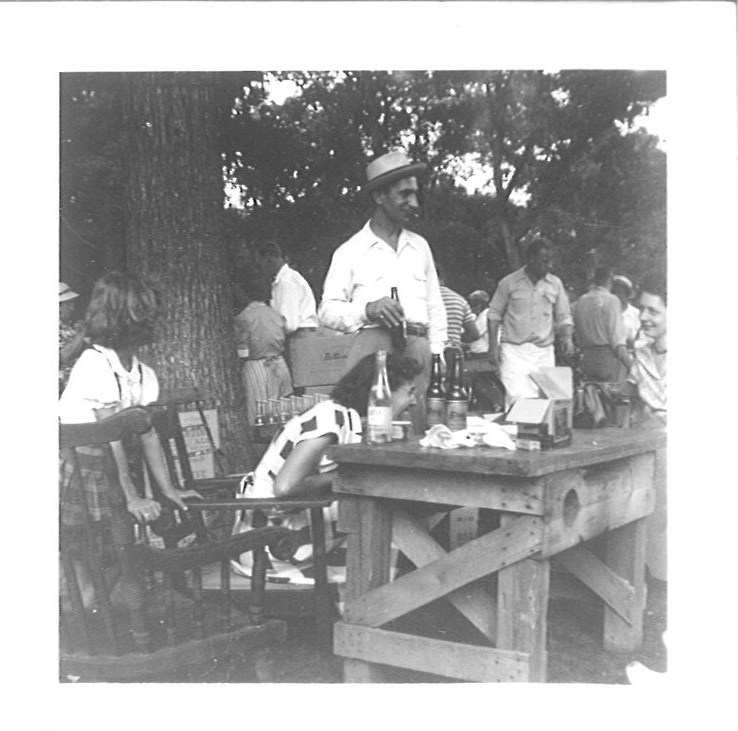
Frank Pakey dancing at "Lithuanian Lodge" picnic, 1950s.

Frank Pakey dancing at “Lithuanian Lodge” picnic, 1950s.

From the 1930s through the late 1950s, Springfield seems to have been home to the “Lithuanian Lodge,” a.k.a, the local lodge of the leftist fraternal benefit society known as the Association of Lithuanian Workers (ALW). In October 1949, the Illinois State Journal ran an announcement of a lodge picnic at the Pakutinskas (Pakutinsky or Pakey) farm on Mechanicsburg Road about seven miles east of the city.

Wikipedia says the ALW was established in June 1930 as a communist-leaning splinter of the Lithuanian Alliance of America. I quickly get lost in the alphabet soup of twentieth century American leftist organizations with Lithuanian-language branches, not to mention exclusively Lithuanian left-wing groups.

However, two facts about leftist Lithuanian immigrants of the first wave seem interesting: According to some sources, Lithuanians frequently constituted the largest foreign language group on the early American left. Second, although illiteracy was the rule among first-wave Lithuanians, it seems that many of those who were educated gravitated to socialist organizing and publishing.

Frank Pakey chatting up the ladies at "Lithuanian Lodge" picnic, 1950s.

Frank Pakey chatting up the ladies at “Lithuanian Lodge” picnic, 1950s.

For example, according to Wikipedia, the Amerikos Lietuvių Socialistų Sąjunga (American Lithuanian Socialist Union or ALSS), was established in 1904 by Lithuanian immigrants, and did not affiliate with the Socialist Party of America until 1915. Although independent, the Laisvė (Freedom) newspaper affiliated with the ALSS. It was called “one of the most influential and longest-running radical Lithuanian-language newspapers in the United States, issued daily from 1919 through 1958.”

When the Socialist Party of America split in 1919, its communist-leaning Lithuanian Socialist Federation branch moved en mass into the newly formed Communist Party of America, and Laisvė became an organ of the CPA. (The “lodge” or ALW had its own national publication, Tiesa (Truth).

Communists Down on the Farm

Joseph Pakutinskas, left, Herrin coal miner, 1910s.

Joseph Pakutinskas, left, Herrin, Ill. coal miner, 1910s.

A local man who wrote for Laisvė during the 1930s under the pen name, “Urbana Farmer,” was Joseph Pakutinskas (Pakutinsky), who owned the aforementioned 80-acre farm on Mechanicsburg Road with his son Frank Pakey. Joseph and his wife Anna Janusauskis were born in Lithuania in the 1880s, and immigrated to the U.S. around 1907. According to grandson Donald Pakey, Joseph was a coal miner in the Herrin area and later a farmer in Champaign County before settling in Sangamon County.

What Don, a physics professor at Eastern Illinois University, remembers from family lore are his grandfather’s radical writings for Laisvė and the lively summer picnics of the Lithuanian Lodge on the Pakey farm. The Pakeys even had a cement slab laid in the picnic area to create an outdoor dance floor.

When he was a toddler, Don joined the picnics in a play pen, where he was not alone. A goat that his older sister Emily bought from one of the Lithuanian-American women for three cents was small enough to squeeze in through the bars of the pen and play with him. Although he was too young to remember, Don’s guess is that the Lithuanian Lodge Pakey farm picnics ended when his grandmother Anna died in 1958.

Don Pakey in playpen, sister Emily and "the goat." Pakey farm, 1950s.

Don Pakey in playpen, sister Emily and “the goat.” Pakey farm, 1950s.

“Then, in the early 1960s, my grandfather, whom we called “Pa,” had the first of several strokes,” Don recalled, “and he couldn’t really talk after that. He lived with us there on the farm till he died in 1969. I only have memories of my grandfather wandering around the farm and doing light farm work. However, Emily has good memories of talking to ‘Mamita,’ as we called our grandmother, and her flocks of baby turkeys. Mamita didn’t know a lot of English, but they did talk.”

Don’s father Frank and Uncle Pete attended the University of Illinois in the 1930s and fought in World War II.

Hard Times on the Left

Immigrant leftist organizations provided self-help and cultural resources, like libraries, choirs and drama clubs.  But even more important, they served as vehicles, often in concert with labor unions, for the struggle against the shameless exploitation of unskilled immigrant workers in mines and factories.

"Mamita" (Anna Janusauskis Pakutinskas) with her baby turkeys, Pakey farm, 1950s.

“Mamita” (Anna Janusauskis Pakutinskas) with her baby turkeys, Pakey farm, 1950s.

To the extent that the U.S. government served more powerful corporate and national interests, immigrant socialist and communist organizations were feared, from their inception, as real or potential enemies of the state. During World War I, they organized pacifist opposition that was an open threat to the draft. As a result, Congress passed the Espionage Act of 1917, subjecting those who opposed or interfered with America’s war effort to jail time and/or deportation.

In fear of the radical foreign language press, the Sedition Act was passed in 1918 to include even opinion that cast the government or the war effort in a negative light. Although the Sedition Act was repealed in 1920, the Espionage Act was upheld by the Supreme Court, and beginning that same year, a succession of U.S. laws closed the spigot of mass immigration from Southern and Eastern Europe that had fueled so much growth on the American left.

After the Russian revolution, American leftists tied their leadership, philosophy and actions to that single existing example of communist government, the U.S.S.R. This was less of a perceived threat during World War II, when the U.S. allied with the Soviet Union to defeat fascism. However, with the beginning of the Cold War, organized communism in the U.S. was actively suppressed. Most of us have heard of McCarthyism and the Hollywood blacklisting of Communist Party members and sympathizers.

Outdoor dance floor at Pakey farm picnic of the "Lithuanian Lodge," 1950s.  Lithuanian leftist groups supported racial equality and were racially integrated.

Outdoor dance floor at Pakey farm picnic of the “Lithuanian Lodge,” 1950s. Lithuanian leftist groups supported racial equality and were racially integrated.

Additionally, according to Don, “The Internet tells us of the June 23, 1947 Taft-Hartley Labor-Management Relations Act, passed by Congress over President Truman’s veto, which sharply curtailed the rights of organized labor while forcing unions to purge communists from their ranks. Likewise, on Nov. 2, 1949, the Congress of Industrial Organizations (CIO) voted at its national convention to revoke the charter of the United Electrical Workers, the CIO’s third largest union, for failing to purge itself of communist influence. Ultimately, 12 left-leaning unions, and countless individual left-wing organizers, were booted from the CIO.”

Stalin and the Abuses of Communism

Leftist party ties (in some cases, slavish ties) to Soviet leaders and policies made them not only a perceived threat to the U.S. government, but also stubbornly blind to the Siberian gulag of Soviet dictator Josef Stalin. The left’s blind allegiance to the U.S.S.R., including the 1940 Soviet re-conquest of Lithuania, was a fundamental cause of conflict and division in Lithuanian-American communities like Springfield’s.

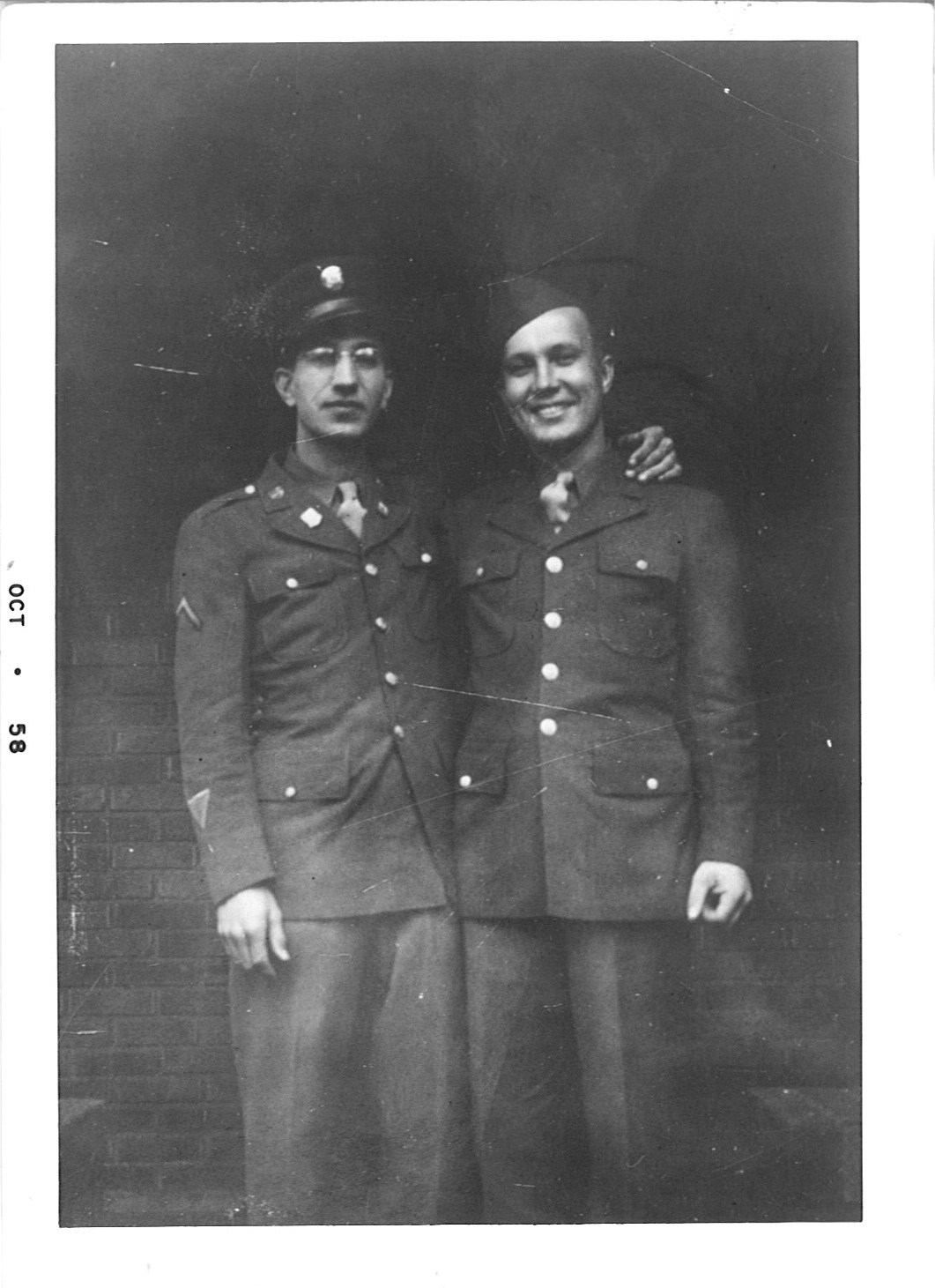
From left:  brothers Frank and Pete Pakey in uniform, World War II.

From left: brothers Frank and Pete Pakey in U.S. Army uniforms, World War II.

With the arrival after World War II of Lithuanian eye witnesses to Soviet brutality, in the form of displaced persons (DPs) like my father, it had to become increasingly precarious to remain a Lithuanian-American Stalinist. Yet decades of true-believer orthodoxy and a lifetime of struggle probably made it emotionally hard even to listen to such witnesses, let alone embrace what they said.

For Dad’s part, living through one Soviet occupation in 1940 and narrowly escaping another in 1944–fleeing thousands of miles into exile and losing his homeland and way of life in the bargain–only to encounter Lithuanian-American communists parading on stage in Springfield in Red Army uniforms, had to be nothing less than traumatic.

Dad recalled the sight well into his 90s, and I believe the large and devoted leftist contingent within the Lithuanian community here played a role in his estrangement from that community. It couldn’t have felt safe to mingle with Stalinists who were hostile to all evidence of the rape of Lithuania, and who might have had contacts– through international communist organizations–that were a danger to family back home and abroad. (During the 1980s I learned that the Lithuanian family members of those who had fled to the West were persecuted and spied on until the very end of the Cold War.)

Brother against Brother

To this day, it strikes me as grotesque that the twentieth century’s first two waves of Lithuanian immigration to the U.S. had to be divided, brother against brother, by two contradictory visions and experiences of communism. For many first-wavers like Joseph Pakutinskas, communism probably was first and foremost about building a world where working people weren’t oppressed by company bosses and their political hacks. (Joseph’s leftist leanings also could have had roots in Lithuania’s anti-czarist movements of the late 1800s.) Yet Lithuanian-American communists’ hierarchical subordination to the Soviet Communist Party, even to the extent of embracing the Soviet conquest of Lithuania, was the ultimate fatal flaw.

Anna and Joseph Pakutinskas, circa 1950.

Anna and Joseph Pakutinskas, circa 1950.

Political divisions pitting brother against brother were obvious from the beginning of the Lithuanian first wave, and may even have partially driven the founding (1906-1911) of Springfield’s St. Vincent de Paul (Lithuanian) Catholic Church. By the late 1910s and the early 1920s, Catholics based at the church also had organized the Knights of Lithuania and the Lithuanian Roman Catholic Alliance of Labor (it seem likely, at least in part) to counter Lithuanian leftist organizing, complete with the same kind of cultural activities that the leftist groups used to attract and uplift their members. (See Knights of Music, Baseball, Picnics.)

Despite being similarly impacted by assimilation and the death of the first-wave immigrants who formed their backbone, Lithuanian leftist associations in Springfield seem to have declined more precipitously than Lithuanian Catholic groups.  This may have been partially due to tendencies towards schism on the national level, and Cold War era attacks on the organized left. However, second-wave immigrants no doubt provided new blood for the parishes, while at the same time undermining the left’s core reliance on the moral superiority of the U.S.S.R.

Trans-generational upward mobility through education, the success of labor unions, and increasing access to white collar professions in Springfield also incrementally stole much of the left’s thunder. The break-up of the Soviet Union in 1991– ironically, on the force of determined Lithuanian, Latvian and Estonian independence movements–precipitated the ultimate crisis for the Lithuanian-American left, along with leftist movements around the world.

Blogroll

  • Enos Park Neighborhood Improvement Association
  • Illinois State Historical Society

Lithuanian Websites

  • Amber Reunion
  • Lithuanian World Center
  • Lithuanian-American Club of Central Illinois
  • Lithuanian-American Community, Inc.
  • Lithuanian-American Publications
  • Lithuanians Of Arizona
  • LTnews.net
  • LTUWorld
  • The Lithuania Tribune

St. Vincent’s murals resurface

Two of the murals from St. Vincent de Paul's Catholic Church have resurfaced. Take a look!

Search

Enter your email address to follow this blog and receive notifications of new posts by email.

Join 142 other subscribers

E-mail us!

Questions or comments? Please e-mail sandybaksys@gmail.com.

Email us!

Questions or comments? Please e-mail sandybaksys@gmail.com.

Blog at WordPress.com.

Privacy & Cookies: This site uses cookies. By continuing to use this website, you agree to their use.
To find out more, including how to control cookies, see here: Cookie Policy
  • Subscribe Subscribed
    • Lithuanians in Springfield, Illinois
    • Join 142 other subscribers
    • Already have a WordPress.com account? Log in now.
    • Lithuanians in Springfield, Illinois
    • Subscribe Subscribed
    • Sign up
    • Log in
    • Report this content
    • View site in Reader
    • Manage subscriptions
    • Collapse this bar
 

Loading Comments...