• Welcome!
  • An indelible role in our history
    • Historical Background, Influences
      • First Lithuanians in Springfield
      • Freedom and Assimilation
      • Divisions and Decline
      • The Mining Life
        • Honoring Central Illinois Mine Casualties
        • The Mine Wars
      • A Second Wave of Immigration: the ‘DPs’
      • Behind the Iron Curtain
      • “Singing Revolution”
        • “The Other Dream Team”
    • Lithuanian Historical Marker Dedication
      • Lithuanians in Springfield Historical Marker
      • A Time to Remember
      • Historical Marker Dedication Program
      • Photo Gallery
      • Marker ceremony noted in Shimkus newsletter
  • Elder Isolation is Elder Abuse
    • Open Letter to Ill. Gov. Pritzker, AG Raoul
    • Open Letter to Illinois Elder Abuse Task Force
  • Sandy’s Blog: News and Profiles
  • Voices of the “Third Wave”
    • Christmas Memories
    • Remembering January 1991
  • Springfield Lithuanian Families
    • Bakunas, Gestaut, Shadis, Petrokas, Chepulis
    • Local Lithuanians Prompt Newspaper Story
    • Stuches, Gillette, Cooper, Chesnut
    • Tisckos, Miller, Wisnosky
    • Treinis, Nevada, Yuskavich
    • Andruskevitch-Shoudis-Moser
      • Weddings
    • Baksys-Yamont
      • Singing Revolution Activities, U.S.
    • Banzin – Liutkus – Kellus – Gestautas
      • Memories
      • Trips to Lithuania and an appreciation of ancestry
    • Giedrys-Kudirka
    • Janners (Jankauskas), Gossrow
    • Kwedar, Olshevsky, Shupenus
    • Lelys, Lilles
      • 1970 Wedding, St. Vincent de Paul Church
    • Turasky, Yakst, Brazas, Stockus
    • Mankus-Tonila
      • Maria Fry Race & Tonilas
    • Zemaitis, Zubkus
    • Casper, Yanor, Walentukonis
    • Rackauskas immigration
    • Treinis-Banaitis
    • Bubnis, Guthrie, Walker
    • Grigsby, Dumbris
    • Missavich-Stankavich
    • Welch, Wilcauskis, Valentanovich
    • Stasukinas, Staken, Bubblis, Poskevicius
  • St. Vincent de Paul Lithuanian Catholic Church
    • St. Vincent de Paul murals resurface
    • Lithuanian Independence Day, 1950
    • People of the Church
    • People of the Church 2
    • People of the Church 3
    • People of the Church 4
    • Fr. Yunker College Scholars
      • Patricia Visnesky and Cynthia R. Baksys
      • Amanda Rackauskas Ross and Elaine (Manning) Kuhn
      • Barbara Blazis, John Dombroski, Patricia Naumovich, Mary Sitki
      • Diane D. Baksys and Emily Warren
  • Business & Professions
    • Journalist Matt Buedel
    • U.S. Senator Richard J. Durbin
    • Chernis: Midwest Demolition
    • Lobbyist “Limey” Nargelenas
      • Horace Mann CEO Marita Zuraitis
    • Nurse Joan Naumovich
    • Tony J. Yuscius, Advanced Digital Media
    • Business Writer Dan Naumovich
    • Teacher Elaine Kuhn
    • Power Co. Executive Maria Race
      • Pediatric Dentist Mary Ann Rackauskas
        • Nurse Debbie Ritter
    • Radio Host Sam Madonia
    • Turasky Meats
      • Tureskis Cleaners
  • The Lithuanian-American Club
    • Founding and Founders
    • Club Lobbies for Lithuanian Independence: Letter to President Bush
    • Recipes / Food
    • Travel

Lithuanians in Springfield, Illinois

Lithuanians in Springfield, Illinois

Monthly Archives: January 2015

What Did They Look Like–100 Years Ago?

31 Saturday Jan 2015

Posted by sandyb52 in Sandy's Blog

≈ 5 Comments

national costume, often woven from flax. blogspot.com

national costume, often woven from flax. blogspot.com

In February 1913, Illinois State Journal-Register columnist Octavia Roberts made and wrote about a visit to St. Vincent de Paul Lithuanian Catholic Church.  Her “Through Feminine Eyes” column gives us our best eye witness account today of what first-wave Lithuanian immigrants looked like 100 years ago.

Sunday mass at the church was packed, with people standing in the aisles and in front of the vestibules, some of them for a full two hours (a longer mass than most of us have ever endured). Men and boys sat on one side of the church, women and girls on the other. It’s not surprising to read that, according to Roberts, the “majority had blue or gray eyes,” and “were a handsome, sturdy people.”
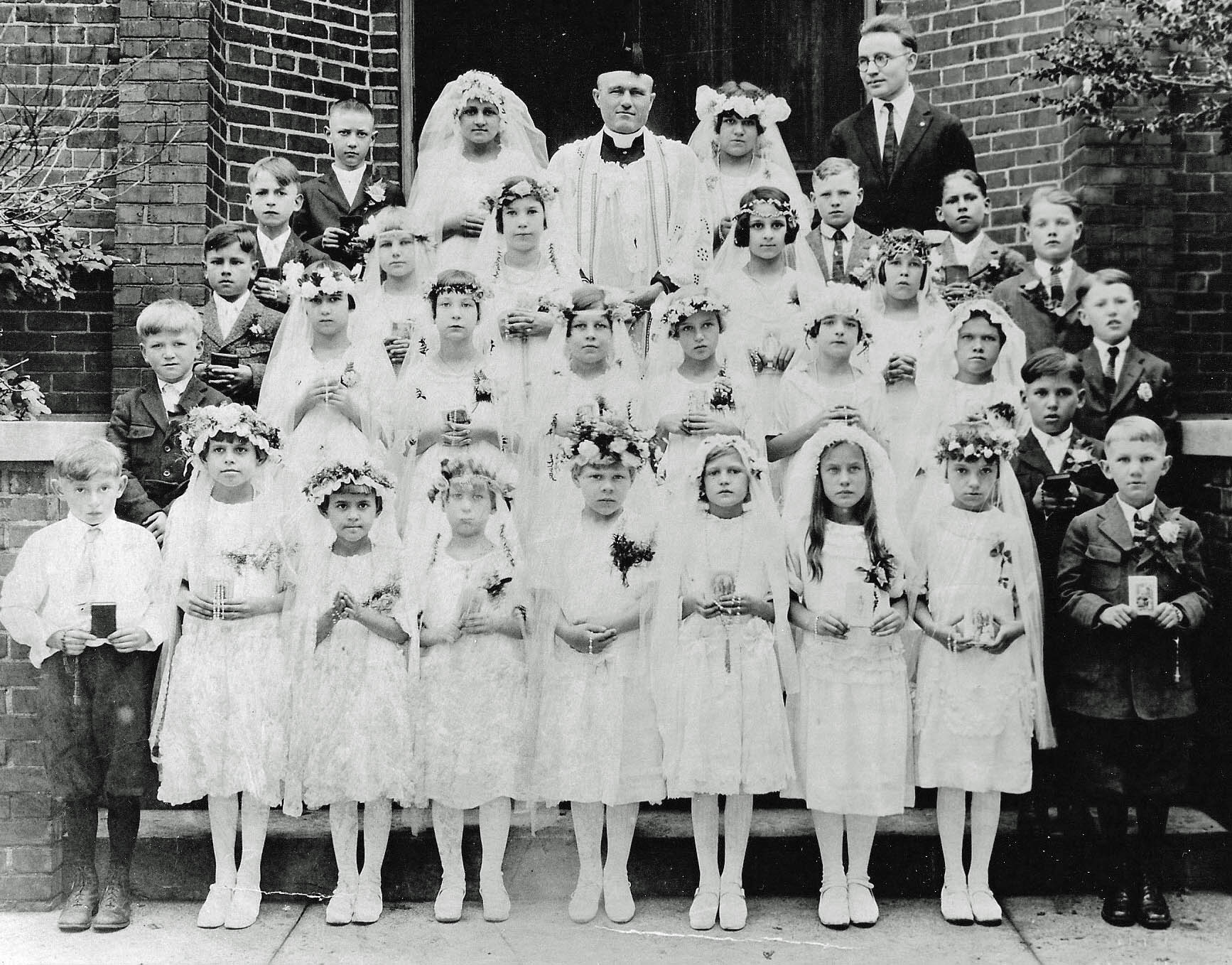
St. Vincent de Paul's First Holy Communion, circa 1920.

St. Vincent de Paul’s First Holy Communion, circa 1920.

The writer makes much, indeed, of the men’s thick and wavy hair. Although she doesn’t say, I imagine the congregation she observed that day was uniformly young. Elders with balding pates–uncles. aunts, parents and grandparents–had mostly been left behind because the light at the end of the immigrant’s tunnel back then could only potentially be reached through a lifetime of hard, manual labor—impossible for the old or weak. “As for the women,” Miss Roberts writes, “their pretty hats covered up their faces according to the mode of the year.”

Lithuanian married women's head-dress.  Courtesy of Reflections from a Flaxen Past, by Kati Reeder Meek.

Lithuanian married women’s head-dress. Courtesy of Reflections from a Flaxen Past, by Kati Reeder Meek.

She goes on to marvel at “how well-dressed”  the female Lithuanian immigrant was after invariably arriving in America “in a full skirt with waist of contrasting material worn in her province, with her head tied up in a bright handkerchief and her goods in great square of cloth, knotted at the corners.” Remarkably, “in an incredibly short time,” these immigrant women “would put away the clothes of the old country and be dressed in the latest fashions of America.”

Lithuanian woman's holiday "costume," courtesy of Reflections from a Flaxen Past, by Kati Reeder Meek.

Lithuanian woman’s holiday “costume,” courtesy of Reflections from a Flaxen Past, by Kati Reeder Meek.

Putting on the New

I like this passage on many levels. Probably the most important meaning is only hinted at:  That before coming to America, Lithuanian immigrants knew only homespun clothing in a cash-poor economy where you didn’t wear it, use it, or eat it unless you grew it or made it yourself. According to Roberts’ article, prior to immigrating, most Lithuanian men were poor, landless agricultural workers (on large estates) earning only about $30 a year. Women no doubt had even less, if any, cash, and it was their job to spin all the family’s clothes from flax, a little cotton, and lots of wool.

It hardly takes much imagination to conceive of these immigrant women’s excitement at being part of a town economy where families had several hundred dollars a year, and retail options for spending it. Since their cash was still far from sufficient,  immigrants still made, not bought, much of what they needed, including cultivating most of their own food, just like in the old country. Critical, non-cash subsistence skills still made the difference between success and failure.

But the habit of having at least one set of store-bought clothes for Sunday mass, for those who could afford it, was likely a habit carried over from the home country, only to be more fully expressed when economics made that possible. And you can bet that one or two fine and fashionable Sunday outfits would have seemed like a necessary dividing line between the old life and the new–at the very least to show that all that had been left behind–given up–was worth it. That they were moving forward in life.

As for St. Vincent’s well-dressed immigrant ladies the day Roberts visited, once married, none was permitted the public exposure of singing in the church choir. That meant the female choir Roberts observed in early 1913 was composed of the few, small girls too young to marry in a culture where the girls married young. However, if this photo dated that same year is correct, due to its pastor’s efforts, St. Vincent’s had an adult mixed-voice choir only months later, perhaps composed of unmarried adult women or women with their husbands. (By the 1920s, it was one of the finest church choirs in the city.)

The first church choir, late1913, St. Vincent de Paul Lithuanian Catholic Church.

The first church choir, late 1913, St. Vincent de Paul Lithuanian Catholic Church.

Homespun to ‘Home Clothes‘

One of the last things my homespun-wearing, subsistence-farming Lithuanian father did before fleeing the advancing Russians in 1944 was to bury his store-bought Sunday suit and shoes in a cardboard box– never doubting, of course, that he would return. (Our grandmother’s china dishes are also still somewhere underground on our lost Baksys land–musu jame.)

Dad’s homespun customs, which I never understood growing up, were echoed in our family’s pronounced distinction between “home clothes” and school or church attire. Before we were of the age when we could take more control over our personal appearance, this went beyond formal vs. informal or school vs. play. Until I was 7 or 8, Dad wouldn’t even let his daughters wear pants in the winter or shorts in the summer–his rule for girls was dresses, no matter what the other kids wore.

I also still remember, as a kindergartener, the shame of being ambushed in my “home clothes” when a neighbor boy unexpectedly packed his birthday party with our classmates in full party dress. And, I still think, to this day, that our family’s “immigrant” difference was most firmly established in my mind by our clothes, and our reaching, as girls, for a normalcy and belonging that was always just out of reach–through clothes that were also always somehow just out of reach.

Clothed in Dignity (and Glory?)
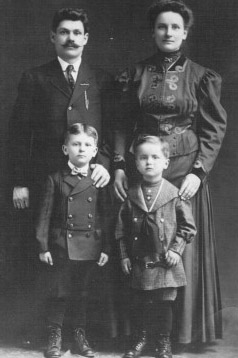
Mary Yamont (Marija Baksyte Jomantiene) with husband and sons Benny (left) and Joseph, circa 1909.

Mary Yamont (Marija Baksyte Jomantiene) with husband and sons Benny (left) and Joseph, circa 1909.

I’m sure others have noticed that poor Lithuanian coal miners and their wives always seemed to take amazingly glamorous “portrait” photos. I puzzled for years over this apparent discrepancy between what I knew about the economic status of my Great Aunt Mary Yamont (or Marija Baksyte Jomantiene) and her coal-mining husband, Benedict, Sr., and their full sartorial splendor in a family portrait in 1908 or 1909.

It seems improbable that all of our ancestors somehow made and lost millions by the time we met them.  And even if true in some cases, great reversals of fortune could hardly explain the pure number of photos wherein glamorous immigrant dress seems to belie verbal histories of poverty. Doubtless these photo portraits aimed to show families at their most solemn, dignified and successful.

Also, in true poverty, limited photographic resources would hardly be wasted on papering the world with that era’s version of the goofy Polaroid snapshot—or today’s proliferation of digital “selfies.” To the contrary, it actually seems logical to me that poverty, itself, and trying to make “bella figura” to the people back home, can explain the extravagance of early 20th Century weddings and other high photographic occasions that were exceptions to the daily grind of hard, manual labor.

I’ve even heard that photographers traveled with glamorous wardrobes to entice the poor to become temporary poseurs to wealth.  And, what better than a photograph to render wistful permanence to a dead-ended miner or laundress’s unfulfilled dream of ease and luxury—never to become real in this life? Image

Lithuanian Sunday church, their own church that was like a piece of their own home soil, was also a place to dream, and to begin to self-actualize, with the support of community and the many social clubs and Lithuanian Catholic lay societies.  Fr. John Czuberkis spoke to columnist Roberts of organizing a larger mixed choir, sports and drama clubs.

Pastor of St. Vincent’s during the parish’s peak years for growth and membership (1909-1919), Father C. knew what a different,  more fully human identity meant to his parishioners, even if that was achievable only at Sunday church–or on special occasions, for example, when the men donned the full regalia of the “Vytautas, Grand Duke of Lithuania Society.”

It’s interesting to ponder what role the individual public statement–and group reinforcement—of Sunday costume likely played for people who had shed so much, and were in the process of clothing themselves anew, in every sense of those words. I’ll bet Ms. Roberts, the writer, never knew her visit to St. Vincent’s would inspire such a meditation on the  social meanings–and the elevating power of clothing–100 years later. My thanks to Tom Mann for finding and sharing Octavia Robert’s article from 1913.

The parish men's

The parish men’s “Vytautas, Grand Duke of Lithuania Society,” 1914.
A Miner and His Museum

03 Saturday Jan 2015

Posted by sandyb52 in Sandy's Blog

≈ 6 Comments

Will (Stankus) Stone (seated) and Ted Fleming in the Christian County Coal Miners' Museum, November 2014

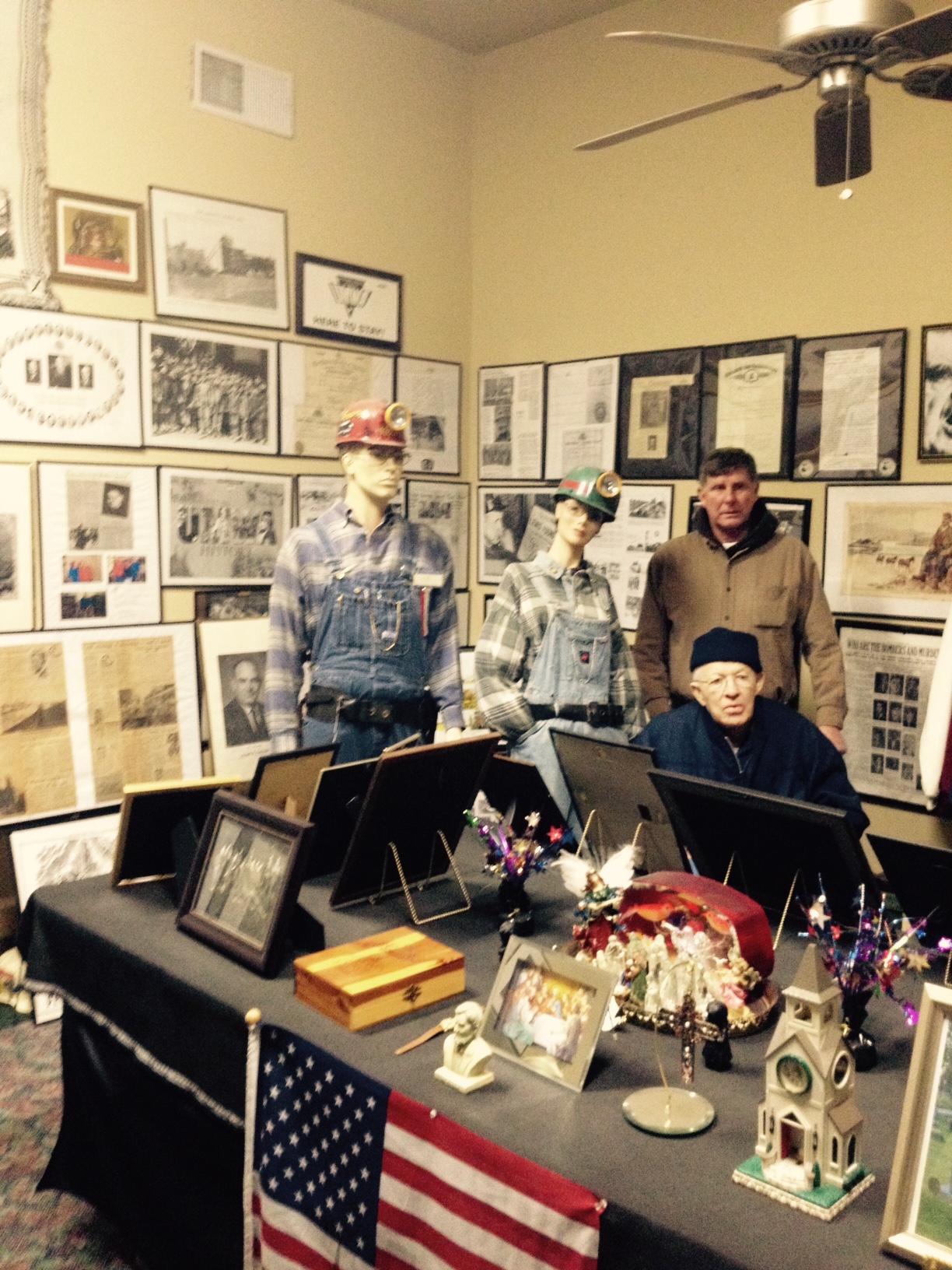
Will (Stankus) Stone (seated) and Ted Fleming in the Christian County Coal Miners’ Museum, November 2014

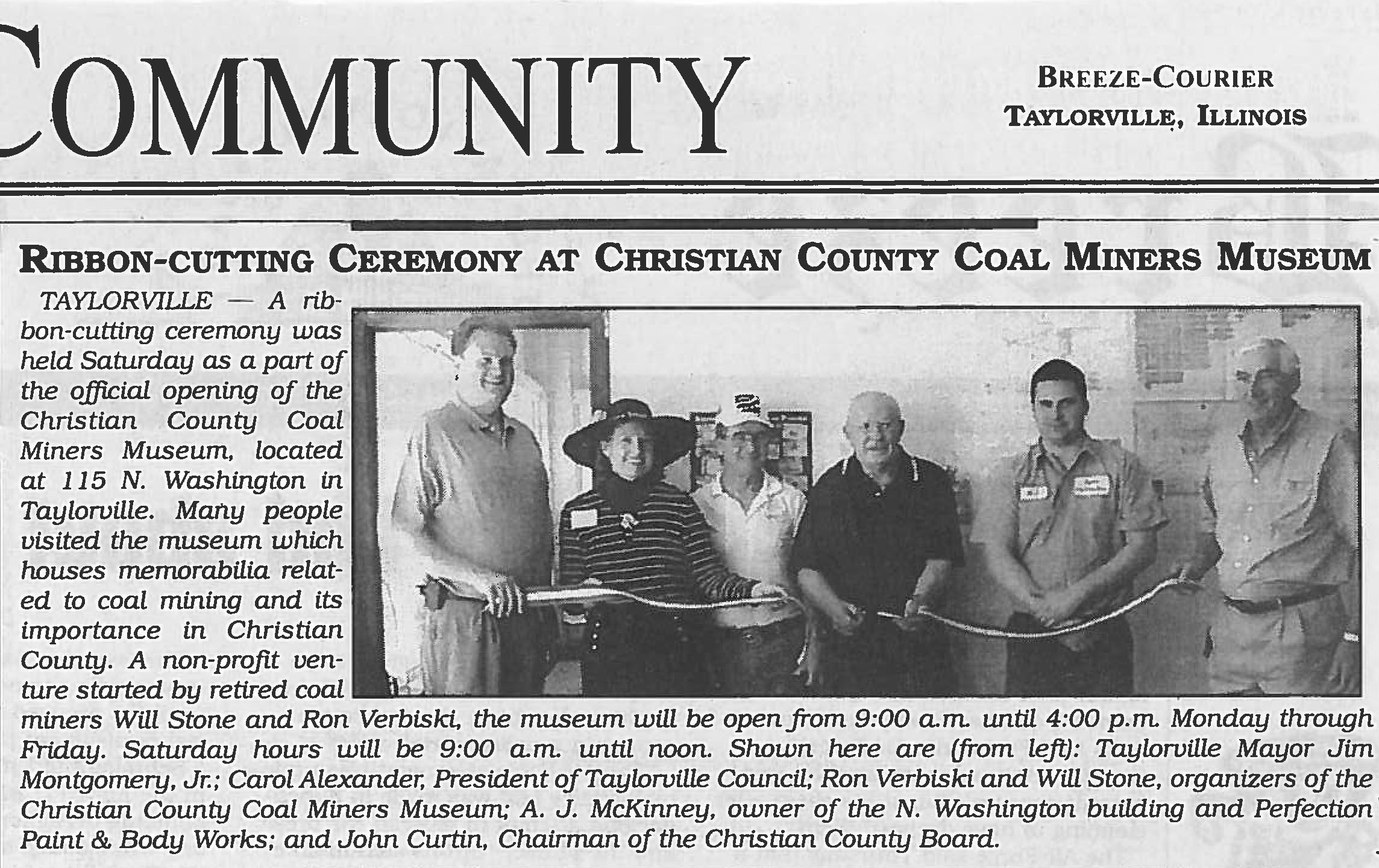
The Christian County Coal Miners’ Museum, located on the east side of the square in Taylorville, was founded on June 22, 2003 by retired Lithuanian-American miners William (Stankus) Stone and Ron Verbiski. Although the museum is temporarily closed, I had the good fortune to visit its collections with Will Stone, 81, and his retired miner son-in-law, Ted Fleming, the day after Thanksgiving 2014. (I just learned that Will died the very day this post went live on Jan. 3, 2015.)

Anna Dabulski Stankus (Stone)

Anna Dabulski Stankus (Stone)

Born in 1933, Will was the son of Lithuanian immigrants Enoch (Stankus) Stone and Anna Dabulski of Bulpitt, a small Lithuanian-American enclave just outside Kincaid in Christian County, south of Springfield. Enoch came to the United States from Lithuania around 1926 at the age of 38 and married Anna five years later, in 1931. The couple had two sons, and Enoch was employed at Peabody Coal Co. No. 7 in the South Fork area near Kincaid.

William (Stankus) Stone

William (Stankus) Stone

Enoch’s son Will also grew up to become a Christian County coal miner. But first, he was a star Kincaid High School athlete known throughout area sport conferences for his agility in football, basketball and track. He made all-state teams in both football and basketball and was a longtime holder of the state’s shot put record. Upon graduating high school in 1953, he was awarded a full scholarship to play football at the University of Arkansas. However, family needs led him back to Bulpitt to support his widowed mother, and after working several factory jobs, Will started mining at Peabody No. 10 (Pawnee) in 1960, from which he retired in 1991.

will Stone, #66, Kincaid High School football player, circa 1952.

will Stone, #66, Kincaid High School football player, circa 1952.

Will leaves behind his wifeJoAnn (Tonks) Stone, two step-children and numerous step-grandchildren. At about the same time he opened the coal miner’s museum, he placed a granite monument to himself and his fellow miners on the north lawn of Taylorville’s courthouse.

The non-profit museum that Will personally operated since its opening, and in which he said he invested about $10,000, is currently in transition to different management and a new location.

Taylorville newspaper article announcing the museum's opening, 2003.

Taylorville newspaper article announcing the museum’s opening, 2003.

However, the museum’s three tightly-packed rooms and one long hallway still store a wide variety of memorabilia related to coal mining and its importance to Christian County (which was, not by coincidence, ground zero for the infamous Central Illinois “Mine Wars” 1932-36.) Several articles on display that caught my attention were about Mine War “martyrs” from the Progressive Miners of America, the new union that formed from former United Mine Workers of America members in 1932 to strike Peabody Coal. During the “Wars,” dozens of deaths resulted from gunfights and other violent clashes, most of them in the so-called “Midland Tract” around Taylorville where many Peabody mines were located. The county jail in Taylorville was often full of arrested miners, and the city’s newspaper was bombed.

Museum's text about PMA martyrs, the "Mine Wars," 1932-36.

Museum’s text about PMA martyrs, the “Mine Wars,” 1932-36.

Three of the PMA martyrs mentioned in the museum were Andy Gyenes of Tovey, who was shot and killed in 1932, and Mrs. Emma Cumerlato, who was killed by a stray bullet on the porch of a Kincaid home in 1933 (in the same melee at the entrance of Peabody No. 7 in which PMA miner Vincent Rodems was also killed.) Joseph Sigler was described as the “only law man shot and killed in Taylorville” during the violence, in 1934.

Miners’ uniforms and equipment, including hats with carbide headlamps, lunch pails, gas detectors and emergency oxygen generators, were also on display.

Hallway, Christian County Coal Miners' Museum

Hallway, Christian County Coal Miners’ Museum

Will made a point of mentioning to me with great pride that Peabody #7 in Kincaid had the highest production numbers (tonnage) in the world at the peak of its operation. Despite mining’s difficult conditions, which improved after the 1930s, Will clearly showed the pride in hard work and production—and his miners’ union, the UMWA–that characterize the profession. I am very happy I got the chance to meet him, even briefly, and visit the coal miners’ museum he loved.

Honoring Central Illinois Mine Casualties

Coal mining was extremely hazardous work during the early years of the 20th century, when labor was cheap and plentiful, and workplace protections few. After ”shot-firers” blasted the coal seams apart (or took down the walls of coal), other men and loaded “trips” of cars full of coal. Timbermen timbered ceilings to create stable passageways and work “rooms,” but as you’ll see from the casualties below, rock or slate falls were common causes of death and injury. “Clod men” cleaned the rooms and passageways of fallen slate.

In the early days, mules were used to haul the trips (or cars) to the surface. Men got to go home after their 10+ hour shifts. The mules spent their entire lives in cramped and dark underground stables, frequently perishing in fires. Unfortunately, men and mules were generally alike in the eyes of the mine owners and bosses, except, as one mine boss was famously quoted as saying, “I have to pay to replace a mule.”

In fact, human casualties were so common that some historical records only log accidents in which two or more miners died. Public blame usually fell on victims, despite routinely dangerous working conditions that would never pass muster today (mainly improperly timbered or buttressed walls and ceilings, explosive coal dust and deadly gases called “afterdamp.” ) There were no death or injury benefits from the company, only from the newly founded union, for surviving families or the disabled.

Advertisement for "colored' miners from the southern states to mine coal in Virden, plus Mother Jones images. Christian County Coal Miners' Museum, 2014.

Advertisement for “colored’ miners from the southern states to mine coal in Virden, plus Mother Jones images. Christian County Coal Miners’ Museum, 2014.

The local Lithuanian-American casualties at the new Web page I just assembled (please scroll down at https://lithspringfield.com/an-indelible-role-in-our-history/lithuanian-local-history-2/the-mining-life/honoring-central-illinois-mine-casualties/) were almost all immigrants. These dead are dwarfed in number by the much larger group of miners who were crippled or maimed in mine accidents or lost years of health and life due to the complications of black lung. (I personally remember the 1990s Springfield funeral of Lithuanian-born miner Tadas Rizutis, a friend of my father’s, who was crippled during a rock fall in a coal mine in the 1960s.)

Most of the deaths I recorded are from Sangamon County, although a few are from Christian and Macoupin counties, and several from the catastrophic Centralia Mine Disaster. We have this listing thanks to the meticulous research of newspaper articles and genealogy websites by retired Springfield police officer Tom Mann. Among the sources he combed were archives of the State Journal-Register and the Sangamon County Coal Mine Fatalities web pages from “Wayne’s World of History and Genealogy.” The ethnicity of each miner was verified by newspaper or U.S. Census records. (Unfortunately, birth towns and cities were almost never recorded by either of these sources.) Please see http://hinton-gen.com/coal/sangamonfatal.html

Blogroll

  • Enos Park Neighborhood Improvement Association
  • Illinois State Historical Society

Lithuanian Websites

  • Amber Reunion
  • Lithuanian World Center
  • Lithuanian-American Club of Central Illinois
  • Lithuanian-American Community, Inc.
  • Lithuanian-American Publications
  • Lithuanians Of Arizona
  • LTnews.net
  • LTUWorld
  • The Lithuania Tribune

St. Vincent’s murals resurface

Two of the murals from St. Vincent de Paul's Catholic Church have resurfaced. Take a look!

Search

Enter your email address to follow this blog and receive notifications of new posts by email.

Join 142 other subscribers

E-mail us!

Questions or comments? Please e-mail sandybaksys@gmail.com.

Email us!

Questions or comments? Please e-mail sandybaksys@gmail.com.

Create a free website or blog at WordPress.com.

Privacy & Cookies: This site uses cookies. By continuing to use this website, you agree to their use.
To find out more, including how to control cookies, see here: Cookie Policy
  • Subscribe Subscribed
    • Lithuanians in Springfield, Illinois
    • Join 142 other subscribers
    • Already have a WordPress.com account? Log in now.
    • Lithuanians in Springfield, Illinois
    • Subscribe Subscribed
    • Sign up
    • Log in
    • Report this content
    • View site in Reader
    • Manage subscriptions
    • Collapse this bar
 

Loading Comments...