• Welcome!
  • An indelible role in our history
    • Historical Background, Influences
      • First Lithuanians in Springfield
      • Freedom and Assimilation
      • Divisions and Decline
      • The Mining Life
        • Honoring Central Illinois Mine Casualties
        • The Mine Wars
      • A Second Wave of Immigration: the ‘DPs’
      • Behind the Iron Curtain
      • “Singing Revolution”
        • “The Other Dream Team”
    • Lithuanian Historical Marker Dedication
      • Lithuanians in Springfield Historical Marker
      • A Time to Remember
      • Historical Marker Dedication Program
      • Photo Gallery
      • Marker ceremony noted in Shimkus newsletter
  • Elder Isolation is Elder Abuse
    • Open Letter to Ill. Gov. Pritzker, AG Raoul
    • Open Letter to Illinois Elder Abuse Task Force
  • Sandy’s Blog: News and Profiles
  • Voices of the “Third Wave”
    • Christmas Memories
    • Remembering January 1991
  • Springfield Lithuanian Families
    • Bakunas, Gestaut, Shadis, Petrokas, Chepulis
    • Local Lithuanians Prompt Newspaper Story
    • Stuches, Gillette, Cooper, Chesnut
    • Tisckos, Miller, Wisnosky
    • Treinis, Nevada, Yuskavich
    • Andruskevitch-Shoudis-Moser
      • Weddings
    • Baksys-Yamont
      • Singing Revolution Activities, U.S.
    • Banzin – Liutkus – Kellus – Gestautas
      • Memories
      • Trips to Lithuania and an appreciation of ancestry
    • Giedrys-Kudirka
    • Janners (Jankauskas), Gossrow
    • Kwedar, Olshevsky, Shupenus
    • Lelys, Lilles
      • 1970 Wedding, St. Vincent de Paul Church
    • Turasky, Yakst, Brazas, Stockus
    • Mankus-Tonila
      • Maria Fry Race & Tonilas
    • Zemaitis, Zubkus
    • Casper, Yanor, Walentukonis
    • Rackauskas immigration
    • Treinis-Banaitis
    • Bubnis, Guthrie, Walker
    • Grigsby, Dumbris
    • Missavich-Stankavich
    • Welch, Wilcauskis, Valentanovich
    • Stasukinas, Staken, Bubblis, Poskevicius
  • St. Vincent de Paul Lithuanian Catholic Church
    • St. Vincent de Paul murals resurface
    • Lithuanian Independence Day, 1950
    • People of the Church
    • People of the Church 2
    • People of the Church 3
    • People of the Church 4
    • Fr. Yunker College Scholars
      • Patricia Visnesky and Cynthia R. Baksys
      • Amanda Rackauskas Ross and Elaine (Manning) Kuhn
      • Barbara Blazis, John Dombroski, Patricia Naumovich, Mary Sitki
      • Diane D. Baksys and Emily Warren
  • Business & Professions
    • Journalist Matt Buedel
    • U.S. Senator Richard J. Durbin
    • Chernis: Midwest Demolition
    • Lobbyist “Limey” Nargelenas
      • Horace Mann CEO Marita Zuraitis
    • Nurse Joan Naumovich
    • Tony J. Yuscius, Advanced Digital Media
    • Business Writer Dan Naumovich
    • Teacher Elaine Kuhn
    • Power Co. Executive Maria Race
      • Pediatric Dentist Mary Ann Rackauskas
        • Nurse Debbie Ritter
    • Radio Host Sam Madonia
    • Turasky Meats
      • Tureskis Cleaners
  • The Lithuanian-American Club
    • Founding and Founders
    • Club Lobbies for Lithuanian Independence: Letter to President Bush
    • Recipes / Food
    • Travel

Lithuanians in Springfield, Illinois

Lithuanians in Springfield, Illinois

Monthly Archives: October 2014

Naumovich Family Memories

30 Thursday Oct 2014

Posted by sandyb52 in Sandy's Blog

≈ 4 Comments

The Leonard Naumovich family is one of the largest Lithuanian-American families in Springfield, thanks to Len and wife Jean’s 10 children, and their children. Like all large and successful families, it grew from modest roots and weathered real adversity. Leonard and brother Joe’s mother Josephine (daughter of Lithuanian immigrant coal miner Benedict Deresker), lost two successive Lithuanian immigrant husbands to the mines, including Len and Joe’s father Leonard Naumovich (Lith. Naumavicius?), Sr.

L to r:  Joe and Leonard Naumovich, Jr. in full altar boy regalia, circa 1932

L to r: Joe and Leonard Naumovich, Jr. in full altar boy regalia, circa 1932

Len, Sr. died when his boys were just seven and five years old, leaving Josephine with no husband (again), and a total of five children to support, including three from her first husband, John Budwitis.

It seems to me that some families just know how to pull together to survive hardships. Some adults are better at keeping their nerve and their wits about them in extreme conditions. They just keep on working and doing the right thing day by day. Josephine was such a woman. After being widowed for the second time, she supported her family as long-time housekeeper for the Cathedral of the Immaculate Conception downtown for $30 a month. The cost of taking the bus to and from work ate into even that small sum.

But somehow, despite everything, Josephine found the time and energy to remain active in St. Vincent de Paul Lithuanian Catholic Church. Joe and Len can still see in their minds the carefully cleaned bathtub at the family home (at 1127 Percy Ave.) filled with the ingredients for the stuffed kielbasa their mother always hand-mixed for the church’s annual bazaar. Josephine also served as an officer in the church’s women’s sodality. A 1936 newspaper article (two years after husband Len, Sr. died) also lists Josephine on the refreshments committee of the Lithuanian Republican Club of Springfield.

Joe and Len were no slouches, themselves, holding down newspaper delivery routes while going to school and helping around the house. They can still remember their dad’s 1934 wake, held at home, according to the custom of the day. Len, Sr. had died suddenly of pneumonia after an accident at the mine at 11th and Ridgely forced the miners to use a distant exit well north of the Fairgrounds and walk home in the middle of winter without their coats. A base “layer” of black lung disease, the universal miner’s scourge, no doubt contributed to the onset and severity of Len’s pneumonia. (John Budwitis, Josephine’s first husband, had died in 1923 at age 33 in an explosion in the same mine, where he was a “shot firer” igniting gunpowder to create controlled explosions to break up seams of coal. One newspaper account actually says he was a last-minute “substitute” in that most dangerous of jobs, which would explain the so-called “windy shot” accident that took his life.)

Laid Out in the Living Room

Len and Joe’s dad was laid out in the living room of the same two-bedroom home as Budwitis probably was–11 years later. Mourners who came and went from the house all night were fed ham and sausage from the kitchen, which also held a keg of beer. A huge flower bouquet on the front porch marked theirs as a home in mourning. After a 24-hour wake, including an all-night vigil, their father’s body was taken to St. Vincent de Paul’s, where the open casket was photographed on the steps of the church surrounded by mourners.

Leonard Naumovich, Sr. with mandolin, circa 1925.

Leonard Naumovich, Sr. with mandolin, circa 1925.

Immigrant miner Len Naumovich, Sr. had been a sacristan at St. Vincent’s. His collection of musical instruments from the attic, after he died, included a mandolin, violin, trumpet and baritone horn. Life without a father couldn’t have been easy for young sons Len and Joe. But life for the two Naumovich boys did go on, closely charting the spiritual ups and economic downs of the Lithuanian-American experience in Springfield.

As a teenager, one of the boys briefly worked for Jake Cohen at the Cohens’ Peoria Rd. grocery for a nickel an hour–until he left to work at a nearby grocery for 10 cents an hour. During Advent every year, St. Vincent’s pastor, Father Stanley Yunker, made his round of home visits to collect the annual parish dues of $8 per family. Len and Joe remember wooden kegs of herring for advent and Kucios, the Lithuanian Christmas Eve celebration, that were sold by Wally Mouske’s grocery on Peoria Rd. south of Griffith.

Leonard, Sr.'s hand-inked music book.  The quality of his handwriting indicates that he was literate before he arrived in the U.S. to mine coal. Note the Polonized spelling

Leonard, Sr.’s hand-inked music book. The quality of his handwriting indicates that he was literate before he arrived in the U.S. to mine coal. Note the Polonized spelling “Naumovicz,” the root of the resulting Naumovich spelling.

Len and Joe also remember voters being coaxed to the polls with the reward of a small bottle of liquor, each. And the night “Shorty” Casper’s illegal still near the Peoria Rd. railroad tracks exploded, burning down the alleged canning shed that hid it, to Shorty’s exclamations that it must have been his tomatoes that blew up. Ethnic Lithuanian picnics at the Wedgewood Pavilion north of the Fairgrounds were well-attended—and frequently punctuated by brawls.

During the “Mine Wars” (1932-36), miners from the opposing unions, not to mention Peabody company thugs, were accustomed to walking around with loaded guns in their waistbands. Len and Joe remember state militia men lining Sangamon Ave. on both sides to create a corridor of safety for children to walk home from St. Aloysius school.

Endemic corruption in Springfield and Sangamon County included suspected police collusion in prostitution and the punchboard business, once a legal, then an illegal form of gambling. Greek-American state’s attorney George Coutrakon famously “cleaned up” Springfield in the 1940s and ’50s.

A page from Len, Sr.'s personal music book:

A page from Len, Sr.’s personal music book: “Jojau Diena” words and music in his own hand. Being able to write Lithuanian was rare for an immigrant of the time due to the Russian czar’s ban on the Lithuanian language. Len, Sr.’s education was likely the product of a determined effort by his own mother, with the aid of smuggled books.

Joe Naumovich still passionately remembers the unrelenting poverty of the Great Depression. The lack of jobs continued, despite Roosevelt’s New Deal, all the way until World War II, when weapons production finally re-opened idled factories.

Today Joe can look back on a long and successful career at the Internal Revenue Service. Len worked at Sangamo Electric and later CWLP as a building and stores supervisor. Both graduated from Cathedral Boys High School, the predecessor of Griffin High School and SHG.

Many thanks to Tom Mann, Leonard, Jr.’s son-in-law, for research, photos, and setting up my interviews with Len and Joe.

The Political Rise of the Adamitis & Yacubasky Families

18 Saturday Oct 2014

Posted by sandyb52 in Sandy's Blog

≈ 2 Comments

Don

Don “Doc” Adams (Adomaitis), courtesy of SangamonLink.org

Up From Mining and Bootlegging: The Political Rise of the Adamitis-Adams and Yacubasky-Yates Families

The story goes that for decades, Republican leader Don “Doc” Adams (Lith. Adomaitis) of Springfield exercised significant patronage power in both the public and private sectors. When “Doc” died in 2011 at age 75, his obituary listed leadership roles with the Illinois State Republican Central Committee, the Illinois Republican State Convention, the Illinois Electoral College, and the Republican National Committee. These roles put him at the heart of city, state and national politics for decades.

Pretty good for the grandson of a Lithuanian immigrant killed in our local mines. But maybe not surprising to those who knew “Doc” as the product of the union of two families, the Adams-Adamitises and Yates-Yacubaskies, who had been working together since the early 1930s on their joint economic and political climb up from the mines–through bootlegging and the grocery/tavern business–to the ultimate prize of patronage-rich politics.

Death in the Mines

On the Adams side, the story begins with “Doc’s” grandfather, immigrant coal miner John Adamites (Adomaitis), who died in 1907 as a result of an accident at Springfield’s Illinois Midland Coal Co. mine, leaving behind a widow and four children. One of those was “Doc’s” father John Joseph Adamitis, who was born in 1899 and served in World War I.

In 1924, a “Mr. and Mrs. John Adamites” were issued federal “liquor writs,” along with 11 other central Illinois individuals and couples, enjoining them from using their soft drink business in Pawnee to sell “intoxicating liquor.” Then in 1927, another Illinois State Journal-Register article reports that brothers John Joseph and William Adamitis of North 17th St. in Springfield were arrested after a raid of rooms above their grocery at 1530 Sangamon Ave. revealed a 20-gallon copper still, “some home brew mush, 120 bottles of home brew, nine gallons of alcohol, and a quantity of alleged whiskey.” (This all happened before John Joseph married Bertha Yacubasky in 1932 and “Doc” was born in 1935.)

In the early 1920s, newspaper reports also say that a John Adomaitis sang in the locally renowned Knights of Lithuania (K of L) Branch 48 choir. In 1925, he was elected president of the local branch following the branch’s leadership by the charismatic Lithuanian composer Alexandras Aleksis.

In the early 1930s, it appears that John began to build his Knights of Lithuania support into a base for entering traditional party politics in the wider community, along with his wife and two of her brothers, Joseph and William Yacubasky (Yates). It’s likely that John liked his first taste of politics inside the K of L. It’s also my hunch that after facing raids, imprisonment and fines from government authorities over the alcohol business during and after Prohibition, Adams and the two Yates brothers decided it was time to get some of that political power–and protection–for themselves.

If You Can’t Beat ‘Em

So, in 1931, the three men and Bertha (who had also been involved in the Knights), along with other Lithuanian-American businesspeople and neighbors from the North 17th St. area, founded the Lithuanian Social and Political Club of Sangamon County. This was one year before the infamous central Illinois “Mine Wars” (1932-36) broke out. I can only wonder what impact the Mine Wars had on this fledgling ethnic political organization, at a time when the strife between the United and Progressive Mine Workers unions tore many ethnic groups, neighborhoods, and families apart.

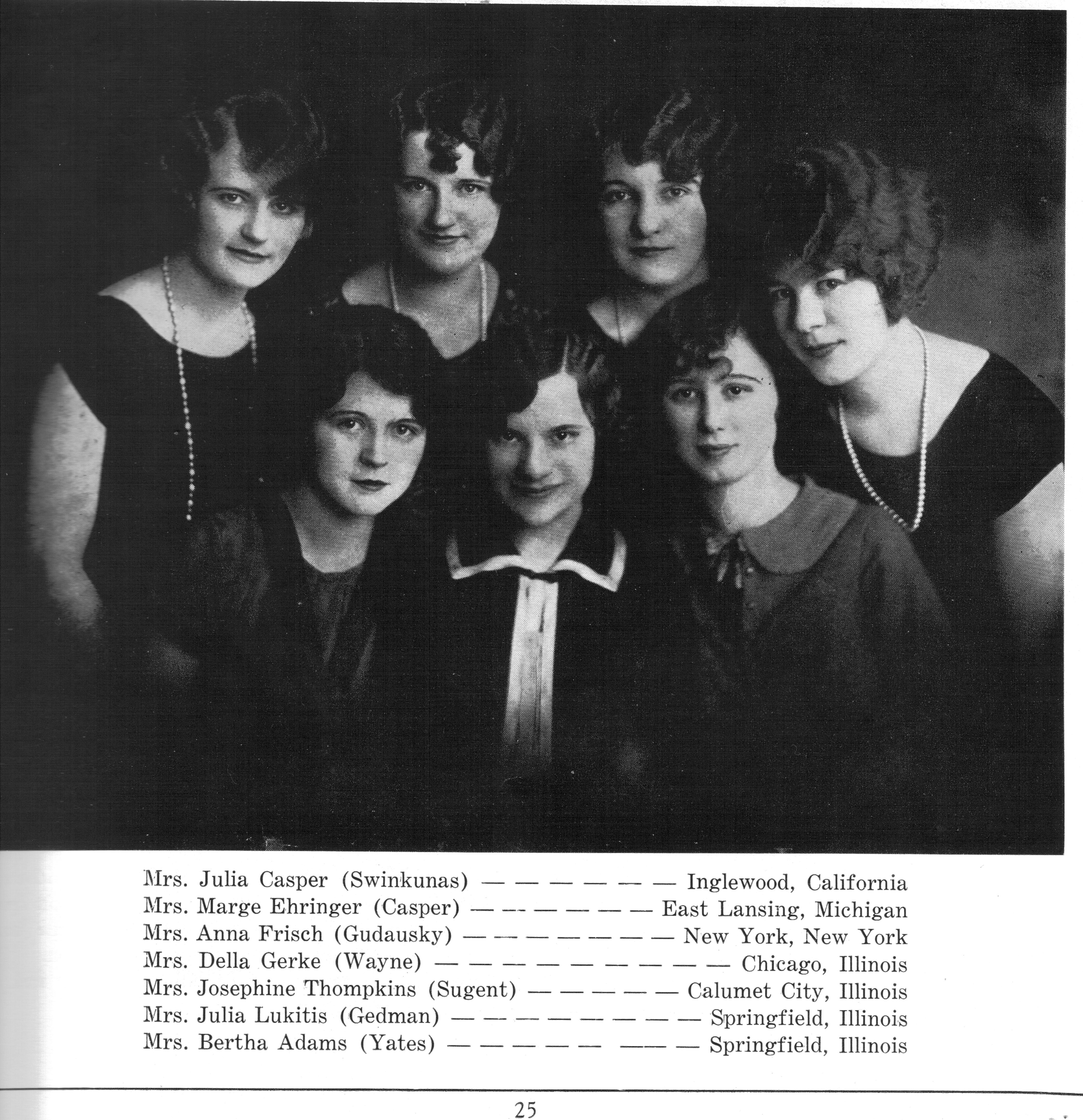
The beautiful Bertha (Yates) Adams, right edge, back row, with friends from St. Vincent de Paul Church, circa 1930.

The beautiful Bertha (Yates) Adams, right edge, front row, with friends from St. Vincent de Paul Church, circa 1930.

Although the original group first met in 1931 at the Labor Temple at 6th and Washington streets, by 1936 the organization was renamed the Lithuanian Republican Social Club and was meeting at the Arion hall to hear an address criticizing Franklin Delano Roosevelt and The New Deal. John Adamitis was the chairman of that meeting at the Arion, supported by committee chairpersons Mrs. Joe Welch (Wilcauskas), William Yates, William Stankavich, and Mrs. Wallace (Julia) Olshefsky. Subsequent meetings, according to the newspaper, were held at Republican headquarters on the west side of the (Old State Capitol) square. There were also many picnics and other social events to gather and galvanize the Lithuanian-American Republican faithful, including food, musical performances, and games and activities for children.

Apparently, a full spectrum of ethnic Lithuanian beneficial and political organizations still proliferated through the 1940s, in some cases serving as stepping stones for their leaders into community-wide politics. An Illinois State Journal article from 1943 mentions no fewer than seven local “Lithuanian societies” as sponsors of a 25-year celebration of Lithuanian independence that year at the Centennial Building next to the Illinois State Capitol. Those were: the Lithuanian Roman Catholic Alliance of America, Branches 275 and 158; the Federation of Lithuanian Workers Branch 29 (a communist-leaning successor to the Lithuanian Roman Catholic Alliance of Labor and possibly, also, the Lithuanian Socialist Federation, that was later named the Lithuanian Association of Workers branch 29 or the “Lithuanian Lodge,”) the Lithuanian Roman Catholic Women’s Alliance Branch 56, the Lithuanian Democratic Social Club, the Lithuanian Cultural Society and the L.D.L.D.A.(?)

The Yates & The Blue Danube

Here our story backtracks to “Doc’s” maternal line, the Yacubasky-Yates family. Tony (Antanas) Yacubasky immigrated to the U.S. in 1890. His first stop was the Shenandoah, Penn., coal fields, where he married Mary Lesko and two of the couple’s three daughters were born. In 1906, the family moved to 1501 Pennsylvania Ave., (the same block where my mother grew up). Sons Joseph and William  were born.

The Yates family were co-founders in 1931 of the aforementioned Lithuanian Social and Political Club. After serving as a Republican precinct committeeman for several years, 25-year-old William was selected the Republican candidate for county auditor in 1932. After his election defeat, William was appointed deputy probate clerk. In 1933, as Tony Yacubasky and sons Joseph and William prepared to advance their family even more ambitiously in business and politics, they saw becoming more publicly “Americanized” as a critical component and filed in circuit court to change their surname to Yates.

That same year, which saw the end of Prohibition, the Yates family built a large tavern/dinner club called The Blue Danube next to their grocery. The tavern was managed by Joseph Yates, as his brother William presumably spent the majority of his time in politics. The Blue Danube had a kitchen, a dance floor that was “well sanded and waxed,” and an ample area for tables and booths–but its claim to fame was its “magic bar.” One newspaper writer described it as “electrically charged in such a way that when specially-treated glasses are placed on it, they are illuminated in many colors. This gives the appearance of nothing short of magic, and has proven a very popular source of entertainment.”

The Blue Danube’s motto was, “where courtesy prevails,” and it featured festive New Year’s parties and Sunday dinners of either roast young duck, fried, milk-fed spring chicken, T-bone steak, frog legs, breaded veal cutlet, or roast loin of pork with many different sides, including “Chinese” celery salad and lime and grapefruit salad, plus a full spread of desserts—all for just 65 cents. Also on the menu were “fancy mixed drinks, the finest of wines, liquors and beer, good music and dancing.”

Liquor License Wars & World War II

However, as early as December 1934, The Blue Danube was caught in a liquor license dispute between Springfield Mayor John Kapp and the city’s liquor board. The Yates family claimed that they had paid the city clerk for their license, which was never issued, and that they were operating under a personal pledge from Mayor Kapp.

The licensing board cited The Blue Danube not just for the failure to have a license to sell alcohol, but also for hosting dancing without a permit and serving alcohol after 1 a.m. The establishment’s windows were also cited because they did not provide a good view into the club from the street—-thereby making it easier to serve alcohol after hours without detection.

In 1935, at age 68, immigrant Tony (Antanas) Yates died. Perhaps as a result of this loss and ongoing “political” troubles, in 1938, The Blue Danube was sold to Kenneth Goby and Harold Cusick–reportedly, so that Joseph Yates could devote all his time to the grocery side of the family business.

By 1942, Joseph’s brother William was chairman of the central committee of the Sangamon County Republican Party. Joseph had closed the Keys Ave. grocery and enlisted to serve in World War II. He is reported by the newspaper to have rushed home to his ill mother’s bedside, with the aid of the Red Cross, just before shipping off to military service. The brothers later operated Y-B Market at First and North Grand Ave. and the nearby Ann Rutledge Pancake House, the most wonderful restaurant in Springfield, for many years as they continued in Republican politics.

“Doc” Picks up the Mantle

I would guess that when it was his turn to carry on—and build upon–his father’s and uncles’ political legacy starting in the 1960s, “Doc” Adams got a nice leg-up from the Republican contacts and organization his three elders had formed. However, although “Doc” no doubt wore their mantle as he entered politics, it’s a testament to his own hard work and political skills that he managed to eclipse the wildest dreams of his immigrant/ethnic forebears by serving and leading the Republican party both locally and nationally for more than 30 years.

Many thanks to Tom Mann for finding State Journal-Register articles that contributed mightily to this post.

Lawyer to Lithuanians

10 Friday Oct 2014

Posted by sandyb52 in Sandy's Blog

≈ 2 Comments

As a lawyer to his fellow Lithuanian immigrants in Springfield, Isidor Yacktis (1883-1953) leveraged his higher education and social status to serve as a mediator between his own people and mainstream Americans to whom the immigrant “hordes” seemed unruly, threatening–and potentially even disloyal. It couldn’t have been easy being an ambassador of the higher potential largely invisible within his community of illiterate miners and laborers back around the time of World War I.

Yacktis, Isidor. c. 1915, Ill. State Jounral Register archive

Illinois State Journal-Register archives, circa 1915

Yet it appears that Mr. Yacktis was first publicly called upon–and rose–to this role as soon as he was admitted to the Illinois State Bar. The year was 1915, and the extreme barbarity of World War I in Europe had already become frighteningly apparent. Neutrality-loving Americans were feeling queasy about immigrants here manifesting the national interests and hostilities of their countrymen back home and dragging the U.S. into the Great War.

Modeling U.S. Citizenship & Patriotism

Therefore, on July 4, 1915, the Illinois governor, lieutenant governor, and other dignitaries held their first large, public meeting to welcome newly naturalized citizens at the arsenal (Illinois Armory) at Second and Capitol, according to the Illinois State Register. Somewhere around a thousand people attended and were exhorted by the governor to give up all former lines of nationality in hopes “that America might be spared participation in the War.” The “right hand of fellowship” was extended on behalf of the city, a speech was given on The Ideal Citizen, and Mr. Yacktis addressed his own people, along with newly-minted U.S. citizens of German, Italian, Scandinavian, English, Scottish and Irish birth, to set a public example of “his unequivocal allegiance to the stars and stripes.” The Declaration of Independence was read, and “Illinois” was sung, accompanied by the Capital City Band.

Eighteen months later, as the U.S. was officially entering World War I, America’s “loyalty” concern became immigrant men responding to the new military draft. The Illinois State Register described a mass “Americanization” meeting on Jan. 12, 1917 at Palmer Elementary School on Springfield’s north side. “While nations across the sea are at war, the United States is busy arousing the love of America among her foreign-born citizens,” the paper proclaimed.

Germans, Italians and Lithuanians were gathered at the school to be formally addressed by a representative of each of their nationalities, including Mr. Yacktis. “The foreigners listened attentively to the admonitions of the representatives of their own governments, who told them they must give unfaltering allegiance to the country of their adoption and be loyal to the American flag and American institutions,” the January 13 article went on.

Included on the program were “simple” explanations of American government at the city, state and national level by a U.S. district court judge. Then a chief examiner for the U.S. Department of Immigration and Naturalization explained the requirements of U.S. citizenship. The mass meeting closed with the singing of “America”—and most likely, the registration of many young immigrant men to enter the charnnel house of trench warfare in Europe. Many male immigrants officially documented their intent to become citizens at this time, and achieved citizenship upon their discharge from military service, provided they survived the War.

Still Lithuanian at Heart

That same year, Mr. Yacktis expressed his identity as a Lithuanian by penning an op-ed for the Illinois State Register entitled, “Lithuania, a Separate Nation,” explaining the distinct nationality of the Lithuanian people and arguing against Polish designs on parts of post-Russian Lithuania.

Several months earlier, Isidor had leaned a little more to his American side, publishing his name in a display ad in the Register supporting the “Committee to Make Springfield Dry.” Prohibition was certainly not a sentiment shared by the majority of his immigrant countrymen. However, that may have been precisely why he supported it, as a way to combat alcoholism and its attendant social ills.

In 1918, Isidor appears in an article encouraging community-spirited individuals to join the YMCA and pay for a six-month “Y” membership for two returning soldiers or sailors. Again in his role as an official voice and ambassador for his community, Mr. Yacktis’s name appears in several additional display ads placed by members of the Illinois Bar on major political and social issues. Another newspaper report finds Mr. Yacktis investing $25,000 in a Flexotile (roofing and wall tile material) manufacturing concern with four other local men, probably lawyers. No mention is made of the success or failure of that business.

Probate & Family Law

In his general practice legal career, Mr. Yacktis seems to have operated from an office at 213 S. Sixth St., where he also let at least one room for $5 a month in 1946. He also appears in a 1937 newspaper mention for regularly giving food and water to a stray kitten living near the Johnny Orlove Tavern, whose paw had been gnawed off by rats. So Mr. Yacktis was a humane man, as well.

Along the way, he represented the following families in estate matters: Grigisky, Lagunas, Yustus, Kasper (Kasparavicius), Lukitis/Gedman and Karvelis. He represented the Adeikis and Kaslauckas couples in chancery (divorce) court. He also represented a Max Bracius, who had been struck on his bicycle by a city water truck. These are the records I found, but I’m sure in his long career, Mr. Yacktis represented many, many clients.

My special thanks to Tom Mann for uncovering several of the feature articles mentioned in this blog, and to Bill Cellini, Jr. for originally drawing my attention to Mr. Yacktis.

Blogroll

  • Enos Park Neighborhood Improvement Association
  • Illinois State Historical Society

Lithuanian Websites

  • Amber Reunion
  • Lithuanian World Center
  • Lithuanian-American Club of Central Illinois
  • Lithuanian-American Community, Inc.
  • Lithuanian-American Publications
  • Lithuanians Of Arizona
  • LTnews.net
  • LTUWorld
  • The Lithuania Tribune

St. Vincent’s murals resurface

Two of the murals from St. Vincent de Paul's Catholic Church have resurfaced. Take a look!

Search

Enter your email address to follow this blog and receive notifications of new posts by email.

Join 142 other subscribers

E-mail us!

Questions or comments? Please e-mail sandybaksys@gmail.com.

Email us!

Questions or comments? Please e-mail sandybaksys@gmail.com.

Blog at WordPress.com.

Privacy & Cookies: This site uses cookies. By continuing to use this website, you agree to their use.
To find out more, including how to control cookies, see here: Cookie Policy
  • Subscribe Subscribed
    • Lithuanians in Springfield, Illinois
    • Join 142 other subscribers
    • Already have a WordPress.com account? Log in now.
    • Lithuanians in Springfield, Illinois
    • Subscribe Subscribed
    • Sign up
    • Log in
    • Report this content
    • View site in Reader
    • Manage subscriptions
    • Collapse this bar
 

Loading Comments...