• Welcome!
  • An indelible role in our history
    • Historical Background, Influences
      • First Lithuanians in Springfield
      • Freedom and Assimilation
      • Divisions and Decline
      • The Mining Life
        • Honoring Central Illinois Mine Casualties
        • The Mine Wars
      • A Second Wave of Immigration: the ‘DPs’
      • Behind the Iron Curtain
      • “Singing Revolution”
        • “The Other Dream Team”
    • Lithuanian Historical Marker Dedication
      • Lithuanians in Springfield Historical Marker
      • A Time to Remember
      • Historical Marker Dedication Program
      • Photo Gallery
      • Marker ceremony noted in Shimkus newsletter
  • Elder Isolation is Elder Abuse
    • Open Letter to Ill. Gov. Pritzker, AG Raoul
    • Open Letter to Illinois Elder Abuse Task Force
  • Sandy’s Blog: News and Profiles
  • Voices of the “Third Wave”
    • Christmas Memories
    • Remembering January 1991
  • Springfield Lithuanian Families
    • Bakunas, Gestaut, Shadis, Petrokas, Chepulis
    • Local Lithuanians Prompt Newspaper Story
    • Stuches, Gillette, Cooper, Chesnut
    • Tisckos, Miller, Wisnosky
    • Treinis, Nevada, Yuskavich
    • Andruskevitch-Shoudis-Moser
      • Weddings
    • Baksys-Yamont
      • Singing Revolution Activities, U.S.
    • Banzin – Liutkus – Kellus – Gestautas
      • Memories
      • Trips to Lithuania and an appreciation of ancestry
    • Giedrys-Kudirka
    • Janners (Jankauskas), Gossrow
    • Kwedar, Olshevsky, Shupenus
    • Lelys, Lilles
      • 1970 Wedding, St. Vincent de Paul Church
    • Turasky, Yakst, Brazas, Stockus
    • Mankus-Tonila
      • Maria Fry Race & Tonilas
    • Zemaitis, Zubkus
    • Casper, Yanor, Walentukonis
    • Rackauskas immigration
    • Treinis-Banaitis
    • Bubnis, Guthrie, Walker
    • Grigsby, Dumbris
    • Missavich-Stankavich
    • Welch, Wilcauskis, Valentanovich
    • Stasukinas, Staken, Bubblis, Poskevicius
  • St. Vincent de Paul Lithuanian Catholic Church
    • St. Vincent de Paul murals resurface
    • Lithuanian Independence Day, 1950
    • People of the Church
    • People of the Church 2
    • People of the Church 3
    • People of the Church 4
    • Fr. Yunker College Scholars
      • Patricia Visnesky and Cynthia R. Baksys
      • Amanda Rackauskas Ross and Elaine (Manning) Kuhn
      • Barbara Blazis, John Dombroski, Patricia Naumovich, Mary Sitki
      • Diane D. Baksys and Emily Warren
  • Business & Professions
    • Journalist Matt Buedel
    • U.S. Senator Richard J. Durbin
    • Chernis: Midwest Demolition
    • Lobbyist “Limey” Nargelenas
      • Horace Mann CEO Marita Zuraitis
    • Nurse Joan Naumovich
    • Tony J. Yuscius, Advanced Digital Media
    • Business Writer Dan Naumovich
    • Teacher Elaine Kuhn
    • Power Co. Executive Maria Race
      • Pediatric Dentist Mary Ann Rackauskas
        • Nurse Debbie Ritter
    • Radio Host Sam Madonia
    • Turasky Meats
      • Tureskis Cleaners
  • The Lithuanian-American Club
    • Founding and Founders
    • Club Lobbies for Lithuanian Independence: Letter to President Bush
    • Recipes / Food
    • Travel

Lithuanians in Springfield, Illinois

Lithuanians in Springfield, Illinois

Monthly Archives: June 2014

An Immigrant Childhood: Ann Tisckos Wisnosky

07 Saturday Jun 2014

Posted by sandyb52 in Sandy's Blog

≈ 7 Comments

Ann (Tisckos) Wisnosky, homemaker, writer, contest winner

Ann (Tisckos) Wisnosky, homemaker, writer, contest winner

“Lithuanians in Springfield” by Ann Wisnosky

“…During the oppressive regime of Russian Czar Nicholas II, my father, Jonas Petras (John Peter) Tisckus and his parents lived in Kedainiai and Kaunas. With Father approaching draft age and facing enslavement in the Russian army, Grandfather made arrangements, as did many other parents, to spirit his son out of Lithuania. This was done with the aid of sympathetic Prussian “agents” who lived (in the Konigsberg/Karolauciaus region) near the Lithuanian border.

Father escaped by ship to live with a cousin in Glasgow, Scotland. There, he met other countrymen who had taken refuge and were working in the coal mines. Father joined their ranks. Although the work was hard, dirty, and dangerous, it posed no language barrier and required no skill. After a year as a miner, Father could afford to continue on to “Americka.”

In 1906, he arrived in Salem, Mass. Friends helped him obtain work in a hide (tanning) factory, but he could not tolerate the sickening stench that permeated the entire town. In January 1907, he came by train to Springfield to live with a family he had known in Lithuania, in a home east of the city near what is now the (I-55) bypass.

Springfield’s Streets of Mud

The immigrant of those days found a varied scene in Springfield: muddy roads, board sidewalks, gas street lights, outdoor plumbing, and horse-drawn fire engines, trolley cars, carriages and paddy wagons, as well as corner saloons, player pianos, nickelodeons, medicine men, and balloon ascensions. There were also chickens, cows and gardens on city lots, nickel bread and penny ice cream cones. The fashion of the day found ladies in long dresses with “rats” in their hair and plumes in their hats; boys in knickers, girls with braids and ribbons, and men in celluloid collars, striped shirts, and straw or felt hats.

To work and play in this new environment, the immigrant had always to cope with the language barrier. Father, like most men, immediately applied for work in one of the dozen or more coal mines in the area, although Springfield also had over three hundred manufacturing concerns employing several thousand workers. Immigrant women found work as hotel maids or domestics. To supplement its income, nearly every foreign family already established here took in a “greeneris” (greenhorn) or a “boardingerie” (boarder) or two or three, no matter how crowded the home already was.

Mother Arrives

My mother, Alexandra (Olse) Urbas, left Aztenu, Lithuania at the age of 17. An older brother living here paid her fare. Sailing to New York as a third-class passenger, she recalled how she had almost died aboard ship from breathing the gas from an extinguished lamp. Crowded conditions and seasickness plagued the passengers; with the latter condition, victims sniffed camphor in an effort to obtain relief.

In April 1908, Mother arrived by train in Springfield to live with a married cousin who had many boarders. Mother earned her keep by cooking and doing housework and laundry, the latter all by hand. She remarked that she had not found America any easier than Lithuania.

Four months after her arrival, mother married my father in “Old St. Mary’s” Catholic Church at 7th and Monroe Streets. A year later, a son was born–then a daughter, followed by three boys in rapid succession. Babies were usually born at home with the help of a midwife who stayed on for several days to assist in the household. After the children arrived, a three-room house on 15th St. near Madison St. was rented. The range and a heating stove supplied warmth, and kerosene lamps supplied light. Hot water was obtained from a nearby railroad roundhouse.

Mutual Aid in America

Immigrant families felt that owning a home was their greatest security. So, in 1916, my parents made a down payment on a modest home of four rooms on E. Reynolds St. in an almost all-Lithuanian community. Most families were buying homes and raising children, chickens, cows, and gardens. With parents and grandparents left behind in Lithuania, neighbors had to rely on each other for help in everyday projects, as well as emergencies. They exchanged tools, seeds, cuttings, recipes, and ideas about life in America. Women helped each other cut out clothes from homemade patterns, and many owned foot-operated Singer sewing machines.

From Flour Sack to Embroidered Petticoat

Because most families baked bread, flour was purchased in 50-lb cotton bags. Bags that were not used for dish towels or bedding were bleached in boiling lye solution, then used for nightgowns and petticoats. Sometimes, the commercial markings were not quite bleached out of the sacks, but even such petticoats boasted hand-crocheted hems of lace made by loving mothers. These were “Sunday best” for many little girls.

Sundays saw most church-going Lithuanians attending the Roman Catholic Church. By 1909, they had built their own church, St. Vincent de Paul’s, at N. 8th St. and Enos Ave. It became the center of their religious, cultural and social life, and was a great force in the preservation of their language, songs and customs.

“Those Foreign Kids”

Home recreation found children playing with hoops, marbles, home-made stilts, and kites. Some families listened to Victrolas or sang along with player pianos. Occasionally, a nickelodeon movie starring Pearl White or Mary Pickford could be enjoyed. As children, our happy hours of neighborhood play were in contrast to our ambivalent feelings about attending school. When we started Palmer School, we were looked upon as “those foreign kids” and sometimes called names. (Ann doesn’t mention it, but she might have started school without speaking any English, like many children of immigrants back then.)

Other ethnic groups had the same problem. It gave us a deep sense of not belonging in the outside world. Our real world was the family, neighborhood, and church. To add to our educational hurdles, few parents could help with school lessons, for most knew only their native language, manners and customs. Father had learned to read and write by now, but Mother had not. She did learn to write her name and do some reading later through classes held in the homes of immigrants.

The free public school system was an overwhelming joy to Father, compared to the suppression of education he had endured in Czarist Lithuania. As we began school, Father told us, “Tas kas skaita ir rasa, duonas ne prasa.” (“The one who reads and writes does not ask for bread.”) Study was encouraged, and teachers were respected. There were some fine, dedicated and very helpful teachers at Palmer School who understood the problems the frustrated foreign children faced. They encouraged the use of the Lincoln Library, where pupils were introduced to stereoscopes and free books that could be taken home to enjoy. Most immigrants had few, if any books at home.

Feathers in My Stockings

On wet days, teachers let children huddle near radiators to dry stockings, while shoes were drying nearby. Many pupils had wool stockings, mittens, hats, scarves, and sweaters–but few owned boots. One freezing winter day, Mother sent me to school with feathers stuffed in my stockings for warmth. Each time a feather stuck out, I bent to pull it free. Finally, the teacher, in a rare moment of exasperation, rapped my knuckles with her ruler. Mother was tearfully told that afternoon that “no other second-grader wore feathers to school.”

Home life had its share of other major and minor problems and inconveniences: numerous contagious diseases and indoor pollution from smoke and ashes; the dodging of lines of laundry drying throughout the house during winter; and Saturday night baths in a tub in the kitchen. Economies were achieved by fathers repairing children’s shoes with soles cut from large slabs of tough leather. In addition to chores like bringing in coal and wood from outdoor sheds and carrying out ashes, many boys sold papers or had routes. Girls helped with housework, cleaned and filled lamps, and helped with smaller children.

In the homes of miners, incomes were far from steady; work was seasonal and strikes frequent. Grocers developed a system of extending summer-long credit while mine work was slack. Families lived with uncertainty, and hard work was accepted as a way of life. Uncertainty and disruption had also been the lot of the immigrants in their native Lithuania, but American held the promise of a better living, new opportunities, and certainly, new freedoms. There were milestones along the way–the earning of U.S. citizenship (Father and Mother gained theirs on a happy day in 1918) and subsequent political participation.
Eventually, economic gains were realized, and many first-generation Lithuanian-Americans secured advanced education and entered professional and business fields. Certainly, a new diversity had been added to America’s talent and character.”

Possibly penned around the time of the U.S. Bicentennial in 1976 and adapted for “Historico,” a publication of the Sangamon County Historical Society. The piece printed here is taken from Ann’s original typed essay as preserved by Ann Pazemetsky Traeger, with minor edits for my blog.

Post-script: Long before I started writing about Lithuanians in Springfield, a very special lady, Ann (Tisckos) Wisnosky (Visnauskas), wife of self-made Illinois National Bank executive August (Augie), Sr., and mother of John, a University of Hawaii art professor, and Augie, Jr., a leading Springfield architect, wrote the story of her immigrant family under the same title.

In addition to being a first-class homemaker who won the Chicago Daily Tribune “Cook of the Month” award for her fruitbread recipe, and a 1948 Tribune recipe contest for her Lithuanian potato kugelis, as well as a Quaker Oats contest, Ann was a talented writer with some touching childhood memories, as you see here. Please share it with family and friends.

Lithuanian Taverns II: Holding Up the Neighborhood

01 Sunday Jun 2014

Posted by sandyb52 in Sandy's Blog

≈ 5 Comments

Sam and Mary Lapinski, proprietors, behind the bar

Sam and Mary Lapinski, proprietors, behind the bar

Last week’s post struck a rich vein of local Lithuanian lore, which I continue to mine this week, after hearing from Wally Surgis (Lith. Sudrius) about another interesting tavern-keeper, immigrant Tony Romanowski (Antanas Ramanauskas), who owned a grocery store/tavern on East Reynolds from what appears to be the 1920s to the mid-1950s. Tony, whom Wally Surgis describes as only about 5-foot-3 and very round, with “Peter Lorre” eyes, lived in the attached house at #1729 E. Reynolds and cooked food and gave out drinks to poor Lithuanian immigrants in the area. According to Wally, “Tony would feed and house the poor of the neighborhood, and even bought enough life insurance to bury the ones who had no family.”

Tony’s moving service to his fellow man was probably part of a larger fabric of Lithuanian immigrant communalism in a neighborhood between 16th and 19th Streets on E. Reynolds that rivaled the north 15th St. and 11th St. and Peoria Road areas for its concentration of Lithuanian residents. We already know that during the infamous 1932-36 “Mine Wars,” when thousands of Progressive Miners of America went on strike, corner groceries and taverns acted as food collection and distribution points or “commissaries” for hungry mining families. According to Wally, mutual aid in the neighborhood long after the 1930s included sharing personal fishing catches and canned garden produce.

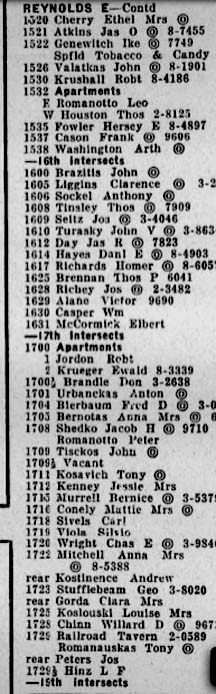
1956 East Reynolds

To get a sense of the persistence of the E. Reynolds Lithuanian community from the year 1900 or so up through the 1950s, take a look at these snapshots taken by Genealogics from the Springfield City Directories of 1951 and 1956, including familiar Lithuanian names like: Genewitch, Valatkas, Brazitis, Sockel, Turasky, Alane, Casper, Urbanckas, Bernotas, Tisckos, Kosavich, Sivels, Kostinence(?,) Gorda (?), Koslouski, Ro(a)manauskas, Kerchowski—and Orback(!!)

1951 East Reynolds

Finding my Lost Orback Family

Here is where my passion for the stories of other families—and of a community—gets unexpectedly personal. The Anna Orback living at 1729 and ½ E. Reynolds in 1956, right next to the Railroad Tavern at #1729, which had since been sold by Tony Ramanauskas to a Mrs. Frances Casper, is my long-lost great aunt! (Tony is listed as living at the rear of the tavern.)

How serendipitous that a few days after I hear about a man with strong ethnic loyalty and a big heart who is helping all the old and poor Lithuanians of his neighborhood, I also learn that one of the closest and poorest of those immigrants, who happens to be living right next to Tony, is my own, lost aunt Anna. Could there be any doubt that she was one of those whom Tony housed, fed, and possibly even buried?

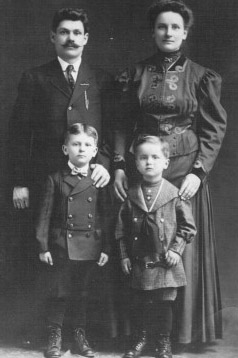
My great aunt or “Teta” Mary Yamont (Marija Baksyte Jomantiene), who was like our grandmother, spoke only Lithuanian. She, herself, was of modest circumstances and lived in a three-room house at 2102 N. Peoria Rd. But I remember hearing nothing, ever, of Mary’s own sister Anna, either from Teta or my father. Sometime in the years after Teta died in 1978, I remember hearing maybe once of a second great aunt in Springfield who was unmentionable: someone of very close blood, considering we had so few relatives on our Springfield Lithuanian side, yet someone I had never met.

Mary Yamont (Marija Baksyte Jomantiene) with husband and sons Benny (left) and Joseph, circa 1909.

Mary Yamont (Marija Baksyte Jomantiene) with husband and sons Benny (left) and Joseph, circa 1909.

How strange and miraculous to find her—Anna Orback–suddenly on May 31, 2014 in a snapshot from our city directory, and to learn the family shame that was hidden along with any mention of her. According to several newspaper reports, Anna’s husband Frank, also a Lithuanian immigrant, reportedly had died of methyl alcohol poisoning at age 39 in 1926, and Anna had sued three people, Joseph Ponder and corner grocery owners Anthony and Ursula Lawrence (Launikonis), for selling him that alleged wood alcohol. (I don’t know yet how the suit turned out).

Even more clippings relate to the criminal history of Anna’s then-fatherless son Joe Orback, starting in the trough of the Great Depression in 1932 with an arrest for burglary and larceny at age 17, in connection with an attempted break-in met by a police ambush that left one of the youths Joe was with shot dead. Joe requested and was given probation for his first string of property crimes, but is reported to have violated it within a year and to have been sent to Menard for a term of 1-5 at age 18.

Anna and Frank also had a daughter, Elizabeth, and a son Frank, Jr., who got an upstanding job as a driver, married a Frasco, and built onto a home, but may have fallen on hard times or perished before his mother Anna reached old age on E. Reynolds. And so, I find myself grateful that tavern-keeper Tony Ramanauskas was there for Anna, whom I’m now told was alcoholic, in her declining years. (The story of Tony and the old, poor and alcoholic immigrants left behind on E. Reynolds by the 1950s is the flip-side of the immigrant success story whereby the young, educated and successful American-born of the 1930s and 1940s left the immigrant neighborhoods.)

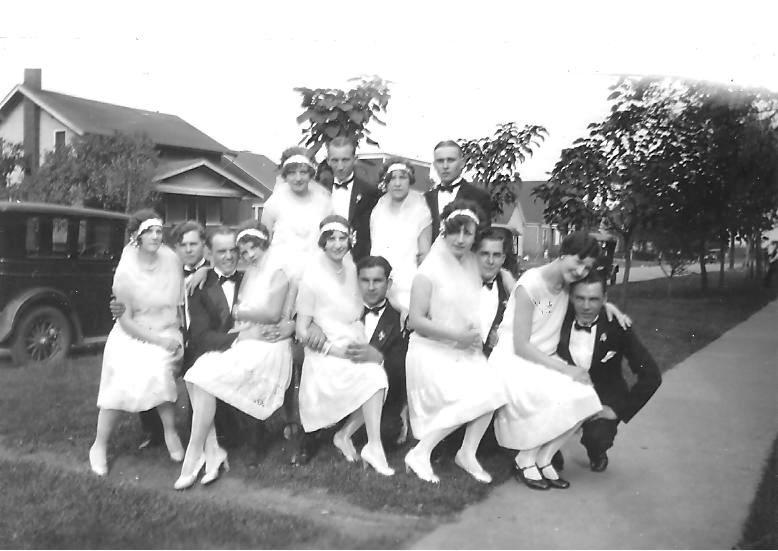
The 1924 Springfield City Directory lists Tony as a grocer at 1729 Reynolds with wife Mary (later, also living with his brother John), according to Genealogics. (Readers will remember that in 1927, the Kasawich family of “Three-Day Lithuanian Wedding” fame owned the grocery/tavern at the corner of 16th and Reynolds.)

The Wedding Party: Eva Kasawich and Victor Alane wedding, 1600 block of E. Reynolds, 1927.

The Wedding Party: Eva Kasawich and Victor Alane wedding, 1600 block of E. Reynolds, 1927.

Scrolling back in time, the 1906 Springfield City Directory listed quite a few more Lithuanian-owned taverns that apparently did not make it till the 1930s, roughly the beginning of the tavern and supper club coverage in my first blog. In 1906, William Anskis owned a tavern at 1931 Peoria Rd; John Brazis, a tavern at 805 E. Washington; Michael Dunkus, one at 729 E. Washington; Charles Gedmin (Gedman?), 800 E. Washington; George Kamiczaites (Kamizaitis), at 1800 S. 11th; Mssrs. Kaslavsky (Kazlauskas) & Burezik, at 1428 E. Reynolds; and Mssrs. Yuris & Kalosky, at 112 S. 7th St.

Why did more of these very early taverns not survive? It is awe-inspiring to consider the possibilities: 1. Those that were in the famous “Levee” area might have been burned or sacked in the 1908 Springfield (White) Race Riot, or 2. They could have been put out of business by 1920s Prohibition and never recovered, as some did after stints as groceries or confectionaries. Imagine coming to the U.S. with no education, money or language, fighting your way up through the mines to save enough to open a “beer parlor,” even a hole in the wall, only to be hit by the disaster of Prohibition—followed by The Great Depression.

Enabling Alcoholism vs. Social Safety Net

Suddenly, through this study of Lithuanian tavern life, I understand the manifold reasons why many Lithuanian-Americans in Springfield were poor, living in crowded or substandard housing and with little money after two generations on American soil. The times were very, very hard. There was a lot of alcoholism. And seeing how little headway many of the first-wave immigrants and their descendants had made here, without having seen the causes, must have been frightening—even incomprehensible–for the mostly professional and educated Lithuanians who arrived as refugees or displaced persons (“DPs”) after World War II.

These new immigrants, like my father, could easily have seen “tavern life,” i.e., alcoholism, as a cause, and not mainly a result of the poverty and lack of opportunity faced by first-wave immigrants–first in their homeland, where they were not even taught to read and write–and then here in the U.S., where they were cruelly exploited then abandoned by the coal mines. Although drinking was never part of my family life, I have come to believe that the human psyche is far too sensitive for the extreme hardships of life, leading many individually–and when such brutalities are widely shared, even communally—to a culture that numbs the senses when such hardships cannot be escaped.

Alcoholism was certainly an ugly reality of immigrant family life all over Springfield. At the same time, corner groceries and taverns seem to have been the only/first visible nodes of immigrants’ economic progress–not only for the families that owned them, but also, as the story of Tony Ramanauskas demonstrates—for the surrounding neighborhood when tavern proprietors communally shared some of their modest success through a sense of ethnic loyalty/responsibility. And, finally, corner taverns are were what remained, along with the poor and outcast of once-vibrant ethnic neighborhoods, after younger generations progressed and joined the American mainstream, leaving their families and communities behind.

Helping World War II Displaced Persons

Along the way, tavern owners like Sam and Mary Lapinski helped displaced persons (DPs) who immigrated after World War II. Violeta (Abramikas) Abad remembers that her immigrant family, including her parents and baby sister Regina, lived in a third-floor apartment above Lapinski’s Tavern for several years after their arrival in the U.S. under the U.S. Displaced Persons Act of 1948. Violeta says, “In fact, my father sponsored his brother and family to come to America in 1951 from the DP camps in Germany, and they also lived with us above Lapinski’s until my Uncle Vincas was able to save enough money to move to their own apartment.”

Immigrants Stephanie and Walter Abramikas, circa 1985.

Immigrants Stephanie and Walter Abramikas, circa 1985.

After reading last week’s taverns post, Violeta says she shared memories with her first cousin Laima (Abramikas) Milaitis of moving their mattress out on the porch/balcony on summer nights because it was too hot to sleep inside the third-floor apartment. After its first years above the Lapinskis, the Abramikas family made its way to middle class success in America with a speed that the First Wave of coal-mining immigrants had found elusive. Mr. (Walter) Abramikas, who had been a forestry professional in Lithuania, worked a union job at Fiat-Allis, which hired many immigrants after World War II. This allowed him and his wife Stephanie to save enough money to get into rental real estate–and send their two daughters to college. In my own immigrant family, also thanks to a good union job, parents who had never gone to high school sent five daughters to college and straight to the middle class.

As for the first generations of coal-mining Lithuanian immigrants and their children who faced many harsh decades of minimal opportunity in Springfield, I am now convinced that institutions like the church and neighborhood taverns and groceries fulfilled the critical function of building and preserving the communal bonds that could often be an individual or family’s last means of survival and support. May we always view with respect the people who had to face such incredibly tough times, study these times for perspective, and pray that they never return.

Sincere thanks to Genealogics for my serendipitous discovery of my lost great aunt while researching the Ramanauskas tavern on E. Reynolds.

Blogroll

  • Enos Park Neighborhood Improvement Association
  • Illinois State Historical Society

Lithuanian Websites

  • Amber Reunion
  • Lithuanian World Center
  • Lithuanian-American Club of Central Illinois
  • Lithuanian-American Community, Inc.
  • Lithuanian-American Publications
  • Lithuanians Of Arizona
  • LTnews.net
  • LTUWorld
  • The Lithuania Tribune

St. Vincent’s murals resurface

Two of the murals from St. Vincent de Paul's Catholic Church have resurfaced. Take a look!

Search

Enter your email address to follow this blog and receive notifications of new posts by email.

Join 142 other subscribers

E-mail us!

Questions or comments? Please e-mail sandybaksys@gmail.com.

Email us!

Questions or comments? Please e-mail sandybaksys@gmail.com.

Blog at WordPress.com.

Privacy & Cookies: This site uses cookies. By continuing to use this website, you agree to their use.
To find out more, including how to control cookies, see here: Cookie Policy
  • Subscribe Subscribed
    • Lithuanians in Springfield, Illinois
    • Join 142 other subscribers
    • Already have a WordPress.com account? Log in now.
    • Lithuanians in Springfield, Illinois
    • Subscribe Subscribed
    • Sign up
    • Log in
    • Report this content
    • View site in Reader
    • Manage subscriptions
    • Collapse this bar
 

Loading Comments...